
The French painter Henri Rousseau (1844 to 1910) taught himself to paint while he worked for the city toll at the gates of Paris, checking the carts that brought goods into town. He is best known for his tigers, monkeys and forests so thick that the sky barely shows.
His canvases also include a rugby match and a sitter in a red fez whose name is still disputed.
Cool Stories About Art is a newsletter to learn art the fun way.
Join 200,000+ readers and get:
10 new art stories / month
The entire archive of content (140+ articles)
Comment, ask questions, and chat with other readers
A Toll Clerk Who Painted the Tropics
That job at the city gates gave him his nickname, Le Douanier, French for the customs officer. The name was a joke, since he collected a city toll rather than customs duties, and he kept the post for over twenty years, until 1893.
In 1886 he first showed his work at the Salon des Indépendants, a yearly exhibition in Paris open to anyone, with no jury to turn him away. He came back with new canvases almost every year until the spring of 1910.
The press often laughed at what he hung there, though a few critics took him seriously, among them the Swiss painter Félix Vallotton as early as 1891.
Even his tropical forests came from Paris, from the hothouses and the small zoo of the Jardin des Plantes, the city's botanical garden, and from pictures he found in print. He never left France or saw a real jungle.
12. Portrait of Monsieur X, Pierre Loti (1906)
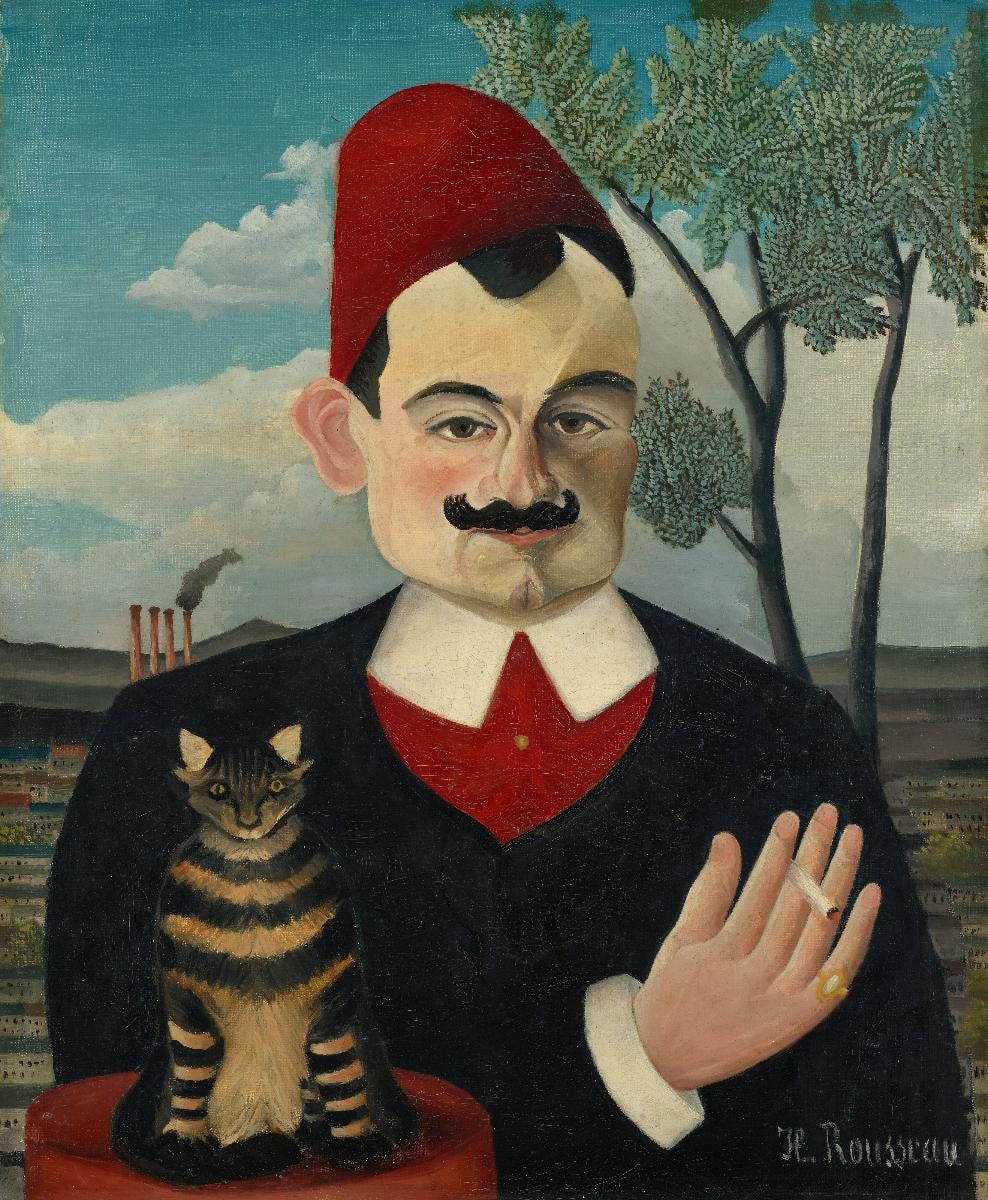
A man with a black moustache and a red fez holds a cigarette and looks straight out of the canvas. A striped cat sits at his shoulder, and a row of factory chimneys rises behind him.
Nobody has ever settled who this man is, which is why the picture carries two names, Portrait of Monsieur X (Pierre Loti). Pierre Loti was the pen name of Julien Viaud, a French naval officer known for his novels set in faraway places.
The case for Loti rests on the cat. In 1891, fifteen years before this picture, Rousseau had exhibited a portrait of the writer, and that one had a cat too. The two men are not known to have met, and Rousseau may have worked from a photograph or a newspaper cutting.
If the sitter is Loti, why Rousseau painted him twice is unexplained. The picture's first known owner, the satirical writer Georges Courteline, did not care who he was. He probably had the canvas from 1906 and hung it in his Musée des Horreurs, his Museum of Horrors, a collection of paintings he found laughable.
The title as we know it dates from 1914, when the German critic and dealer Wilhelm Uhde reproduced the picture as Portrait of Mr. X (Pierre Loti), giving the man in the fez an unknown name and a famous one at once.
In 1952 a Parisian man of letters named Edmond Achille Frank said he recognized himself in the picture, forty two years after Rousseau's death. His claim settled nothing, and the man in the fez still goes by both names.
At a Glance
Artist: Henri Rousseau (1844 to 1910)
Painted: 1906
Medium: Oil on canvas
Size: 61 × 50 cm (24 × 19 3/4 in)
Where to see it: Kunsthaus Zürich, Zurich
11. The Muse Inspiring the Poet (1909)
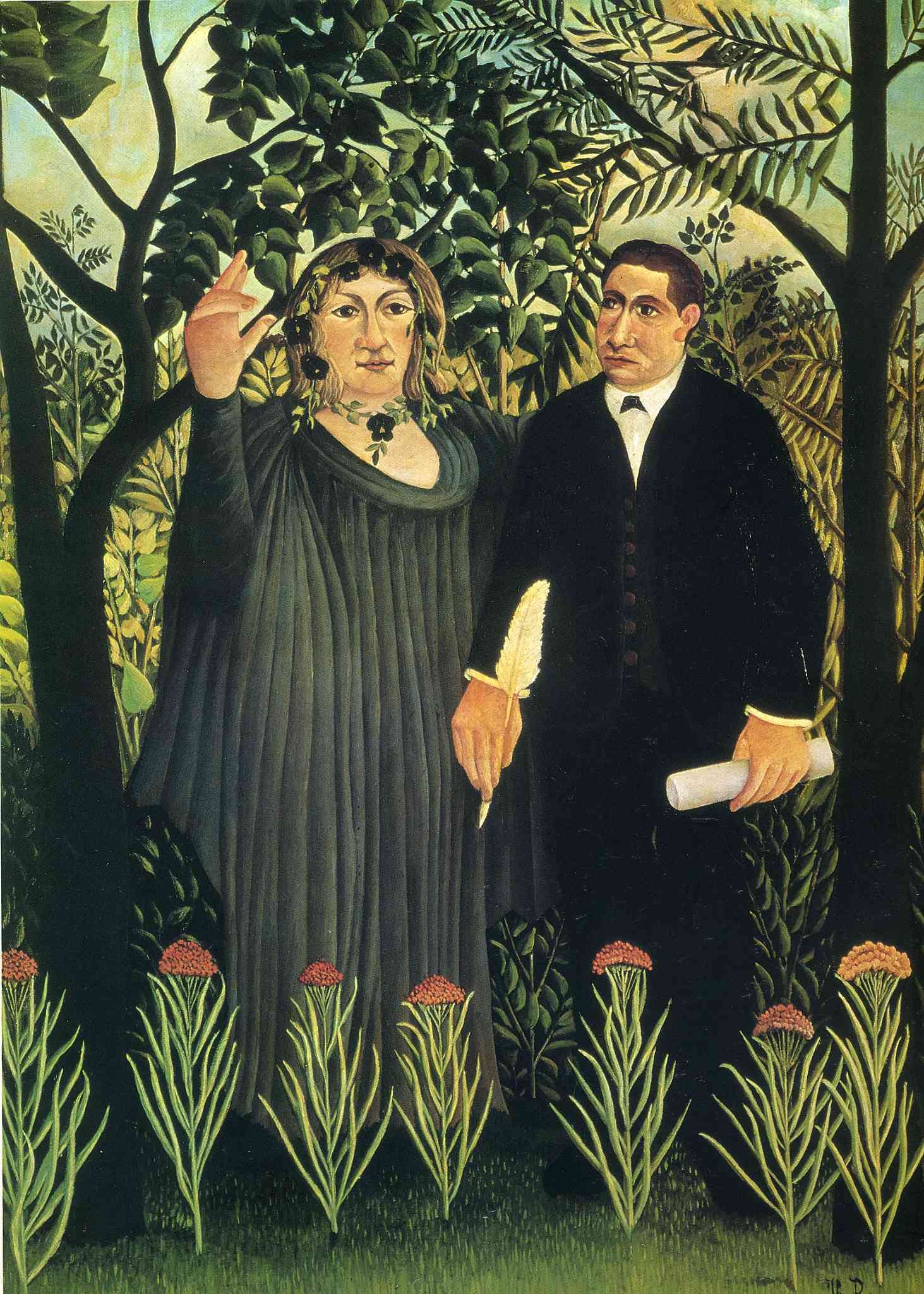
Much larger than the man beside her, a heavy woman in a long violet dress raises one hand above his head. He is dressed in black and holds a quill and a scroll. They stand in a grove of trees, and a neat row of flowers lines the foot of the picture. Those flowers are not the ones Rousseau asked for.