
Hieronymus Bosch's twelve most famous paintings run from Ascent of the Blessed to The Garden of Earthly Delights, by way of The Haywain and The Last Judgment. Bosch never dated a painting, and only two dozen or so panels are accepted as his.
That small body of work was nonetheless copied across Europe, and some of it hung in a Brussels palace and in a Spanish king's private rooms. It still sends people hunting for a key to his monsters.
Cool Stories About Art is a newsletter to learn art the fun way.
Join 200,000+ readers and get:
10 new art stories / month
The entire archive of content (140+ articles)
Comment, ask questions, and chat with other readers
A Town in Brabant and the Fate of the Soul
Bosch spent his whole life in 's-Hertogenbosch, a busy town of Brabant, the old duchy that straddled what are now the southern Netherlands and northern Belgium. His clients there worried about one thing above all, where the soul goes when the body fails.
He answered them with crowds of sinners, angels and devils, and he often left the outcome open. Almost every picture on this list turns on that question, from the saved rising toward the light to the damned hanging from hooks in hell.
Bosch's surviving work comes to 24 to 27 paintings. The count is a range because some panels are still argued over, between Bosch himself, his workshop and his imitators. None bears a date in his own hand either, so every date on this page is a range too.
Several of the best known are in Madrid, at the Prado, and the others are spread over Lisbon, Vienna, Venice, Berlin, Brussels, Paris and Washington.
The list is a ranking, numbered from twelve down to one, and it climbs toward his most famous work. When an attribution is still disputed, the entry explains the dispute.
12. Ascent of the Blessed (about 1505 to 1515)
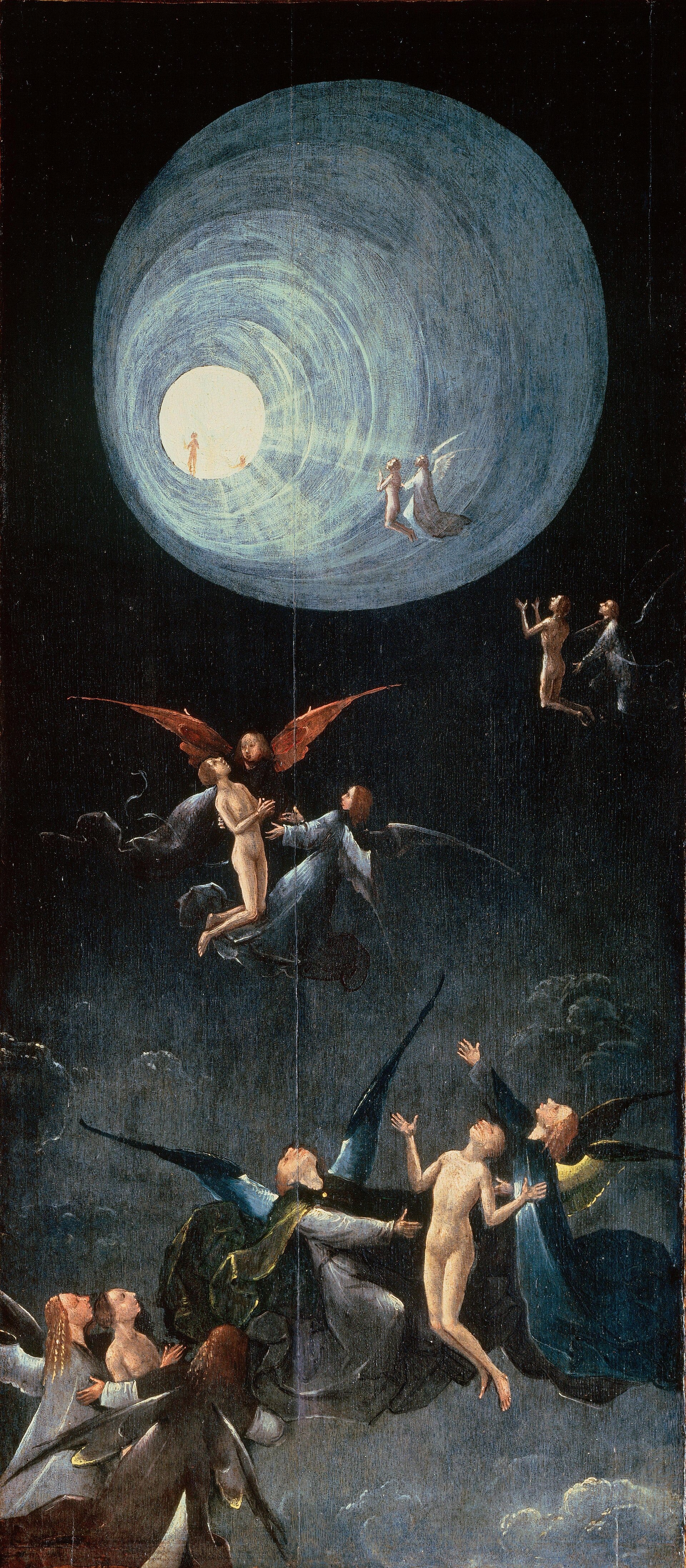
High on a tall, narrow, dark panel, a round tunnel opens onto white light, like a long tube seen from one end. Small naked figures drift up toward it, each held by one or two angels, and at the far end two figures stand in the glow.
Ascent of the Blessed contains no monster at all, a rare thing for a painter known for his devils. This board is one of four known together as the Visions of the Hereafter, the hereafter being the life that follows death.
The four show the earthly paradise, this rising of the saved, the fall of the damned and hell. Bosch painted them in his fifties or sixties, still in his home town, for clients who knew his hells well, and here he turned the movement upward.
That tunnel is the puzzle. Painting before modern times offers almost nothing like it, and no one knows what model Bosch followed. The likeliest clues lie instead in what he could have read about the journey of souls after death.
One candidate is the Vision of Tondal, a twelfth-century tale in which an angel leads an Irish knight through heaven and hell. The other is Dante's Divine Comedy, a journey of the same kind, and it was close at hand: a Dutch translation appeared in 1484 in 's-Hertogenbosch itself.
The four boards soon left the North for Italy. In 1521, five years after Bosch's death, the Venetian writer Marcantonio Michiel, who recorded the art collections of his city, described paintings by Bosch in the house of Cardinal Domenico Grimani.
These panels are thought to be the ones he described. Their attribution was doubted for a time, and today they are accepted as his.
The tunnel has also drawn readers far from art history. In 2012 a physician argued that the scene matches modern accounts of near-death experiences. He even suggested that the painter had had one, which nothing known about Bosch's life can confirm or exclude.
At a Glance
Artist: Hieronymus Bosch (about 1450 to 1516)
Painted: About 1505 to 1515
Medium: Oil on oak panel
Size: 88.8 × 39.9 cm (35 × 15 3/4 in)
Where to see it: Gallerie dell'Accademia, Venice
11. Saint John on Patmos (about 1490 to 1495)
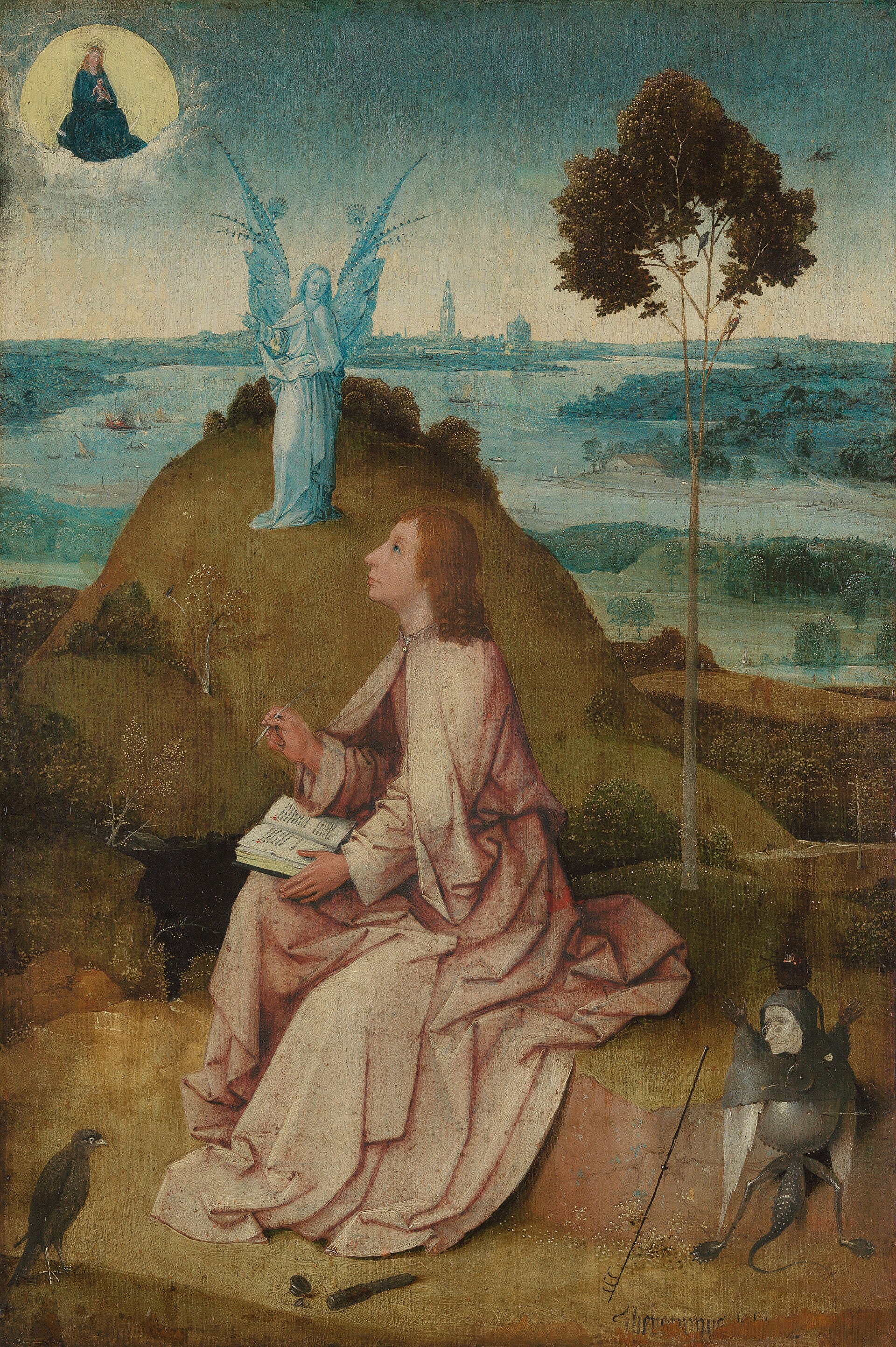
Right beside the worn signature "Jheronimus bosch," at the bottom of Saint John on Patmos, crouches a small creature with an insect's body, a bird's head, a human face and spectacles perched on its nose. This is probably the first painting Bosch ever signed. Why would he set a demon right next to his own name?