
Katsushika Hokusai (1760 to 1849) was the Japanese artist best known for a giant wave breaking over three boats. Many of the pictures people call his paintings are in fact woodblock prints: carvers cut the wood and printers pulled the sheets for a publisher in Edo, today's Tokyo.
He also painted with his own brush, on silk and on paper. In his last years he wrote his age beside his signature.
Cool Stories About Art is a newsletter to learn art the fun way.
Join 200,000+ readers and get:
10 new art stories / month
The entire archive of content (140+ articles)
Comment, ask questions, and chat with other readers
What Edo Paid Hokusai to Make
Hokusai earned his living from the publishers of his city. They paid him for portraits of actors from kabuki, the city's popular theater, for illustrations in printed books and, from around the age of seventy, for series of landscapes.
A print was cut and printed by other hands and sold in many copies. A painting was a different kind of job: a single work made by his own hand for a single owner.
He kept up all three, prints, books and paintings, until the end. He illustrated more than 200 printed books, and in 1849, at ninety, he was still painting scrolls. That age follows the Japanese count, in which a baby was already one year old at birth. By Western reckoning he died at eighty-eight.
His landscapes, the pictures everyone knows, came only around 1830, more than fifty years into a working life that began in 1779 with actor prints signed under another name.
12. Ejiri in Suruga Province (about 1830 to 1832)
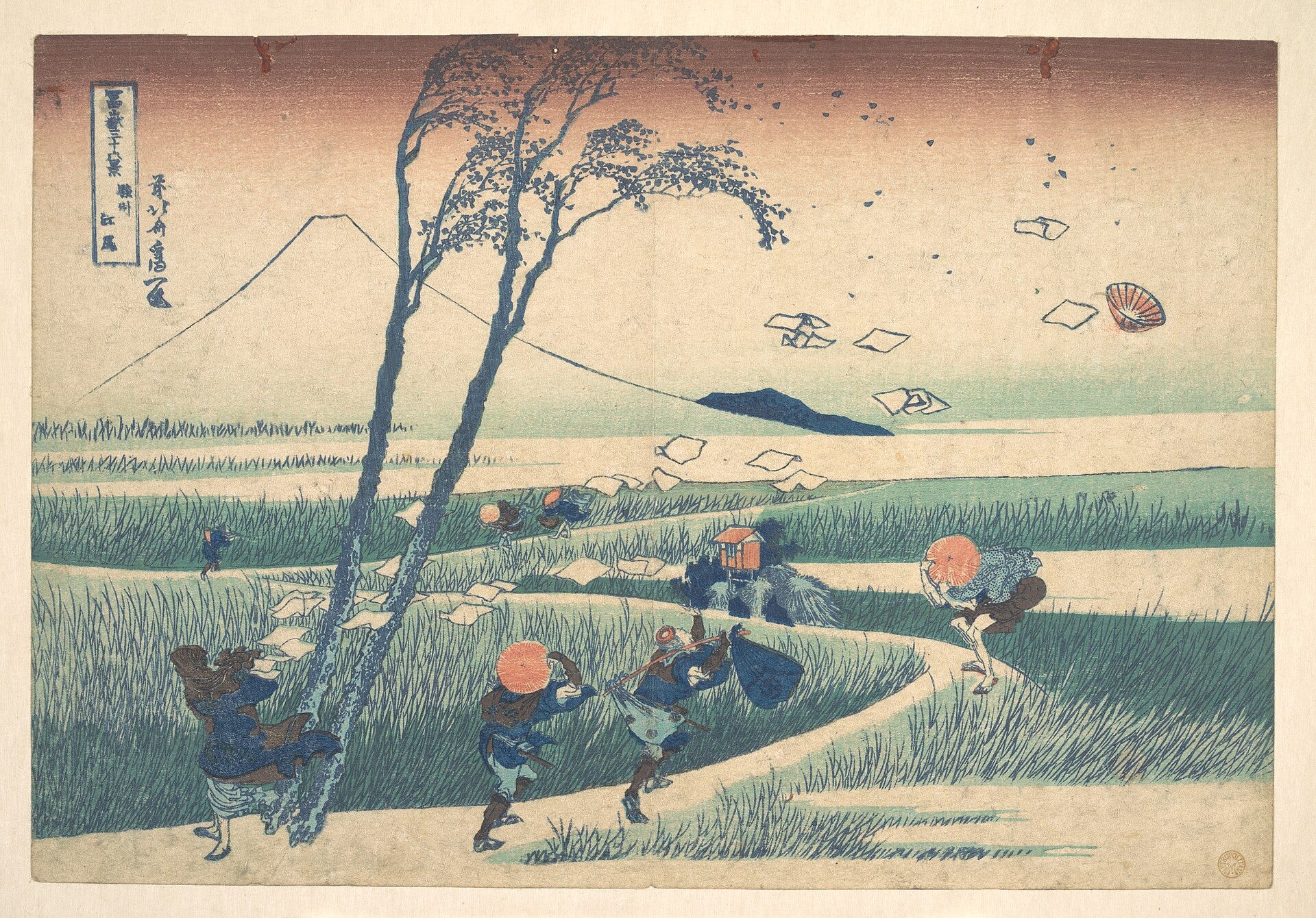
A gust has just crossed a marsh path in Ejiri in Suruga Province, and everything loose is in the air. Paper tissues stream out of a woman's kimono, a hat sails away, and the travelers bend into the wind with their faces turned aside.
Ejiri, today part of the city of Shizuoka, was a post town on the Tōkaidō, the great road between Edo and Kyoto: a stop where travelers found inns and fresh horses.
Mount Fuji, far off, is only a single outline on the horizon. Yet the sheet is part of a set named after it, the Thirty-six Views of Mount Fuji, which Hokusai began around 1830, at about seventy.
Timothy Clark, a curator at the British Museum, says the mountain plays "a backstage role" here. The wind takes the stage, and it shows itself in everything it carries off.
One more detail is easy to miss. The porter whose hat has gone throws up his arms, and all that is left on his head is the ring of padding that cushioned the hat.
Hokusai's gust blew again in 1993, some 160 years later, when the Canadian photographer Jeff Wall moved the scene to a cranberry bog outside Vancouver.
His A Sudden Gust of Wind (after Hokusai) is a color transparency nearly four meters wide, lit from behind in a lightbox like an advertising sign. Papers fly and walkers lean into the wind just as they do in the print.
Wall's picture looks like a single instant caught by the camera, but it was never one instant: he composed it digitally, piece by piece.
At a Glance
Artist: Katsushika Hokusai (1760 to 1849)
Made: About 1830 to 1832
Medium: Woodblock print, ink and color on paper
Size: 25.4 × 37.1 cm (10 × 14 5/8 in)
Where to see it: The Metropolitan Museum of Art, New York, among other collections
11. Thunder God (1847)
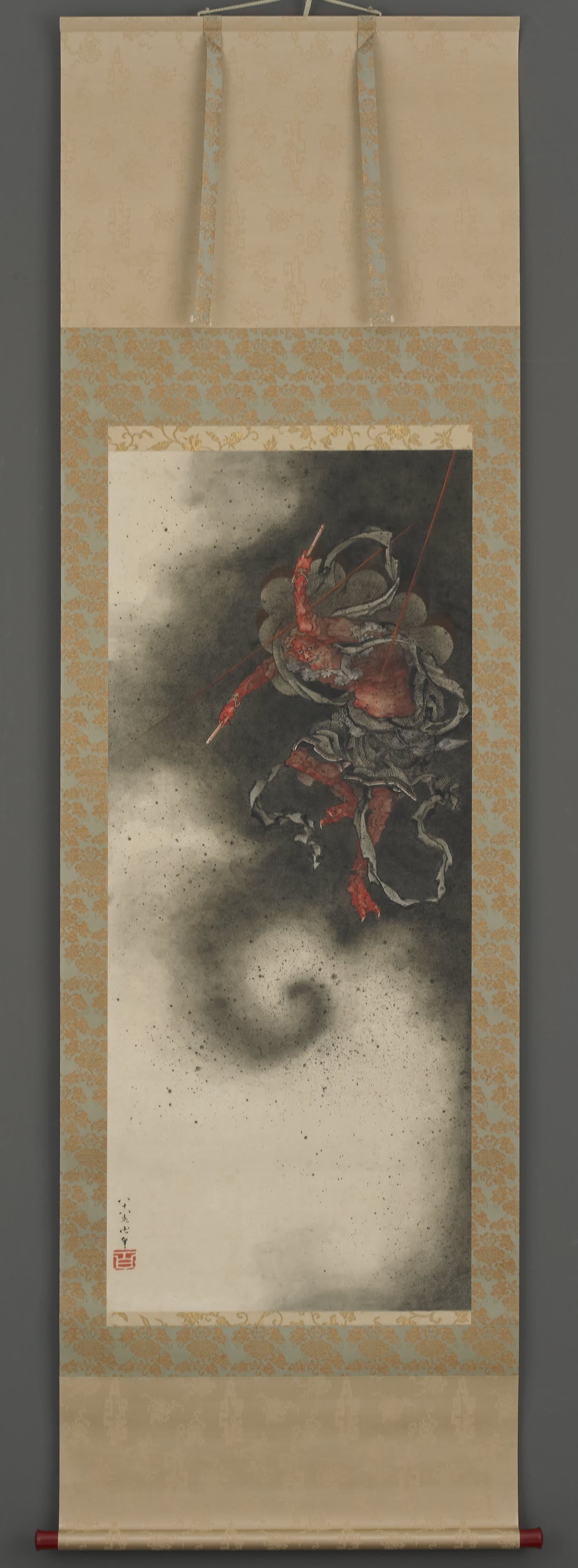
High in a tall, narrow scroll, a muscular red figure with a ring of drums on his back hovers among black clouds spattered with ink. Low on the left, above a small seal, a column of characters signs the picture, and among them is a number that is not a year.