Horse Paintings: 12 Famous Works to Know

The most famous horse paintings gallop between science and myth. Stubbs painted one so completely he left out the whole background, Rosa Bonheur dressed as a man to sketch the horse market, and Franz Marc made a herd of blue horses stand for the soul of the world. Here are twelve to know, and where to see them.

For most of history the horse was power itself, in war, in work and in wealth. Painters used it to flatter kings, to show off their skill and, in the end, to carry pure feeling. The twelve below run from a Renaissance battlefield to a field of blue.

Use this as a quick tour:

  • The specialists: Stubbs and Rosa Bonheur, who knew the horse inside out.

  • The power players: Velazquez and Uccello, horses as kingship and war.

  • The dreamers: Delacroix and Franz Marc, the horse as pure emotion.

  • Where to see them: a museum list at the end, grouped by city.


New here? Learn art the fun way. Free stories every week, no boring lectures.


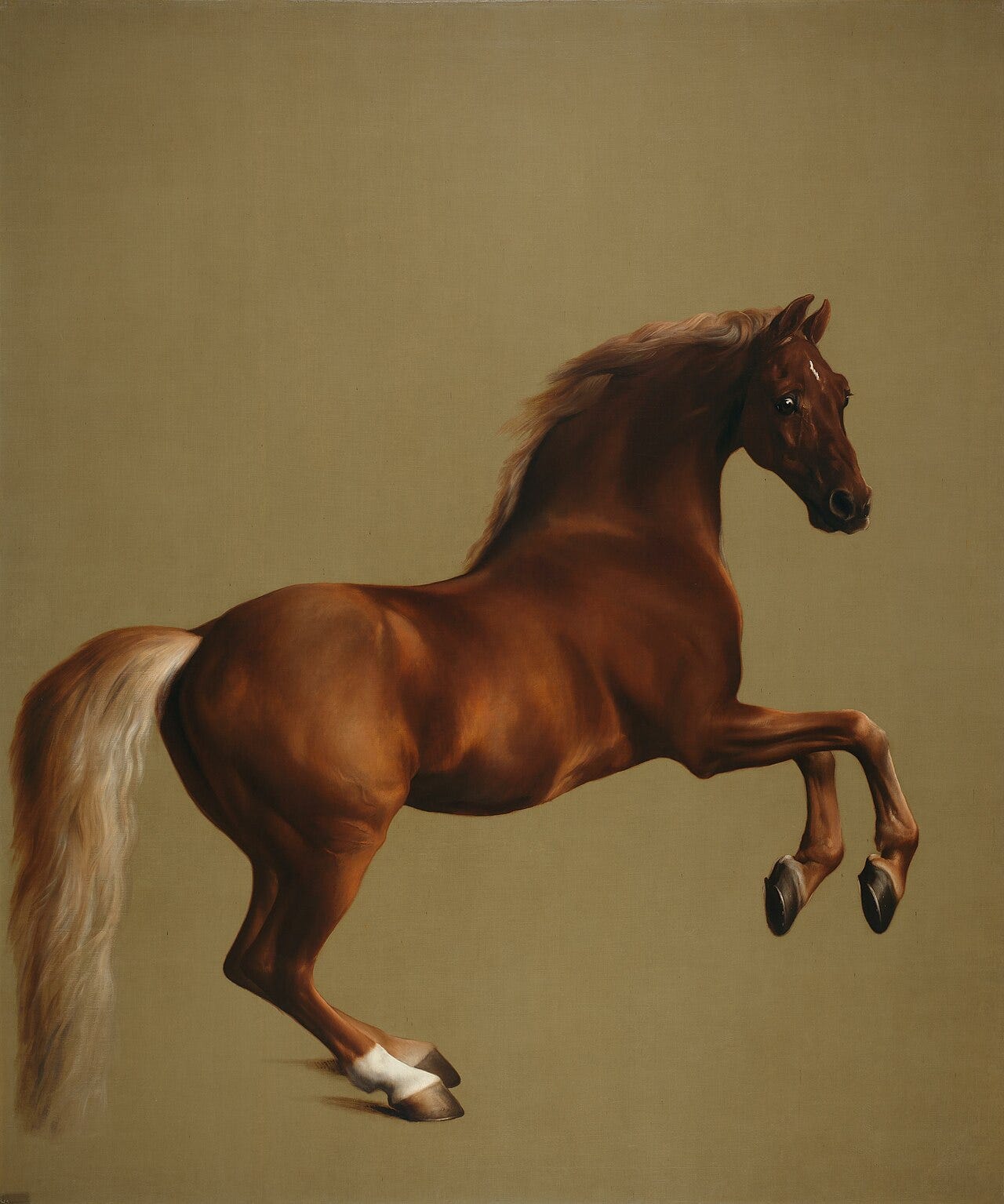
George Stubbs, Whistlejacket

A life size chestnut racehorse rears against a plain golden background with no rider or setting
George Stubbs, Whistlejacket, around 1762

George Stubbs painted the racehorse Whistlejacket around 1762 at life size, rearing against nothing at all. There is no rider, no saddle, no landscape, just the horse and a plain golden ground.

Stubbs knew horses better than any painter alive, having spent years dissecting them to understand the anatomy. That knowledge lets Whistlejacket stand as a portrait as serious as any of a duke.

It hangs at the National Gallery in London. Leaving out the background was a daring choice, and it turns a single animal into one of the grandest images in British art.

Rosa Bonheur, The Horse Fair

Powerful draft horses rear and surge through a crowded Paris horse market
Rosa Bonheur, The Horse Fair, 1855

Rosa Bonheur painted The Horse Fair in 1855, a surging mass of powerful draft horses being shown at a Paris market, rearing and stamping in a great diagonal wave.

To study the horses, Bonheur got police permission to wear men’s clothes and sketch at the market unbothered. She became one of the most famous women artists of the century.

It hangs at the Metropolitan Museum in New York. Nearly five metres wide, it made her a star on both sides of the Atlantic, a woman who out painted the men at their own grand subject.

Theodore Gericault, The 1821 Derby at Epsom

Four racehorses stretch out flat in a full flying gallop across an English course
Theodore Gericault, The 1821 Derby at Epsom, 1821

Theodore Gericault painted The 1821 Derby at Epsom in England, four racehorses stretched out flat in a full flying gallop, all four legs off the ground at once.

This was how everyone believed a galloping horse looked, until photography proved decades later that no horse ever runs like this. Gericault painted the feeling of speed, not the fact.

It hangs at the Louvre in Paris. Wrong or not, it is one of the most thrilling images of racing ever made, the whole field frozen mid flight.

Diego Velazquez, Equestrian Portrait of Philip IV

The king of Spain sits calmly on a rearing horse in a wide landscape
Diego Velazquez, Equestrian Portrait of Philip IV, around 1635

Diego Velazquez painted the king of Spain on horseback around 1635, Philip IV sitting calmly in control as his horse rears up in a wide golden landscape.

The rearing horse under a still, commanding rider was the classic image of a king who masters his realm. Velazquez used the portrait to turn a rather weak monarch into an image of total power.

It hangs at the Prado in Madrid. The horse does the work of the propaganda, its raised hooves a sign that the man on its back rules everything beneath him.

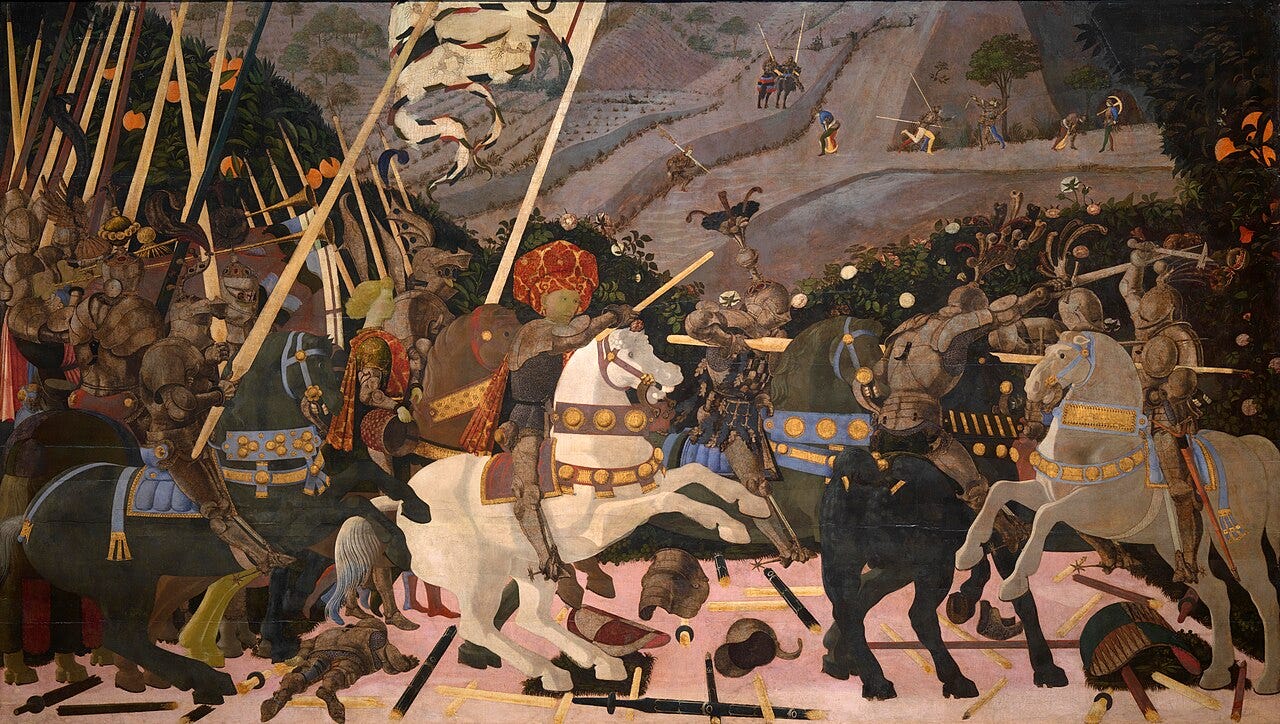
Paolo Uccello, The Battle of San Romano

Armoured knights and rearing warhorses clash in a crowded, tilting battlefield of lances
Paolo Uccello, The Battle of San Romano, around 1440

Paolo Uccello painted the Battle of San Romano around 1440, a tangle of armoured knights and rearing warhorses clashing in a field bristling with lances. It was made in three huge panels.

Uccello was obsessed with the new science of perspective, and he arranged the fallen lances and horses like a geometry lesson. Even a dead horse lies at a perfect diagonal.

The three panels are now split between the Louvre, the National Gallery in London and the Uffizi. The warhorses turn a real battle into an almost abstract puzzle of shapes.

Edgar Degas, At the Races

Jockeys in bright silks hold nervous thoroughbreds still before a race begins
Edgar Degas, racehorses before the start, around 1870

Edgar Degas painted the racecourse again and again from the 1860s, jockeys in bright silks holding nervous thoroughbreds still in the tense moments before a race.

Degas cared less about the finish than about the waiting, the fidgeting horses and the off balance jockeys. He treated the track like his ballet studios, an Impressionist study of bodies in motion.

His racing scenes are spread across the world’s museums. He caught the horse not as a hero but as a highly strung athlete, all nerves before the start.

Franz Marc, The Large Blue Horses

Three rounded blue horses stand together against rolling red and green hills
Franz Marc, The Large Blue Horses, 1911

Franz Marc painted The Large Blue Horses in 1911, three rounded blue horses curled together against rolling red and green hills. This is Expressionism, colour used for feeling, not fact.

Marc believed animals were purer and more spiritual than people, and gave each colour a meaning. Blue, for him, stood for the spiritual and the male, so blue horses were almost holy.

It hangs at the Walker Art Center in Minneapolis. Marc was killed in the First World War a few years later, and his gentle blue animals became an emblem of a world about to be destroyed.

Eugene Delacroix, Horses Coming Out of the Sea

Two rearing Arab horses splash out of the surf under a stormy North African sky
Eugene Delacroix, Horses Coming Out of the Sea, 1860

Eugene Delacroix painted wild Arab horses splashing out of the surf in 1860, drawing on the North African journey that had transformed him decades earlier. The horses rear and strain against the water.

Delacroix, the great Romantic, loved the horse as raw energy, all muscle, foam and danger. He filled sketchbooks with the horses of Morocco and returned to them all his life.

His horse paintings hang in museums including the Phillips Collection in Washington. For Delacroix the horse was never calm. It was passion made flesh.

George Stubbs, Horse Frightened by a Lion

A white horse rears in terror as a lion crouches to attack in a dark rocky landscape
George Stubbs, Horse Frightened by a Lion, around 1770

George Stubbs returns with a very different mood, a white horse rearing in pure terror as a lion crouches to spring, in a dark rocky landscape. He painted this drama many times.

The cool anatomist of Whistlejacket here goes full Romantic, the horse’s eyes rolling white with fear. He may have seen a real lion attack a horse abroad, or a famous sculpture of one.

Versions hang at the Tate and Yale. Stubbs proved he could paint not just the horse’s body but its terror, science and feeling in the same animal.

Frederic Remington, A Dash for the Timber

Cowboys on galloping horses flee toward trees while firing back at pursuers
Frederic Remington, A Dash for the Timber, 1889

Frederic Remington painted A Dash for the Timber in 1889, a line of cowboys on galloping horses fleeing toward the trees while twisting to fire back at their pursuers.

Remington built the myth of the American West, all speed, dust and danger. He studied real cavalry horses and, like Gericault, painted the gallop as pure momentum.

It hangs at the Amon Carter Museum in Fort Worth, Texas. The thundering horses are the engine of the whole scene, carrying the legend of the frontier at a flat run.

Leonardo da Vinci, Studies of Horses

Delicate ink and chalk studies of a horse from several angles, muscles carefully drawn
Leonardo da Vinci, studies of a horse, around 1490

Leonardo da Vinci filled sheets with horse studies around 1490, drawing the animal from every angle, muscle by muscle, for a giant bronze monument he was designing in Milan.

The huge bronze horse was never cast. The clay model was destroyed when French soldiers used it for target practice, so these drawings are almost all that survives of the plan.

The studies are held at the Royal Collection in Windsor and elsewhere. They show the greatest mind of the Renaissance trying, and failing, to build the biggest horse in the world.

Theodore Gericault, The Charging Chasseur

A cavalry officer twists back on a rearing, panicking warhorse amid smoke and fire
Theodore Gericault, The Charging Chasseur, 1812

Theodore Gericault burst onto the scene in 1812 with The Charging Chasseur, a cavalry officer twisting back on a rearing, wild eyed warhorse amid smoke and the fire of battle.

Gericault was only twenty one, and he painted the horse as a whirl of panic and energy, half rearing away from the guns. It announced a thrilling new Romantic talent.

It hangs at the Louvre in Paris. The horse, not the officer, carries all the drama, its terror and force the real subject of the picture.


Join 130,000 readers who get the secrets behind the paintings. Free.


Questions people ask about horse paintings

  • What is the most famous horse painting? Stubbs Whistlejacket and Rosa Bonheur The Horse Fair are the two best known, along with Franz Marc The Large Blue Horses.

  • Why is there no background in Whistlejacket? Stubbs left it out on purpose, so the life size horse stands alone against gold like a formal portrait, with nothing to distract from it.

  • Did horses really gallop the way Gericault painted them? No. He showed all four legs stretched out flat, but photography later proved no horse runs like that. He painted the feeling of speed.

  • Why did Rosa Bonheur dress as a man? She got police permission to wear men’s clothes so she could sketch at the rough Paris horse market without being bothered.

  • Why did Franz Marc paint horses blue? He gave colours spiritual meanings, and blue stood for the spiritual, so blue horses became almost sacred animals.

Where to see them

  • National Gallery, London: Stubbs Whistlejacket and Uccello The Battle of San Romano.

  • Metropolitan Museum, New York: Rosa Bonheur The Horse Fair.

  • Louvre, Paris: Gericault The 1821 Derby at Epsom and The Charging Chasseur.

  • Prado, Madrid: Velazquez Equestrian Portrait of Philip IV.

  • Walker Art Center, Minneapolis: Franz Marc The Large Blue Horses.

Keep exploring

If the horses pulled you in, three more paths from here. Meet the forgotten women who shaped art in the old masters were women too, learn to read the hidden clues in famous canvases in seven secrets hidden in famous paintings, or start with the basics of oil painting.


Two new stories a week, 130+ secrets unlocked. Start free.


One last thing. Long before the engine, the horse was the fastest thing most people ever saw. Painters used it to carry kings, win wars and, in the end, to gallop straight into pure feeling. These twelve still run.