
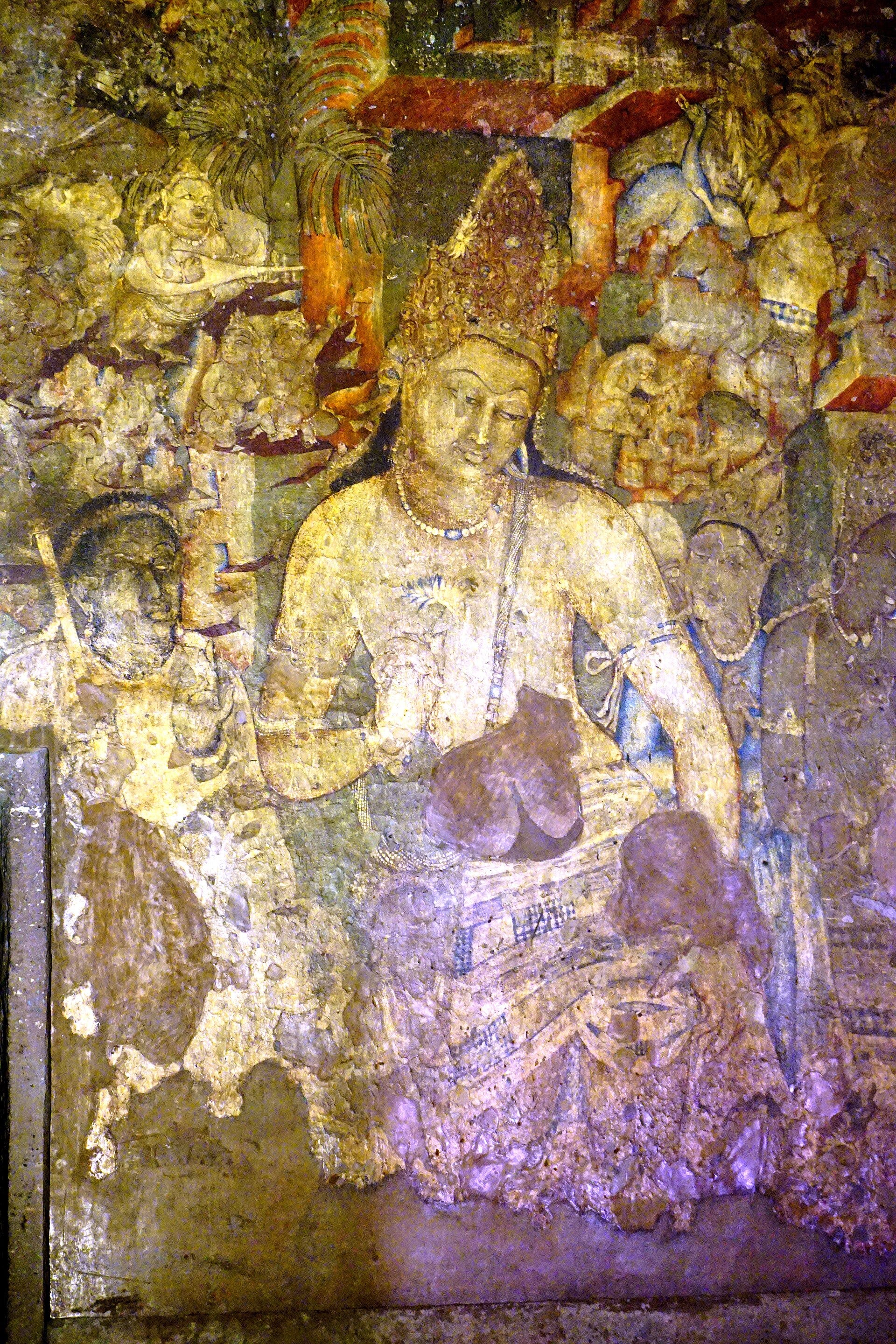
Most lists of Indian paintings begin around 1870, with oil on canvas. By then painting in India was more than a thousand years old, and much of it had never been meant for a frame. Some of its best stories hide in pictures that rarely make those lists, among them the portrait of a bird on the brink of extinction.
Cool Stories About Art is a newsletter to learn art the fun way.
Join 200,000+ readers and get:
10 new art stories / month
The entire archive of content (1,000+ articles)
Comment, ask questions, and chat with other readers
Painted for Caves, Courts and Bazaars
For most of its long history, Indian painting was made for a particular place or a particular person: the walls of a Buddhist cave, an emperor's album, a poet king's verses, a stall at a temple bazaar. Most pictures were small, in opaque watercolor on paper.
That changed in the 1800s, under British rule, when Indian artists met the European academy, with its oil paint and its perspective. Some mastered it and used it to paint Hindu gods and heroines.
Others turned away from it, toward Japanese ink or village art, and a few of their images joined the campaign against British rule.
The works here run from a cave wall of the fifth century to a canvas of the 1980s, and no artist appears twice. Each was chosen for a story the picture itself can tell.
12. Ustad Mansur, A Page of Birds with a Dodo (about 1625)
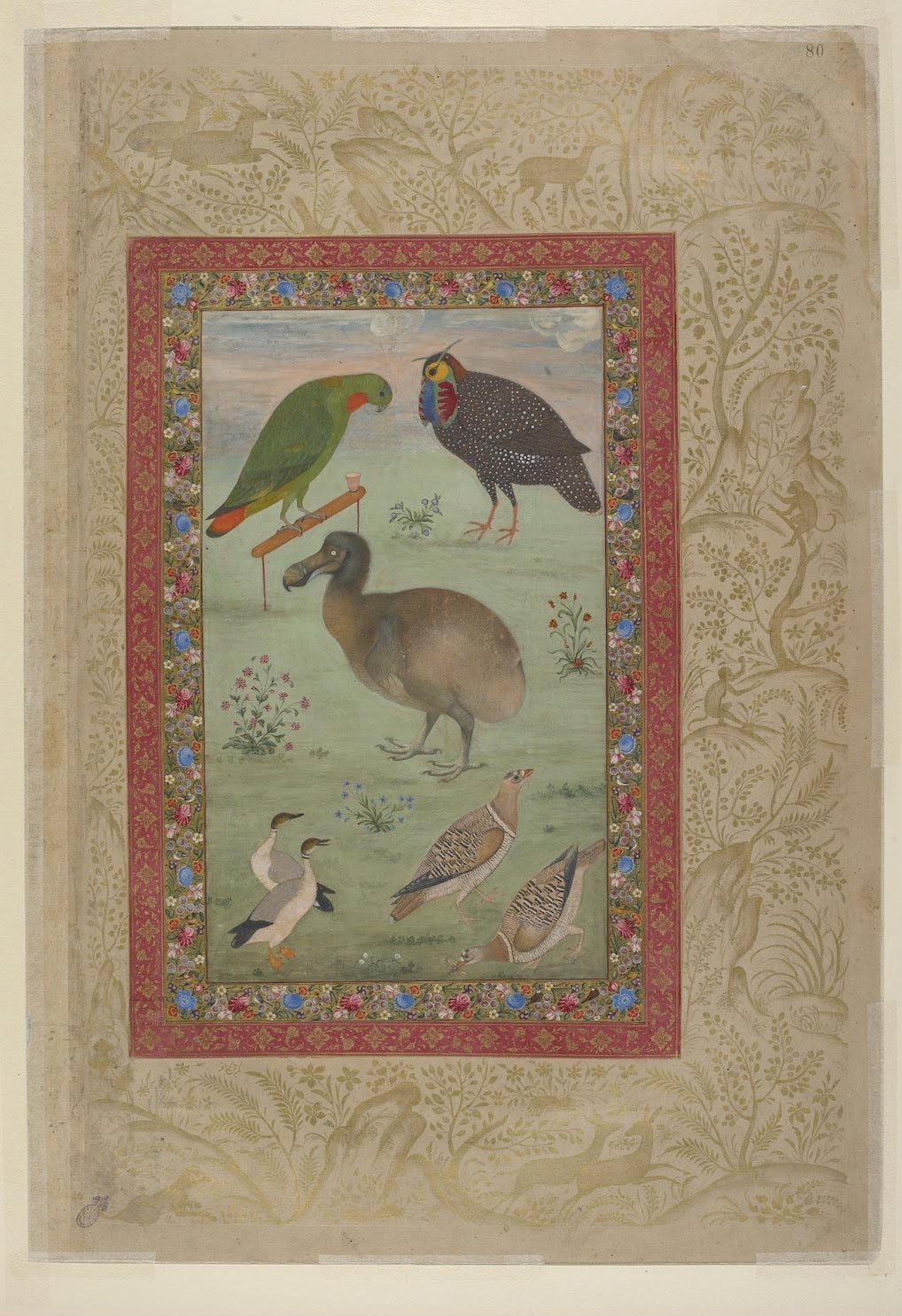
Low on the page, among a pheasant, a parakeet, ducks and partridges, stands a heavy gray bird with a hooked beak. It is a dodo, the flightless bird of Mauritius, an island in the Indian Ocean. And it was painted from a living animal, in India, about 1625.
How a dodo reached India has to do with the tastes of Jahangir, the Mughal emperor. Visitors to his court brought him rare animals as gifts, and at least two dodos joined his menagerie. An English traveler, Peter Mundy, saw two of them at Surat in 1628.
Jahangir also kept a painter for such creatures. Specialists credit this page to Ustad Mansur, whom the emperor honored with the title Nadir al-'Asr, the Rarity of the Age. Mansur painted the dodo upright and alert, and for the paleontologist Julian Hume it is the most accurate color image of the bird to survive.
That accuracy matters because Europe kept a very different dodo in mind. The fat, clumsy bird familiar there comes from a captive, overfed animal painted in Amsterdam in 1627.
Mansur's version, meanwhile, stayed out of sight for a long time. In 1739 the Persian ruler Nadir Shah invaded India and carried off a great many Mughal paintings. In Iran, the birds, first painted one by one, were pasted together on a single sheet, and a green ground was added in Isfahan to hide the joins. The album later reached St. Petersburg, and the dodo remained unpublished until 1958.
By then the species had been gone for well over two centuries, since the last reports of living dodos on Mauritius stop in the 1680s. Its most faithful portrait had been made thousands of miles from its island, by a painter who saw the bird alive.
At a Glance
Artist: Ustad Mansur (active about 1589 to 1626), attributed
Painted: About 1625 (the page was assembled later, in Iran)
Medium: Opaque watercolor and ink on paper
Size: 15.3 x 26 cm (6 x 10 1/4 in)
Where to see it: Institute of Oriental Manuscripts of the Russian Academy of Sciences, St. Petersburg (St. Petersburg Album)
11. Bichitr, Jahangir Preferring a Sufi Shaikh to Kings (about 1615 to 1618)
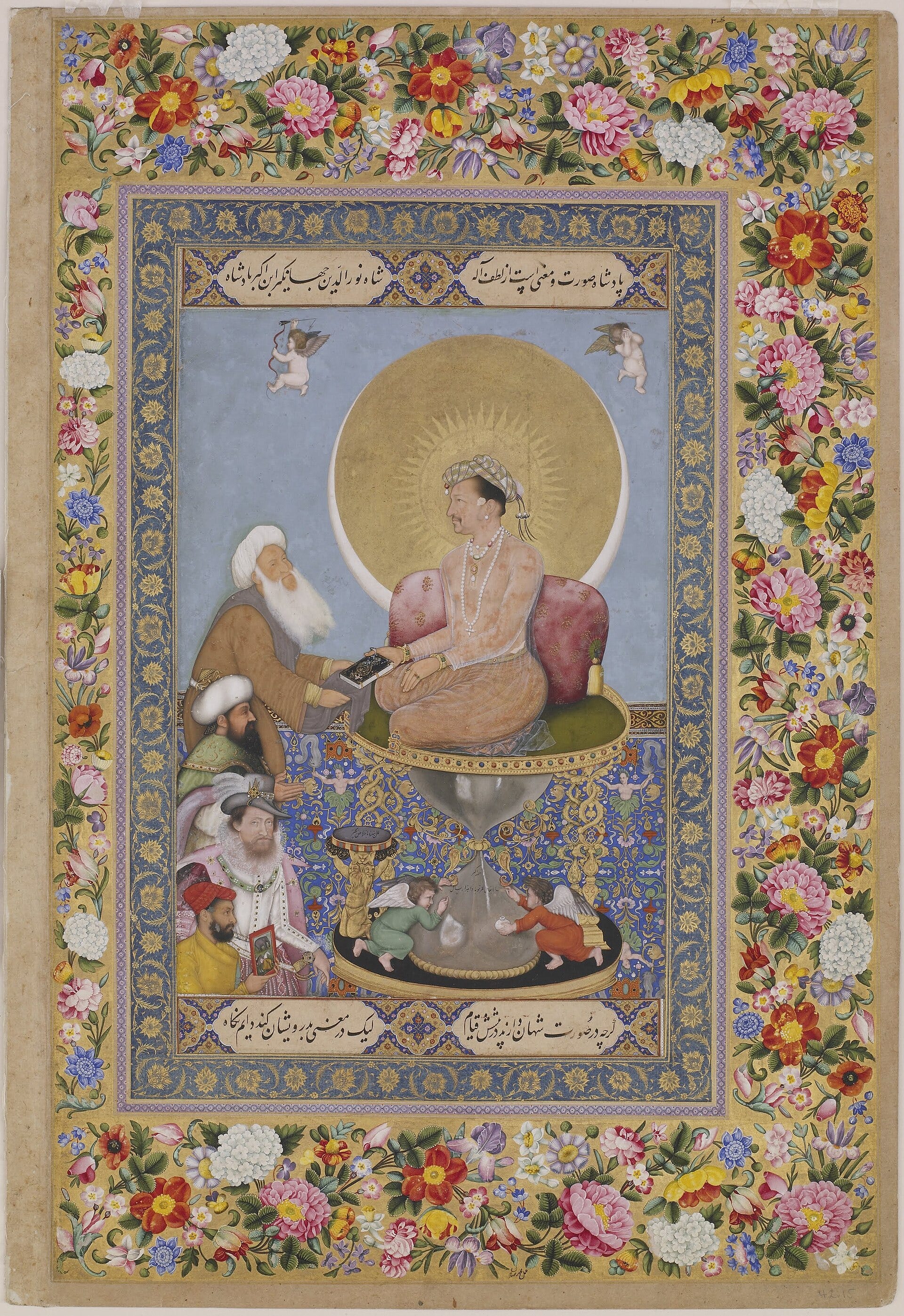
The throne in this picture is an hourglass. On it sits Jahangir, the emperor who kept the dodo, his head framed by a golden sun and a crescent moon. He leans down to hand a book to a white-bearded holy man, while below him wait an Ottoman sultan, the painter himself and the king of England, a man who never set foot in India, standing in line with the petitioners.