
Few painters have worked for a king, then for the revolutionaries who beheaded him, then for the emperor who came after them. This one did, and history kept walking into his studio. A painting of a rich couple still hides its first version under the paint, and a picture he abandoned returned some hundred and fifty years on with a coffin in the sitter's place.
Cool Stories About Art is a newsletter to learn art the fun way.
Join 200,000+ readers and get:
10 new art stories / month
The entire archive of content (140+ articles)
Comment, ask questions, and chat with other readers
A Painter Close to Power
Jacques-Louis David painted for Louis XVI, for the Revolution that executed him, and for Bonaparte. Few artists have stood so close to power, and he paid for it twice, with prison in 1794 and with exile in 1816.
His best-known pictures show Roman heroes and modern martyrs, painted large, with hard edges and bare settings. The style is called Neoclassicism. He set it against the light, playful painting of his youth, and his Paris studio trained much of the next generation.
The twelve paintings run from his first success in 1781 to his exile in Brussels, so every regime he served is here. In most of them, events outside the studio changed what became of the canvas once he had finished it.
12. Antoine-Laurent Lavoisier and His Wife (1788)
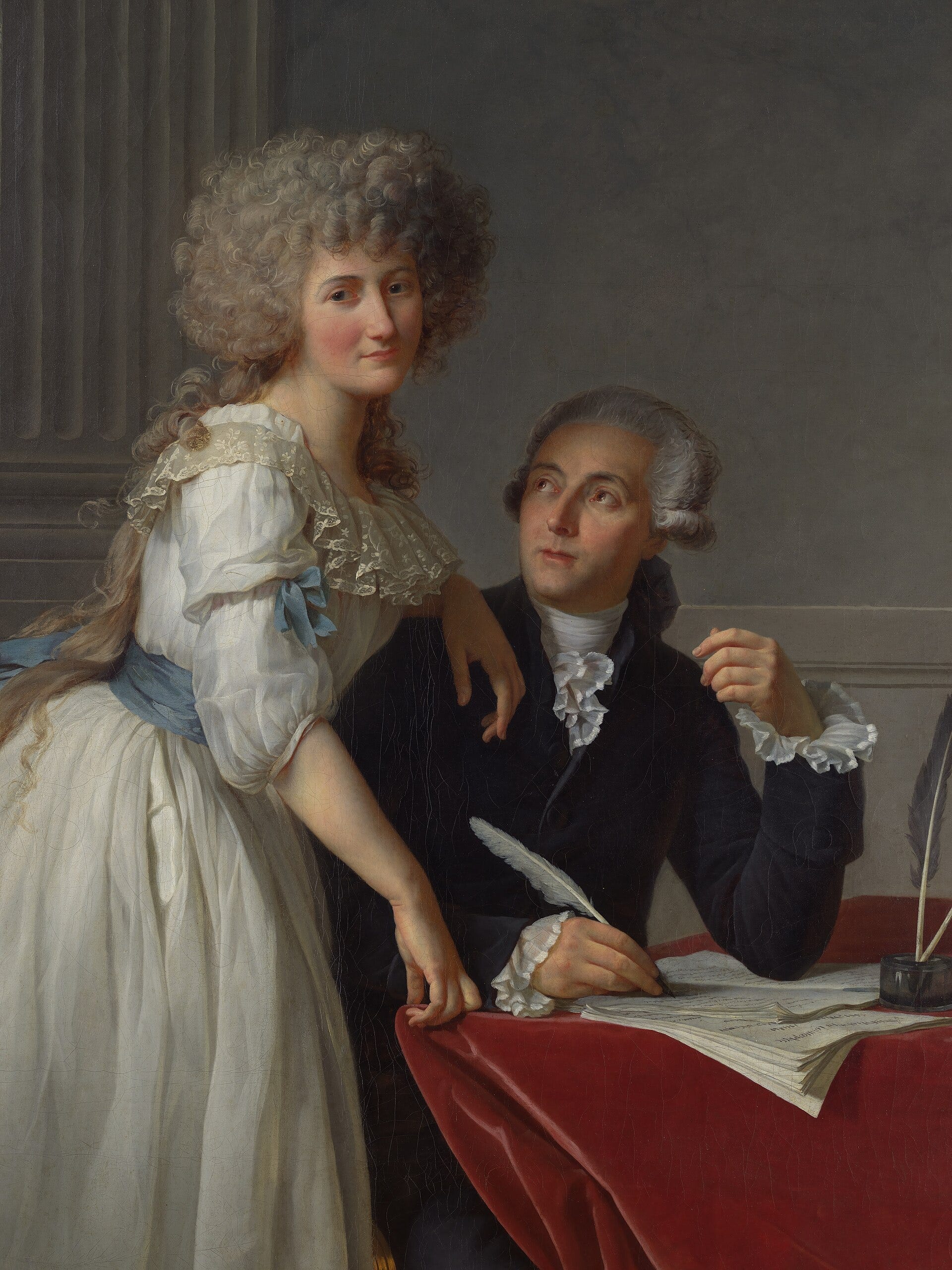
Glass flasks and scientific instruments crowd the red tablecloth in Antoine-Laurent Lavoisier and His Wife. The chemist sits at the table, pen in hand, and turns to look up at Marie-Anne, who leans on his shoulder in a white dress. She kept the records of his experiments and engraved the plates for his books, so the picture shows two scientists at work.
David painted the couple in 1788, three years after the triumph that had made him the leading history painter in Paris, and they paid for the portrait that December. The chemist's fortune, though, did not come from chemistry. Lavoisier was a tax farmer, one of the private financiers who collected taxes on behalf of the king.
That second job is the key to a secret the canvas kept for over two hundred years. In 2019 the conservator Dorothy Mahon was removing a degraded synthetic varnish from it in New York when she noticed small irregularities and tiny cracks that did not belong to the surface she could see.
Infrared imaging and X-ray fluorescence mapping, which maps what each buried layer is made of, then brought a first version to light. In it, Marie-Anne wore an enormous hat piled with feathers, ribbons and artificial flowers, the fashion of 1787. The red cloth covered a desk trimmed with gilded bronze, and the scientific instruments were nowhere to be seen.
So David had added the instruments in a second campaign, turning a wealthy tax farmer and his fashionable wife into a pair of scientists. The researchers who studied the picture suggest that the change followed the couple's public image on the eve of the Revolution. I am persuaded by that reading.
The timing mattered. David had intended the portrait for the Salon of 1789, the great public exhibition in Paris, and the authorities withdrew it at the last minute for fear of inflaming the crowd. It was not shown again until 1889. By then the man at the table had been dead for almost a century, guillotined on May 8, 1794, as a tax farmer.
At a Glance
Artist: Jacques-Louis David (1748 to 1825)
Painted: 1788
Medium: Oil on canvas
Size: 259.7 × 194.6 cm (102 1/4 × 76 5/8 in)
Where to see it: The Metropolitan Museum of Art, New York
About This Painting
What happened to Antoine Lavoisier's wife?
The Revolution took her husband, her father, who was also a tax farmer, and her fortune. She later married the American-born physicist Benjamin Thompson, Count Rumford.
11. Cupid and Psyche (1817)
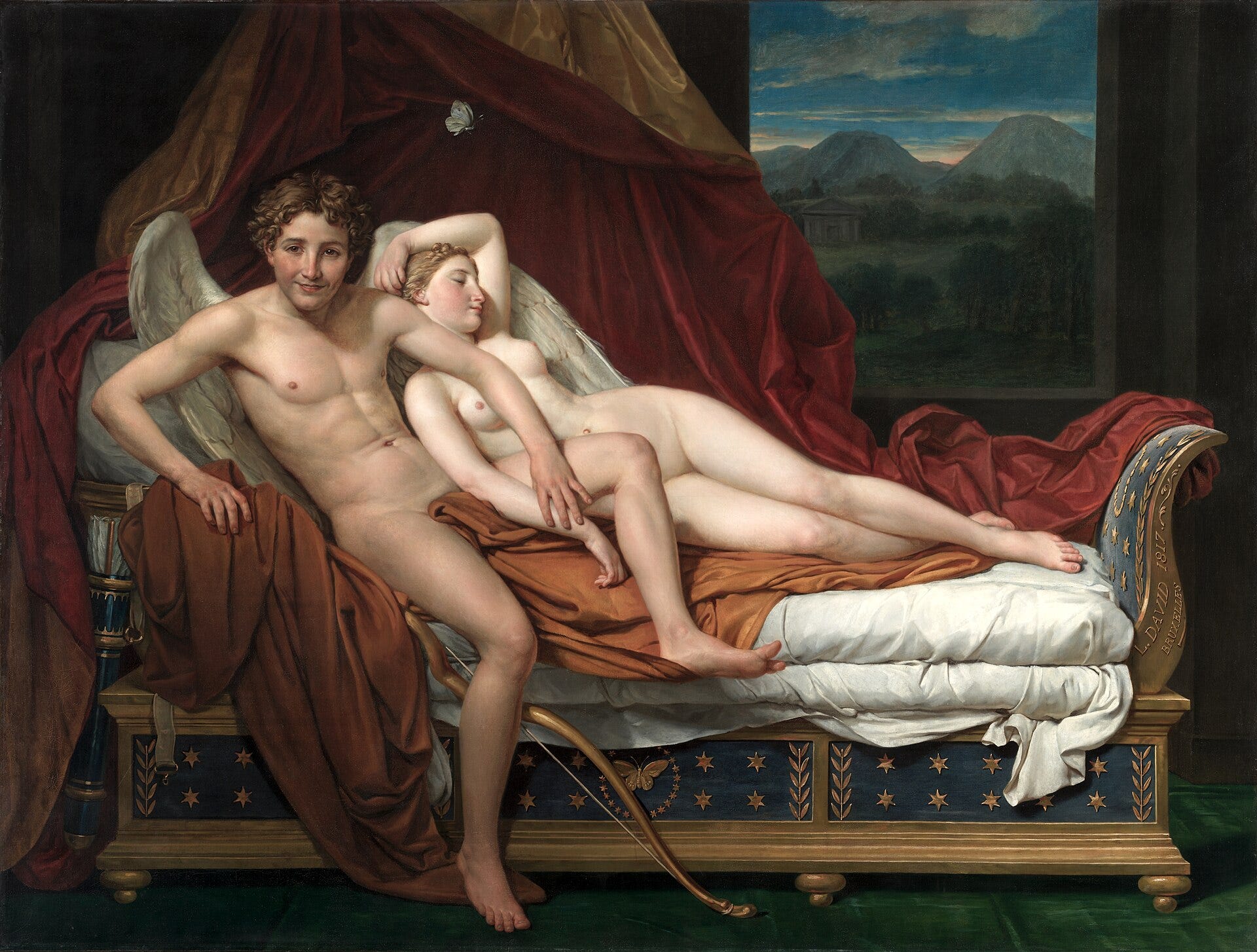
A naked boy with wings slides out of a bed at dawn, one leg still lying across the sleeping girl beside him, and grins at whoever is looking. The man who painted him had spent his career on stern Roman heroes. On the wood of the bed he signed his name, the year 1817 and a city he had not chosen to live in, Brussels.