
Most of the paintings left by the duke of Burgundy's painter in Bruges are no bigger than a book. Up close, they raise questions that are still open. Did the churchman named in the title of one of them ever sit for it? And why did the painter write that he had "made" a panel that looks only drawn?
Cool Stories About Art is a newsletter to learn art the fun way.
Join 200,000+ readers and get:
10 new art stories / month
The entire archive of content (140+ articles)
Comment, ask questions, and chat with other readers
A Court Painter in Bruges
The painter spent his final years in Bruges working for the duke of Burgundy. He also took commissions from men of the duke's court, from churchmen and from merchants, and all of them expected to recognize a face, a fabric or a building down to its smallest part.
That precision has not settled everything. His surviving paintings are now spread across ten cities, from Bruges and Antwerp to London, Paris, Berlin, Vienna, New York, Philadelphia and Washington, and several still leave basic questions open, such as who sat for them and which version came from his own hand.
The twelve works picked for this list date from the early 1430s until shortly before his death in 1441. They mix altarpieces made for churches with small private pictures, faces and devotional panels that their owners kept close at hand.
12. Portrait of Margaret van Eyck (1439)
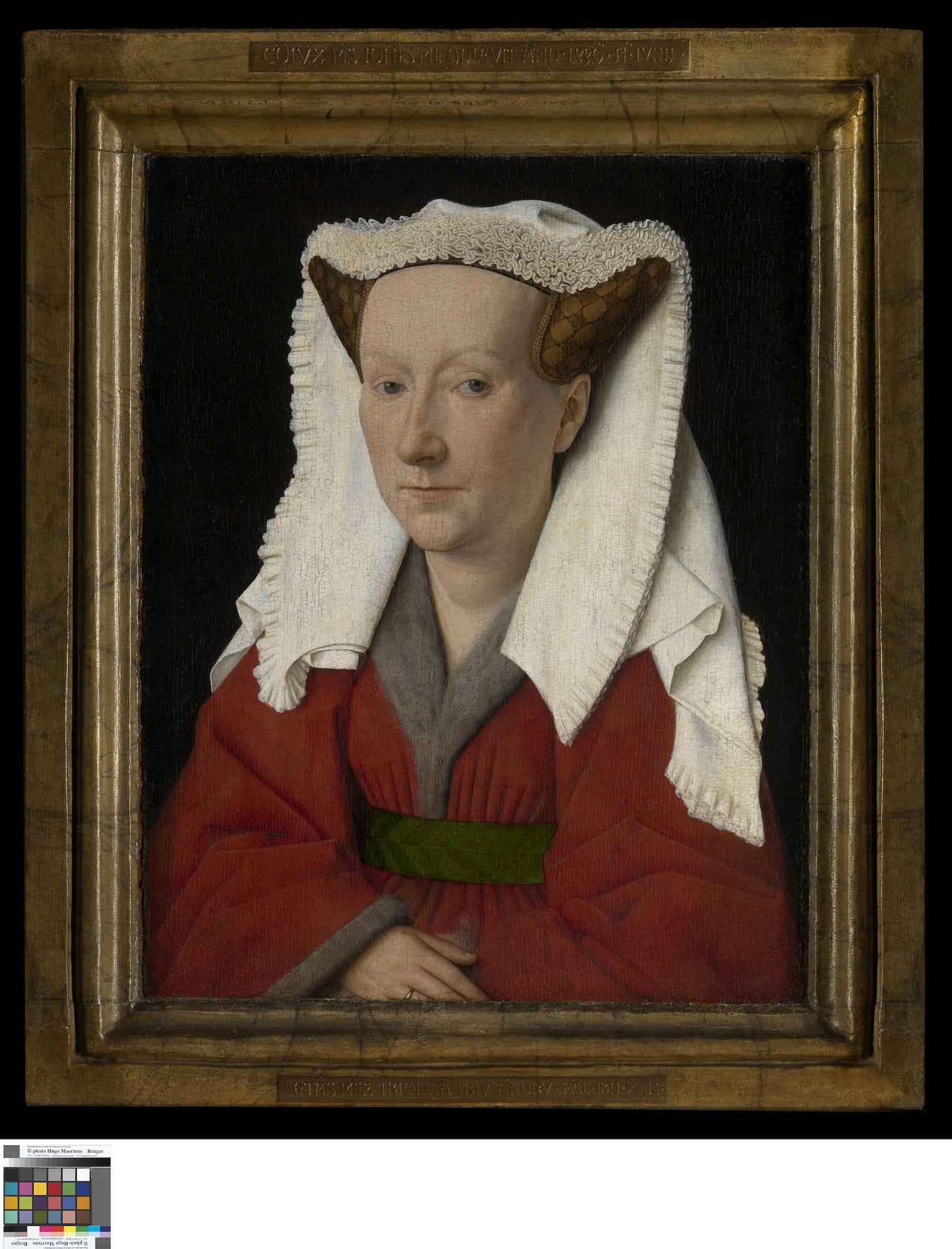
The words on the frame of this portrait are written as if the woman inside it were speaking. Along the top, in Latin, the Portrait of Margaret van Eyck states that Jan, her husband, completed her in June 1439. Along the bottom come her age, thirty-three, and a short motto, Als ich can, which means "as I can."
That motto was the painter's own. It plays on his name, Eyck, and in 1433 he had already painted it on the frame of a man in a red headdress who may be Van Eyck himself. On this frame, he gives it to his wife.
The frame is painted too, just like the woman. Its moldings imitate a yellowish gray marble streaked with dark veins, and the letters look carved into the stone. Inside it, Margaret sits against a black ground in a red gown trimmed with fur, under a white linen headdress that rises in two horns.
Beneath that surface, the portrait first looked different. After an exhibition in London in 2008, the panel stayed at the National Gallery for cleaning, and infrared and X-ray images revealed the changes under the paint. Van Eyck had first drawn her eyes higher, and he lengthened the horns of the headdress after he had started to paint it.
Her hands came even later. He added them only once the first red layers of the gown were down, and they now rest folded just above the frame.
At a Glance
Artist: Jan van Eyck (about 1390 to 1441)
Painted: 1439
Medium: Oil on oak panel
Size: 32.6 × 25.8 cm (12.8 × 10.2 in)
Where to see it: Groeningemuseum, Bruges
11. Portrait of Cardinal Niccolò Albergati (about 1435)
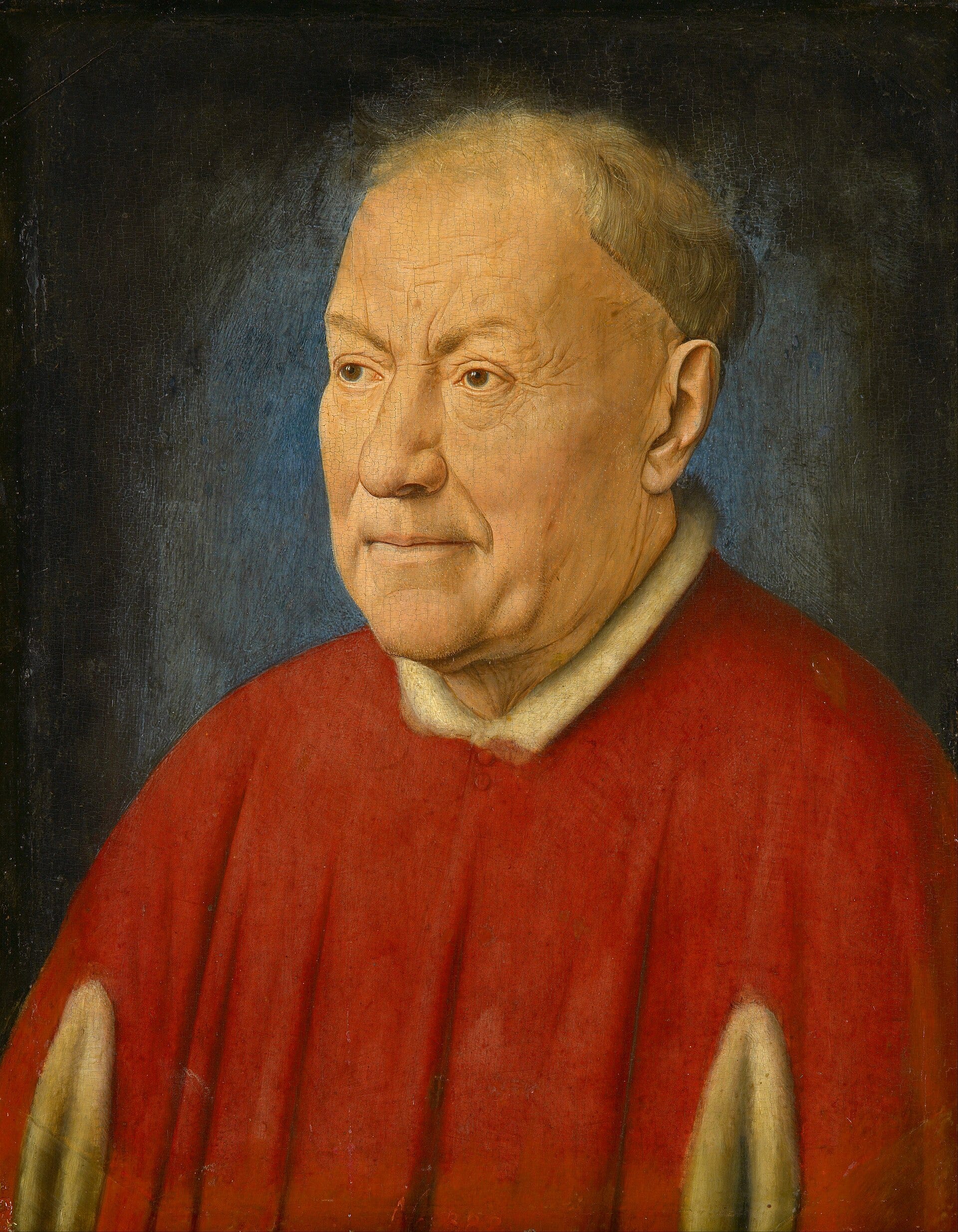
An elderly man in a fur-trimmed red robe turns three quarters toward the light. His cheeks are lined, the skin under his eyes is heavy, and gray stubble shadows his chin. Before painting this face, Van Eyck had drawn it on paper and surrounded it with written instructions to himself.