
The most famous Japanese paintings run from Hokusai's Great Wave and a red glowing Mount Fuji to a kabuki actor's snarl and a skeleton crashing through a palace wall.
Most of these are woodblock prints, made in the hundreds or thousands, and together they explain how a handful of Edo period artists still shape how the world pictures Japan.
Japan closed itself to most foreign trade for over two centuries, and inside that closed system a print industry grew that had almost nothing to do with European painting. When Japan reopened in the 1850s, these prints reached Paris within a decade and changed how a whole generation of Western painters used color, line and empty space. I have picked twelve works that did the most, on either side of that story.
What these twelve pictures have in common:
The medium. Most of these are woodblock prints, cut and printed by teams of specialists rather than single unique paintings, so many original impressions of each design survive today.
The reach. Van Gogh copied at least two Hiroshige prints from this list directly onto his own canvases.
The mystery. Sharaku's entire documented career lasted about ten months, and nobody has ever conclusively identified who he really was.
The range. The list runs from a single sheet print that once sold for the price of a bowl of noodles to a National Treasure folding screen kept in a Kyoto temple.
Learn art the fun way
If these Japanese paintings pulled you in, you will love these too:


Twelve prints and paintings, one very long tradition
1. Studio of Tawaraya Sotatsu, Royal Visit to Ohara (first half of the 17th century)
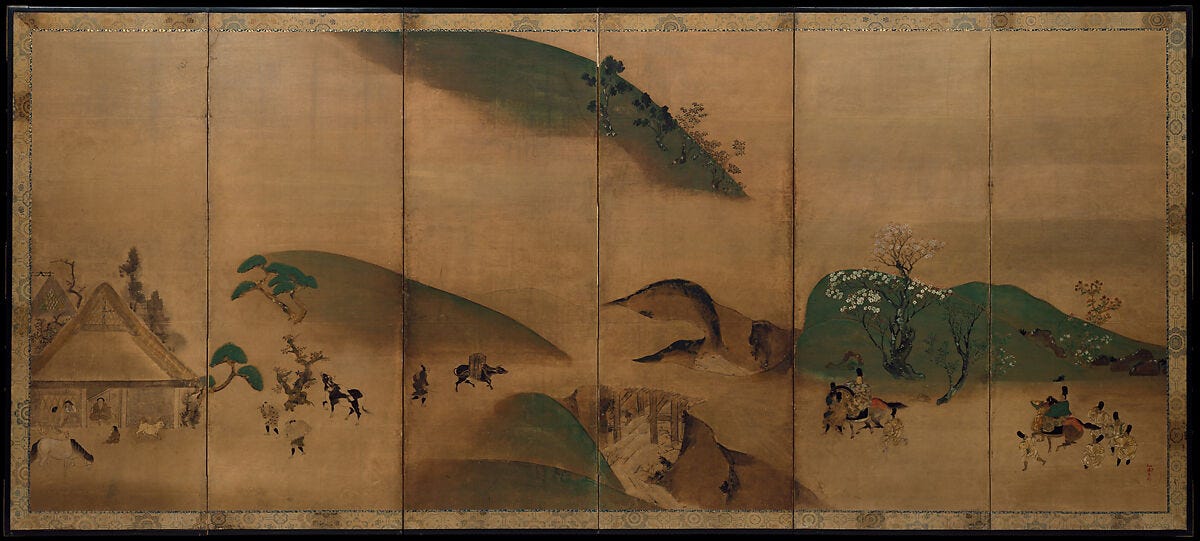
This pair of folding screens illustrates an episode from The Tale of the Heike, showing a retired emperor traveling to a remote mountain temple to visit Kenreimon'in, the last empress of the defeated Taira clan, who survived a decisive 1185 naval defeat and became a Buddhist nun there.
The screens carry no signature or seal anywhere, yet no scholar disputes that they came from Sotatsu's workshop. Meant to be read right to left across both screens, they helped define the decorative Rinpa style that later artists like Korin would build directly on.
2. Ogata Korin, Irises at Yatsuhashi (after 1709)
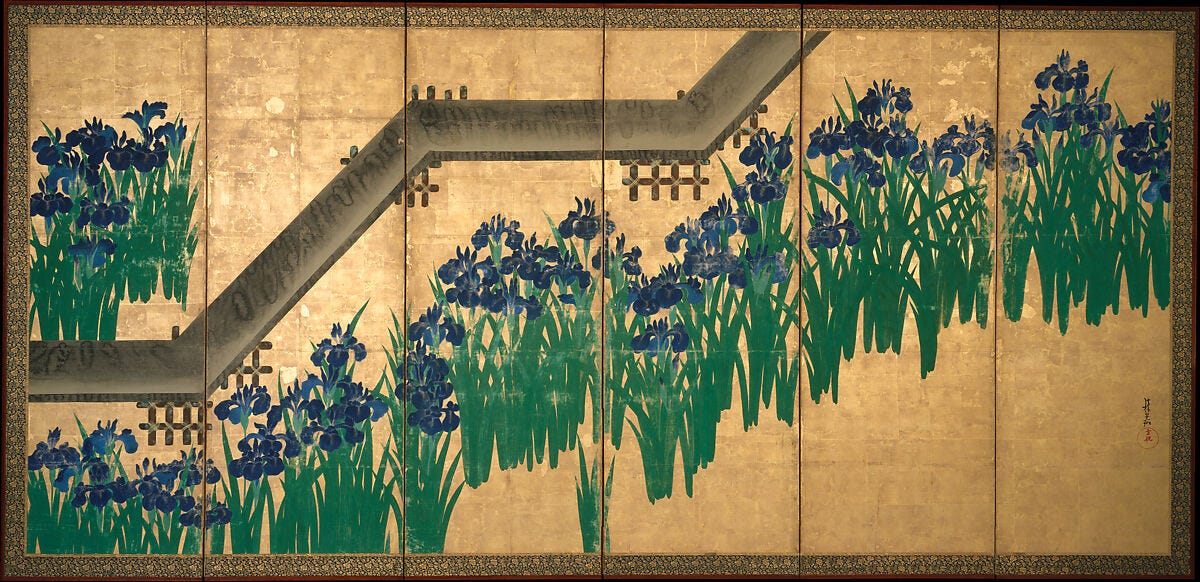
Korin's screens illustrate an episode from the Tales of Ise, an older literary classic, in which an exiled courtier stops at a place where a stream splits into eight channels and writes a poem about the wife he left behind. Read the first syllable of each line of that poem in Japanese and it spells out kakitsubata, the word for iris.
No ground, water or figures appear anywhere on the screens, only irises and a zigzag bridge set against solid gold leaf. Korin painted this after 1709, near the end of a career spent updating Sotatsu's decorative style for a new generation of patrons.
3. Kitagawa Utamaro, Three Beauties of the Present Day (about 1793)
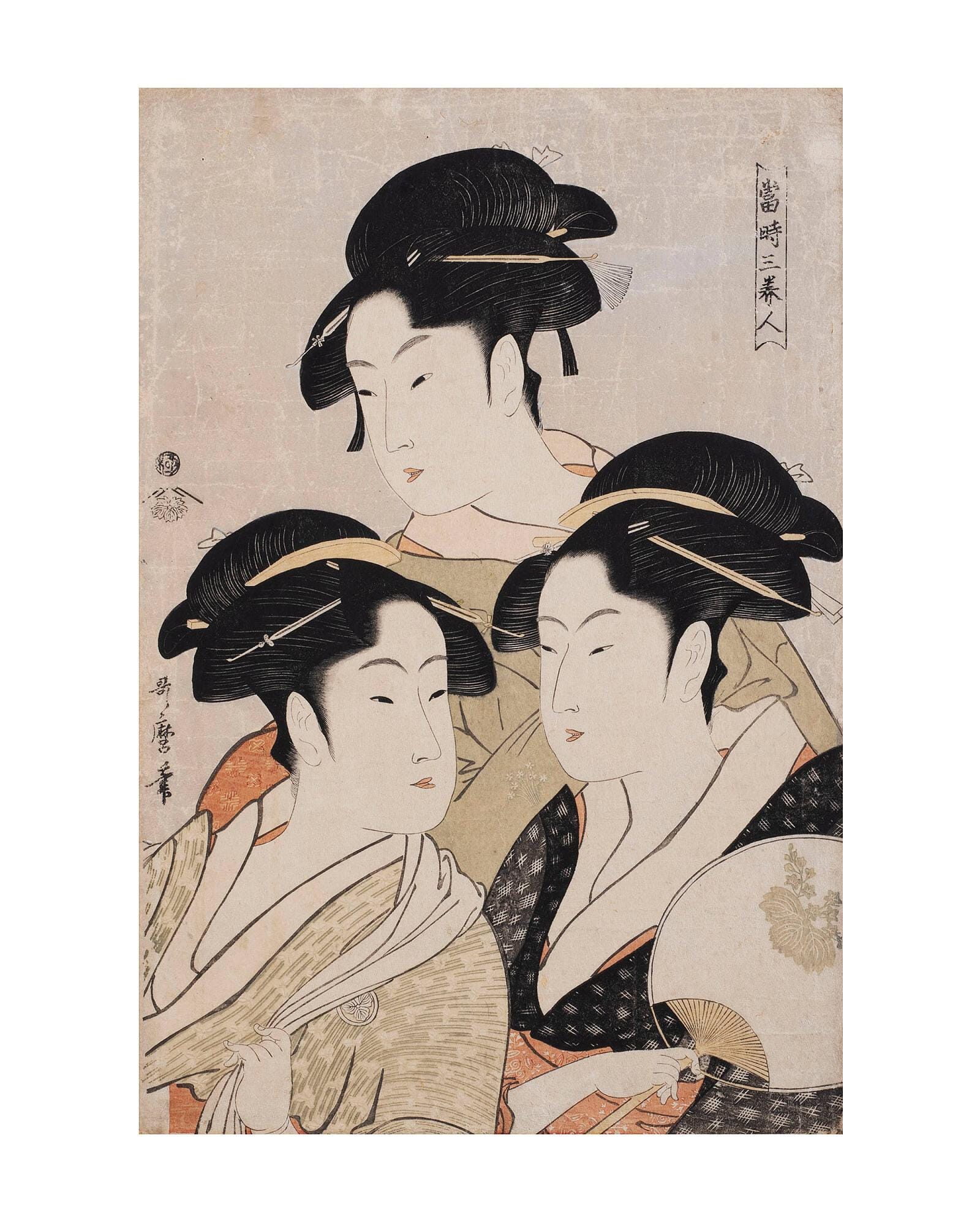
Utamaro's print shows three real, named residents of Edo, a geisha and two teahouse waitresses rather than the courtesans usually pictured in this kind of print. The three faces look nearly identical at first glance, distinguished only by small differences around the nose and eyes.
Only two surviving impressions still carry the original title cartouche naming the three women. Later reprintings of this design, including most that survive today, dropped their names entirely, which researchers now read as a sign of how heavily reprinted the design became.
4. Toshusai Sharaku, Otani Oniji III as Yakko Edobei (1794)
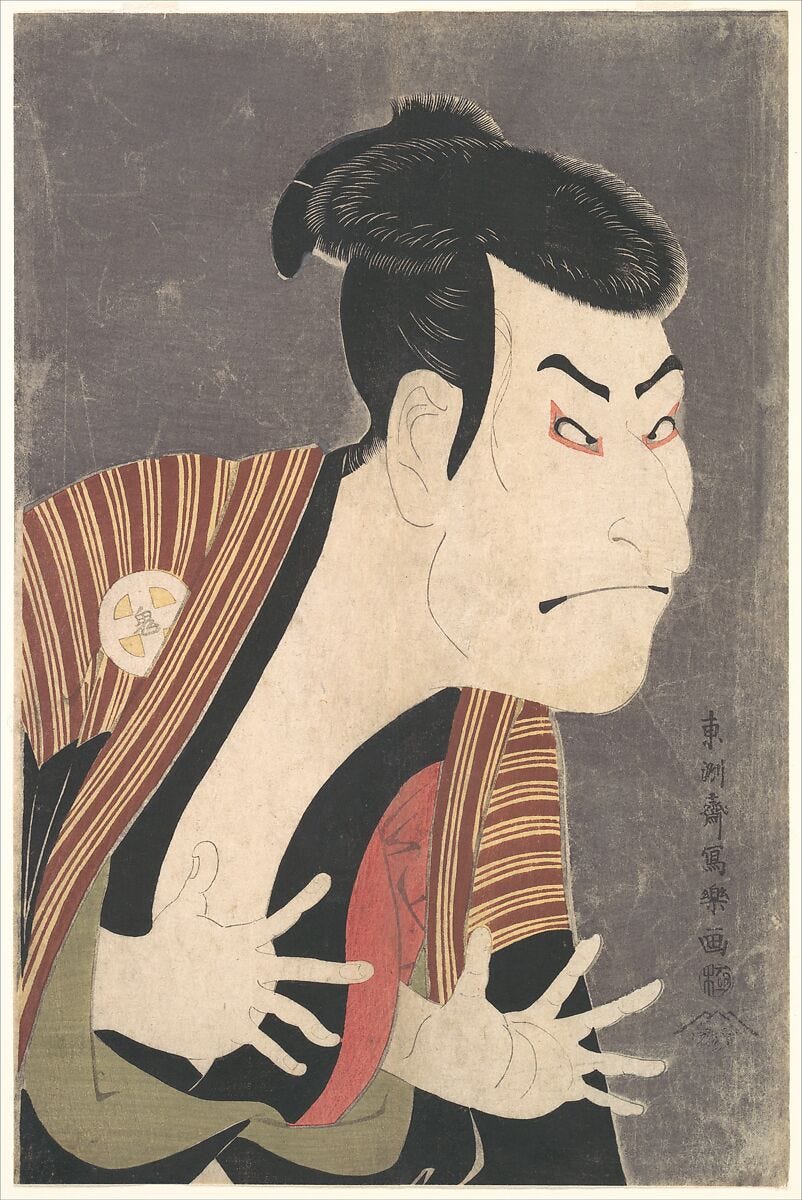
Sharaku made this print of a kabuki actor playing a ruthless manservant for a play staged in 1794, using a mica dust background that caught the light reserved for the most expensive prints of the period. The actor is shown mid snarl, hands grasping outward toward the viewer.
Sharaku's entire documented career runs from 1794 to 1795, with no confirmed work before or after those two years, and no one has ever conclusively identified who he was outside of his prints.
5. Utagawa Toyokuni I, The Actor Sawamura Sojuro III (about 1795)
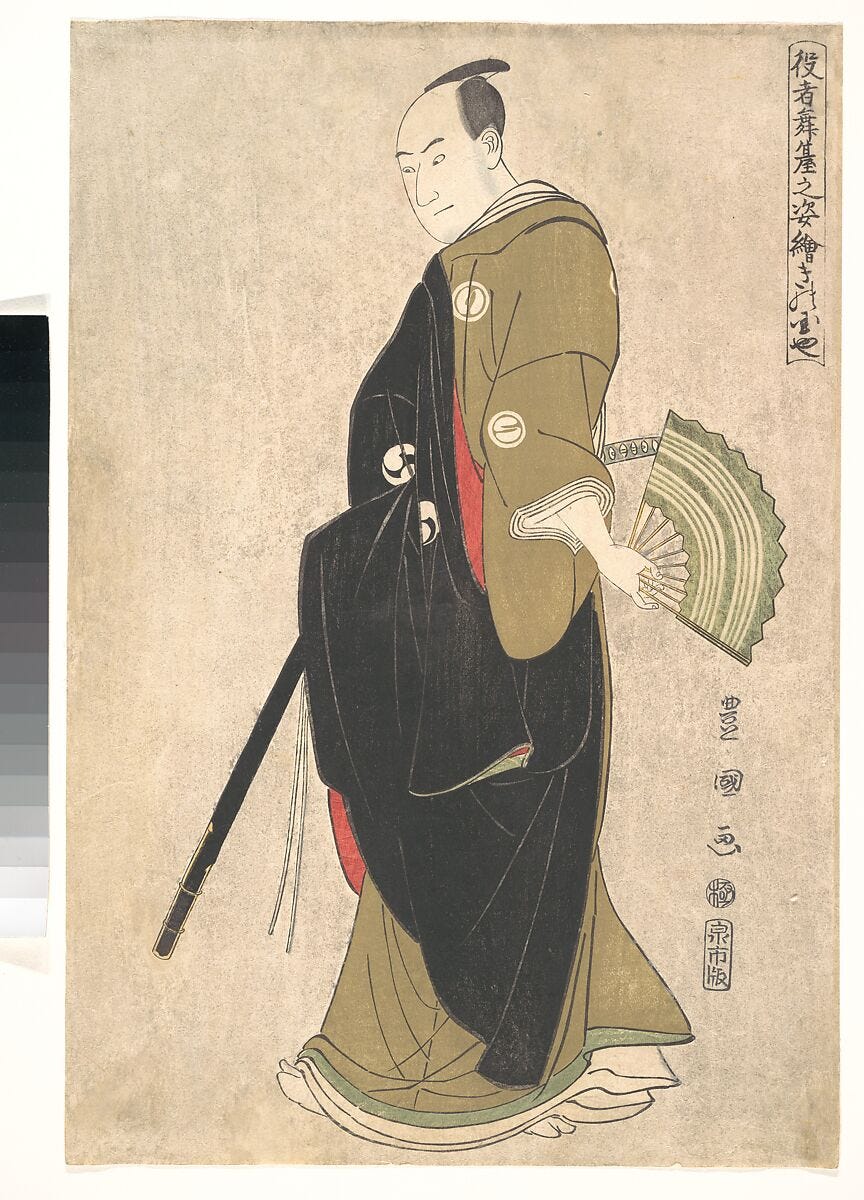
Toyokuni I made this kabuki actor portrait around 1795, a year after Sharaku's prints appeared, using the same costly mica background technique known as kirazuri, where powdered mica mixed with glue was applied in an extra printing step.
Toyokuni went on to found one of the most commercially successful print workshops of the entire Edo period, training students who dominated actor prints for decades after Sharaku had already vanished from the record.
6. Katsushika Hokusai, Under the Wave off Kanagawa, The Great Wave (about 1831)
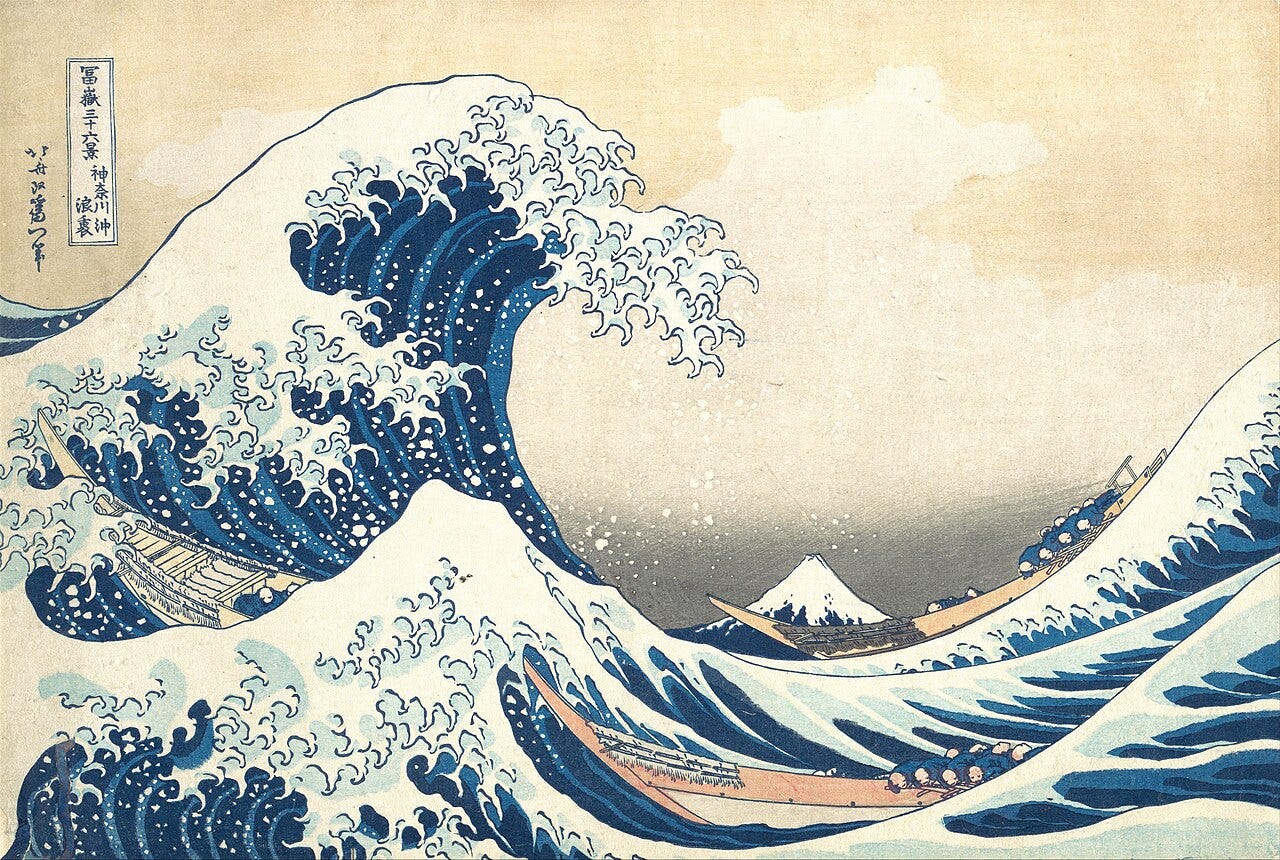
Hokusai designed this print, part of his series Thirty Six Views of Mount Fuji, when he was already past seventy years old. The sheet itself measures only about 26 by 38 centimeters, roughly the size of a placemat, far smaller than most people picture.
I have written the full story of how this print came together elsewhere, from Hokusai's early sketches through its 1831 publication, in the true story behind the Great Wave. Mount Fuji sits small and calm in the background, dwarfed on purpose by the wave in front of it.
7. Katsushika Hokusai, Fine Wind, Clear Morning, Red Fuji (about 1830 to 1832)
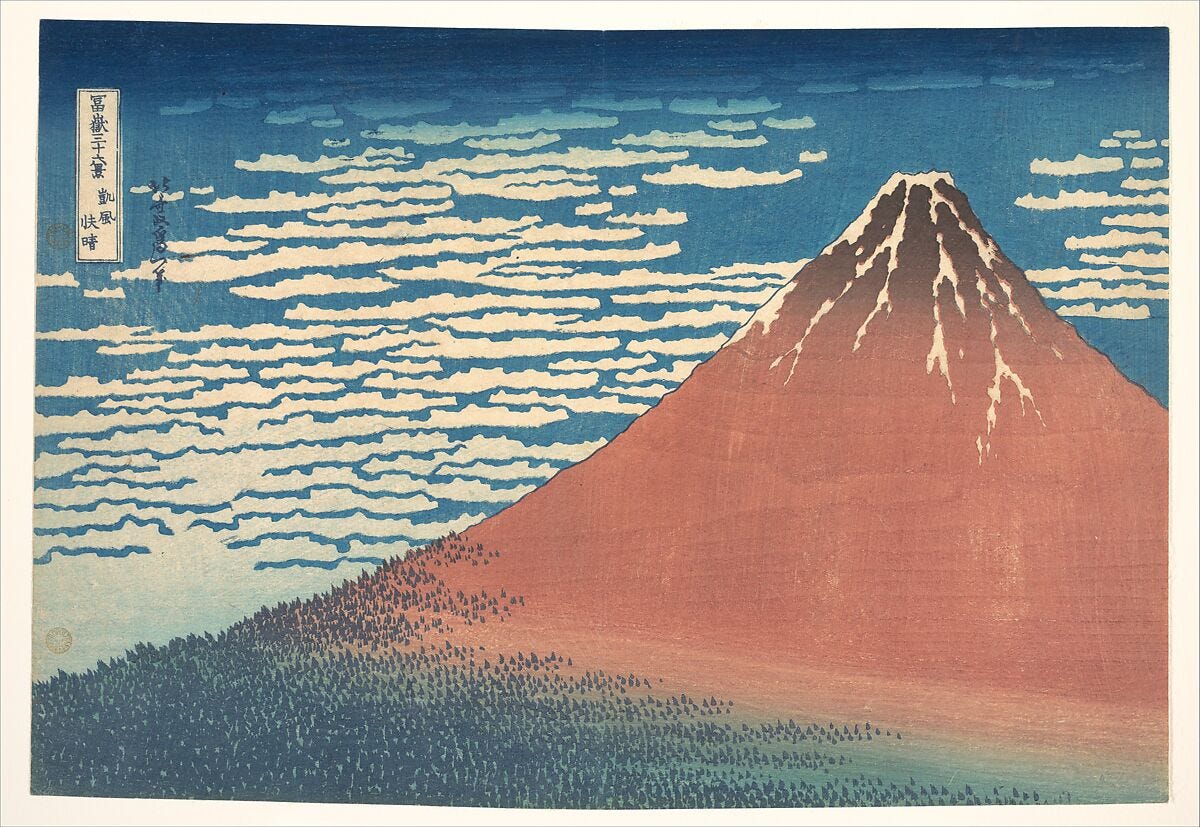
Also from the Thirty Six Views series, this print shows Mount Fuji glowing red under a striped blue sky, with no location given for the viewpoint. The earliest pulls of this design look almost nothing like the version now famous, showing a pale, uneven blue sky known among collectors as Pink Fuji.
The strong, even red now associated with the print came from later printings using a different red pigment. A well preserved early impression sold for over 500,000 dollars at a New York auction in 2019.
8. Katsushika Hokusai, Ejiri in Suruga Province (about 1830 to 1832)
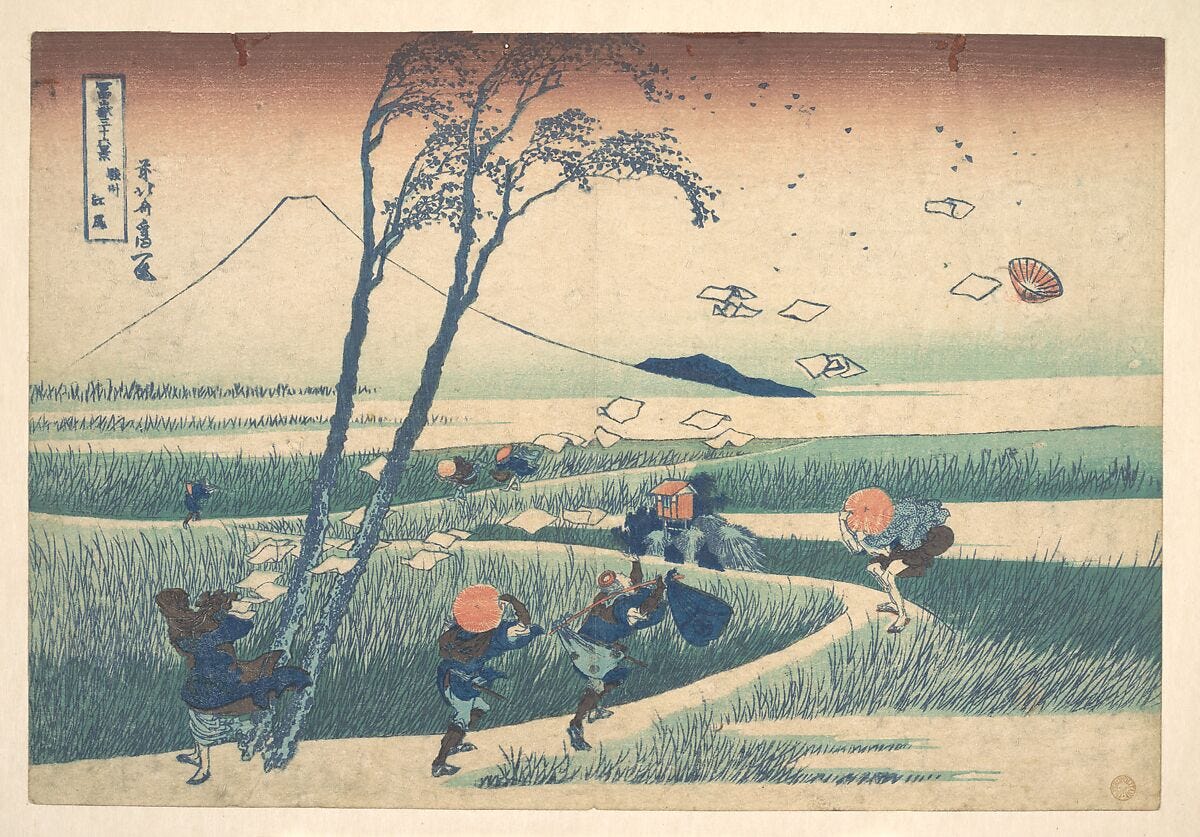
A third print from the same series, this one shows travelers on a road at Ejiri battling a sudden gust of wind that scatters loose papers into the air and bends the roadside grass flat. Mount Fuji again appears reduced to a small triangle in the distance.
Hokusai used the same trick across the series again and again, small human chaos in the foreground against a mountain that never moves. He kept working, by his own account, into his final years, chasing what he called true mastery of drawing.
9. Utagawa Hiroshige, Evening Snow at Kanbara (about 1833 to 1834)
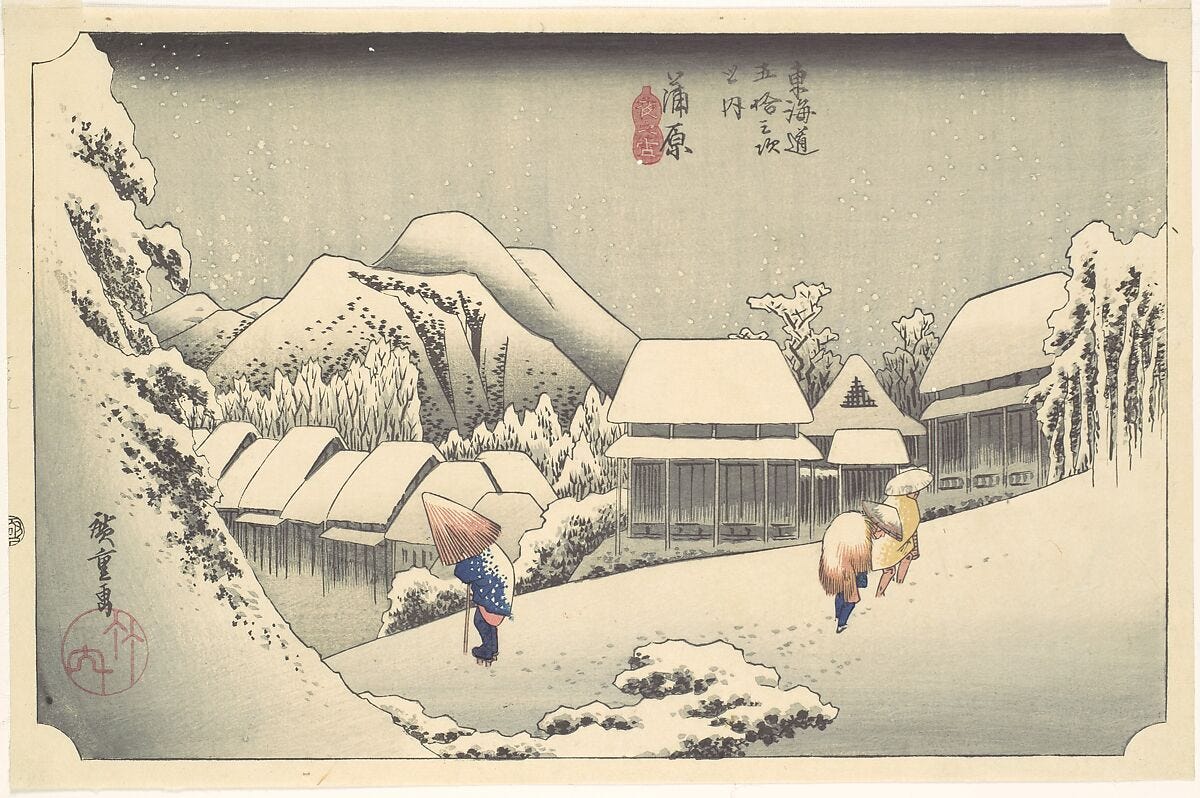
This print, from Hiroshige's Fifty Three Stations of the Tokaido series, shows three travelers crossing a snow covered village at dusk. Records of Hiroshige's own journey along this road show he actually passed through Kanbara in summer, meaning the snow itself is invented.
Blank white paper stands in for a hushed, snow deadened silence, with almost no line work beyond the three walking figures. I cover his full career in my complete Hiroshige profile.
10. Utagawa Kuniyoshi, Takiyasha the Witch and the Skeleton Spectre (1845 to 1846)
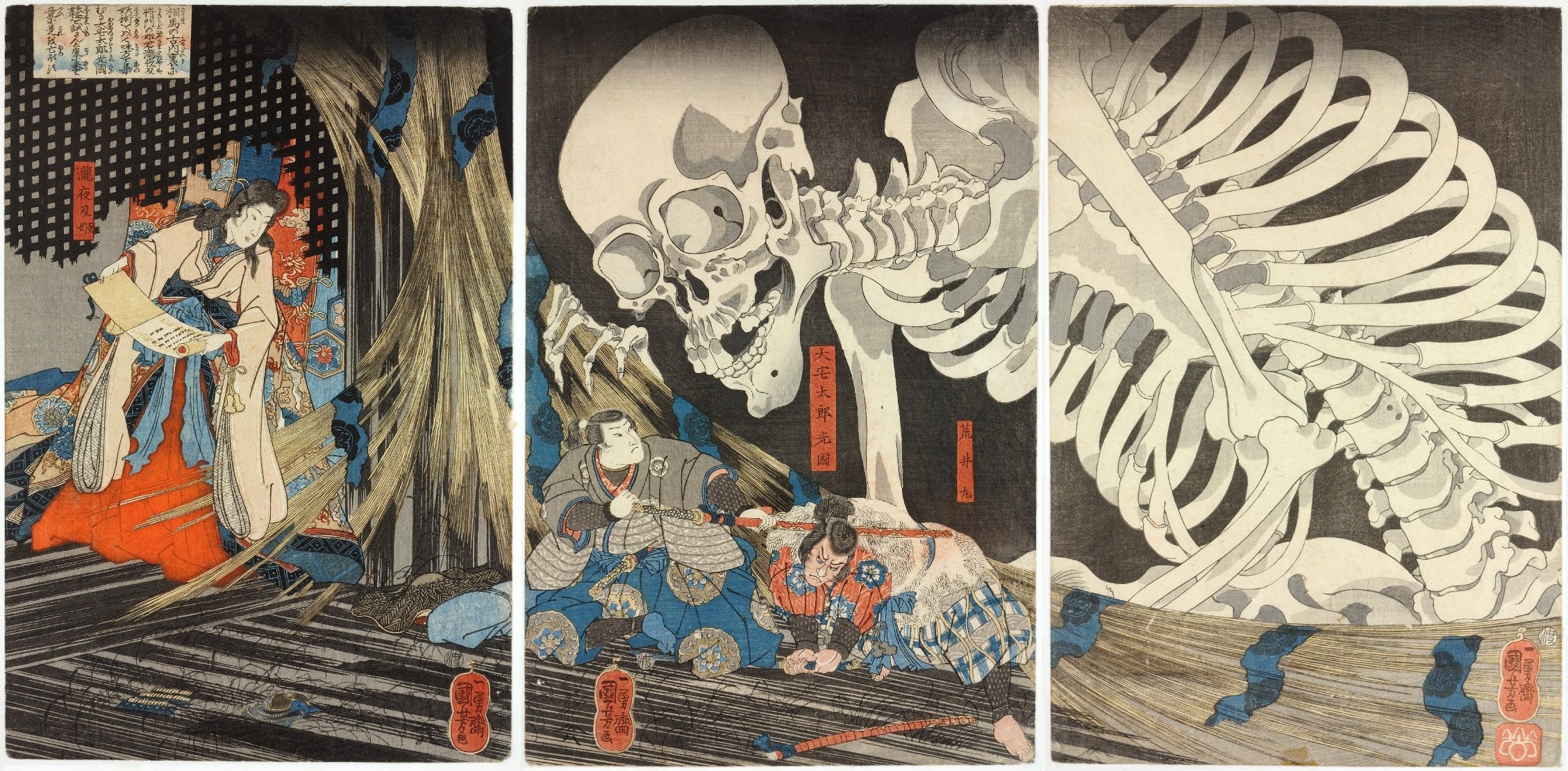
Kuniyoshi built this print as a triptych, three separate printed sheets that only form a complete image when displayed together in the right order, with the giant skeleton's body running across all three panels at once. The skeleton crashes through a set of palace blinds directly toward the viewer.
The scene illustrates a legend of Princess Takiyasha summoning a monstrous spirit to defend her father's stronghold. Few print designers attempted a single figure spanning three sheets, since the smallest printing misalignment would break the illusion.
11. Utagawa Hiroshige, Sudden Shower over Shin Ohashi Bridge and Atake (1857)
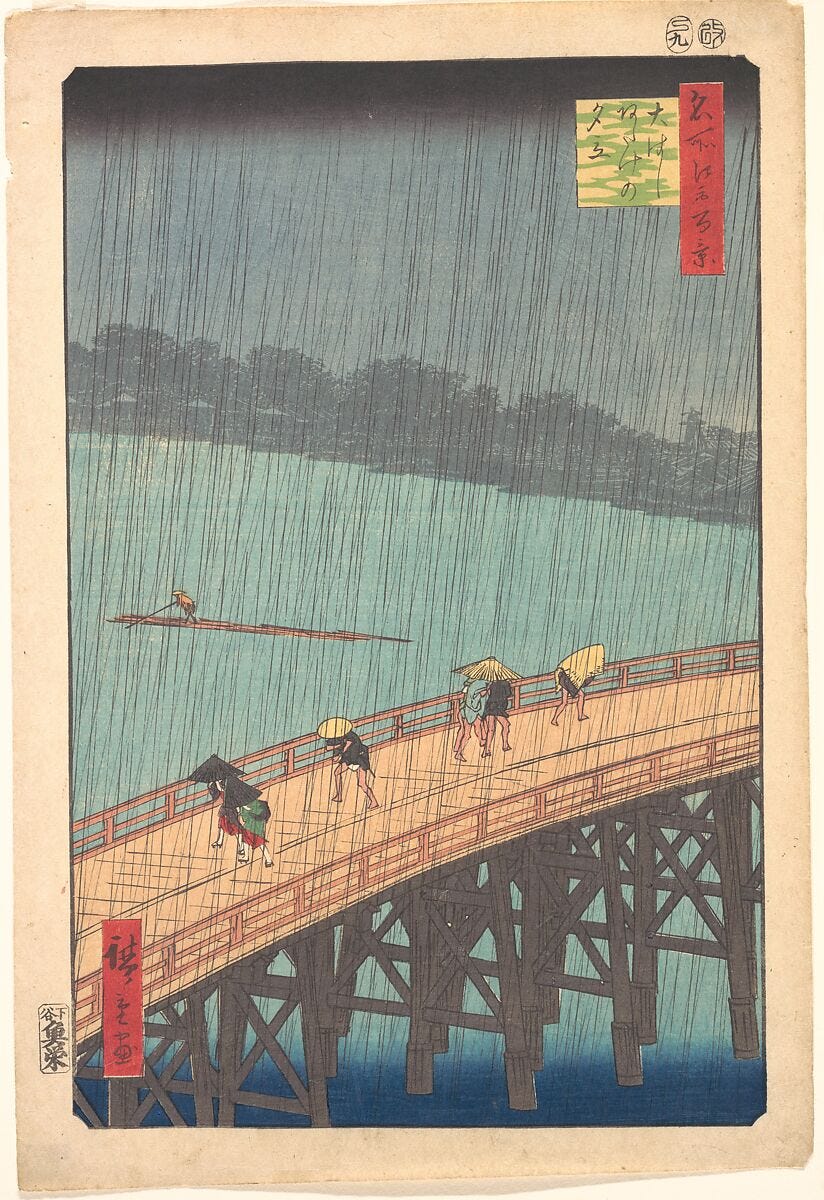
Hiroshige printed the rain in this design as two overlapping sets of fine parallel lines cut directly into the woodblock, a technique that reads at a glance as a sudden downpour. A lone boatman on a log raft is dwarfed by the crowded bridge above him.
Vincent van Gogh painted a direct copy of this print in 1887, adding invented Japanese looking characters of his own around the border since he could not read the originals. The copy, titled Bridge in the Rain, now hangs in the Van Gogh Museum in Amsterdam.
12. Utagawa Hiroshige, Plum Estate, Kameido (1857)
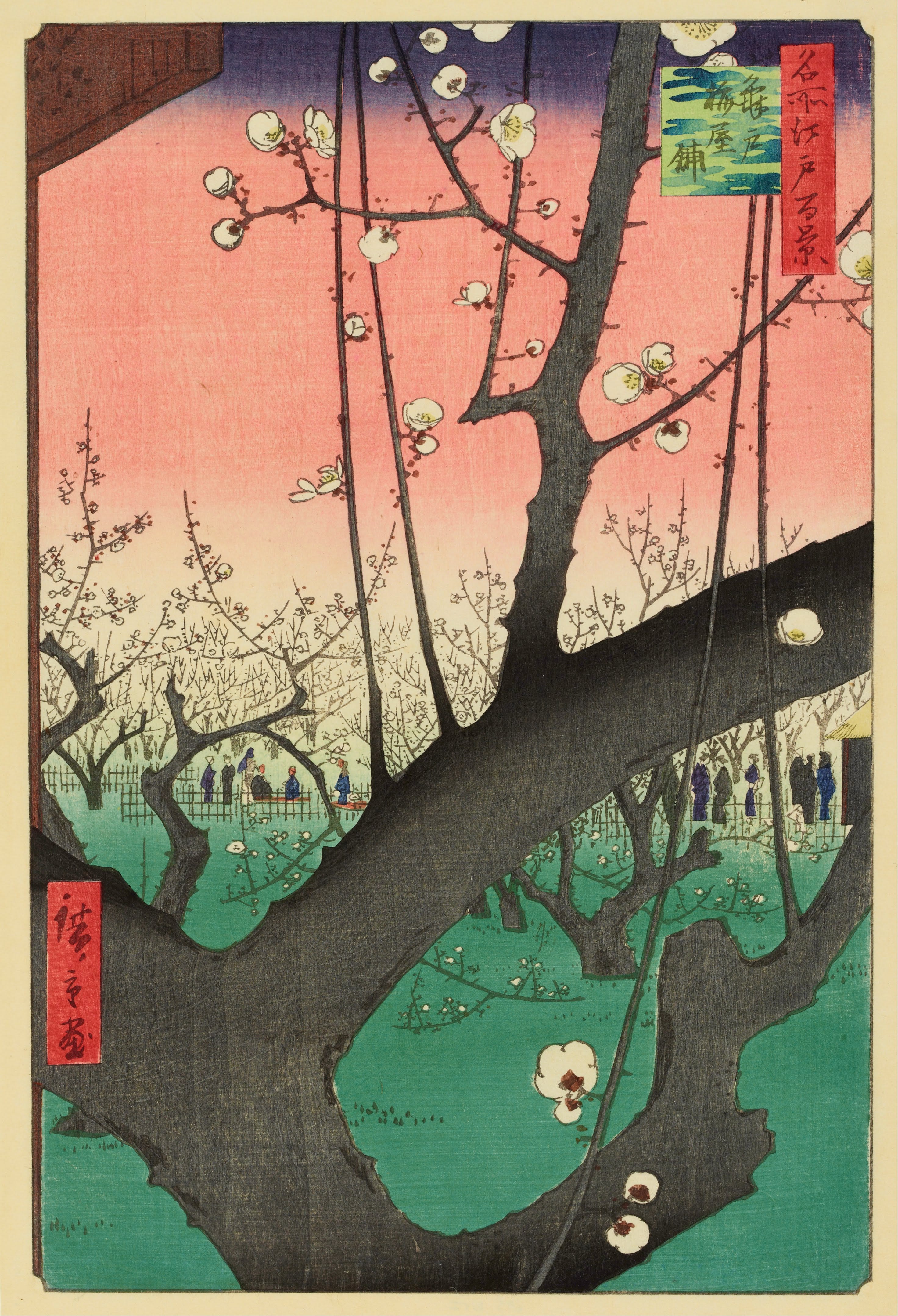
The tree in this print was a real, well known tree in Edo nicknamed the Sleeping Dragon Plum, so named because its branches grew long enough to touch the ground and root into new trunks nearby. Hiroshige cropped the branches so tightly in the foreground that the trunk reads almost like calligraphy.
Van Gogh copied this print too, in 1887, as Flowering Plum Tree. Both Hiroshige prints Van Gogh chose to copy sit on this list, a detail I explore further in Japonisme: How Japan Reshaped Western Art.
Where to see these today
Studio of Sotatsu, Royal Visit to Ohara: Metropolitan Museum of Art, New York.
Korin, Irises at Yatsuhashi: Metropolitan Museum of Art, New York.
Utamaro, Three Beauties of the Present Day: Toledo Museum of Art, Toledo.
Sharaku, Otani Oniji III as Yakko Edobei: Metropolitan Museum of Art, New York.
Toyokuni I, The Actor Sawamura Sojuro III: Metropolitan Museum of Art, New York.
Hokusai, The Great Wave: Metropolitan Museum of Art, New York, among many other collections worldwide.
Hokusai, Red Fuji: Metropolitan Museum of Art, New York.
Hokusai, Ejiri in Suruga Province: Metropolitan Museum of Art, New York.
Hiroshige, Evening Snow at Kanbara: Metropolitan Museum of Art, New York.
Kuniyoshi, Takiyasha the Witch: British Museum, London.
Hiroshige, Sudden Shower over Shin Ohashi Bridge: Metropolitan Museum of Art, New York.
Hiroshige, Plum Estate, Kameido: British Museum, London.
Common questions about these Japanese prints and paintings
What is the most famous Japanese painting? Hokusai's Great Wave off Kanagawa is by far the most reproduced Japanese image in the world, though it is technically a print, not a unique painting.
What is ukiyoe? A genre of Japanese woodblock prints and paintings from the Edo period, called ukiyoe in Japanese, focused on everyday pleasures: actors, beauties, landscapes and travel.
How did Japanese prints influence Western art? Painters including Van Gogh, Monet and Manet collected and copied Japanese prints directly, a movement now called Japonisme. I cover it in full in What Is Japonisme?.
Are these paintings or prints? Most on this list are woodblock prints made in multiple impressions, not unique paintings, though a few, like the Sotatsu and Korin folding screens, are one of a kind works.
Who is Sharaku? An artist who made a small number of intense kabuki actor prints for about ten months in 1794 and 1795, then disappeared from the historical record entirely. His true identity remains unconfirmed.
What came before these prints? Japan's Edo period printmakers worked centuries after the dynastic ink traditions covered in Famous Chinese Paintings, which spans roughly a thousand years of painting before Japan's own golden age of prints.
You Might Also Like


From folding screens to five hundred dollar prints
Line these twelve up chronologically and you can watch a private, decorative art form turn into a mass produced one. Sotatsu and Korin painted directly onto gold leafed screens for wealthy patrons who would never sell them.
By the 1790s, prints of kabuki actors and beauties were selling on Edo street corners for the price of a bowl of noodles. Hokusai and Hiroshige pushed the same cheap medium into landscapes precise enough that a Dutch painter, working from prints mailed to Paris, copied two of them onto canvas without ever visiting Japan.
Between the two landscape print masters on this list, Hiroshige is the better painter of atmosphere and Hokusai is the better designer of shapes. The Great Wave reads instantly even shrunk to a postage stamp, while Sudden Shower over Shin Ohashi Bridge depends on the rain and the crowded bridge rather than one dominant shape.
The Sotatsu and Korin screens took more raw technical skill to produce than any single print on this list, since a mistake in gold leaf or ink could not be corrected the way a worn woodblock could simply be recut. But the prints did more work in the world: a screen stayed in one temple or one collector's house, while a Hokusai or Hiroshige design sold in the thousands and crossed an ocean.
Of the two Impressionists on this list, Van Gogh copied Hiroshige's prints directly, brush for brush; Monet borrowed habits from them, the flattened space and the high horizon line, without copying a single image outright. Monet's approach aged better, since a style is harder to dismiss as imitation than a direct copy.
That popular, widely reproduced spirit never left Japanese art. Starting in the 1990s, Yoshitomo Nara built a career on big headed children with sharp eyes, a style just as instantly recognizable and just as widely collected.
For the full ranking, see the greatest painters of all time.