
For about twenty years, John Singer Sargent was the portrait painter the rich of London and New York wanted most. Then, past fifty, he more or less gave up portraits, though he kept working until his death in 1925. Several of his most striking pictures were never commissioned at all, and one of them was never exhibited in his lifetime.
Cool Stories About Art is a newsletter to learn art the fun way.
Join 200,000+ readers and get:
10 new art stories / month
The entire archive of content (140+ articles)
Comment, ask questions, and chat with other readers
From the Paris Salon to the Boston Rotunda
Sargent was an American born in Florence, in 1856, and he trained in Paris. There, a portrait shown at the yearly Salon could launch a career, and he learned to paint fast and directly, building a face or a silk sleeve out of a few loose strokes.
That training carried him a long way from Paris. His major works hang mostly in Boston, at the Museum of Fine Arts, the Isabella Stewart Gardner Museum and the Boston Public Library, whose walls he decorated, and otherwise in New York and London.
The twelve chosen here follow that road from 1881 to about 1920: the Paris debut, the society portraits, then the late work for walls and for the war.
12. Nude Study of Thomas E. McKeller (about 1917 to 1920)
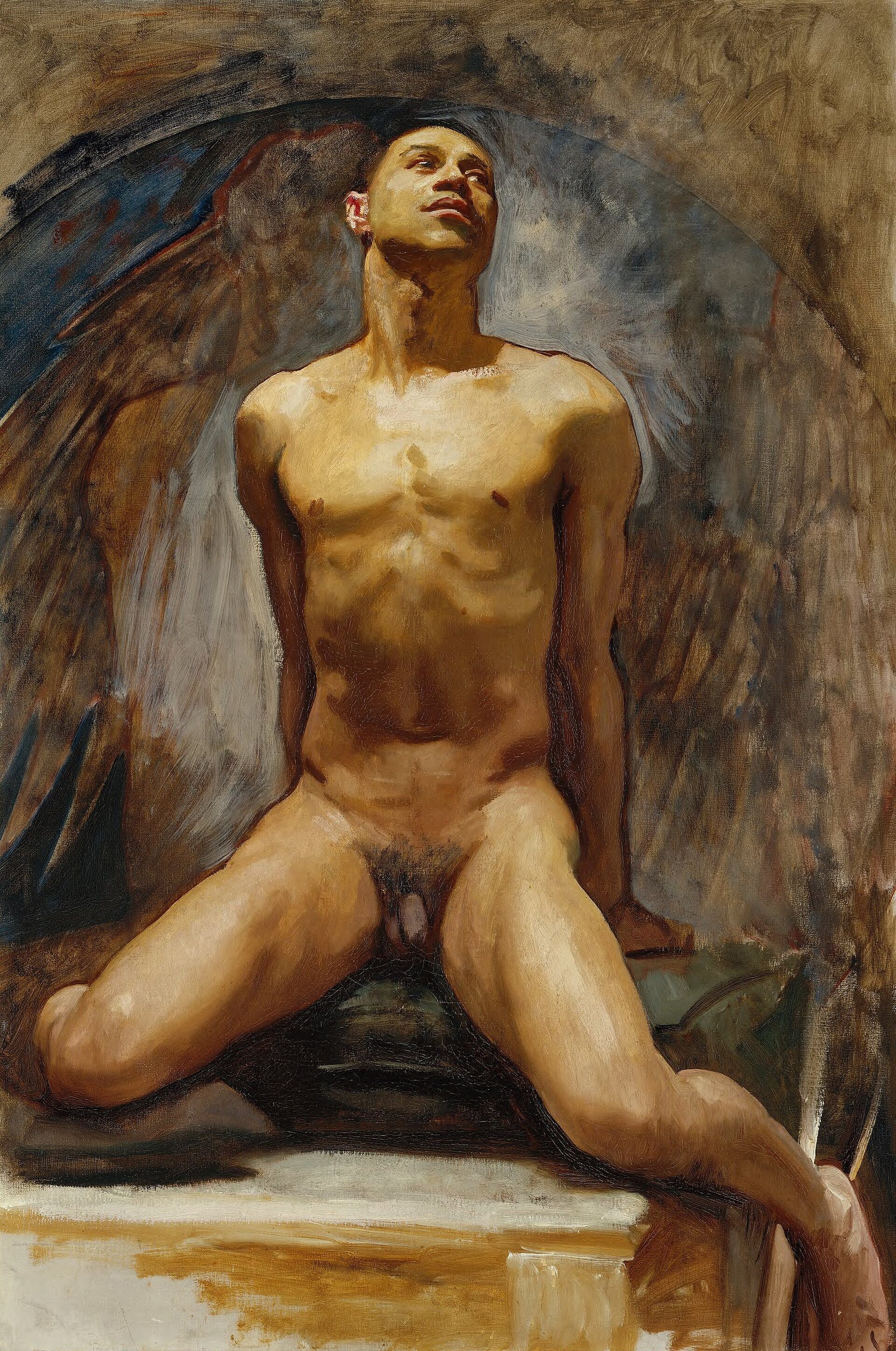
A pale shape opens behind the seated man like a pair of wings. He sits naked on a cushion, knees apart, his head thrown back into a warm golden light. In Nude Study of Thomas E. McKeller, those wings may be what remains of a plan Sargent dropped: a Prometheus, the Titan of Greek myth whom an eagle tormented for giving fire to humans.
The plan belonged to the last big project of his life. By 1916, Sargent had all but given up portraits and was working in Boston on paintings for the domed hall above the grand staircase of the Museum of Fine Arts. He filled it with Greek gods and heroes in a classical style.
For those gods he wanted a living model, and he met him at the Hotel Vendôme, the grandest hotel in the city. Thomas McKeller, born in Wilmington, North Carolina, in 1890, ran its elevator. The two men met there in 1916 and kept working together for at least eight years.
On the walls, McKeller became almost everyone. He posed for Apollo, the god of the arts, and for goddesses too, for which Sargent fitted him with breasts shaped from cheesecloth. Yet as the New York Times critic Holland Cotter pointed out, every figure on the finished walls has alabaster-white skin and blond hair.
The art historian Nikki A. Greene, of Wellesley College, summed up that disappearance in one sentence: "Thomas McKeller is under erasure, safely contained within the pale skins of Apollo."
This oil was a different matter. Nobody commissioned it, and Sargent never gave it a title. He kept it on show in his Boston studio for years, but it never went to an exhibition while he lived. A century later, the artist Steve Locke said: "It was a painting he made for himself." Under the golden light, the skin is brown, and the face turned up toward the wings is McKeller's own.
At a Glance
Artist: John Singer Sargent (1856 to 1925)
Painted: About 1917 to 1920
Medium: Oil on canvas
Size: 125.7 × 84.5 cm (49.5 × 33.3 in)
Where to see it: Museum of Fine Arts, Boston
11. Robert Louis Stevenson and His Wife (1885)
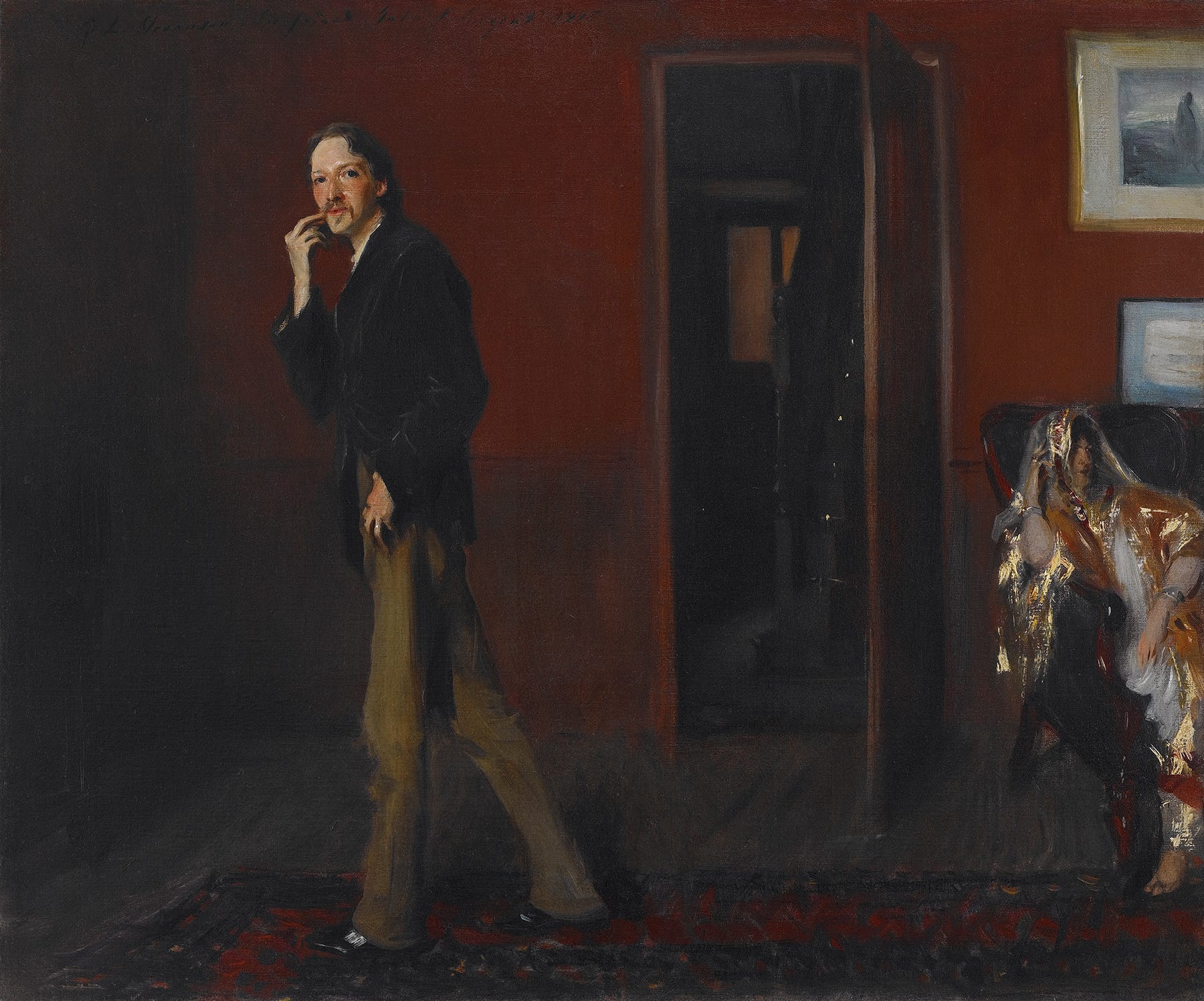
Nobody in this small room is looking at anyone else. A thin man in a brown suit strides along the left edge, fingers at his moustache, one foot already beyond the frame. At the far right, a woman wrapped in a gold-embroidered shawl sits cut off by the other edge. Between them, a door stands open on a staircase. The man walking out of the picture thought it far too eccentric to be shown in public.