
Early in the twentieth century, a Russian painter settled in Munich set himself a strange goal: a picture that would work like music, with nothing in it to recognize. Reaching it took him most of his life, a world war and a revolution. Along the way, a jury of fellow artists turned him down, and a composer he had never met wrote back to encourage him.
Cool Stories About Art is a newsletter to learn art the fun way.
Join 200,000+ readers and get:
10 new art stories / month
The entire archive of content (140+ articles)
Comment, ask questions, and chat with other readers
A Painter Who Wanted Pictures to Sound
Music reaches a listener without a tree or a face. For more than thirty years, this painter asked whether a picture could do the same, and move people through color and line alone, without showing anything at all.
He got there slowly. He started with horsemen and meadows, kept traces of boats and towers for years, and later built pictures from disks, grids and triangles. He is remembered as one of the first painters of abstraction, art with no recognizable subject.
The twelve pictures follow that road from his years in Munich to his last ones near Paris, with a stop in the Russian war years that are easy to forget. Each one shows how much of the visible world he still allowed in.
12. Impression III (Concert) (1911)
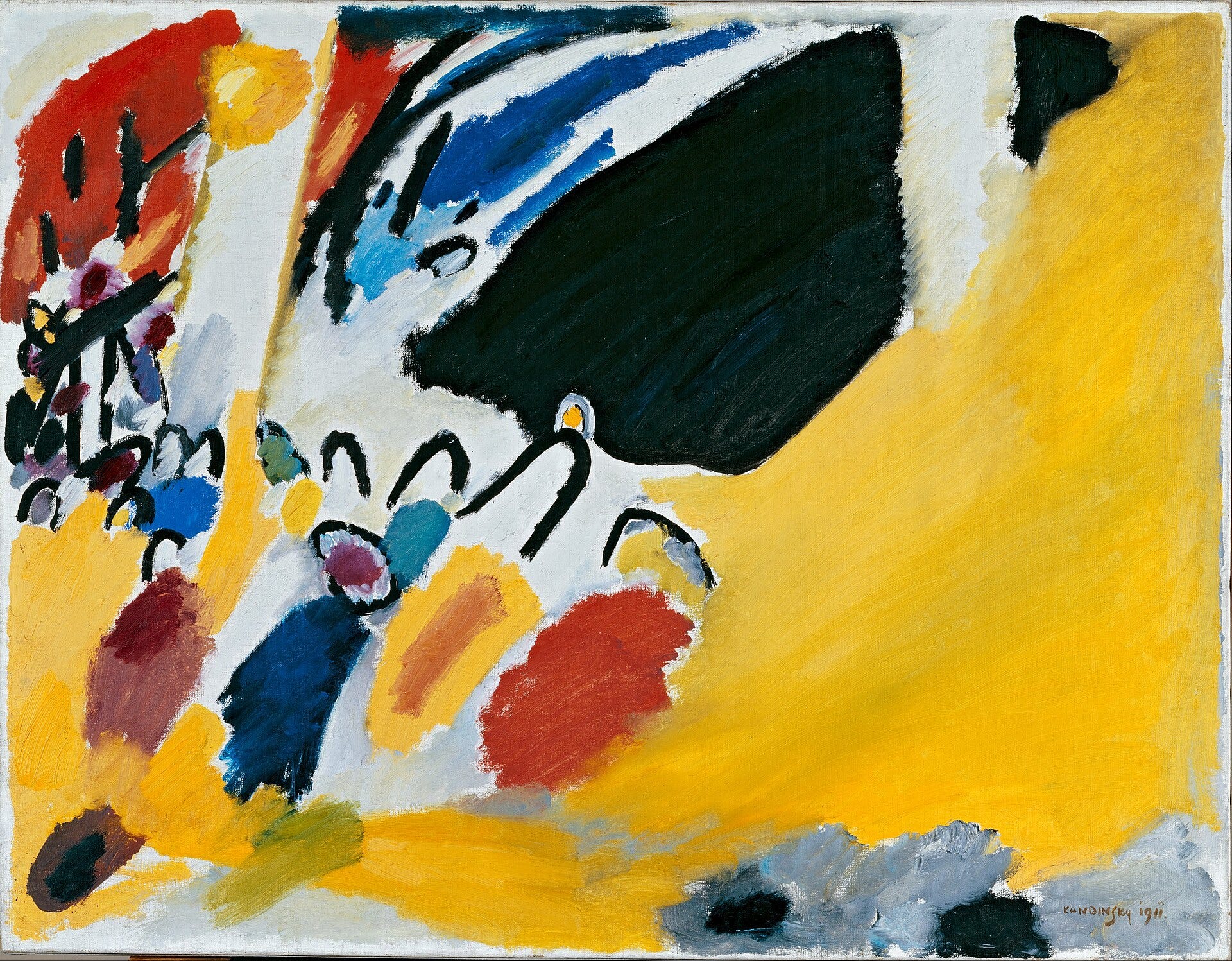
A heavy black wedge cuts across a field of bright yellow, above small patches of white, red and green. The title, Impression III (Concert), turns the wedge into the lid of a grand piano and the patches into an audience.
The concert took place in Munich on January 2, 1911. That evening the painter and his friend Franz Marc heard music by the Viennese composer Arnold Schoenberg, and the canvas was painted the next day.
The meeting did not stop at the concert hall. A few weeks later the painter wrote to Schoenberg, a man he had never met, and the reply was not what one would expect from a musician. "Art belongs to the unconscious!" Schoenberg wrote, and then: "I do not believe that painting must necessarily be objective."
Schoenberg could say so with some authority, because he painted too. Before the year was out, two of his canvases hung beside the painter's own in a Munich exhibition, and the following spring a book the painter edited printed his music.
Seen in that light, the canvas from the day after the concert already leans the same way. Of the piano only a black shape remains, of the listeners only spots of color, and the yellow may well be the sound itself, filling the hall.
At a Glance
Artist: Wassily Kandinsky (1866 to 1944)
Painted: 1911
Medium: Oil on canvas
Size: 78.5 × 100.5 cm (30 7/8 × 39 5/8 in)
Where to see it: Lenbachhaus, Munich
11. Composition V (1911)
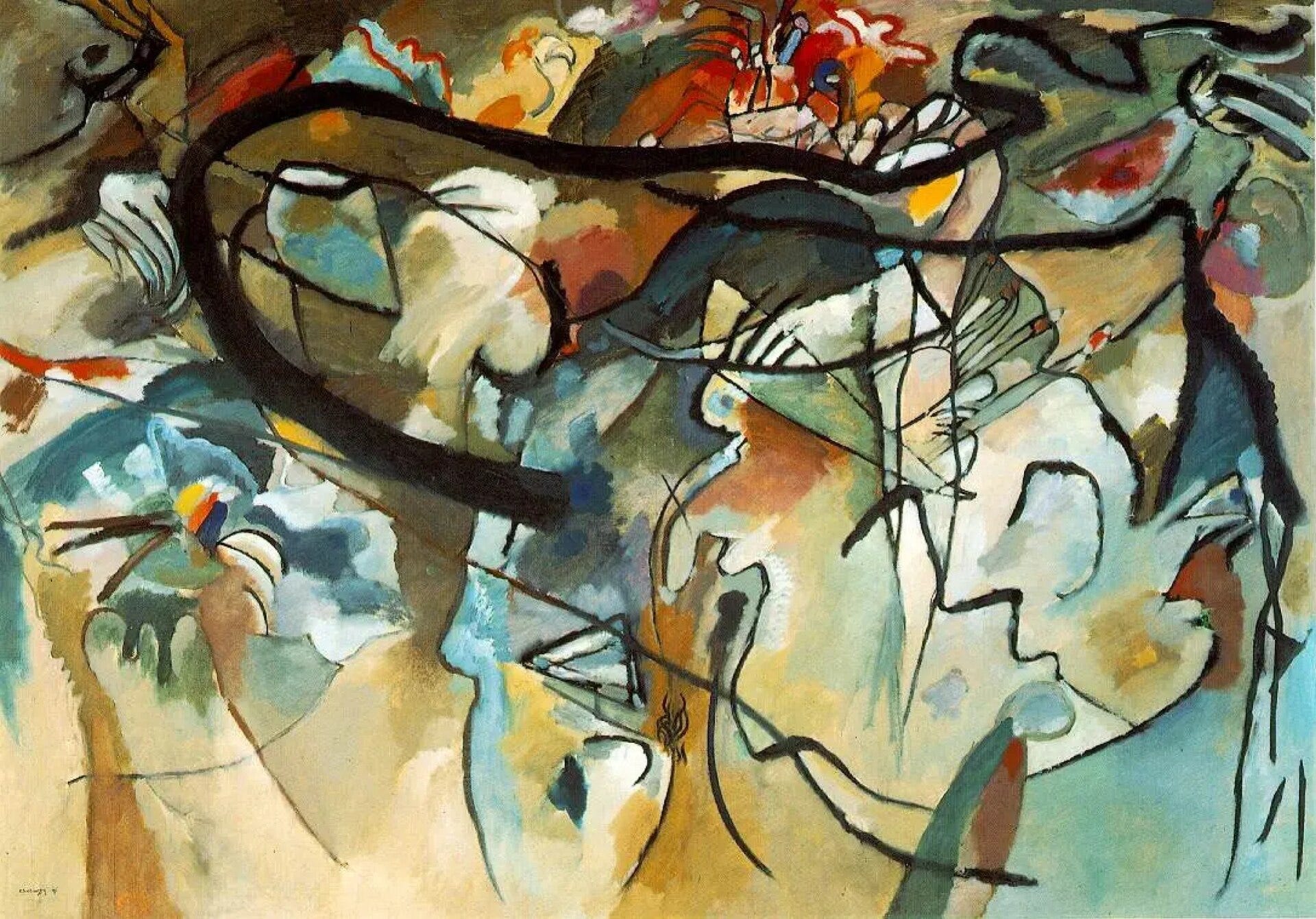
Almost the whole width of this canvas is crossed by a long black line, curling over patches of blue, white, ochre and violet. In December 1911, a jury of Munich artists refused to hang the picture in their group's exhibition. Its painter had helped found that very group.