Kiss Paintings: 12 Famous Works in Art History
The most famous kiss paintings turn a single embrace into a whole story. Klimt wrapped his lovers in gold. Hayez hid a political message. Munch let two faces melt into one. Each canvas below carries a secret worth knowing.
A painted kiss is never just a kiss. It can hide a revolution, a scandal, a myth, or a private grief. Painters have used this one gesture to talk about desire, death, faith and power for six centuries. One quick note, Rodin famous Kiss is a marble sculpture, so it sits outside this list of paintings.
The gold one: Klimt covered his lovers in real gold leaf and sold the canvas straight off the wall.
The political one: Hayez painted a love scene that was really a coded call for a free Italy.
The dark one: Munch fused two faces into a single blur that some read as a loss of self.
The forbidden one: Bronzino painted a kiss between a mother and her son, wrapped in hidden symbols.
If these pull you in, you will also love the impossible love in Botticelli, how Picasso destroyed the six women who loved him, and 7 secrets hidden in famous paintings.
1. Gustav Klimt, The Kiss
A man bends over a woman at the edge of a flowered cliff. Klimt painted the pair during his golden phase, using thin sheets of real gold leaf pressed onto the canvas. He had just returned from Ravenna, dazzled by the gold mosaics in its churches.
People love to say the couple is Klimt and his companion Emilie Floge. There is no proof. Klimt left almost no letters about the work and never named the models, so the identity stays open.
The Austrian state bought the canvas in 1908, before it was even finished on the wall of an exhibition. It has never left the country and remains the most visited work at the Belvedere.
2. Francesco Hayez, The Kiss
A couple embraces on a stone staircase. The young man has one foot on a step, as if he must run at any second. Hayez painted it in Milan in 1859, the year an Italian and French alliance pushed against Austrian rule.
The romance hides a message. The blue dress and red tunic echo the flags of the alliance, and the fleeing man reads as a patriot leaving for war. Look at the shadow on the left stairs, where a figure seems to wait.
Hayez painted at least four versions. The Brera canvas is the one Italians treat as a national image, reproduced on chocolate boxes and film posters ever since.
3. Edvard Munch, The Kiss
Two lovers stand at a window, half swallowed by shadow. A thin strip of light slips through the curtain. Munch worked the motif for nearly a decade before this 1897 oil, part of his cycle on love and life called the Frieze of Life.
The faces have no features. They dissolve into one shape. One early critic mocked it as two figures with faces fused like melting wax. Munch saw union and threat at once, a couple becoming one person and losing themselves.
The painting has hung in Oslo since 1903. Munch also cut the same lovers into wood, letting the raw grain of the plank stand in for the dark room.
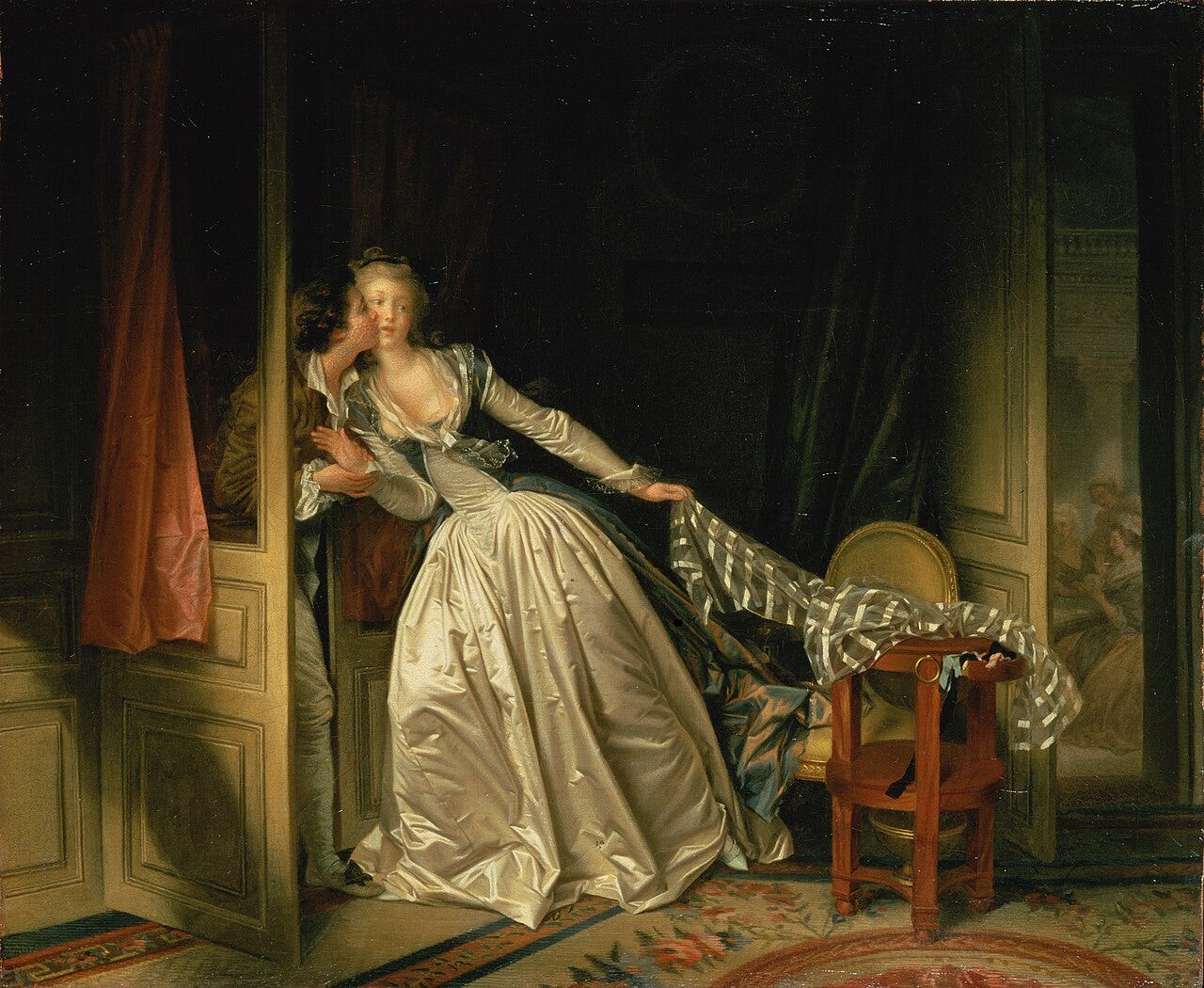
4. Jean Honore Fragonard, The Stolen Kiss
A young woman leans out of a doorway to receive a quick kiss, her silk scarf catching the light. Through the open door behind her, a card party carries on. She glances back, afraid of being caught.
The polished silk and porcelain finish led many to credit Fragonard sister in law, Marguerite Gerard, with part of the work. The attribution has been argued for over a century and still is not settled.
The Russian court bought it. The canvas passed from the king of Poland into the Hermitage, where it stayed through revolution and war.
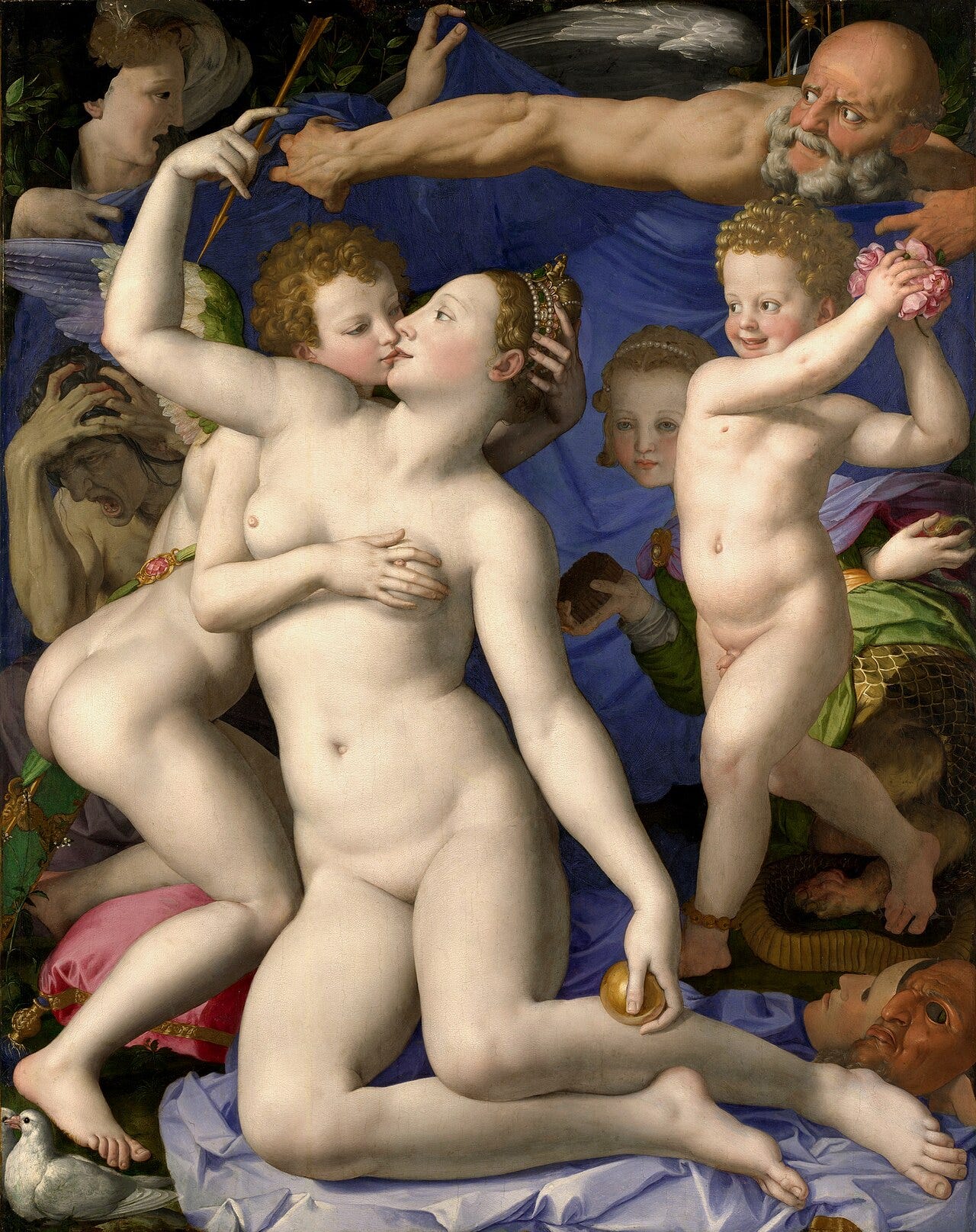
5. Agnolo Bronzino, Venus, Cupid, Folly and Time
Cupid kisses his mother Venus on the lips while reaching for her crown. Bronzino painted this cold, glassy scene in Florence for Cosimo de Medici, who sent it as a gift to the king of France.
The kiss is only the start of the puzzle. Around the lovers, Bronzino hid figures of Folly, Time, jealousy and deceit. Some scholars read the screaming face and swollen limbs as signs of syphilis, then spreading across Europe.
The picture was made to be decoded by a clever court. It still divides experts, who cannot fully agree on what every figure means.
6. Francois Gerard, Psyche Receiving the First Kiss of Cupid
Cupid leans in to kiss Psyche on the forehead. She cannot see him. A butterfly hovers over her head. Gerard showed the exact instant the god of love brushes the mortal girl for the first time.
The butterfly is the clue. In Greek, the word psyche means both soul and butterfly, so the insect stands for her awakening spirit. Cupid is invisible to her by the rules of the myth, which is why she stares into empty air.
Gerard showed it at the Paris Salon of 1798 and became famous overnight. The smooth marble skin made him one of the most wanted portrait painters of the Napoleonic age.
7. Henri de Toulouse Lautrec, In Bed, The Kiss
Two women lie under the sheets, one leaning up to kiss the other. Lautrec painted them in a Paris brothel, where he had been asked to make pictures for the salon of a house on the rue d Amboise.
He did not paint the women as spectacle. He showed private tenderness between them, plain and warm. Lautrec actually lived in these houses for weeks, treated as a regular, which is why the scenes feel so unposed.
He used oil on cardboard, his usual quick surface. The work is one of a small group of intimate brothel scenes that stayed hidden in private hands for decades.
8. Jean Leon Gerome, Pygmalion and Galatea
A sculptor climbs a step to kiss the statue he carved, and her body turns from white marble to warm flesh from the waist up. Gerome caught the moment the goddess Venus answered the artist prayer and brought his ivory woman to life.
Gerome was a sculptor as well as a painter, so the subject was personal. He painted the scene from several angles and even made a marble Galatea of his own, an artist dreaming his own creation awake.
The Met version shows the couple from behind, Cupid firing an arrow at them. It entered the museum in 1927 and is one of the most reproduced love scenes in the collection.
9. William Adolphe Bouguereau, The First Kiss
Two winged children lean together for a shy kiss on a rock. Bouguereau, the reigning star of the Paris academy, gave the ancient lovers the soft faces of toddlers. The work is often called The First Kiss.
Modern critics once treated Bouguereau as sugar with no substance, and his prices collapsed after his death. That verdict flipped. Collectors rediscovered his flawless finish, and his paintings now sell for millions.
This canvas stayed in private hands and rarely appears in public. Its sweetness made it one of the most printed images of late Victorian homes.
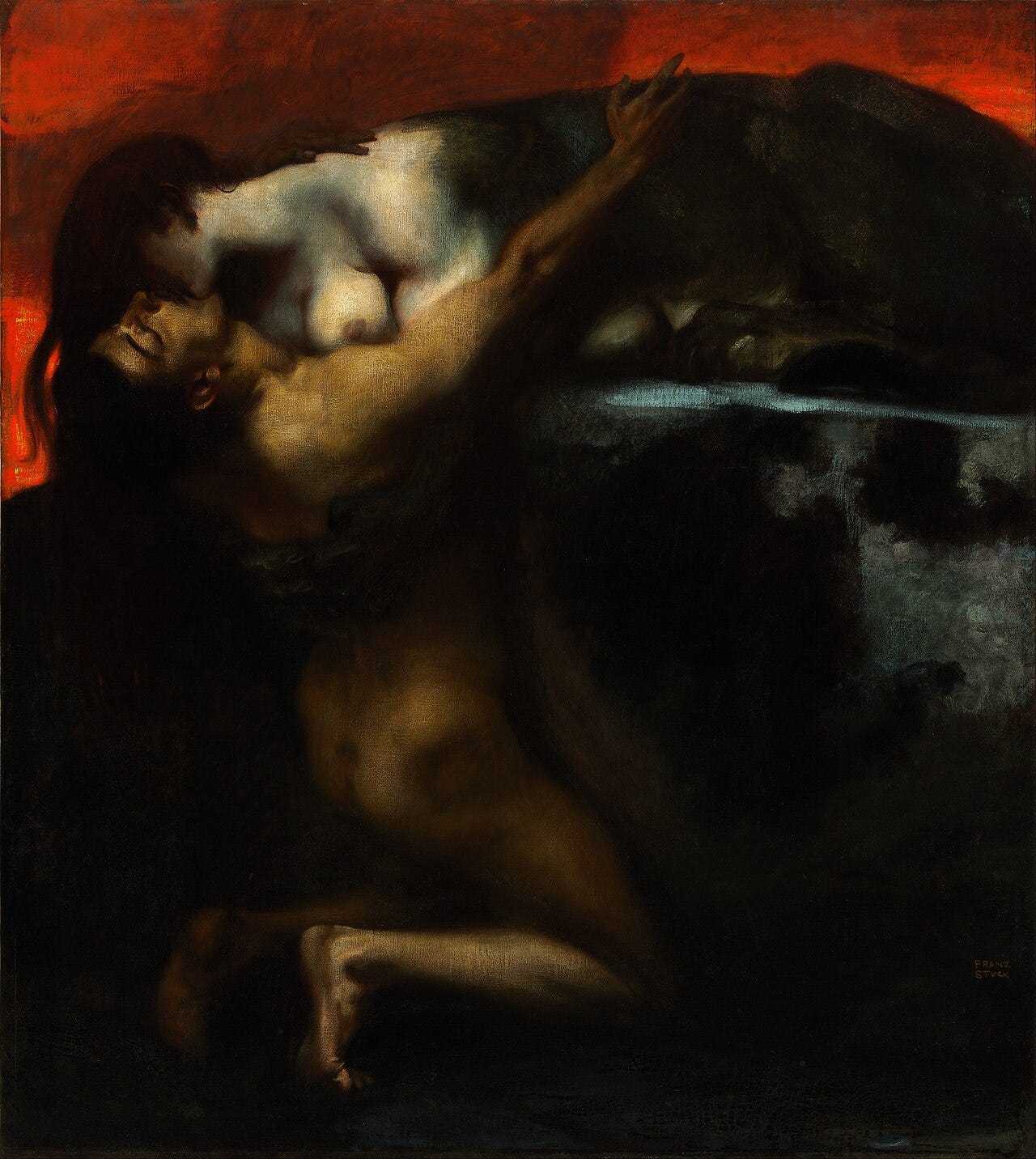
10. Franz von Stuck, The Kiss of the Sphinx
A naked man arches back into the grip of a Sphinx, who kisses him on a dark rock. Stuck, a leader of the Munich symbolists, painted desire and danger as the same act.
This is a kiss that could kill. The Sphinx of Greek myth strangled travelers who failed her riddle, so the embrace reads as surrender to a woman who devours. It fit the symbolist obsession with the femme fatale.
Stuck built himself a villa in Munich full of such images, now a museum. The Budapest canvas remains his most requested loan.
11. Marc Chagall, Birthday
A man floats up and twists his whole body backward to kiss a woman who holds a bouquet. Chagall painted it in his home town of Vitebsk, around his own birthday, just before he married Bella Rosenfeld.
The scene bends gravity because Chagall painted feeling, not a real room. Bella wrote later that she had brought him flowers, and he began the picture on the spot. The floating kiss became his sign for young love.
Chagall left Russia and the canvas traveled with the century upheavals. It now hangs at MoMA, one of the museum most loved images of joy.
12. Rene Magritte, The Lovers
A man and a woman kiss, but white cloth covers both their heads. Magritte painted the shrouded couple in 1928, during his years in Paris among the surrealists.
Writers often link the veils to his mother, who drowned when Magritte was a boy and was found with her nightdress over her face. Magritte rejected easy readings of his own work and never confirmed the link, so it stays a guess.
The couple cannot truly reach each other through the cloth. That barrier, kissing yet blind, is why the image keeps its cold pull nearly a century later.
Where to see them
Belvedere, Vienna: Gustav Klimt, The Kiss.
Pinacoteca di Brera, Milan: Francesco Hayez, The Kiss.
Louvre, Paris: Francois Gerard, Psyche Receiving the First Kiss of Cupid.
National Gallery, London: Agnolo Bronzino, Venus, Cupid, Folly and Time.
Metropolitan Museum of Art, New York: Jean Leon Gerome, Pygmalion and Galatea.
Why a painted kiss carries so much
Many of these are Symbolist works, where a kiss stood for desire, danger and death at once, as in Stuck deadly Sphinx.
Others use myth and allegory to talk about love without naming it, and Klimt reached back to gilding and gold mosaic to make his embrace glow.
Kiss paintings, questions people ask
What is the most famous kiss painting? Gustav Klimt The Kiss, painted from 1907 to 1908, is the best known. It hangs at the Belvedere in Vienna and is covered in real gold leaf.
Where is Klimt The Kiss? At the Belvedere museum in Vienna, Austria. The Austrian state bought it in 1908 and it has stayed there ever since.
Is Rodin The Kiss a painting? No. The Kiss by Auguste Rodin is a marble sculpture, not a painting, which is why it is not on this list.
Why is Hayez The Kiss considered political? The colors of the lovers clothes echo the Italian and French flags, and the fleeing man reads as a patriot leaving to fight for Italian unity in 1859.
What does the kiss in Bronzino allegory mean? It shows Cupid kissing his mother Venus, framed by figures of Time, Folly and deceit. It was a coded puzzle made for a royal court to decode.
The kiss that made the most money
One painted kiss now outsells almost every other. In 2006, Klimt portrait of Adele Bloch Bauer, made in the same gold years as The Kiss, sold for 135 million dollars. The Kiss itself will never come to market. Austria treats it as national property, so its price is, in effect, infinite.