Famous Landscape Paintings: 12 Views That Changed Art
The most famous landscape paintings run from Bruegel's snowy hunters and Constable's Hay Wain to Turner's blazing sunset, Friedrich's lone wanderer, Hokusai's Great Wave and Van Gogh's Starry Night.
Each one turned plain scenery into the real subject of art.
For centuries the land was only a backdrop, something behind the saints and kings. Then painters realized the sky, the weather and the light could be the whole point, and landscape became a way to talk about God, nation, memory and the sheer size of the world.
I have picked twelve that did it best, across four hundred years and three continents. The basics are in what landscape painting is.
What a great landscape is really about:
The weather. Snow, storm, fog and sunset are the real drama, more than any building or figure.
The scale. Tiny people under huge skies, a way of saying how small we are.
The message. A landscape can stand for a nation, a faith, a lost age or a state of mind.
The light. From golden classical calm to Turner's blaze, light is what the painter is really chasing.
If this was your kind of thing
Three that take a single painting apart, properly:
The secret behind Monet Magpie, one bird in the snow, and why it matters
Lady with an Ermine, detail by detail, why she is holding that animal
The secret behind Hopper Soir Bleu, the clown picture that went wrong
1. Pieter Bruegel the Elder, The Hunters in the Snow (1565)
Three tired hunters and their dogs trudge home over a hill above a frozen valley where tiny skaters play on the ponds. Bruegel gives you a whole world in the deep cold, one of the first great landscapes where the people are small and the land is everything.
It belongs to a set of the seasons. Bruegel painted a series showing the months of the year, and this one is deep winter, all whites, browns and the black shapes of bare trees and birds.
Look how far you can see. The eye travels from the dogs' backs down to the skaters and out to jagged blue peaks, a trick of depth that makes the freezing air feel real.
2. Claude Lorrain, Seaport with the Embarkation of the Queen of Sheba (1648)
A calm harbor glows at sunrise, ships at anchor, grand buildings framing a path of light straight into the rising sun. Claude Lorrain perfected the ideal landscape, nature ordered into pure golden calm.
The tiny Bible story is an excuse. The Queen of Sheba boarding a boat is barely visible, because the real subject is the light on the water, and painters worshipped Claude for it for two centuries.
Turner idolized him above all others. When Turner died he willed two of his own paintings to the nation on one condition, that they hang forever beside two by Claude, this very seaport among them.
3. Jacob van Ruisdael, View of Haarlem with Bleaching Grounds (about 1670)
Two thirds of the picture is sky. Huge clouds throw moving shadows over a flat Dutch plain, with the town of Haarlem small on the horizon and the weather itself as the hero.
This is roughly where pure landscape began. Painters in 1600s Holland were the first to sell a view of their own low, wet, windy country as a subject in its own right, no saints or myths attached.
The pale strips in the fields are linen laid out to bleach in the sun, so Ruisdael's sweeping sky doubles as a quiet portrait of how Haarlem made its money.
4. J M W Turner, The Fighting Temeraire (1839)
A pale, ghostly old warship is towed down the Thames at sunset by a small, dark steam tug, on its way to be broken up for scrap. Turner turned the death of a ship into one of the most moving landscapes ever painted.
The Temeraire was a hero of Trafalgar. Turner paints the graceful sailing ship as a fading ghost and the sooty steamer as the grubby future, a whole changing age caught in one blazing sky.
Britain took it to heart. In a 2005 national poll the public voted The Fighting Temeraire the greatest painting in any British gallery, beating every rival.
5. Caspar David Friedrich, Wanderer above the Sea of Fog (about 1818)
A man in a dark coat stands on a rocky peak with his back to us, gazing over a sea of mist and far mountains. Friedrich made the defining image of the Romantic sublime, one small human soul before the vastness of nature.
Because we never see his face, we stand where he stands and look out through his eyes, and the fog turns into a mirror for whatever we bring to it.
Friedrich used peaks, mist and lonely figures to paint faith, death and longing, landscape as a kind of quiet prayer.
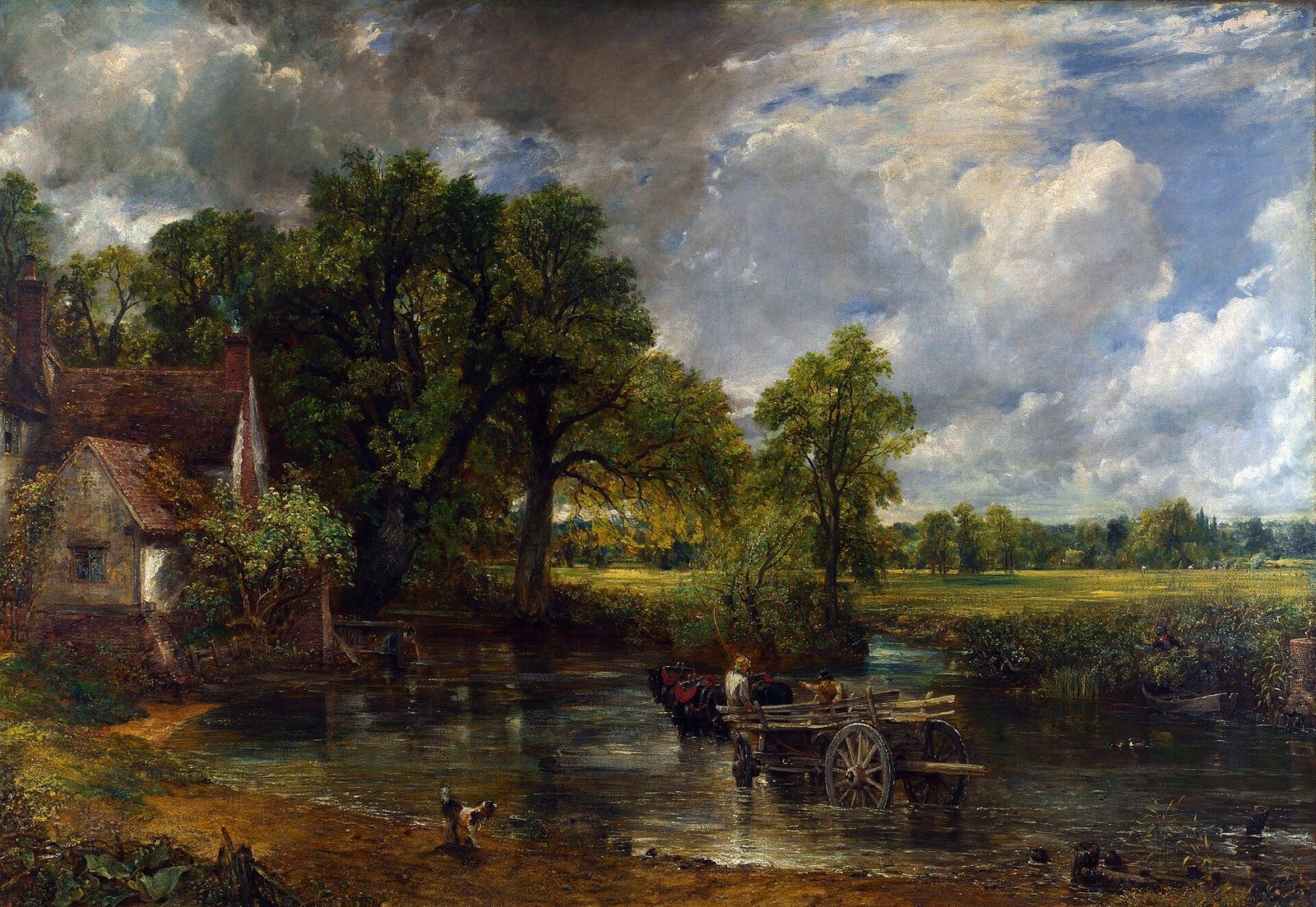
6. John Constable, The Hay Wain (1821)
A wooden hay cart pauses in a shallow river before a mill, under a wide English sky full of moving cloud, a dog watching from the bank. Constable painted the ordinary Suffolk country he grew up in with total, loving attention.
He studied clouds like a scientist and dabbed on flecks of white for sparkle, chasing real, damp, changing weather instead of a tidy ideal.
The Hay Wain barely sold at home, yet when it hung in Paris in 1824 it won a gold medal and stunned young French painters, helping set their whole landscape tradition in motion.
7. Camille Corot, Souvenir de Mortefontaine (1864)
A silvery lake at dawn, feathery trees, a woman reaching for a branch, everything soft and dreamlike. Corot painted the memory of a place more than the place itself, a mood rather than a map.
He worked outdoors decades before the Impressionists and taught them to trust light and quick impressions, standing right between the old ideal and the new.
He was also so kind, and so widely copied, that dealers still joke he made three thousand paintings, of which ten thousand are in America.
8. Thomas Cole, The Oxbow (1836)
A great river loops through a valley, wild storm broken forest on the left, calm sunlit farmland on the right, a whole argument about America in one view. Thomas Cole more or less founded American landscape painting with pictures like this.
The split is the message. On one side is untouched wilderness, on the other tamed, settled land, and Cole is asking what his young country should do with the vast nature it had been handed.
Find the painter in it. Down on the slope, tiny, is Cole himself at his easel, turning to look back at you, right on the line between the wild and the farmed.
9. Albert Bierstadt, Among the Sierra Nevada (1868)
Golden light pours through storm clouds onto a mirror lake, deer at the water, snow peaks soaring behind. Bierstadt sold the American West back east as a glowing promised land.
The scene was built far from the mountains. He made quick sketches on expeditions west, then worked these enormous canvases up in eastern studios and even in Rome, tuning the drama higher.
Pictures like this toured as ticketed attractions, shown alone under careful light, closer to a film premiere than a quiet day at a gallery.
10. Frederic Edwin Church, The Heart of the Andes (1859)
A vast South American panorama unfolds, jungle and waterfalls in front, snow volcanoes far behind, every leaf sharp enough to name. Church packed a whole continent of nature into one enormous canvas.
He staged it like a show, hanging the picture alone in a darkened room framed by a heavy curtain and handing visitors opera glasses to scan it like a real view.
Thousands lined up and paid, drawn by a spectacle that was part science and part theater, inspired by the explorer Humboldt's dream of capturing all of nature in a single grand image.
11. Katsushika Hokusai, The Great Wave off Kanagawa (about 1831)
A giant wave curls its white claws over three tiny boats, and far away, small and calm, sits Mount Fuji. It is probably the most famous landscape image in the world, and I dig into its secrets in the story behind the Great Wave.
It is a print, not a painting. Hokusai designed it as a color woodblock, printed many times, part of a series called Thirty Six Views of Mount Fuji, which is why copies hang in museums all over the world.
That deep color was brand new. The intense blue came from a synthetic pigment, Prussian blue, freshly imported into Japan, and it helped make the wave feel so cold, sharp and modern.
12. Vincent van Gogh, The Starry Night (1889)
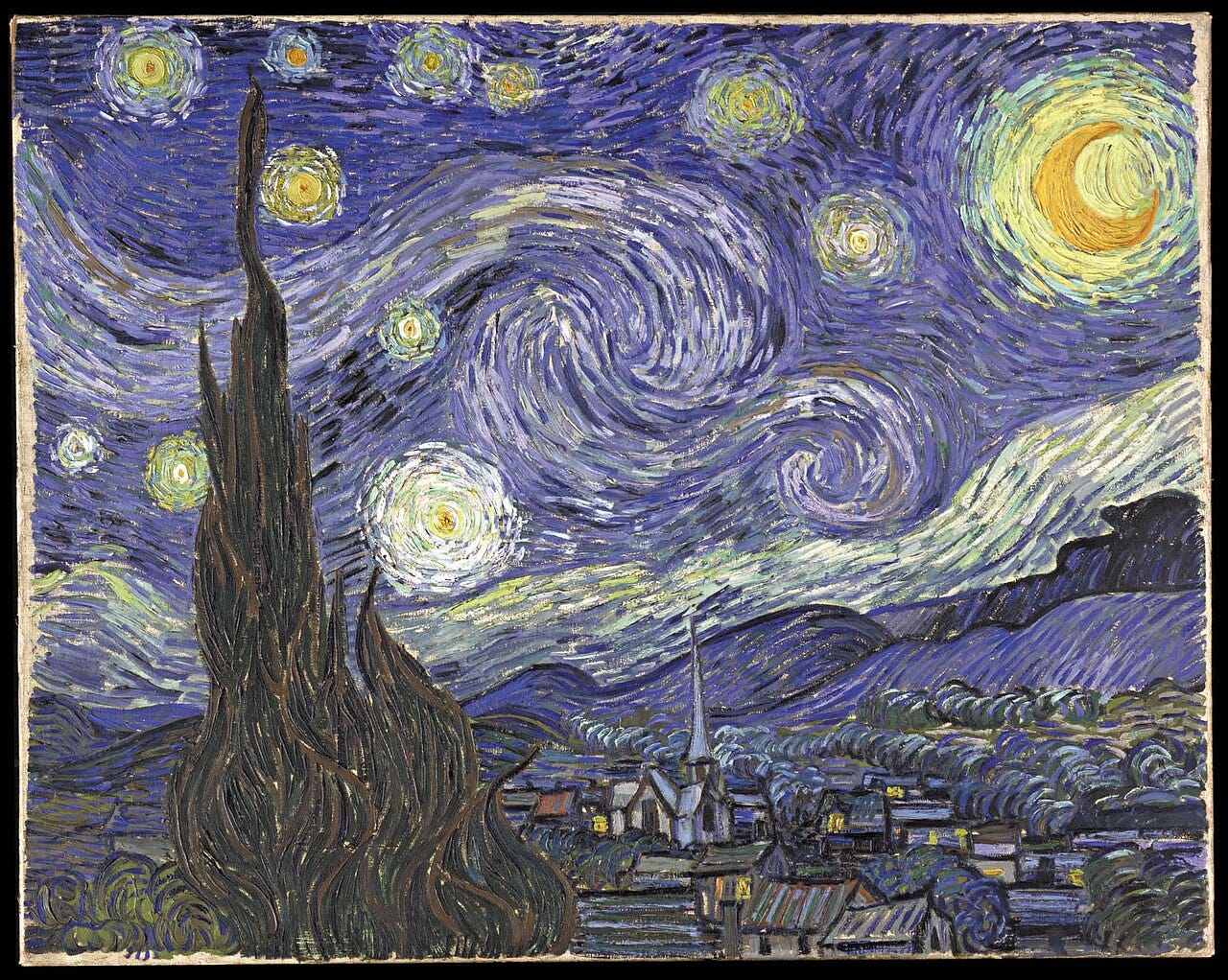
A night sky rolls and swirls in great spirals of blue and gold above a quiet village, a dark cypress reaching up like a flame. Van Gogh painted it from the window of the asylum where he had committed himself, and I tell the story of his final year in the last day of Vincent van Gogh.
Much of it came from memory. Van Gogh painted the view from his room at Saint Remy, but he added the village and reshaped the sky by day and in his head, so it is a landscape of feeling as much as of fact.
He thought it a failure. Van Gogh was unsure about the picture and sold almost nothing in his life, yet this restless night sky is now one of the most loved images ever made.
Where to stand in the landscape
Bruegel, The Hunters in the Snow: the Kunsthistorisches Museum, Vienna.
Turner, The Fighting Temeraire, and Constable, The Hay Wain: the National Gallery, London.
Friedrich, Wanderer above the Sea of Fog: the Hamburger Kunsthalle.
Cole and Church: the Metropolitan Museum of Art, New York.
Van Gogh, The Starry Night: the Museum of Modern Art, New York.
Follow the horizon further
Landscape is where painting learned to breathe. These go deeper:
Titian, Sacred and Profane Love, which of the two women is which
The Last Supper, detail by detail, the detail hiding at that table
Six women, one monster, what Picasso did to the women who loved him
A few landscape questions worth answering
What is the most famous landscape painting? Van Gogh's The Starry Night and Hokusai's Great Wave are the two most reproduced landscape images in the world, with Constable's Hay Wain close behind.
Who invented landscape painting? Dutch painters of the 1600s, like Jacob van Ruisdael, were the first to make pure landscape a respected subject in its own right.
What is the Hudson River School? A group of 1800s American painters, including Thomas Cole and Frederic Church, who painted the vast landscapes of the young United States.
Why is landscape painting important? It let artists paint light, weather and the scale of nature, and use the land to speak about nation, faith and feeling.
Is the Great Wave a painting? No. It is a Japanese woodblock print by Hokusai, printed in many copies, though it is often listed among the great landscapes.
The world becomes the subject
Put them in a line and you watch nature take over the canvas. The saints and kings shrink and vanish, and the sky, the snow and the sea move to the center.
A Dutch painter sells a cloud, an Englishman is ignored at home and crowned in Paris, an American hides himself tiny on a hillside, and a Japanese wave printed on cheap paper ends up in every museum on earth.
Van Gogh thought his swirling night was a failure. It now hangs behind glass in New York while crowds file past to photograph a view he painted from a locked room.