
Leonardo da Vinci left few paintings, and he carried some of the unfinished ones with him as far as France. The twelve below follow his career from a pupil's workshop in Florence, through Milan and Rome, to his final years at the court of King Francis I.
Cool Stories About Art is a newsletter to learn art the fun way.
Join 200,000+ readers and get:
10 new art stories / month
The entire archive of content (1,000+ articles)
Comment, ask questions, and chat with other readers
Twelve Paintings, Nearly Fifty Years
Leonardo is easier to know as a legend than as a painter. He worked slowly, abandoned several ambitious pictures and kept others with him until his death, so each painting reached us with a history of its own, and often with an argument about it.
That is why a dozen works can carry a whole career. They run from his early years in Florence through Milan to Rome and France, and they build toward the pictures everyone knows.
Most of them show Leonardo testing something new: a way of drawing, of glazing or of painting on a wall. Sometimes the test cost the picture dearly. Where scholars disagree about the hand, the entry says so.
12. Saint Jerome in the Wilderness (about 1480)
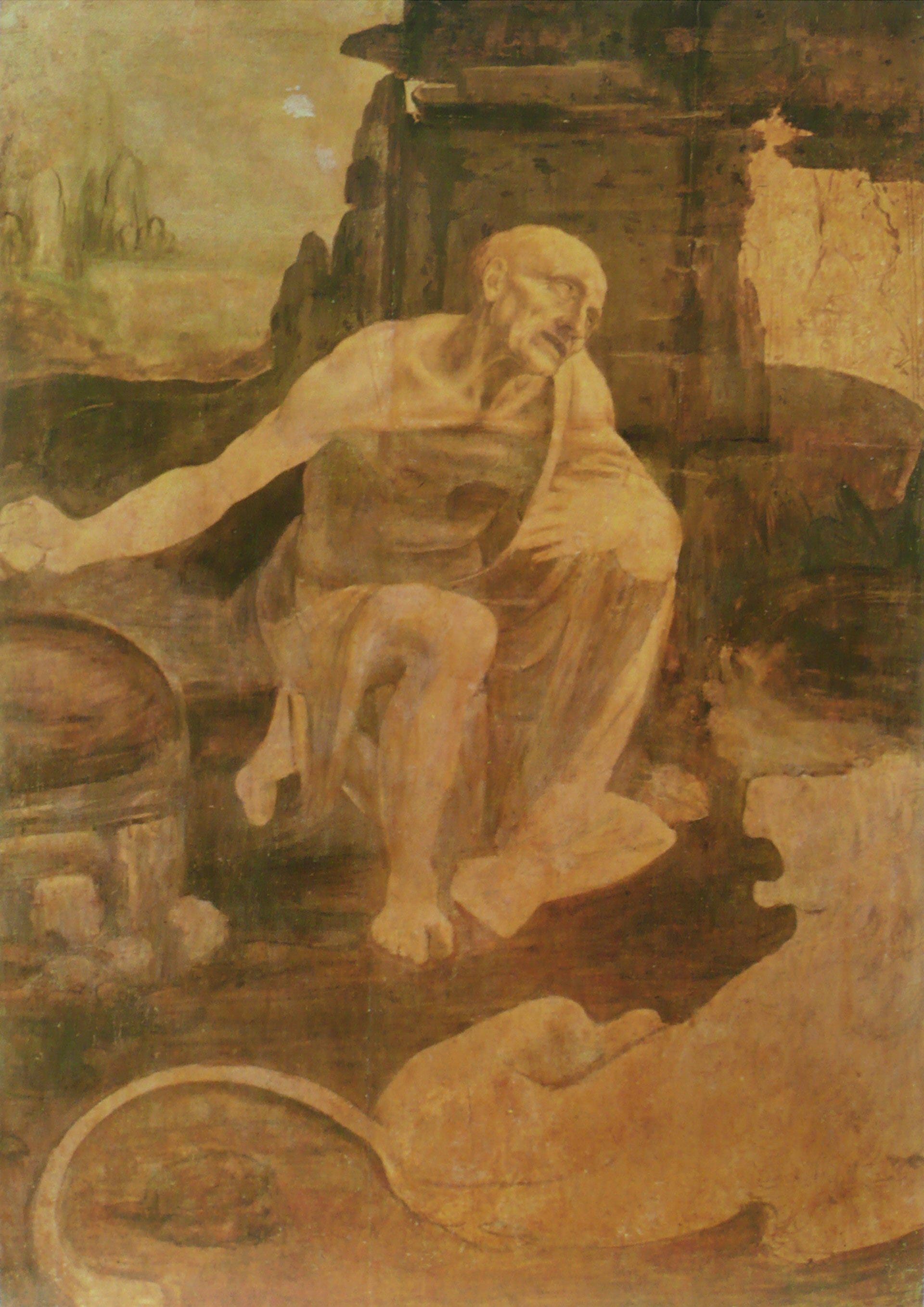
In Saint Jerome in the Wilderness, the kneeling saint, the lion at his side and the rocky landscape are still a brown drawing. Leonardo spread a thin, translucent layer of lead white over the lines and stopped there.
Because he stopped here, the panel shows how he began: with a complete drawing in brown. Most sources date this one to about 1480 to 1483, when he was between 28 and 31, still in Florence or newly settled in Milan. Whichever date is right, he never went further.
Its troubles did not end with him. At some point the panel was divided in two. According to the story that goes with it, which may be a legend, Napoleon's uncle, Cardinal Joseph Fesch, who owned more than 16,000 paintings, found one half in the back of a Roman antiques shop and the other in a cobbler's home, where it served as the top of a stool.
Even in this state, the panel keeps a trace of the painter's hand. Macro photographs show Leonardo's own fingerprints in the paint, mostly in the upper left, where he worked the surface with his fingers.
At a Glance
Artist: Leonardo da Vinci (1452 to 1519)
Painted: About 1480 to 1483 (the date is debated)
Medium: Oil on walnut panel
Size: 103 × 74 cm (40.5 × 29 in)
Where to see it: Vatican Museums, Vatican City
About This Painting
What is Saint Jerome in the Wilderness about?
It shows Saint Jerome, a theologian of the early Church who lived from about 347 to 420, in the years he spent alone as a hermit, an episode told in the thirteenth-century Golden Legend. Leonardo gives him a gaunt body and a strained face and uses them to study expression.
11. Saint John the Baptist (about 1508 to 1519)
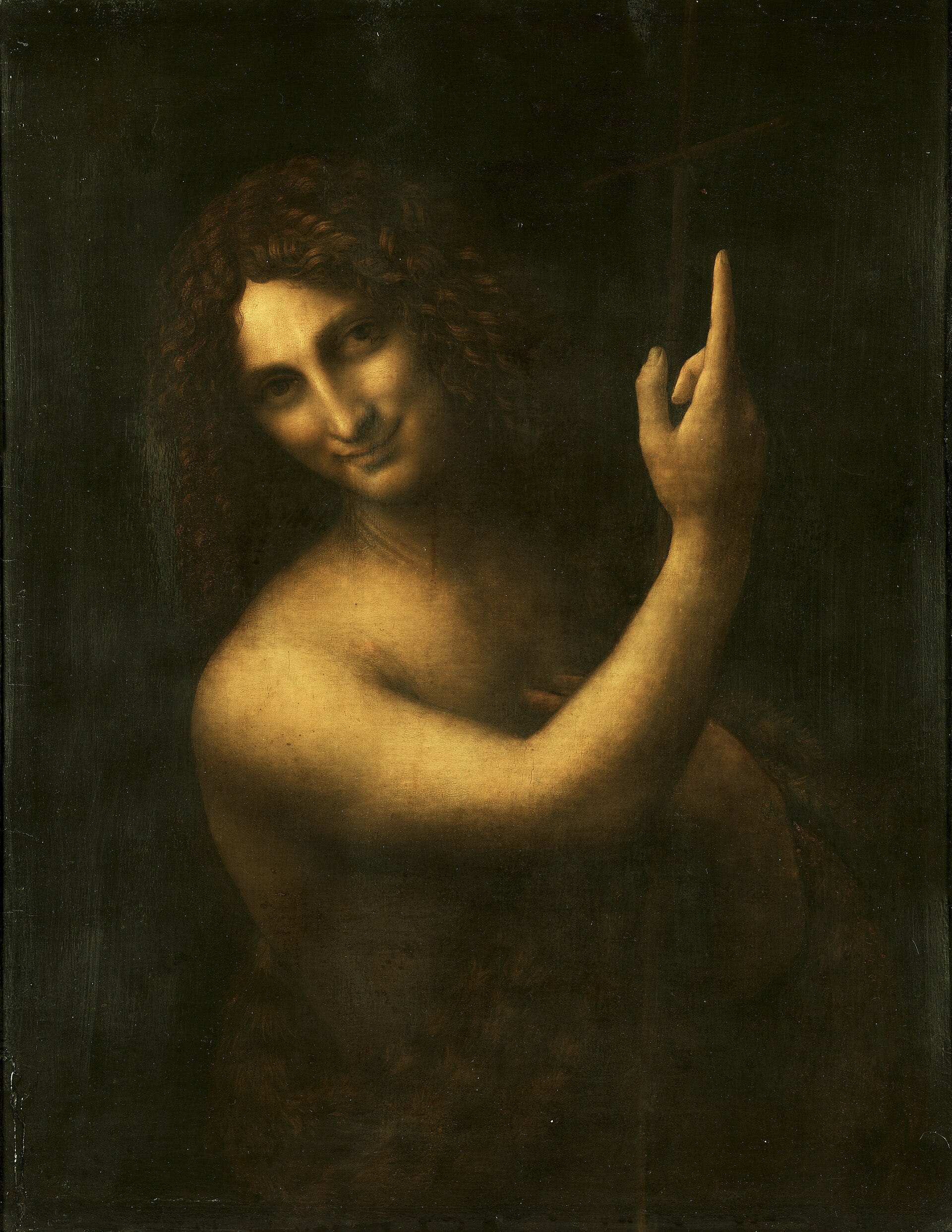
Wrapped in an animal skin, a young man with long, curling hair smiles out of near-darkness in Saint John the Baptist, one finger raised toward the sky. No one is known to have ordered the picture, and Leonardo kept it with him until he died.