Letter Paintings: 12 Famous Works of Reading and Writing
Letter paintings show people writing, reading, or waiting on a note. The letter is a private message we never fully read. From Vermeer quiet rooms to David Death of Marat, the sealed page holds news of love, money, or death.
A letter in a painting is a locked box. Someone knows what it says and we do not. Painters used that gap to pull us in, to make us guess at love, bad news, or a secret. Here are twelve works built around a page of writing.
We never read it: the words stay hidden, so the letter becomes a mystery the viewer has to solve.
A private world: most of these scenes happen indoors, alone, which is where letters were read in the 1600s.
Clues in the room: a map, a seascape, or a dog nearby often hints at what the letter is about.
News that changes a life: the page can carry a marriage, a debt, or a death, so the whole picture waits on it.
If these draw you in, you will also love the secret in Vermeer Woman Holding a Balance, 7 secrets hidden in famous paintings, and 12 famous portraits and the real people behind them.
1. Johannes Vermeer, Girl Reading a Letter at an Open Window

A young woman stands by an open window, reading. Her face is caught in the glass. A dish of fruit spills in front of her.
For centuries the wall behind her was blank. A restoration finished in 2021 removed later overpaint and revealed a large picture of Cupid that Vermeer had painted there.
The Cupid changes the story. With the god of love on the wall, the letter is almost certainly from a lover.
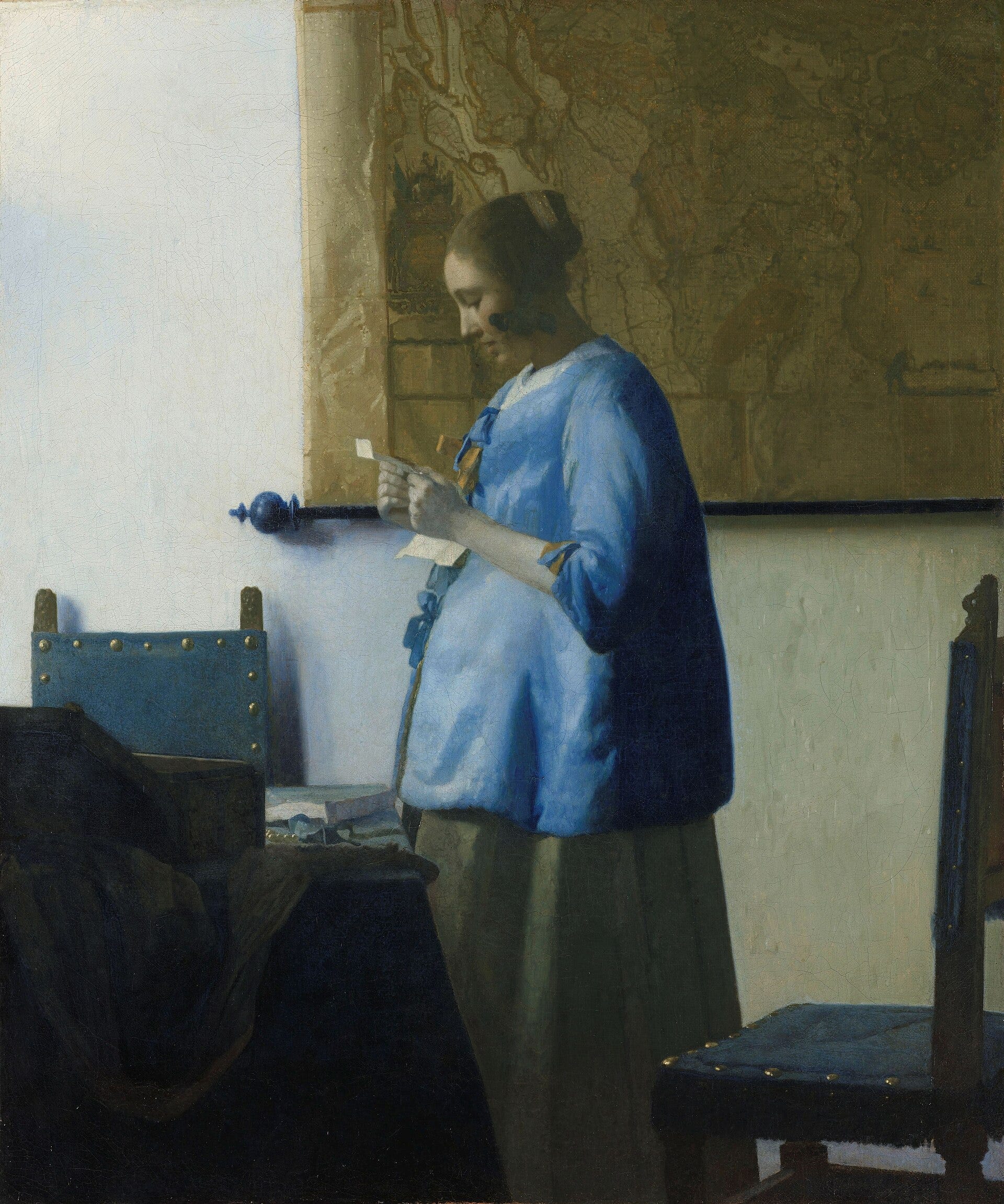
2. Johannes Vermeer, Woman in Blue Reading a Letter
A woman in a blue jacket reads a letter by a window we cannot see. A map of Holland hangs on the wall behind her.
People often say she is pregnant. Her shape comes from the loose jacket, a common style then, and there is no proof either way.
The map points outward, to distance and travel. The reader is here and the writer is somewhere far off across that painted country.
3. Johannes Vermeer, A Lady Writing
A woman pauses mid letter, pen in hand, and turns to look straight at us. A pearl earring catches the light. Papers lie on the table.
She stops writing to meet our eyes, which is rare in Vermeer. We have walked in on her, and she has caught us doing it.
The picture hangs on that glance. She holds the pen but gives us her attention, and the unfinished letter waits.
4. Johannes Vermeer, The Love Letter
We look through a doorway into a bright room. A maid hands her mistress a letter. The woman holds a lute and looks up, unsure.
A seascape hangs on the back wall. In Dutch emblem books of the time, a calm or stormy sea stood for the state of a love affair.
The maid already knows what the letter says. Her small smile tells us the news is good before the mistress even opens it.
5. Johannes Vermeer, Mistress and Maid
A woman in yellow is writing when her maid arrives with a letter. She looks up and raises a hand, surprised. The background is dark and bare.
The plain background is unusual and may be unfinished. This was the last painting Henry Clay Frick bought before he died in 1919.
The moment is a hinge. A letter arrives just as she writes one, and we never learn if the two notes are the same story.
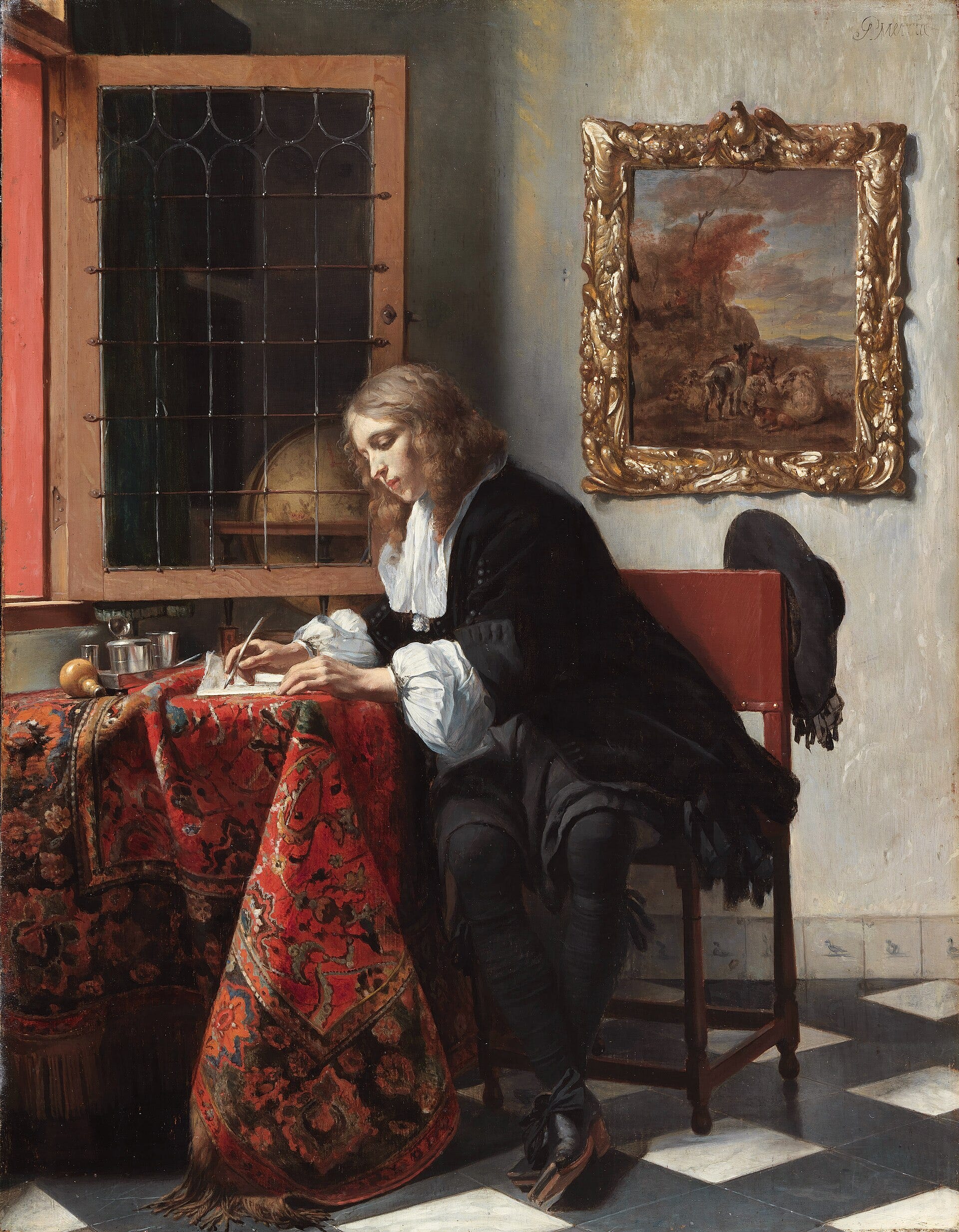
6. Gabriel Metsu, Man Writing a Letter
A well dressed young man sits at a table by a window and writes with care. Light pours over the paper and his hand.
This is one of a pair. Its partner, Woman Reading a Letter, shows the reply being opened, with a maid pulling back a curtain to reveal a small seascape.
Split between two panels, the exchange plays out like a short film. One person writes, the other reads, and the sea hints at love.
7. Gerard ter Borch, Woman Writing a Letter
A young woman sits alone at a table and writes, head bent over the page. A satin dress catches the light around her.
Ter Borch often used his own half sister, Gesina, as a model for such scenes. She wrote poems and letters herself and knew the pose from life.
We see the writing but never the words. The whole picture is one private thought, caught before it leaves the room.
8. Jean Honore Fragonard, The Love Letter
A young woman at a writing desk turns toward us with a note and a bunch of flowers. A small dog sits beside her. The mood is light and quick.
The card in her hand is inscribed to a gentleman. The sitter has never been firmly named, so the flirtation stays anonymous.
Fragonard paints the giddy second after a note arrives. The flowers came with it, and she cannot hide her pleasure.
9. Jacques Louis David, The Death of Marat
The radical Jean Paul Marat lies dead in his bath, killed on 13 July 1793. He still holds a letter. A knife lies on the floor.
The note in his hand is the letter Charlotte Corday used to get into his home. David smoothed away Marat skin disease and turned a grim murder into a calm, saintly scene.
Two papers tell the crime. The letter that let the killer in, and the note David added on the crate, signed to Marat.
10. Rembrandt van Rijn, Bathsheba at Her Bath
Bathsheba sits nude after her bath, a letter in her hand. A servant dries her feet. Her face is heavy with thought.
The letter is a summons from King David, who has seen her from his roof. Rembrandt companion, Hendrickje Stoffels, is thought to have modeled for her body.
She has already read it and cannot unread it. The whole tragedy that follows is decided in that quiet, downcast look.
11. Caravaggio, Saint Jerome Writing
The old scholar Jerome leans across a table, pen in hand, translating scripture. A skull rests on his books. His body stretches into the light.
For nearly two centuries the Borghese inventories credited this to the Spanish painter Ribera, from 1700 until 1893. Only later was it returned to Caravaggio.
The line runs from Jerome head, along his arm, to the pen and page. Caravaggio turns writing into pure physical effort.
12. Mary Cassatt, The Letter
A woman in a patterned dress bends over a writing desk and seals an envelope at her lips. Flat color fills the dress and the wallpaper.
This is a color print, not a painting. Cassatt made it after a large show of Japanese woodblock prints in Paris in 1890, and she copied their flat shapes and clean outlines.
The letter is already written. She is licking the seal, the last small act before it goes out into the world.
Where to see them
Rijksmuseum, Amsterdam: Johannes Vermeer Woman in Blue Reading a Letter and The Love Letter.
Musee du Louvre, Paris: Rembrandt van Rijn Bathsheba at Her Bath.
The Metropolitan Museum of Art, New York: Jean Honore Fragonard The Love Letter.
National Gallery of Ireland, Dublin: Gabriel Metsu Man Writing a Letter.
Galleria Borghese, Rome: Caravaggio Saint Jerome Writing.
Why a painted letter pulls you in
Most of these are genre scenes of private life, where the whole drama fits in one quiet room lit by a window.
A few are history paintings, like David Marat, and others are painted with the deep chiaroscuro of Caravaggio and Rembrandt.
Letters in art, questions people ask
Why are so many letter paintings Dutch? In the 1600s the Dutch Republic had wide literacy and a busy postal system, so letters were part of daily private life and a natural subject.
What does the letter usually mean? Most often love. Painters added clues like a Cupid, a seascape, or flowers to hint that the note is from a suitor.
Which is the most famous letter painting? Vermeer letter scenes are the best known, and Jacques Louis David Death of Marat is the most dramatic use of a letter in art.
What is hidden in Vermeer Girl Reading a Letter? A large picture of Cupid, painted over long ago and uncovered again in a restoration finished in 2021.
Do we ever see what the letters say? Almost never. The hidden words are the whole point, a private message the viewer is left to imagine.
The words we were never meant to read
Every letter in these pictures stays sealed to us. Vermeer Cupid, Marat bloodied note, Bathsheba summons from a king, all of them carry news we can only guess at. That is the trick. The painter hands you a private page, keeps the words, and lets you finish the story yourself.