
A famous lion painting is one where the animal carries a meaning or holds the whole scene. It can stand for a threat, a state, a prophecy or a patron saint, or simply pose for its portrait.
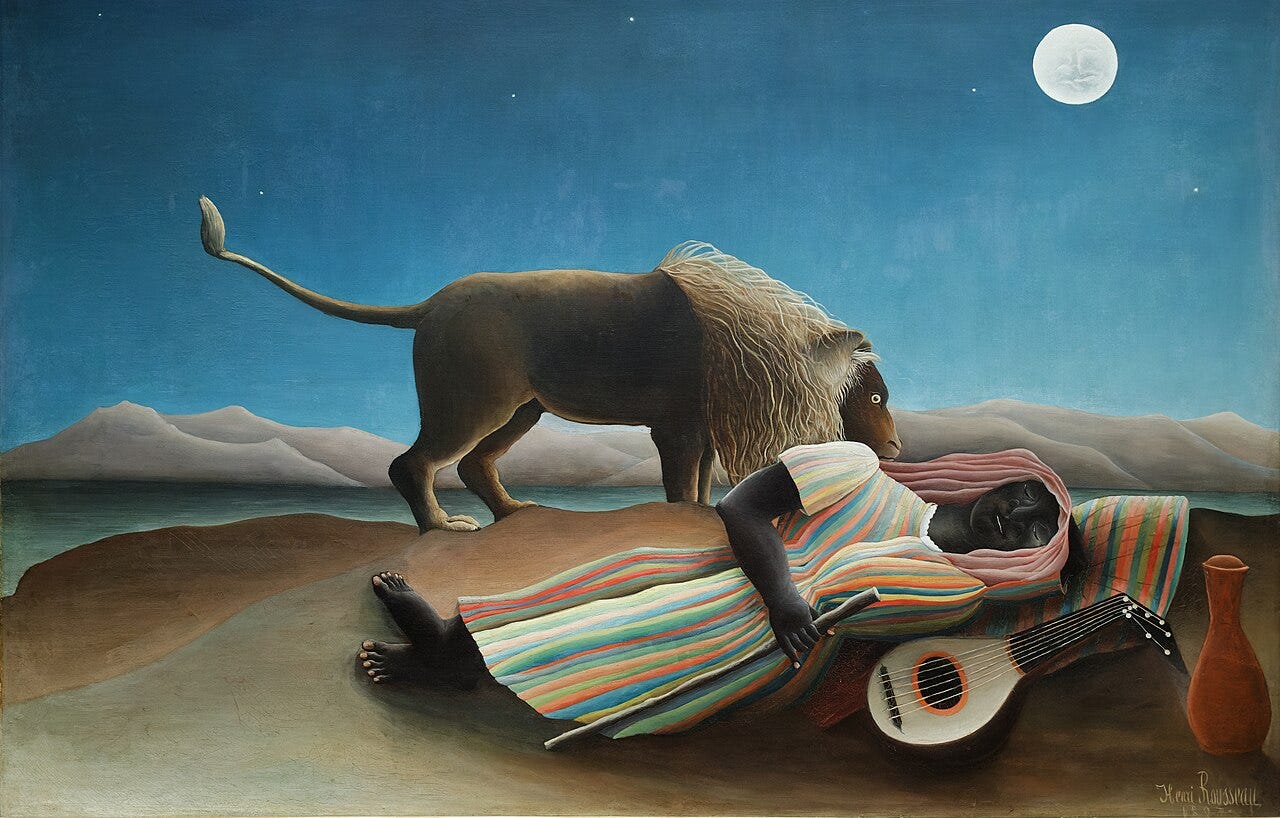
I like these pictures for the effort behind them, since a real lion was hard to meet and several painters worked from a zoo, a menagerie or a stuffed display. They run from the sixteenth century to Henri Rousseau's jungle of 1905.
Cool Stories About Art is a newsletter to learn art the fun way.
Join 200,000+ readers and get:
10 new art stories / month
The entire archive of content (140+ articles)
Comment, ask questions, and chat with other readers
How These Were Chosen
A painting made this list when the animal is its main subject, or when the artist, a museum or an art historian has explained what it means. Only paintings qualify, so prints and drawings were left out, and the list counts down from the twelfth picture to the first.
12. Jean-Léon Gérôme, The Christian Martyrs' Last Prayer (1883)
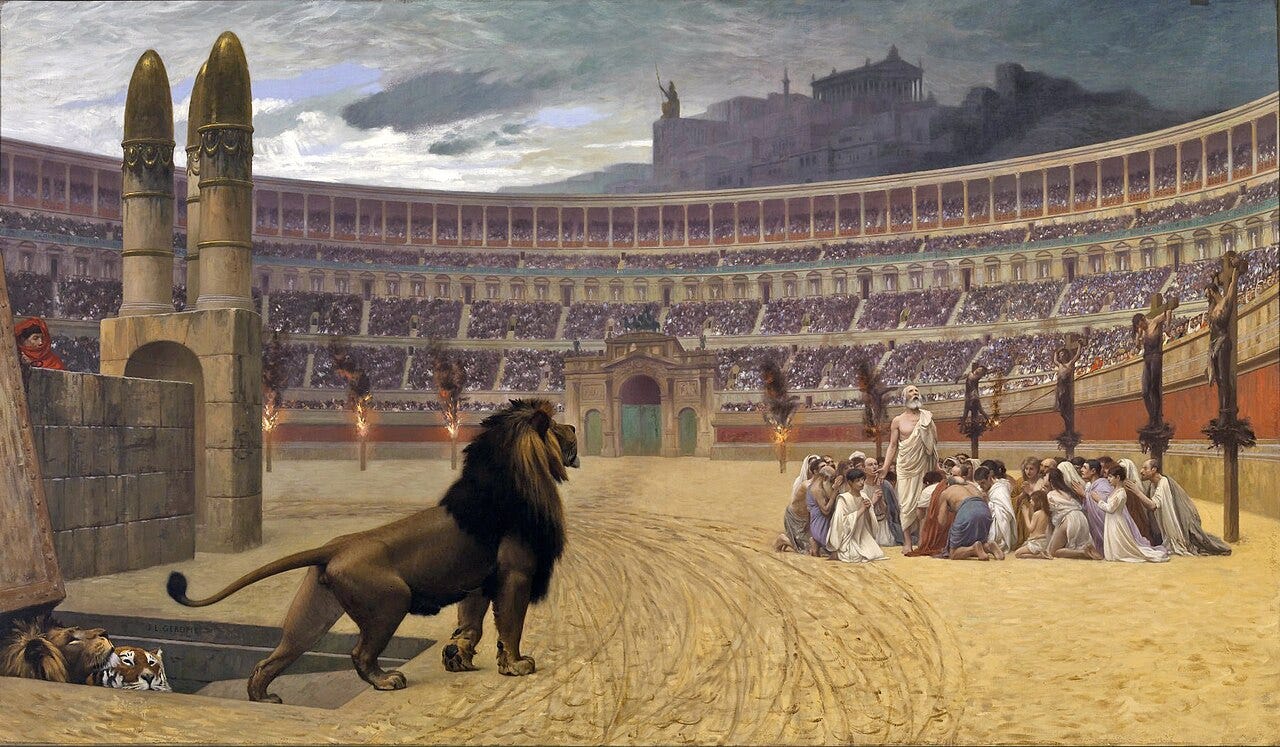
Far out on the sand of a Roman arena, a small group of Christians kneels in prayer around an old man with a white beard, who stands and lifts his eyes to the sky. Thousands of spectators fill the stands all around them.
The danger comes from the left. A big lion has just climbed the steps from the dens beneath the arena floor, with a second one and a tiger still coming up behind him. Yet he does not charge. He stands at the top and stares out at the crowd.
Along the far side, other Christians hang on crosses, and some have been set on fire like torches. Jean-Léon Gérôme, a French artist known for highly finished scenes of ancient Rome, completed The Christian Martyrs' Last Prayer in 1883.
It had taken him twenty years. William T. Walters, the Baltimore collector whose name the Walters Art Museum bears today, commissioned it in 1863. In a letter dated July 15, 1883, Gérôme explained the delay: he had repainted the canvas three times from the start.
What troubled him was the arrangement of the scene. A preparatory study, a first version painted to try out the composition, survives at the Utah Museum of Fine Arts, in Salt Lake City. Discussing it, the scholar Joan Mut Arbós notes that Gérôme hesitated over where to place the martyrs.
The lions, on the other hand, he had worked out. Gérôme explained why they do not leap: coming out of their dark dens, their first reaction must have been surprise at the daylight and the huge crowd.
Mut Arbós, writing in volume 77 of the Journal of the Walters Art Museum in 2024, takes that passage as the key to the painting. For her, it shows the moment before the attack, when the beasts are still dazzled and nothing has happened yet. My eye keeps going back to that lion at the top of the steps, held back by the light.
The burning Christians may be borrowed. Roman historians tell how the emperor Nero blamed them for the great fire of Rome and had some of them burned alive as torches.
The Polish painter Henryk Siemiradzki had turned that story into a huge canvas, Nero's Torches, exhibited in Paris in 1878. Mut Arbós thinks it likely that Gérôme added his burning crosses after seeing it.
The arena itself is a patchwork. In his letter, Gérôme set the scene in the Circus Maximus, the long chariot racing track of ancient Rome, and he painted its turning posts, the tall cones at the left, with wheel tracks curving through the sand.
But the tiers of seats look more like those of the Colosseum, and the hill above the stands, crowned with a temple and a colossal statue, recalls the Acropolis of Athens.
Such martyrdoms never took place in the Circus Maximus. Executions by wild beasts were held in amphitheaters, not on a racetrack. The catalog entry says it politely: Gérôme "has subordinated historical accuracy to drama," which means he chose the stronger image over the true one.
The racetrack links the picture to another one. Gérôme had shown the same arena in The Chariot Race of 1876, now at the Art Institute of Chicago. Mut Arbós reads the two canvases as scenes from a single day: the wheel tracks in the martyrs' sand were left by the races held a few hours before.
The background ties them together. The same triumphal arch, barely visible at the back of the race, stands at the far end of the arena where the martyrs pray.
At a Glance
Artist: Jean-Léon Gérôme (1824 to 1904)
Painted: 1863 to 1883, delivered in 1883
Medium: Oil on canvas
Collection: Walters Art Museum, Baltimore
About This Painting
How big is The Christian Martyrs' Last Prayer? The Christian Martyrs' Last Prayer measures 87.9 by 150.1 centimeters, about 34 5/8 by 59 1/8 inches. In its frame, the painting reaches 139.7 by 202.25 centimeters, about 55 by 79 5/8 inches.
Where did Gérôme sign the canvas? The signature "J. L. Gérôme" sits at the left of the picture. The Walters catalogs the painting under the number 37.113.
How did The Christian Martyrs' Last Prayer reach the Walters Art Museum? William T. Walters received The Christian Martyrs' Last Prayer from Gérôme in 1883. Henry Walters inherited it in 1894. He bequeathed it to the museum in 1931.
Where is the earlier study for The Christian Martyrs' Last Prayer? The Utah Museum of Fine Arts, in Salt Lake City, holds the study under the number 1988.014.001.
11. Peter Paul Rubens, Daniel in the Lions' Den (about 1614 to 1616)
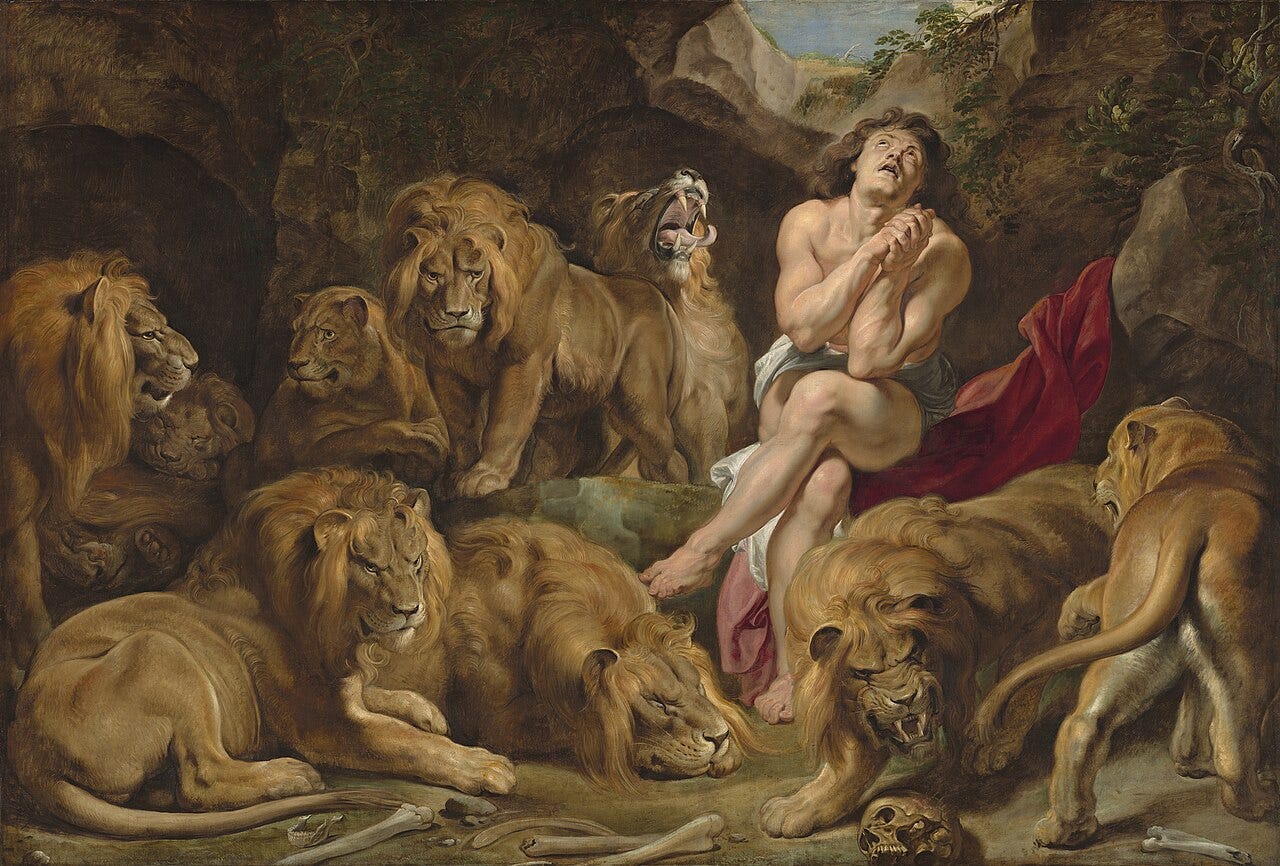
Ten lions crowd a rocky den, painted life size. One roars, one sleeps, several stare straight out of the canvas, and bones and a skull lie on the ground.
In their midst, the prophet Daniel sits on a rock, almost naked, a red cloak spread behind him. He clasps his hands and raises his eyes toward the light.
Peter Paul Rubens, the great Flemish painter based in Antwerp, made the picture about 1614 to 1616. A few years later, in a letter, he made a precise claim about these lions.