Famous Male Nudes in Art: 12 Bodies That Made History
For most of Western art history the serious subject was the male nude. It was what every student drew, what proved a painter could paint, and what carried the ideas of courage, faith and citizenship.
Then the nineteenth century flipped it, women's bodies filled the galleries, and the naked man became awkward. Here are twelve of the most famous male nudes in art, from a chapel ceiling to a photographer's grid, and the arguments they were built to win.
All are in the public domain.
1. Michelangelo, The Creation of Adam (1512)
The most reproduced male body in the world is lying down, half awake, reaching. Michelangelo painted Adam on the Sistine ceiling in fresco, and gave God's side of the picture a swirling red cloak whose outline, physicians have argued since 1990, matches a cross section of the human brain.
Whether he meant it is unresolved. What is certain is that as a teenager he dissected corpses at the monastery of Santo Spirito, in exchange for carving them a wooden crucifix.
2. Antonio Pollaiuolo, Battle of the Nude Men (about 1470)
Nobody has ever agreed what the fight is about. Ten naked men hack at each other in a hedge of corn, in the earliest large engraving signed by a named Italian artist, made to be sold and copied as an advertisement for what its author could do with anatomy.
Pollaiuolo shows the same two figures from front and back, so a student could learn the body from a single sheet. Vasari says he dissected bodies to get there.
Prints of it turned up in workshops across Europe.
3. Luca Signorelli, The Damned Cast into Hell (1500)
Signorelli spent three years covering a chapel in Orvieto cathedral with the end of the world, and filled it with bodies seen from every angle he could invent, using foreshortening to shove a leg or a shoulder out at the viewer as demons carry the damned away.
Michelangelo went to look, and the Last Judgment came out of what he saw. Vasari tells a story that when Signorelli's son died, the father drew the stripped body without weeping.
Vasari attaches it to a different picture, the Lamentation at Cortona, and the drawing does not survive.
4. Hendrick Goltzius, The Farnese Hercules (1592)
Goltzius engraved the back of an ancient statue, all shoulder and buttock, with two tiny men gazing up at it from below. He had travelled to Rome to draw the Farnese Hercules and turned it into a print that made him famous.
His own right hand had been crippled in a fire when he was a baby, fused into a claw, and he used exactly that hand to cut some of the finest lines in the history of engraving These muscles are marble, copied from an antique statue, and much of Europe learned the male body from copies of copies like this one.
5. Anne Louis Girodet, The Sleep of Endymion (1791)
Girodet was twenty four, a pupil of David, and he sent this from Rome. A young man sleeps naked in a wood while a winged figure, usually identified as Zephyr, parts the branches so that moonlight falls across his thigh.
The moon is the goddess Selene, in love with him, painted as pure light instead of a figure, so that the beam itself becomes the lover.
It caused a sensation at the Salon of 1793. The nude here is passive, dreaming and looked at, a role that Western painting normally reserved for women.
6. Jacques Louis David, The Death of Marat (1793)
David knew Marat, visited him the day before Charlotte Corday stabbed him, and finished this within four months, presenting it to the Convention in November 1793 as a public altarpiece for a republic that had just abolished religion.
The dead man lies in his bath, one arm hanging, the wound under his collarbone. David cleaned up the corpse. Marat sat in that bath because of a skin disease that had eaten his face, and none of it appears here.
The body is smoothed into a martyr's.
7. Ingres, Oedipus and the Sphinx (1808)
A naked hero leans in toward a monster with a woman's face, one foot up on a rock, close enough to be eaten. Ingres painted it at twenty seven as a student exercise in Rome and reworked it for decades, enlarging the canvas around the figure.
Behind Oedipus, half in shadow, a fleeing man and a scatter of human bones tell you what happened to everyone else. The riddle he is solving is about the human body: four legs, two legs, three.
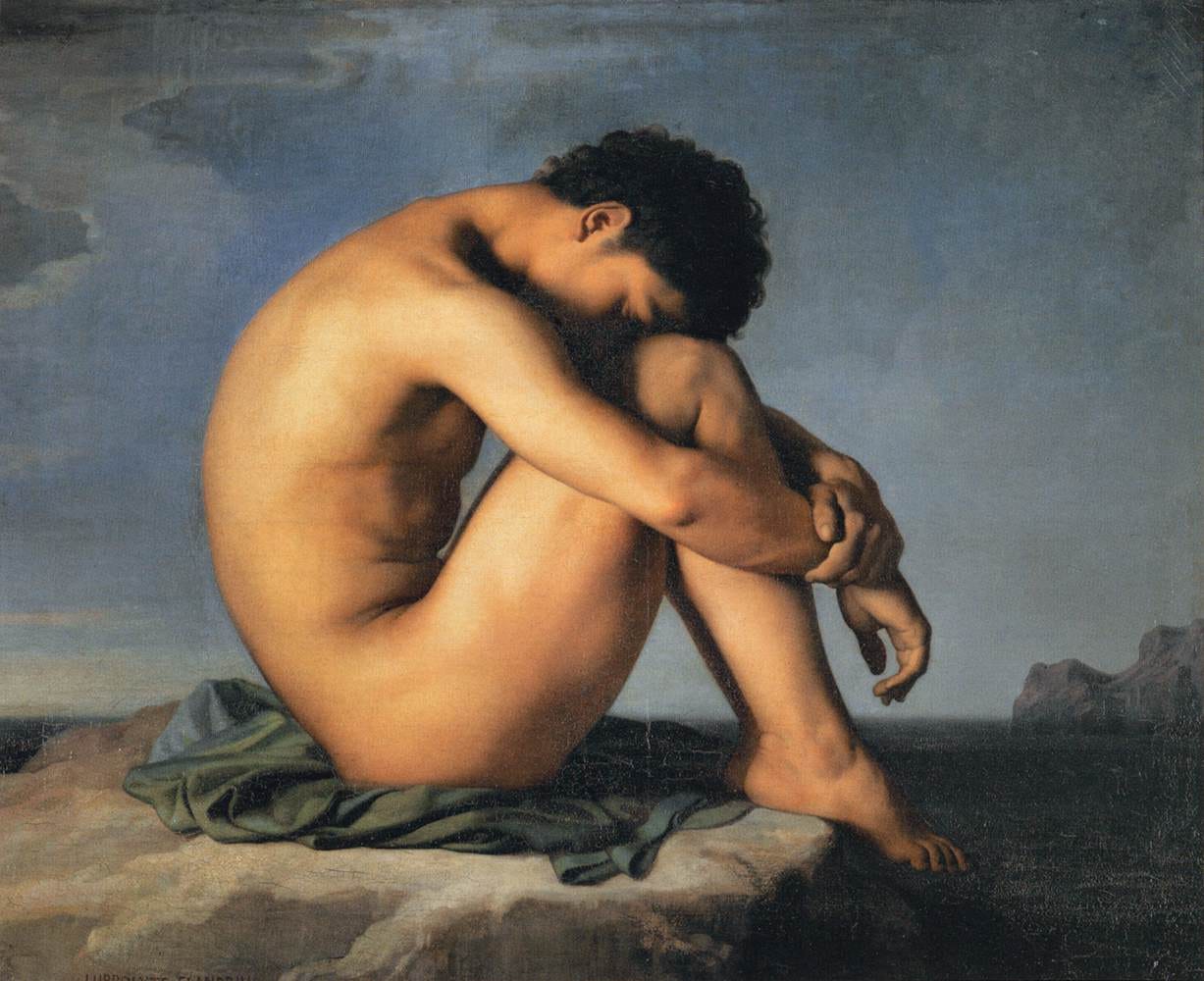
8. Hippolyte Flandrin, Young Male Nude Seated beside the Sea (1836)
He folds himself into a ball on a rock, forehead on his knees, face hidden, and turns his back on the sea. Flandrin painted it in Rome as an academy study and it became one of the most reproduced images of the century, printed, copied, and later restaged endlessly by photographers.
Nothing in it says who he is or what he is grieving. It is a body used as a mood, which is what academic art claimed the nude could never be.
9. Frederic Bazille, Summer Scene (1869)
Bazille painted his own friends outdoors, in ordinary bodies rather than antique ones, and the Salon accepted it in 1870. Young men in bathing drawers stand about a pond in dappled light, awkward, unheroic, entirely modern.
A year later he was dead, shot at twenty eight in the Franco Prussian war. He had been quietly paying Monet's rent. Impressionism lost the one member with money and manners before it had a name.
10. Gustave Caillebotte, Man at His Bath (1884)
A man stands with his back to us, towelling himself, wet footprints on the floor. Nobody had painted a naked man doing something so ordinary.
Caillebotte showed it in Brussels in 1888 in a separate room, screened off, because the organisers feared the reaction. It then vanished into private hands for a century.
The Museum of Fine Arts in Boston bought it in 2011, for a reported seventeen million dollars, and hung it opposite Degas.
11. Thomas Eakins, The Swimming Hole (1885)
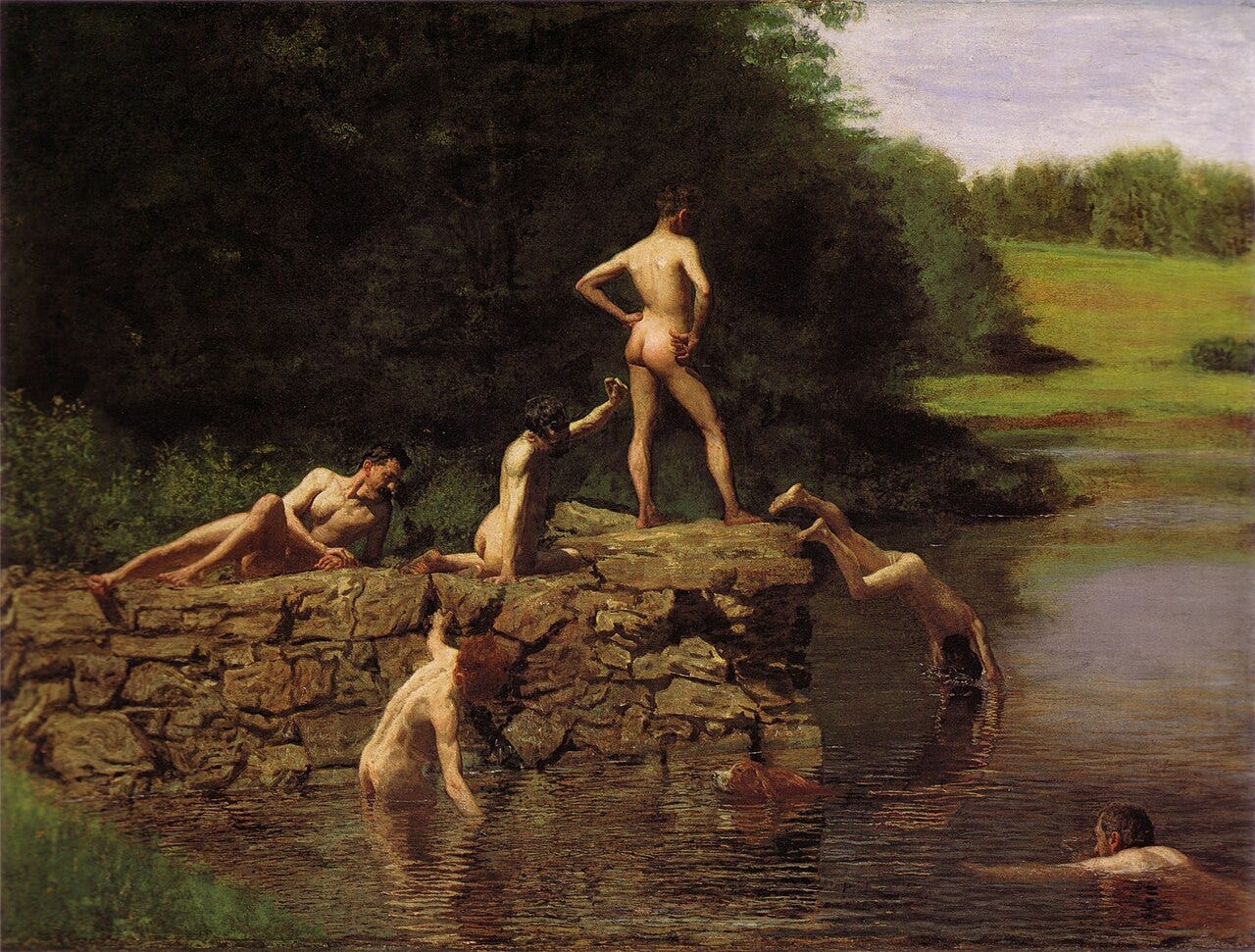
Eakins built this from his own photographs of his students swimming in the Pennsylvania sun, and painted himself into the water at the lower right.
Six men and a dog occupy the rock, one diving, one climbing out. He believed a painter had to know the body from life, and in February 1886 he was forced out of the Pennsylvania Academy for removing a loincloth from a male model in front of a mixed class.
The picture cost him his career.
12. Eadweard Muybridge, Animal Locomotion (1887)
Twenty four photographs of a man striding across a grid, taken a fraction of a second apart. Muybridge started out settling a public argument about whether a galloping horse ever has all four hooves off the ground, and the famous wager attached to that story is a legend historians have found no evidence for.
He then turned the same cameras on people, printing hundreds of plates of men running, boxing and throwing, most of them naked or nearly so, many of the models his own colleagues at the University of Pennsylvania.
He had earlier shot his wife's lover dead and been acquitted by a jury who called it justifiable. His grids handed painters the body in motion, and handed cinema its first frames.
The male nude, briefly explained
Why is the male nude so common in classical art? The Greeks competed and exercised naked, and later academies made the male model the basis of all training. Female models were often forbidden.
What is the most famous male nude? Michelangelo's David in sculpture, and his Adam on the Sistine ceiling in painting.
Why did the female nude take over? From the seventeenth century the market shifted toward pictures made for private male collectors, and the nude followed the buyer.
Were women allowed to draw male nudes? Not until late. Academies barred women from the life class with a male model well into the nineteenth century.
Did artists really dissect bodies? Yes. Michelangelo, Leonardo and Pollaiuolo all worked from dissection, usually with a monastery or hospital turning a blind eye.
If these bodies pulled you in, you will love these too:
Titian, Sacred and Profane Love, which of the two women is which
Ten women artists you need to know, the names the textbooks skipped
Luncheon of the Boating Party, detail by detail, who everybody at that table actually was
What the naked man was for
For four hundred years a painter proved himself on the male body, and the men in these pictures are almost never simply naked. They are Adam, a martyr, a hero, a specimen.
Only at the end, with Caillebotte's man towelling his back, does anyone paint a naked man who is just having a bath. That canvas was shown behind a screen in 1888, and then disappeared from public view for over a hundred years.