
Édouard Manet spent his life asking the official Salon for approval, and most of the time Paris answered with laughter. He was no rebel by temperament. He painted the people of his own city as he saw them, then kept sending the results to be judged in public. The twelve here trace that argument, from his first refusal to his last great picture.
Cool Stories About Art is a newsletter to learn art the fun way.
Join 200,000+ readers and get:
10 new art stories / month
The entire archive of content (140+ articles)
Comment, ask questions, and chat with other readers
A Painter Who Kept Facing the Jury
Manet never set out to start a revolution. What shocked Paris was what he painted and how. He put people of his own time, from the streets and cafés, on the large canvases kept for gods and heroes, and he laid light against shadow in flat patches that critics took for clumsiness.
That stubbornness also set him apart from the Impressionists. He was eight years older than Claude Monet, and many younger painters looked to him, yet he never joined their group shows. Year after year he sent his work to the official jury instead.
The twelve run from the first large canvas he could call his own, painted at twenty-seven, to the last one he sent to the Salon. Most are the pictures people look for, three are ones most lists leave out, and each sits where it falls in his life.
12. The Asparagus (1880)
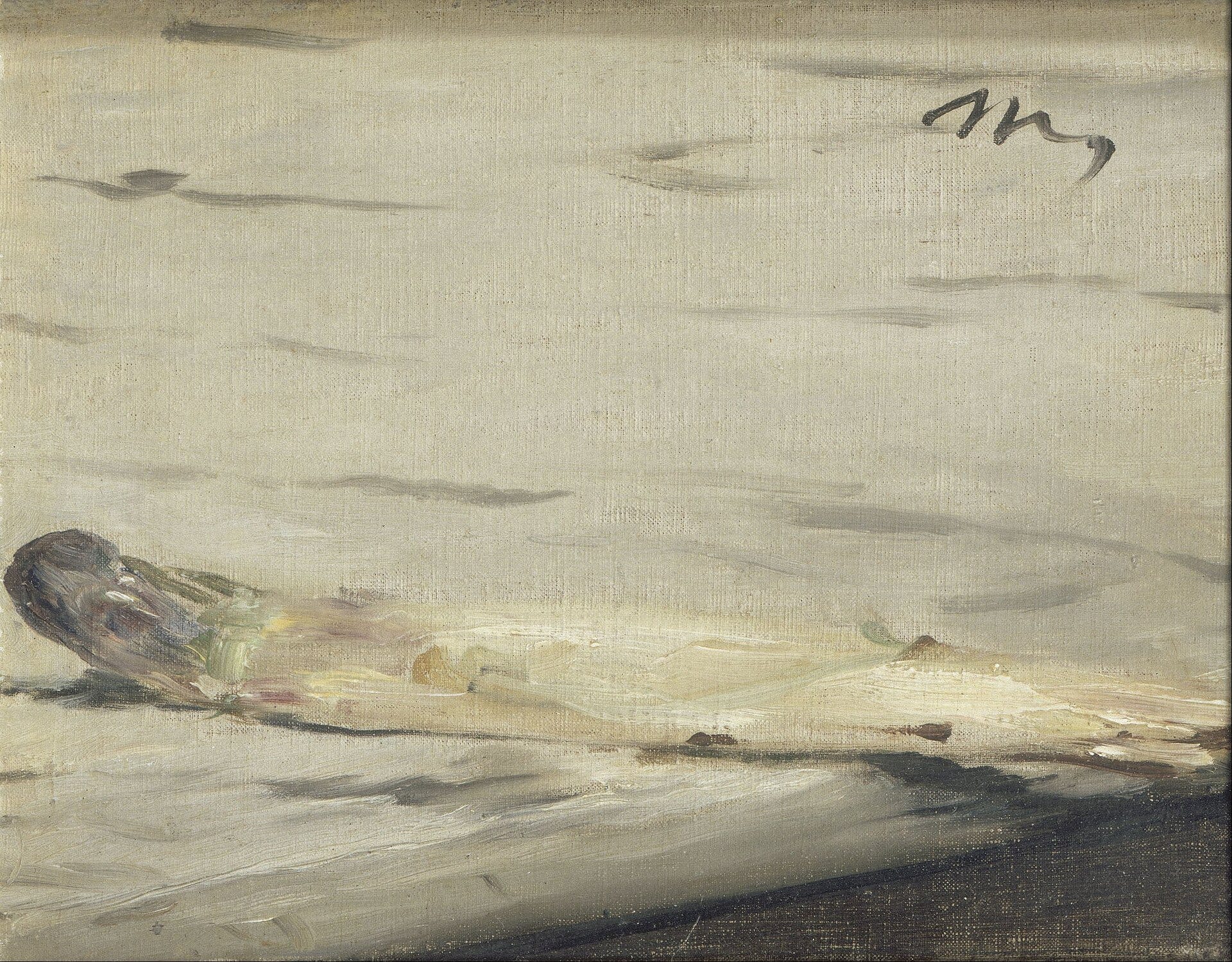
A single stalk of white asparagus lies on the corner of a marble table, its tip tinged with mauve. The Asparagus is barely larger than a postcard, and it began as a thank-you note.
The note belongs to the last years of Manet's life. In 1880 he was forty-eight and already ill. The pain that would soon keep him from standing at the easel had started the autumn before, and he was turning more and more to small still lifes of a few flowers or fruits, which he often gave to friends with a funny or affectionate word.
One of those friends was Charles Ephrussi, a collector and art critic, and one of the men Marcel Proust later drew on for the character of Swann. That year Ephrussi bought a larger picture from Manet, A Bunch of Asparagus, at an agreed price of 800 francs. He sent 1,000.
Manet did not send back the change. He painted one more stalk, alone on the marble, and sent it to Ephrussi with a note: "There was one missing from your bunch."
The joke lives in the painting itself. The bunch had lain on a black ground, in the manner of Dutch still lifes of the seventeenth century. The single stalk is all mauves and grays against pale stone, signed with a lone "M." in the lower right, the way one initials a note to a friend.
The writer Georges Bataille later said it was not a still life like the others, and I think he was right. It is a whole friendship told with one vegetable.
At a Glance
Artist: Édouard Manet (1832 to 1883)
Painted: 1880
Medium: Oil on canvas
Size: 16.9 × 21.9 cm (6.7 × 8.6 in)
Where to see it: Musée d'Orsay, Paris
11. The Dead Toreador (1864)
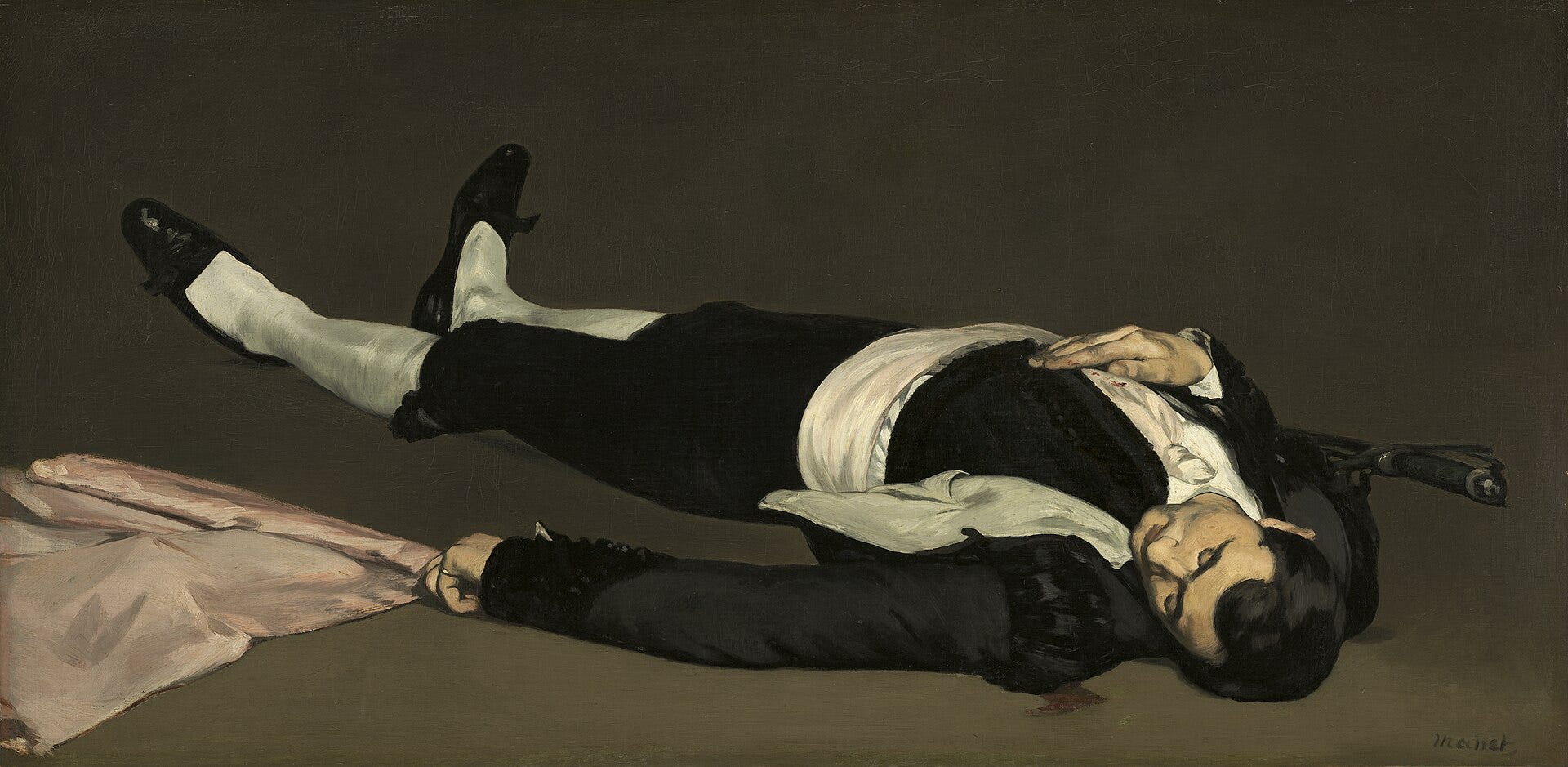
Stretched on his back across a bare brown floor, a bullfighter in a black jacket and white stockings lies dead, his pink cape crumpled beside him and his sword near his hand. The Dead Toreador looks complete. It is in fact only the lower half of a larger canvas that Paris laughed at in 1864, and the man who cut it apart was Manet himself.