
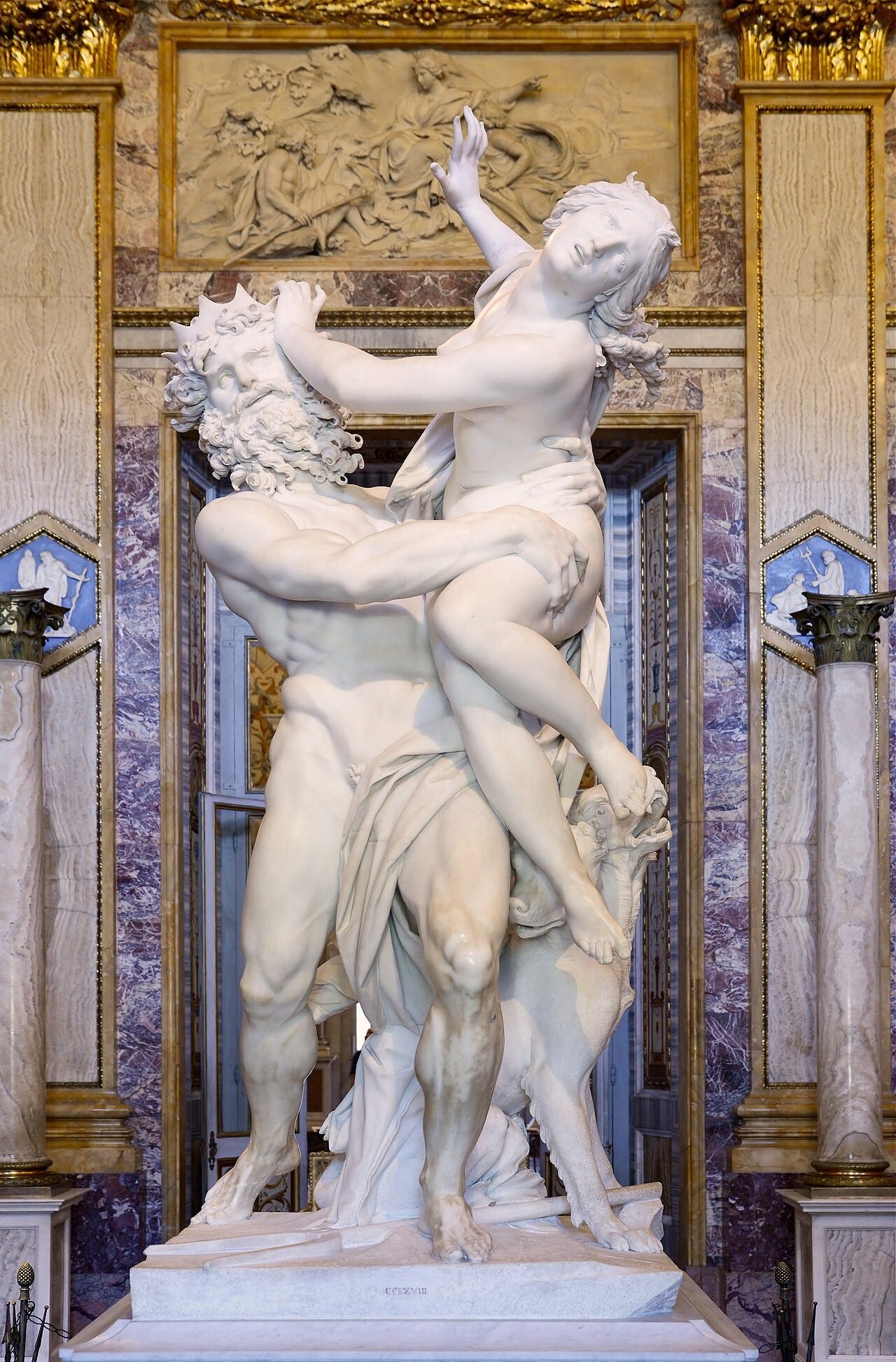
Twelve marble sculptures, from a frieze carved in Athens in the fifth century BC to a pair of lovers cut in Paris for Rodin.
In each one, a sculptor made a hard, unforgiving stone pass for skin, hair, cloth or leaves. The countdown ends with the boldest of those feats, a girl turning into a tree under the hand of a god.
Cool Stories About Art is a newsletter to learn art the fun way.
Join 200,000+ readers and get:
10 new art stories / month
The entire archive of content (140+ articles)
Comment, ask questions, and chat with other readers
How These Were Chosen
Marble has a fine grain that takes a high polish, and a polished surface catches light much as skin does. Sculptors have prized it for millennia.
It is also unforgiving. A cut can never be undone, and an arm or a finger held out in the air can snap under the chisel. Carvers brace such parts with struts, small bridges of stone left between a limb and the body, or with a stump of rock or tree trunk carved beside a leg.
The block sets limits too. Its shape decides how far a figure can stretch, a hidden flaw can weaken the finished statue, and a standing figure carries tons of stone on its two ankles.
Each of the twelve is here for something that stone explains. In some it is a feat of carving, in others the story of a quarry, from Carrara in the mountains of Tuscany to the Greek island of Paros and Mount Pentelicus, outside Athens.
A few were marked by what happened to them afterward, a hammer blow, a scraping with copper tools or the loss of a limb, and that damage became part of what they are.
Not every sculptor here held the chisel alone. Canova had assistants rough out his figures from a full-size plaster model before he took over the final surface, and Rodin left the carving of his marbles to hired stonecutters.
12. Michelangelo, David (1501 to 1504)
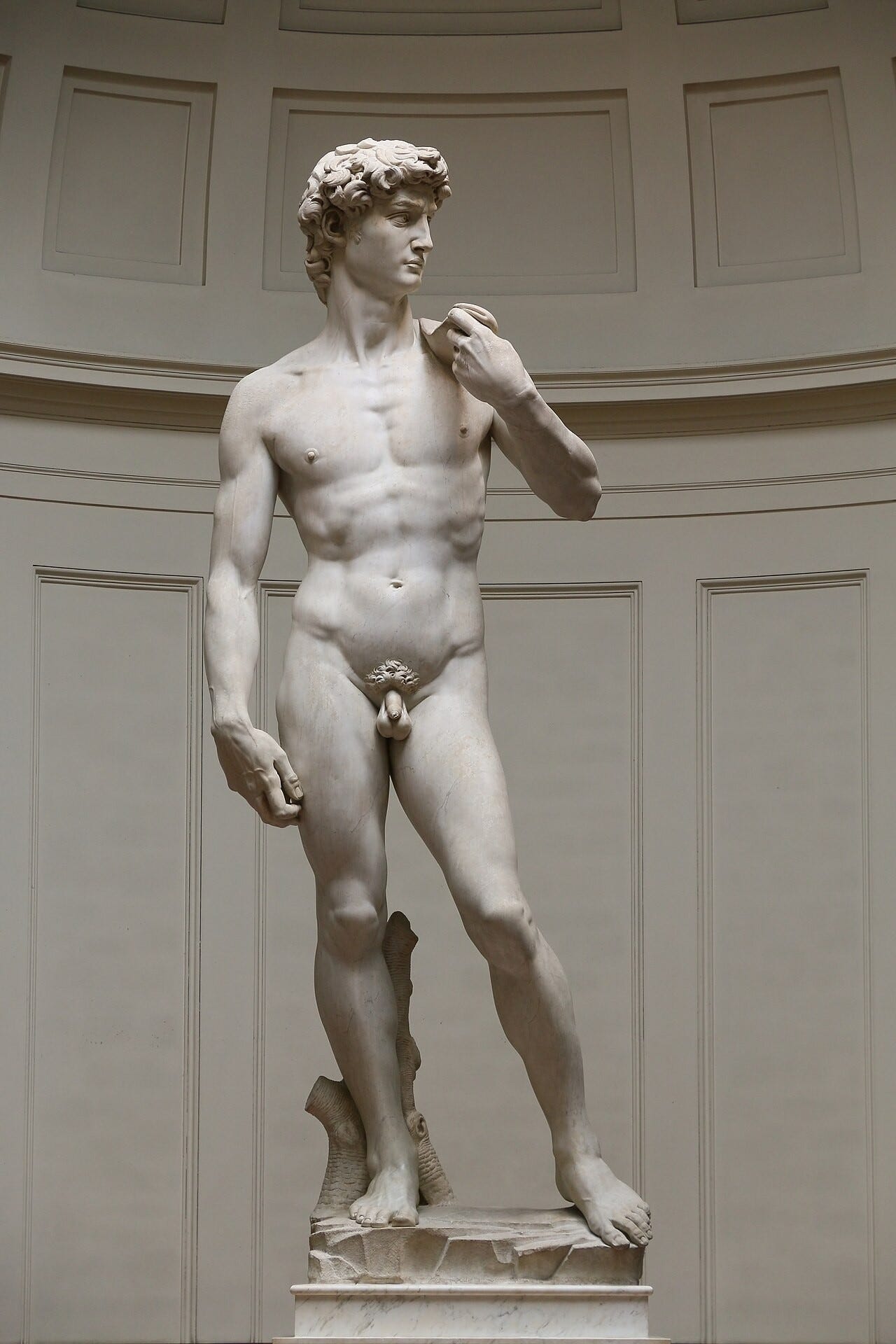
In Michelangelo's David, seventeen feet of Carrara marble, base included, give shape to a naked young man. He stands with his weight on his right leg, the left knee relaxed, and his head turns sharply to his left, toward an enemy who is not there.
That enemy is Goliath, the giant whom the young shepherd David kills with a single stone in the Bible. The sling lies over his left shoulder, its strap running down his back, and his right hand, hanging by his thigh, closes on the stone he is about to throw.
Michelangelo carved the statue in Florence between 1501 and 1504, and it now stands in the city's Galleria dell'Accademia. He was 26 when he took on the job, and the block he was given had already defeated two sculptors.
Its story began in 1464. That year the Opera del Duomo, the office that ran the works of Florence Cathedral, ordered a David for a high spot on the east end of the building from the sculptor Agostino di Duccio.
Agostino roughed out the legs, and the work went no further. In 1476 the board turned to Antonio Rossellino, who soon withdrew, and later accounts say he blamed the stone.
The abandoned block then lay outdoors in the cathedral workshop yard for another twenty-five years. The men in charge of it called it the Giant, and an inventory of 1500 lists it as a marble figure called David, "badly blocked out and supine," roughly hewn and lying on its back.
On August 16, 1501, the board handed the Giant to Michelangelo. He made his first cuts on September 13, in a block that two earlier sculptors had already cut into.
Rossellino's complaint found support five centuries later, by accident. In September 1991 a man broke the statue's second toe with a hammer, and the repair gave scientists tiny samples of the original stone.
In 2005, researchers at Italy's National Research Council traced them to the Fantiscritti quarries, above the town of Carrara. They found a marble of mediocre quality, full of microscopic holes that make it weaker.
The block was also thin for its height, probably quarried with the slimmer statues of Agostino's generation in mind. Michelangelo had to fit the whole figure inside it, and seen from the side the David is unusually shallow from front to back.
The statue weighs about 5.5 metric tons with the base, and all of it rests on two slim ankles. Behind the right leg, a rough tree stump rises against the back of the calf and shares the load.
At a Glance
Artist: Michelangelo Buonarroti (1475 to 1564)
Carved: 1501 to 1504
Medium: Carrara marble, from the Fantiscritti quarries
Size: 517 cm (204 in) with its carved base
Where to see it: Galleria dell'Accademia, Florence
About This Sculpture
What is the biblical story behind David?
In the First Book of Samuel, chapter 17, the young David is the one Israelite willing to answer the daily challenge of Goliath, the Philistine giant, and he brings him down with a sling and pebbles. He later ruled the united kingdom of Israel and Judah.
11. Venus de Milo (about 150 to 125 BC)
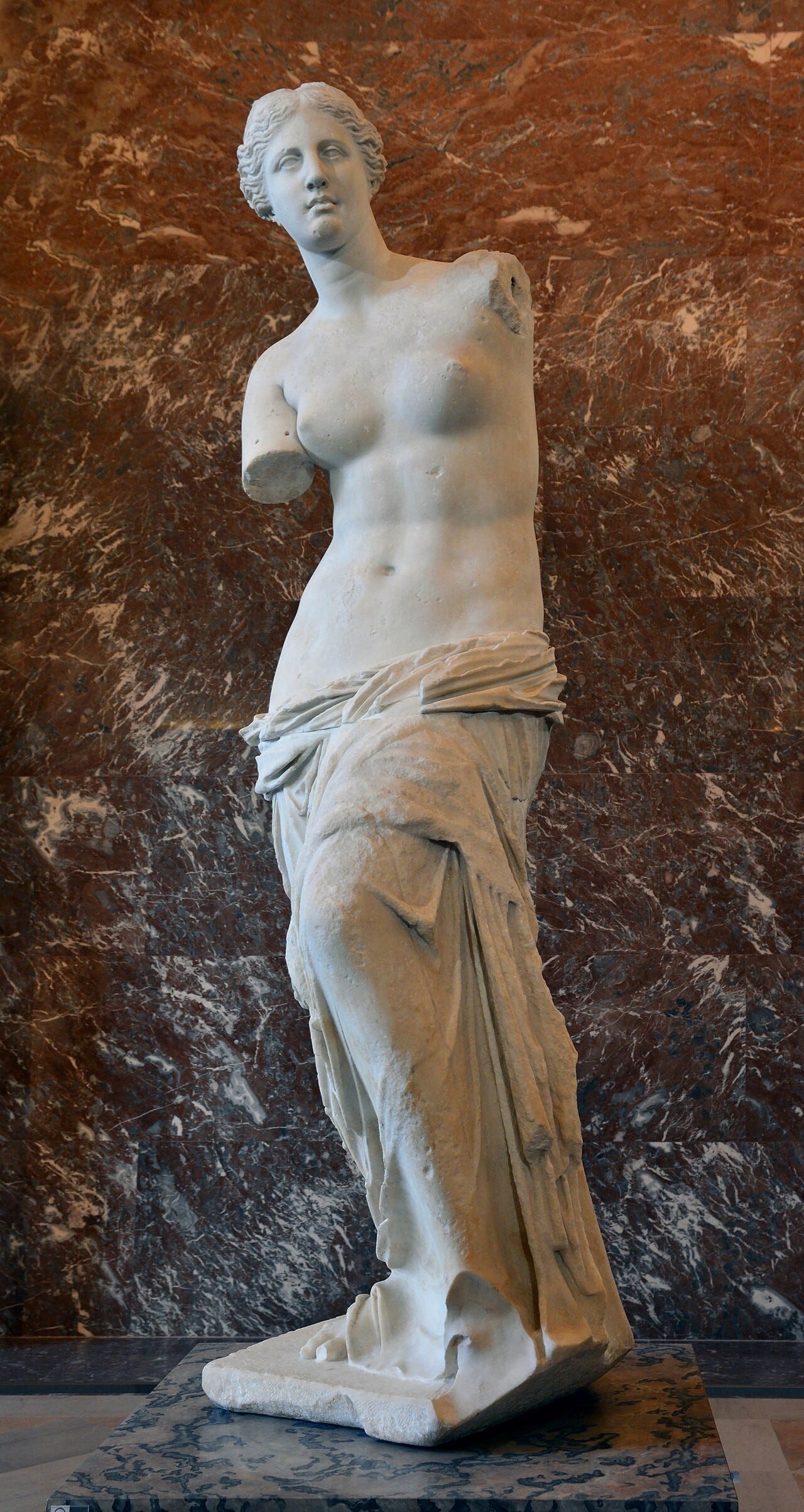
The Venus de Milo is a goddess carved in marble from the Greek island of Paros, taller than a grown man. She is bare above the hips, and a heavy cloak slides down around her hips and legs.
Her weight rests on her right leg, so her right hip pushes out and her torso twists gently the other way. Both arms are gone.
She is Aphrodite, the Greek goddess of love, whom the Romans called Venus. A stone that traveled with her to Paris named the man who carved her, and within a few years that stone had disappeared.