Market Paintings: 12 Famous Works to Know
The most famous market paintings smuggle big ideas in among the cabbages and carcasses. Pieter Aertsen piled a butcher’s stall so high with meat that you almost miss the holy family behind it, and Dutch and Italian painters used the market to celebrate abundance, greed and everyday life. Here are twelve to know, and where to see them.
When painters first turned to the market in the 1500s, it was a quiet revolution. Suddenly food, money and ordinary working people filled the whole canvas, with any sacred story pushed to the background. The twelve below run from a Renaissance meat stall to a busy French country fair.
Use this as a quick tour:
The inventors: Aertsen and Beuckelaer, who created the market picture.
The Italians: Campi, Carracci and Passarotti, the butcher’s shop as drama.
The moderns: Pissarro and Gilbert, the market as everyday life.
Where to see them: a museum list at the end, grouped by city.
Pieter Aertsen, A Meat Stall
Pieter Aertsen painted A Meat Stall in 1551, a butcher’s stall groaning with meat, sausages, a pig’s head and a slaughtered ox, filling almost the whole picture. It helped invent the market painting as a kind of genre painting.
Look past the meat and you find a tiny scene of the holy family giving alms to a beggar. Aertsen puts gluttony in the foreground and charity in the background, a moral hidden inside the feast.
It hangs at the North Carolina Museum of Art. This was something new, a religious message almost buried under a mountain of food.
Joachim Beuckelaer, The Market Woman
Joachim Beuckelaer, Aertsen’s pupil and nephew, painted market women around 1565, seated behind vast spreads of vegetables, poultry and fruit rendered with dazzling care.
Beuckelaer made whole series on the four elements, using markets full of fish, game, fruit and vegetables to stand for water, air, earth and fire. The food is painted so well it becomes the real subject.
His work hangs in the National Gallery in London and the Rijksmuseum. He turned the humble market stall into a grand display of painterly skill.
Vincenzo Campi, The Fruit Seller
Vincenzo Campi painted The Fruit Seller around 1580, a smiling young woman almost buried in baskets overflowing with grapes, figs, peaches and melons, every fruit painted with loving precision.
Campi was one of the first Italians to make the market its own subject, borrowing the idea from the north. The heaped fruit is a celebration of plenty, and maybe a gentle joke about earthly appetite.
It hangs at the Pinacoteca di Brera in Milan. It is one of the sunniest, most generous market paintings ever made.
Annibale Carracci, The Butcher’s Shop
Annibale Carracci painted The Butcher’s Shop around 1583, butchers weighing and cutting meat while carcasses hang around a busy shop. It was a daring choice of subject for a serious young artist.
Carracci, who would go on to grand church frescoes, here painted ordinary tradesmen at full size and full dignity. One of the butchers may even be a self portrait, or a portrait of his own family, who were tailors and butchers.
It hangs at Christ Church in Oxford. It treats a humble butcher’s shop with the weight usually reserved for saints and heroes.
Bartolomeo Passarotti, The Butcher’s Shop
Bartolomeo Passarotti painted grinning butchers around 1580, holding up cuts of meat and a slaughtered animal in a crowded, earthy shop. The mood is coarse, comic and full of life.
Passarotti loved caricature, and his butchers leer and joke among the carcasses. Paintings like this influenced the young Carracci and the whole rise of everyday subjects in Italian art.
His work hangs in the Galleria Nazionale in Rome and beyond. It is the market at its most raw and rowdy.
Frans Snyders, The Fish Market
Frans Snyders painted enormous market stalls around 1620, heaped with fish, lobsters, game and fowl, spilling across the whole canvas in a Flemish blaze of abundance. It is still life at its grandest.
Snyders worked alongside Rubens and shared his love of energy and plenty. His stalls are almost overwhelming, a whole harvest of land and sea piled up for the eye to feast on.
His market scenes hang in the Hermitage, the Prado and beyond. Nobody painted heaps of food with more gusto.
Louise Moillon, The Fruit and Vegetable Seller
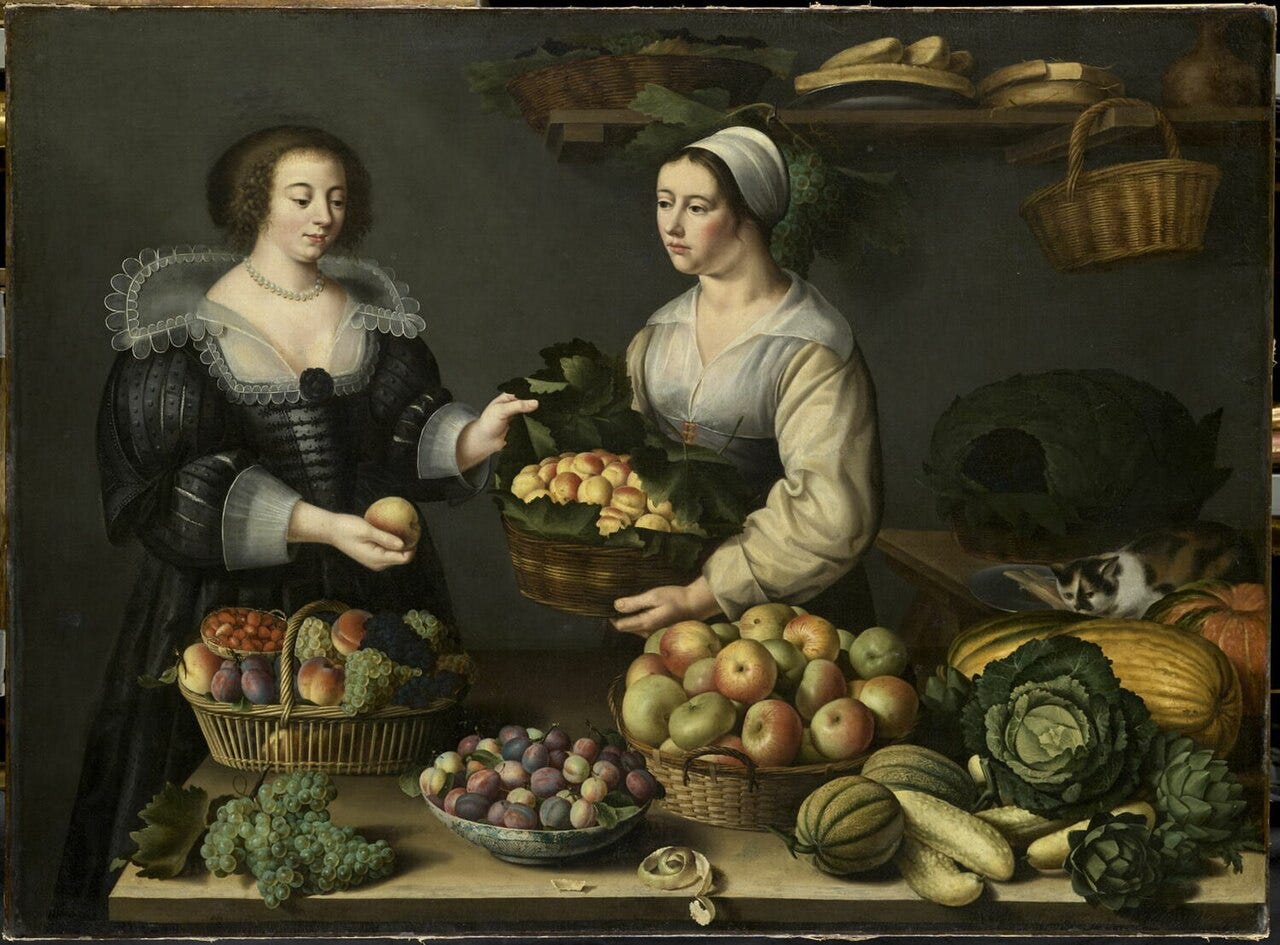
Louise Moillon painted The Fruit and Vegetable Seller in 1630, a market woman quietly offering fruit to a customer beside baskets of produce, in soft still light. She was one of the finest women artists of her age.
Moillon, working in Paris, painted fruit with a calm, jewel like clarity that buyers prized highly. A rare successful woman painter, she brought a quiet dignity to the market scene.
It hangs at the Louvre in Paris. Her market is gentle and human, worlds away from the rowdy butcher shops of Italy.
Gabriel Metsu, The Vegetable Market at Amsterdam
Gabriel Metsu painted The Vegetable Market at Amsterdam around 1660, townsfolk in fine clothes bargaining for vegetables and poultry from stalls in a busy city square.
Metsu filled the scene with small human dramas, a haggling customer, a dozing seller, a dog underfoot. The Dutch loved these lively glimpses of their own thriving cities.
It hangs at the Louvre in Paris. Metsu shows the market not as a still life but as a whole community at work.
Pieter Aertsen, Market Scene
Pieter Aertsen returns with a market woman around 1560, standing proudly behind a table piled with cabbages, carrots and gleaming copper pots. He painted these strong working women again and again.
Aertsen gave his sellers real presence, sturdy and dignified, treating a vegetable stall with the care others gave to portraits of the rich. It was a quiet revolution in what counted as a worthy subject.
His work hangs in museums across Europe. He made the ordinary market woman a monument.
Camille Pissarro, The Pork Butcher
Camille Pissarro painted The Pork Butcher in 1883, a young woman selling pork at a stall in a bustling French market street, the crowd behind her dissolving into flecks of colour. It is the market seen through Impressionist eyes.
Pissarro, the eldest Impressionist and a lifelong radical, loved painting ordinary working people at the market. He gave the everyday scene the same fresh light he brought to landscapes.
It hangs at Tate Britain in London. Three centuries after Aertsen, the market woman is still a subject worthy of a great painter.
Camille Pissarro, The Poultry Market at Gisors
Camille Pissarro painted The Poultry Market at Gisors in 1885, a packed country market where townsfolk trade poultry and produce under bright dappled light, the whole crowd glowing with colour.
Pissarro made many versions of this busy fair, fascinated by the swirl of people and the sunlight falling through it. He treated the humble market as a grand modern subject.
His market scenes hang at the Museum of Fine Arts, Boston, and beyond. Pissarro turned a country poultry fair into a celebration of ordinary life.
Victor Gabriel Gilbert, The Paris Market
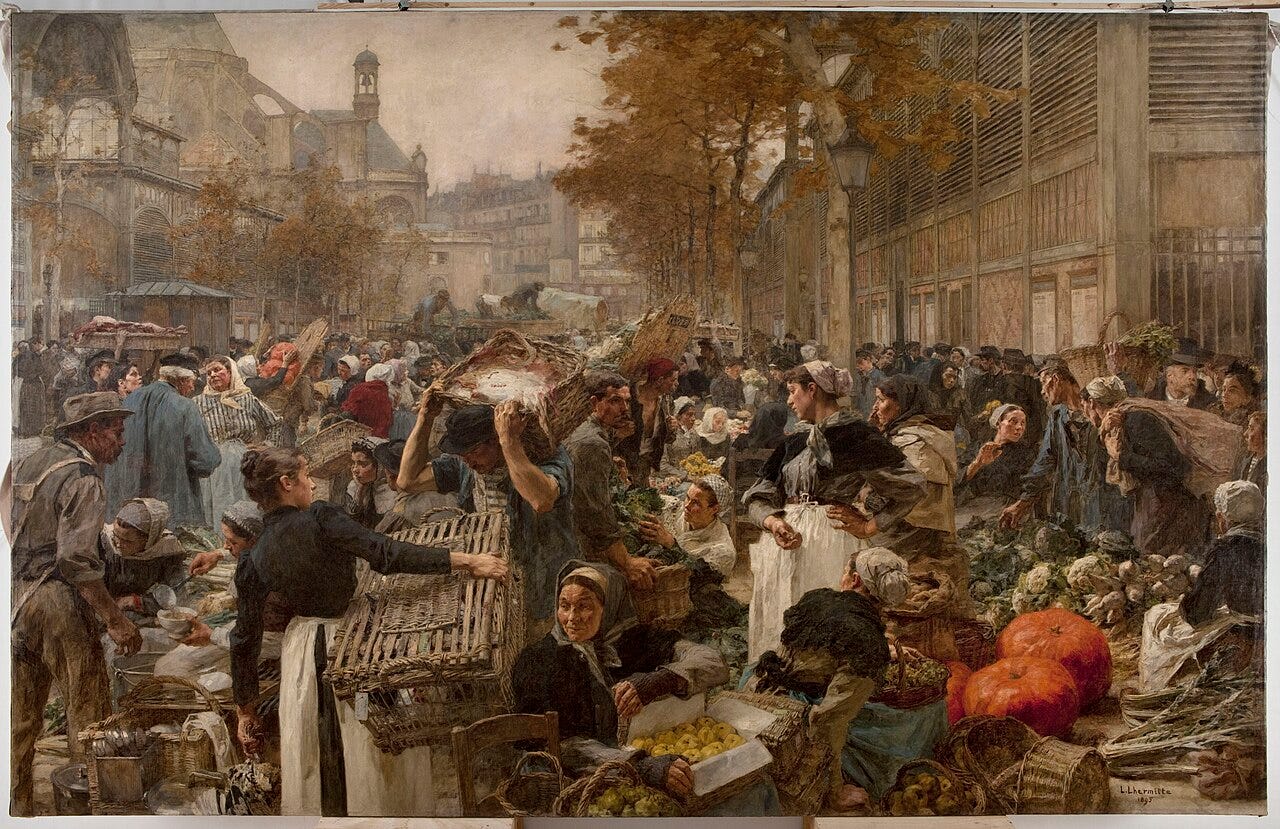
Victor Gabriel Gilbert painted the great Paris markets of Les Halles around 1880, flower and produce sellers crowding the halls in the fresh morning light, baskets and blooms everywhere.
Gilbert specialised in these scenes of the belly of Paris, the huge central market that fed the city. He caught its bustle, its colour and its early morning energy.
His work hangs in French museums and collections worldwide. He is the great painter of the modern city market at its busiest.
Questions people ask about market paintings
Who invented the market painting? Pieter Aertsen and his nephew Joachim Beuckelaer, in the Netherlands around 1550, who first filled the whole canvas with food and market sellers.
Why is there a holy scene hidden in Aertsen Meat Stall? He put a mountain of meat in front and a tiny scene of the holy family giving alms behind, contrasting gluttony with charity as a moral message.
Why did painters like butcher shops? They let an artist show off dazzling skill on flesh and detail, and treat ordinary tradesmen with the dignity once reserved for saints and heroes.
Who was Louise Moillon? A rare successful woman painter in 1600s Paris, famous for calm, jewel like market and fruit scenes now in the Louvre.
Did the Impressionists paint markets? Yes. Camille Pissarro painted busy French markets again and again, giving working sellers the same fresh light he brought to his landscapes.
Where to see them
Louvre, Paris: Louise Moillon The Fruit and Vegetable Seller and Metsu The Vegetable Market at Amsterdam.
North Carolina Museum of Art: Aertsen A Meat Stall.
Pinacoteca di Brera, Milan: Campi The Fruit Seller.
Tate Britain, London: Pissarro The Pork Butcher.
Christ Church, Oxford: Carracci The Butcher’s Shop.
Keep exploring
If the markets pulled you in, three more paths from here. Meet the forgotten women who painted them in the old masters were women too, learn to read the hidden clues in famous canvases in seven secrets hidden in famous paintings, or start with the basics of genre painting.
One last thing. Before the market, art was mostly gods, saints and kings. Then painters turned to the stall of cabbages and the slab of meat, and everyday life walked into the frame for good. These twelve are where ordinary people, and their dinner, became worthy of a great work.