
Mary Cassatt's twelve best-known paintings, made between 1873 and 1900, run from Offering the Panal to the Bullfighter, painted in Seville, to Young Mother Sewing. In between, this American in Paris left the official Salon, joined the Impressionists and turned to mothers and children.
Those mothers were often not mothers at all. And behind many of these pictures stands the French painter Edgar Degas, her sharpest critic and closest ally.
Cool Stories About Art is a newsletter to learn art the fun way.
Join 200,000+ readers and get:
10 new art stories / month
The entire archive of content (140+ articles)
Comment, ask questions, and chat with other readers
From Seville to the Nursery
Cassatt began, like most painters of her generation, by aiming at the Salon, the yearly official exhibition in Paris, where a jury chose which pictures the public would see. Her first entries were Spanish scenes, made in Seville in the manner of the old masters.
The change came through Degas, a painter of dancers, racehorses and Paris life, and one of the leaders of the Impressionists. These artists had stopped waiting for the approval of the Salon jury and organized exhibitions of their own.
Degas invited her to join them, and she became the only American to exhibit as a member of the group. For years afterward he remained her adviser and her critic, and the two even swapped pictures.
In the 1890s two things changed in her work. Japanese woodblock prints, then in fashion in Paris, taught her a new way to build a picture, with flat colors and steep views. And around 1890 she turned more and more to children and to the women who cared for them, a theme fed by her affection for her nieces and nephews.
For those pictures she often hired models. The woman and the child in a Cassatt painting were frequently strangers to each other, asked to pose as mother and child for the length of a sitting.
12. Girl Arranging Her Hair (1886)
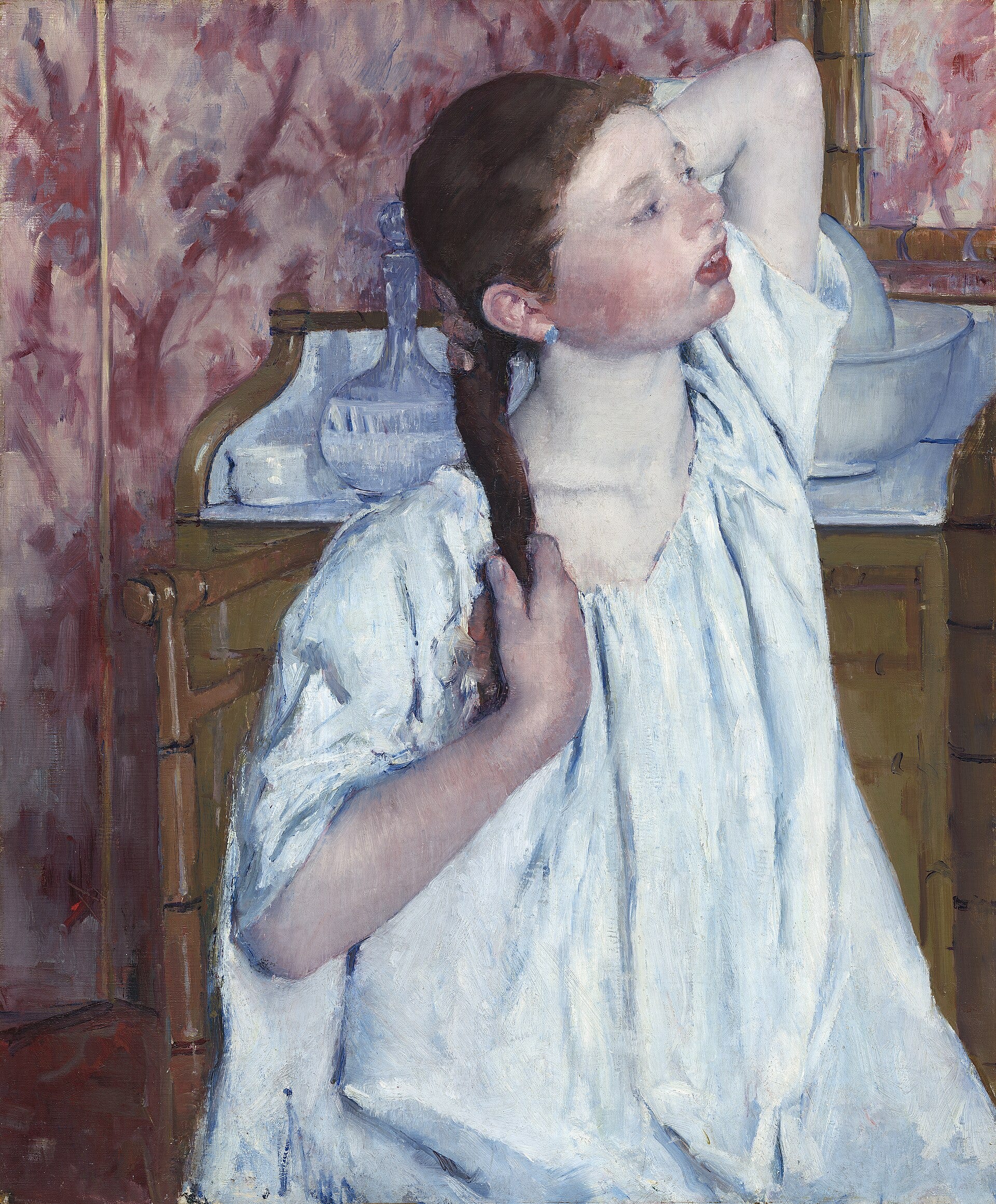
Girl Arranging Her Hair comes from the years before the children, in 1886. Against wallpaper in pink, red and mauve, a girl in a loose white chemise, a simple undergarment, sits on a low sofa with her elbows raised, twisting her long hair behind her neck. Her lips are slightly parted.
Cassatt was forty-two that year. The Impressionists held their eighth exhibition, which proved to be their last, and she, who had shown with them since 1879, entered this canvas under the plainest title she could find: Etude, French for study.
The plain title hid an old subject. For centuries male painters had shown women at their toilette, the private moment of washing, dressing and doing one's hair, and they composed these scenes for a watcher, as if the viewer had walked in on her.
Cassatt kept the gesture and left out the watcher. The girl looks at no one, and no one in the room looks at her. She simply goes on with her hair.
Degas, who doubted that women could paint as well as men, was won over. Cassatt's family reported that he was "quite enthusiastic, for him," and when the exhibition closed the two painters swapped works.
He gave her his pastel Woman Bathing in a Shallow Tub, one of the watched toilette scenes that Cassatt had just turned inside out, and took the girl arranging her hair in return.
That canvas never left him. It hung in his Paris apartment, and when his studio was sold in 1918, a year after his death, it was still among his own works, more than thirty years after the swap.
At a Glance
Artist: Mary Cassatt (1844 to 1926)
Painted: 1886
Medium: Oil on canvas
Size: 75.1 x 62.5 cm (29 9/16 x 24 5/8 in)
Where to see it: National Gallery of Art, Washington, D.C.
11. Lady at the Tea Table (1883 to 1885)
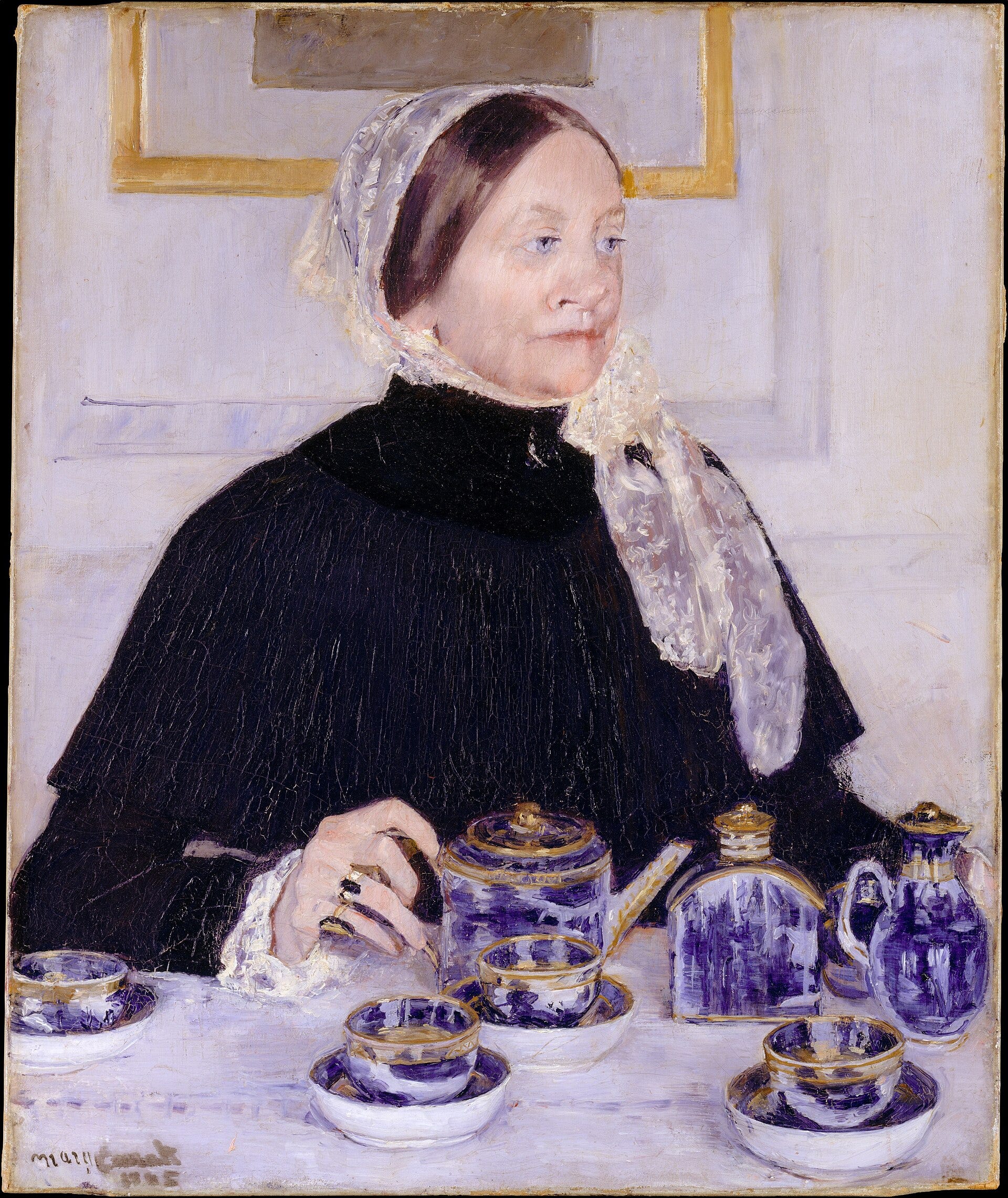
Lady at the Tea Table shows an old woman sitting bolt upright behind a tea table, dressed in black under a white lace cap. She is Mary Dickinson Riddle, a first cousin of the painter's mother.
Her hand rests on the handle of a blue and gold teapot, part of a Chinese porcelain service from Canton that her daughter had given the Cassatts. Cassatt painted the portrait to thank the family for that present, and the family refused it.