
For years, critics said Matisse could not paint. In 1913 art students in Chicago went further and put him on trial, in his absence, for crimes against color. He kept going in the same direction for another forty years, changing his manner more than once, and at the very end he traded the brush for a pair of scissors.
Cool Stories About Art is a newsletter to learn art the fun way.
Join 200,000+ readers and get:
10 new art stories / month
The entire archive of content (140+ articles)
Comment, ask questions, and chat with other readers
The Problem Matisse Kept Solving
Henri Matisse spent his career on one problem, which was color. He wanted it to hold a picture together on its own, without having to match the thing it painted, so that a face could be streaked with violet and a sky could take whatever shade the picture needed.
That ambition first earned him and his friends a name. In 1905 the Paris critic Louis Vauxcelles called them fauves, wild beasts, and the word Fauvism stuck to their style. Matisse moved past it within a few years, toward flatter and larger pictures.
The twelve works chosen follow him from 1904 to 1953, and the Fauve years take only a few places, because most of his changes of direction came after them.
12. Blue Nude, Memory of Biskra (1907)
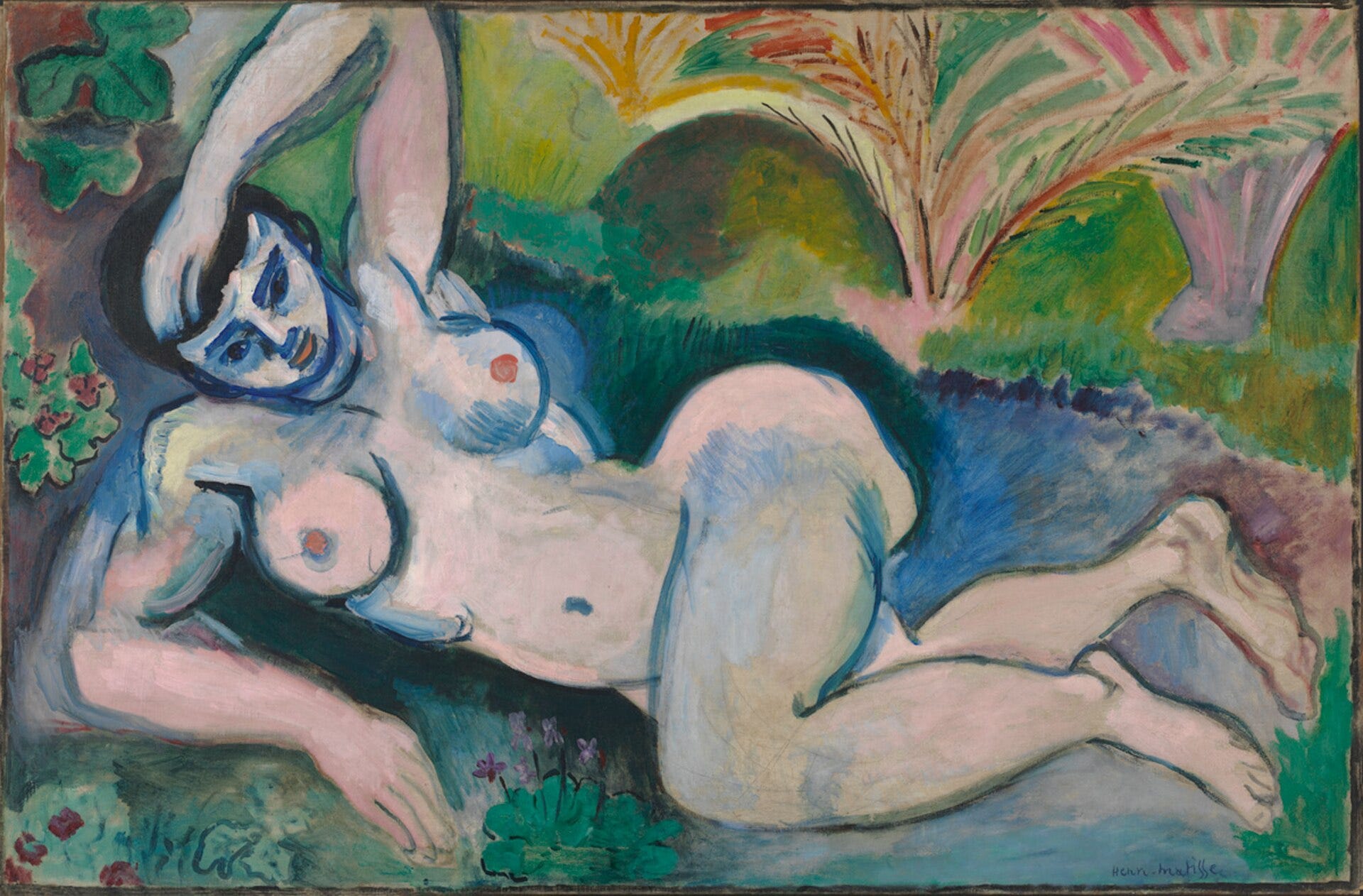
The shadows on this body are blue. On a patch of green and pink ground, a woman is stretched out on her side, an elbow raised above her head and her knees drawn up. Where an older painter would have shaded her with brown or gray, Matisse used strong blue outlines and blue shadows, and he filled the space behind her with palm fronds.
Blue Nude began with an accident. Early in 1907, at Collioure, a fishing port on the Mediterranean, Matisse was modeling the same pose in clay. When the sculpture toppled over in the studio and nearly broke, he decided to try the motif first in a large painting. The palms recall Algeria, where he had traveled the year before.
That spring the canvas went to the Salon des Indépendants in Paris, and the reaction was hostile. Critics reviled it and the public attacked it. Leo Stein, an American collector living in Paris, bought it anyway, and in 1913 he lent it to the Armory Show, the exhibition that traveled from New York to Chicago and Boston.
Of the three cities, Chicago took it worst. According to the local newspapers of the day, students at the school of the Art Institute burned a reproduction of the picture. On the closing day of the exhibition, they staged a trial on the museum's portico. The defendant was "Henry Hair Mattress", charged with "artistic murder, pictorial arson" and "criminal misuse of line".
The sentence was carried out in costume. A student dressed as Matisse was put in chains and "executed", and a mock chaplain offered him a last word of comfort: "We regret that you have only one life to give for your principles."
At a Glance
Artist: Henri Matisse (1869 to 1954)
Painted: 1907, Collioure
Medium: Oil on canvas
Size: 92.1 × 140.3 cm (36 1/4 × 55 1/4 in)
Where to see it: Baltimore Museum of Art, Baltimore
About This Painting
Why was Matisse controversial?
His colors no longer described what he saw, and his bodies were reduced to a few simplified lines. To many critics of the 1900s, a violet face or a shadow in pure color looked like clumsiness or provocation.
11. Luxe, Calme et Volupté (1904)
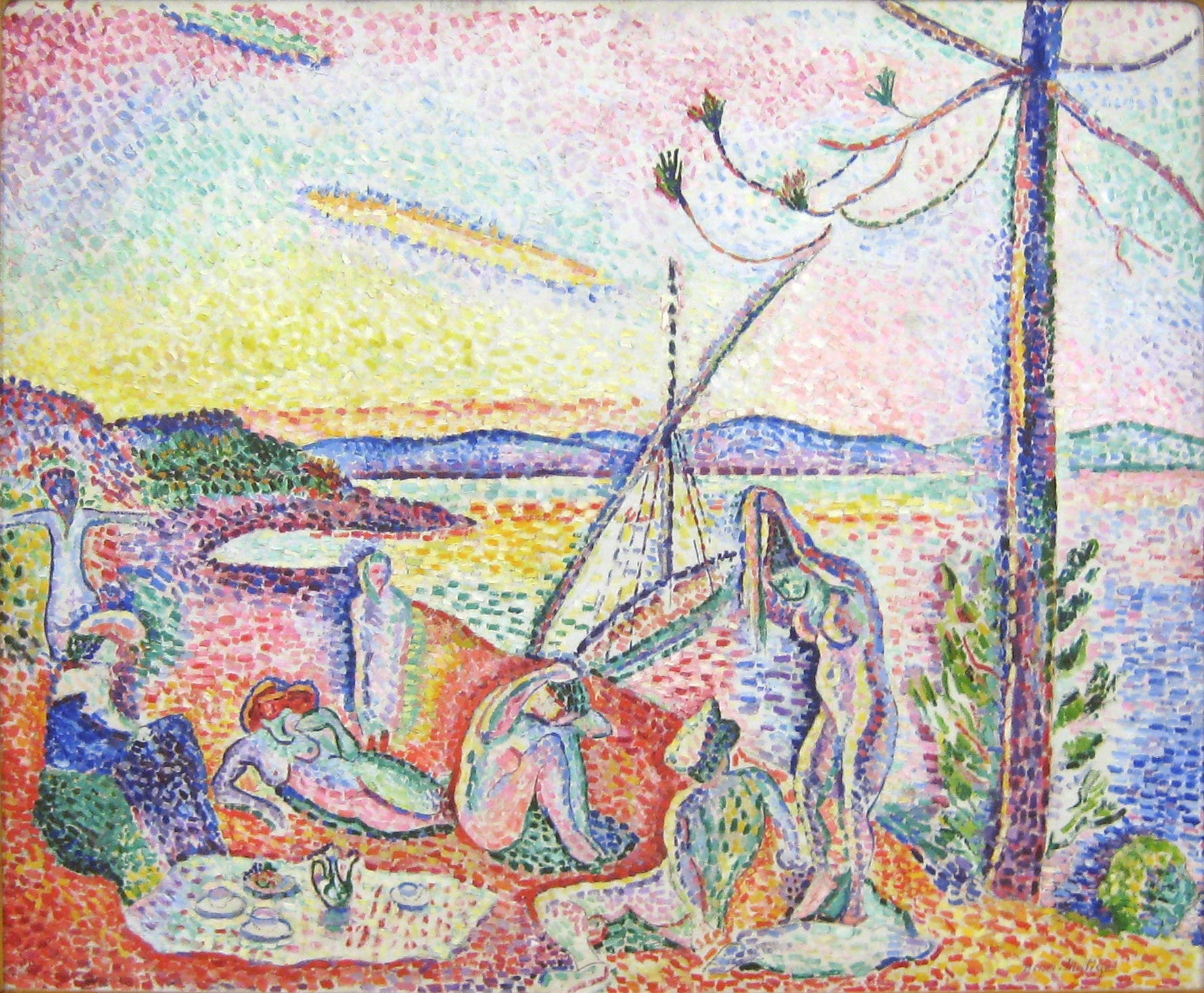
On a curving shore under an evening sky, five nude bathers rest on the sand, every one of them built from small separate dabs of orange, pink, blue and green. Only two figures wear clothes, a seated woman in a dress that reaches the floor and a small boy standing near her. They are the painter's wife and his younger son, and they come from another picture, which Matisse had painted on the same shore a few months before.