
Most people who can name a Mexican artist name someone from a single generation, the one that covered public walls with history and painted its own face in the 1930s. Art made in Mexico starts much earlier. The story on this page opens two centuries before those walls, with a painter called in to decide whether a picture of the Virgin had been made by human hands.
Cool Stories About Art is a newsletter to learn art the fun way.
Join 200,000+ readers and get:
10 new art stories / month
The entire archive of content (1,000+ articles)
Comment, ask questions, and chat with other readers
Who Owns the Image of Mexico
In Mexico, being an artist has long meant answering a question that painters in Paris or Rome rarely faced: who owns the image of the country? Under Spanish rule, the answer was the Church.
After the Revolution of the 1910s, the owner became the state, which handed painters the walls of schools and ministries to tell the history of the nation to everyone. Three men led that movement, still known as los tres grandes, the big three of Mexican mural painting, and for decades a painter who chose a small canvas or a private subject had to defend the choice.
Each generation took the question back. The image passed from the Church to cheap street prints, from the wall to the easel, then to dreams, to the painter's own body and to plain everyday objects.
That is the rule of choice here. Each of the twelve changed who could make the image of Mexico, or how it could be made. Two were born in Europe and did their major work in Mexico.
12. Miguel Cabrera (about 1695 to 1768)
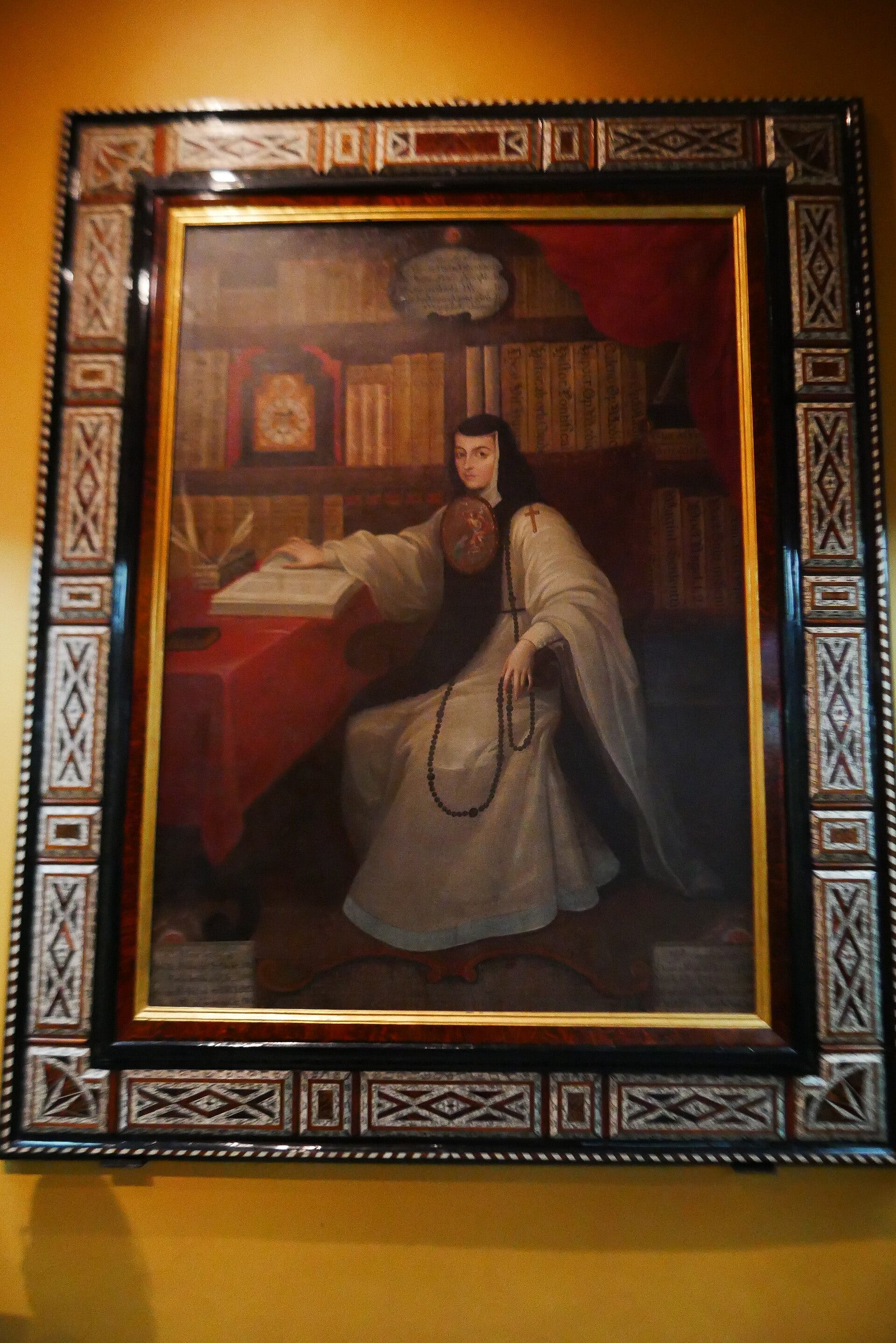
A nun holds the page of an open book flat with her fingers, as if someone had just interrupted her reading. She is Sor Juana Inés de la Cruz, the great poet of colonial Mexico, and Miguel Cabrera painted her in 1750, more than fifty years after her death. He had never seen her, so he built the portrait around her library.
Such ambition was rare in his trade. In New Spain, as Mexico was called under Spanish rule, painting was a craft, and most painters copied saints from European engravings. Cabrera, born around 1695 in Antequera, today Oaxaca, rose far above that rank, as painter to the archbishop of Mexico and head of a large workshop.
His standing was put to the test in 1751. With six other master painters, he was allowed to examine the tilma, the cloak of plant fiber on which, according to tradition, the Virgin of Guadalupe had left her image. On that one surface he found four techniques, oil, tempera, distemper and fresco, and concluded that no human hand could have made it. The eye of a painter had become a form of evidence.
He then painted three copies, for Pope Benedict XIV, for the archbishop and for his own workshop, and for a century the Virgin of Guadalupe was painted in Mexico the way Cabrera had copied her. A legend adds that the pope, facing his copy, quoted a psalm: Non fecit taliter omni nationi, "he has done no such thing for any other nation."
The portrait of Sor Juana carries the same ambition. She sits in a white habit among shelves of philosophy, science and theology, turning a page of Saint Jerome, and a Latin inscription calls her the phoenix of America and the tenth Muse. A painter trusted to judge a sacred image pays homage to a learned woman.
At a Glance
Born: About 1695, Antequera (today Oaxaca City)
Died: 1768, Mexico City
Nationality: New Spanish (colonial Mexico)
Known for: Religious painting, copies of the Virgin of Guadalupe, portraits, casta paintings
Where to see the work: Museo Nacional de Historia (Castillo de Chapultepec) and Museo Nacional del Virreinato, Mexico
11. María Izquierdo (1902 to 1955)
The sketches for the stairway were ready in 1945. They showed a woman in the foreground receiving the plans of Mexico City from figures of the pre-Hispanic past, and María Izquierdo held the contract for the old City Hall. It would have been the first mural by a woman in an official building of the capital. Then the three most powerful painters in Mexico spoke up against her.