Famous Mexican Paintings: 12 From Four Centuries of Art

The most famous Mexican paintings run far deeper than Frida Kahlo and the muralists. For four centuries, from colonial cathedrals to the great valley of Mexico, painters here built one of the richest traditions in the Americas.

Here are twelve, all now in the public domain.

Jose Maria Velasco, The Valley of Mexico, 1875

Most lists stop at the twentieth century, whose giants are still under copyright. I have gone further back, to the images that shaped a nation long before Diego Rivera picked up a brush, paintings you can still visit today.

What runs through them:

  • The sacred. A cloak image that became the heart of Mexican identity.

  • The colony. Baroque grandeur painted in New Spain, a match for anything in Europe.

  • The caste. A strange genre that ranked people by ancestry, unique to Mexico.

  • The nation. Landscapes, folk portraits and history that invented a Mexican eye.


Learn art the fun way. Free stories every week, no boring lectures.


Where I would go next

If this is the kind of art history you want more of:


1. Jose Maria Velasco, The Valley of Mexico (1875)

A vast plateau stretches to distant volcanoes under an enormous sky, a single eagle wheeling above the lake. Jose Maria Velasco painted the valley of Mexico again and again, and no one has ever caught its scale and light better.

These views became the standard image of the Mexican land.

A trained naturalist as much as an artist, he studied the geology, plants and air of the plateau with a scientist's care. He taught at the Academy of San Carlos, where the young Diego Rivera studied under him.

Rivera later paid tribute to his old teacher, and the valley still hangs in the National Museum of Art in Mexico City.

2. The Virgin of Guadalupe (anonymous, sixteenth century)

The Virgin of Guadalupe, sixteenth century

A dark skinned Virgin stands wrapped in a star covered cloak, framed by golden rays, her eyes lowered in calm. Tradition says the image appeared by a miracle in 1531, printed on the cloak of an indigenous man named Juan Diego.

Whatever its origin, no picture matters more to Mexico.

For centuries pilgrims have filled the basilica built to house it, and its face has led armies, revolutions and marches. Painters copied it endlessly, and it became the most reproduced image in the Americas.

To read its symbols is a lesson in iconography, every ray and star placed to carry meaning.

3. Cristobal de Villalpando, Moses and the Brazen Serpent and the Transfiguration (1683)

Cristobal de Villalpando, Moses and the Brazen Serpent and the Transfiguration, 1683

Two enormous scenes stack into one soaring canvas, crowds swirling upward toward a blaze of light. Cristobal de Villalpando filled the sacristy of Puebla Cathedral with Baroque painting as ambitious as any in Europe.

Few outside Mexico have ever heard his name.

He worked at astonishing speed on a huge scale, his brush loose and his color hot, closer to Rubens than to any careful Spanish master. New Spain was rich, and its churches paid for art to match.

In 2017 the Metropolitan Museum gave him a whole show, and visitors met a giant they had never been taught.

4. Sebastian Lopez de Arteaga, The Incredulity of Saint Thomas (about 1643)

Sebastian Lopez de Arteaga, The Incredulity of Saint Thomas, about 1643

A doubting apostle pushes his finger into the wound in Christ's side, the figures lit hard against deep shadow. This is the work of Sebastian Lopez de Arteaga, who carried the drama of Caravaggio across the ocean to New Spain.

The result is one of the most dramatic religious paintings of colonial Mexico.

Spanish born, he settled in Mexico City and brought the newest European style with him, all raking light and blunt realism. He also worked for the Inquisition, which shaped what artists were allowed to paint.

His Saint Thomas now hangs in the National Museum of Art.

5. A Casta Painting of New Spain (18th century)

Anonymous casta painting, From a Mulatto and a Mestiza, 18th century

A well dressed family poses at home, labeled like a diagram, the parents of two different origins and their child named by a special word.

This is a casta painting, a genre invented in Mexico to chart the mixing of Spanish, indigenous and African blood.

Miguel Cabrera made the most admired set of all.

The colony was obsessed with ancestry, and these series sorted people into dozens of categories, each with its own costume and label. Cabrera was the leading painter of his day, favored by the Church and the elite.

The pictures are beautiful and deeply uneasy, a fashion plate for a system built on race.

6. Jose Maria Estrada, Portrait of a Gentleman (about 1844)

Jose Maria Estrada, Portrait of Miguel Arochi y Baeza, about 1850

A man sits stiff and formal against a plain ground, every button, lace edge and ring set down with patient exactness. For decades Jose Maria Estrada painted the citizens of Guadalajara this way, a provincial master far from the capital's academy.

His portraits are flat, sharp and unforgettable.

He had little grand training, and that is his strength, a folk directness that looks almost modern now. Many of his sitters hold a flower or a letter, a small clue to a life.

Museums and collectors prize him today as one of the finest of Mexico's independent portraitists.

7. Hermenegildo Bustos, Self Portrait (1891)

Hermenegildo Bustos, Self Portrait, 1891

A serious man in a dark coat stares out, plain and unsparing, every line of his face set down without flattery. Hermenegildo Bustos painted himself and his neighbors in a small town in Guanajuato, though he never called himself an artist.

On his own portrait he wrote that he was only an amateur.

He worked as a tinsmith, carpenter and tailor, painting ex votos and portraits on the side for anyone who asked. Entirely self taught, he left a record of a whole community, faces no academy would ever have painted.

Mexico now counts him among its greatest folk painters.


Join 130,000 readers who get the secrets behind the paintings. Free.


8. Felix Parra, Fray Bartolome de las Casas (1875)

Felix Parra, Fray Bartolome de las Casas, 1875

A Spanish friar shields a wounded indigenous man while broken idols and ruins lie around them. Felix Parra painted the Conquest as a tragedy, a piece of history painting that took the side of the defeated. That was a pointed thing to say in paint.

The friar Las Casas had defended the native peoples against Spanish cruelty three centuries earlier, and Parra revived him as a hero. Painted as Mexico searched for its own story, the picture cast the indigenous past as something to mourn and honor.

It hangs in the National Museum of Art in Mexico City.

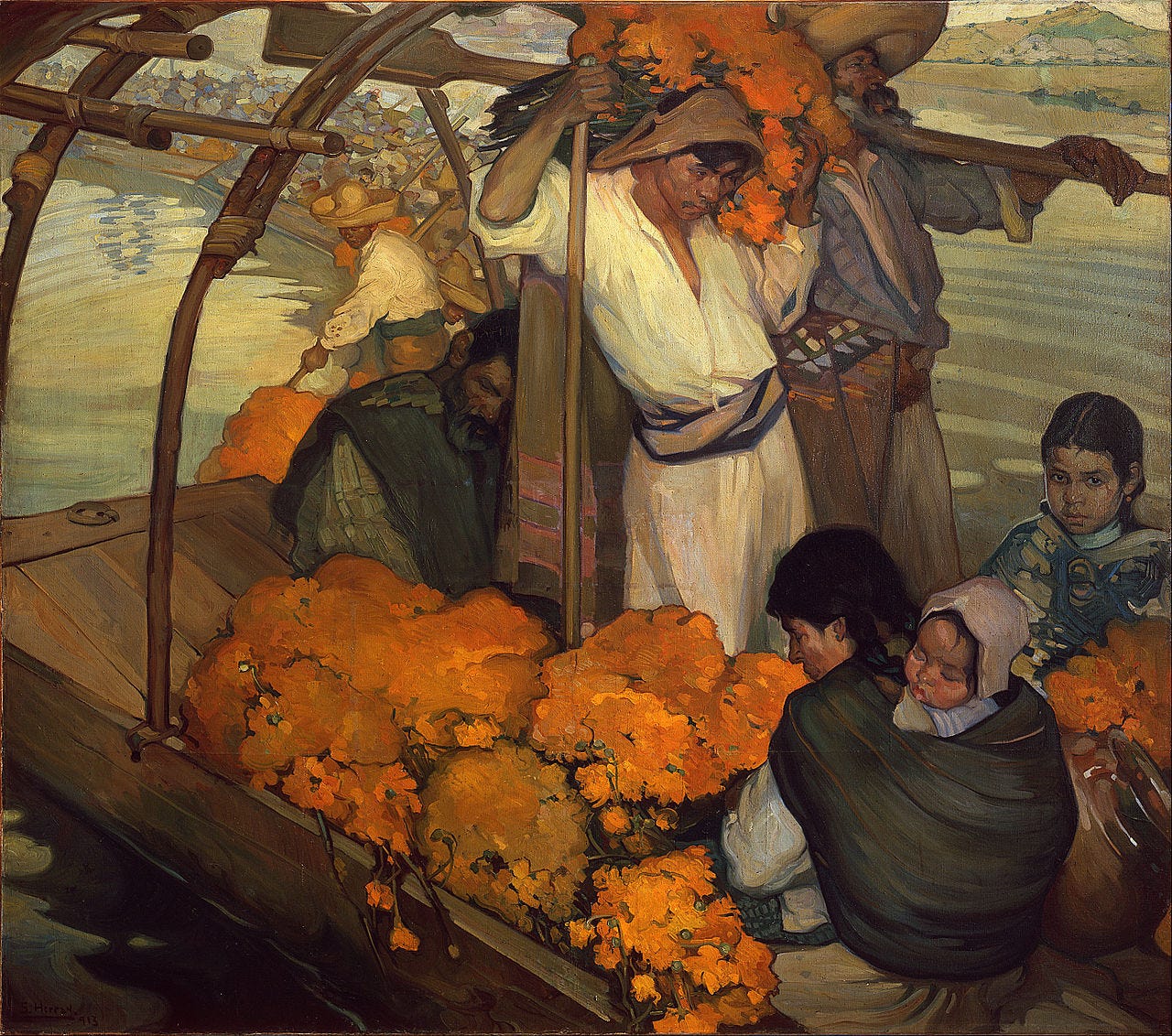
9. Saturnino Herran, The Offering (1913)

Saturnino Herran, The Offering, 1913

A family drifts along a canal in a flat boat piled high with orange marigolds, the flowers of the dead. In Saturnino Herran's hands, everyday Mexican life took on a tenderness that pointed straight toward the murals to come.

He was gone before he turned thirty two.

Working just before the muralists, he wove indigenous faces, folk custom and modern style into something new and wholly Mexican. The marigolds are cempasuchil, gathered every year for the Day of the Dead.

His early death cut short a career that might have rivaled Rivera's.

10. Jose Guadalupe Posada, La Calavera Catrina (about 1912)

Jose Guadalupe Posada, La Calavera Catrina, about 1912

A grinning skeleton wears a huge feathered European hat and little else, elegant and absurd at once. Jose Guadalupe Posada cut her into metal as a cheap newspaper print, mocking Mexicans who aped foreign fashion and forgot their roots.

She became the face of the Day of the Dead.

Posada made thousands of these calaveras, skeletons doing everything the living do, sold on flimsy broadsheets for pennies. Diego Rivera later set the Catrina at the center of a famous mural and made her immortal.

A satirical print by a jobbing engraver turned into a national symbol.

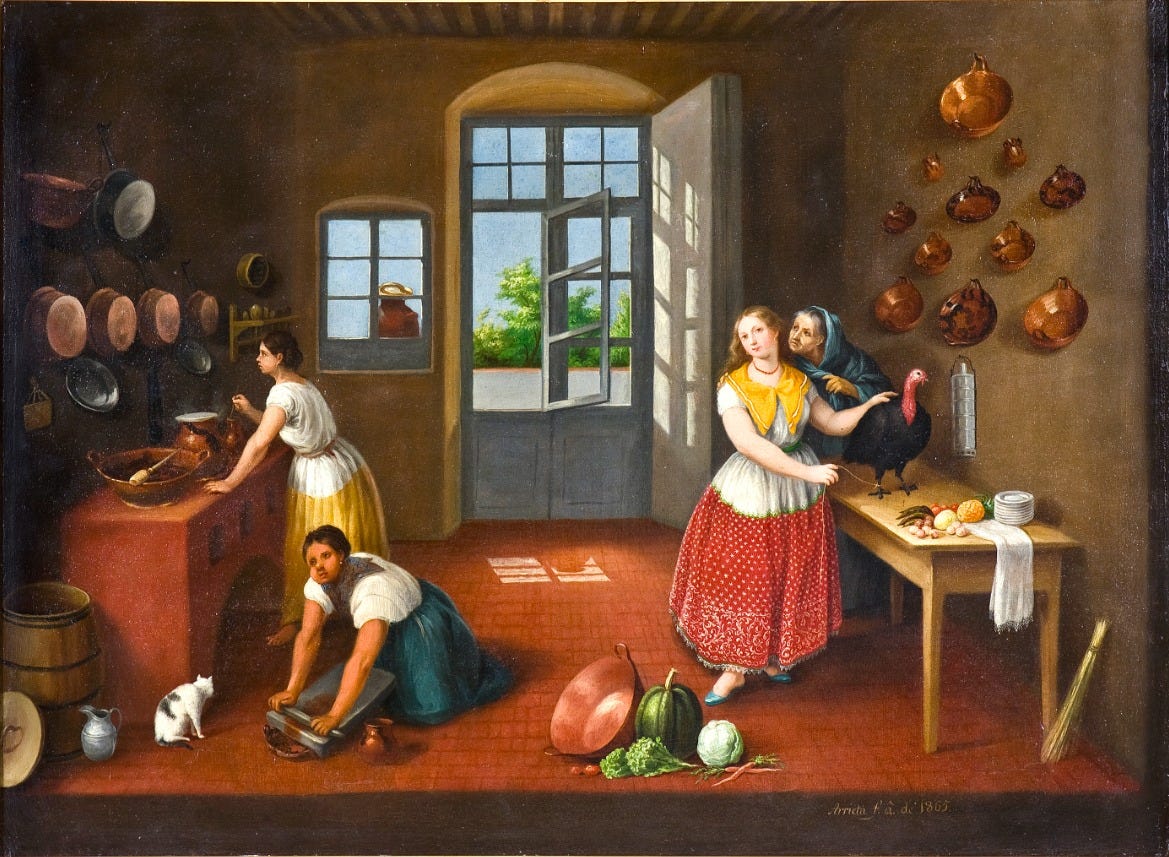
11. Jose Agustin Arrieta, Mesa Revuelta (about 1850)

Jose Agustin Arrieta, Mesa Revuelta, about 1850

A jumble of clay pots, glassware, food and a small devotional print crowds a single table in warm light. In Puebla, Jose Agustin Arrieta made still life and lively tavern scenes a local pride. His cluttered tables are unmistakably Mexican.

Where European still life leaned on grapes and silver, Arrieta painted talavera pottery, mangoes and mole, the real food of his region.

He also painted market women, soldiers and cantina scenes full of humor. He turned humble local life into art worth hanging on a wall.

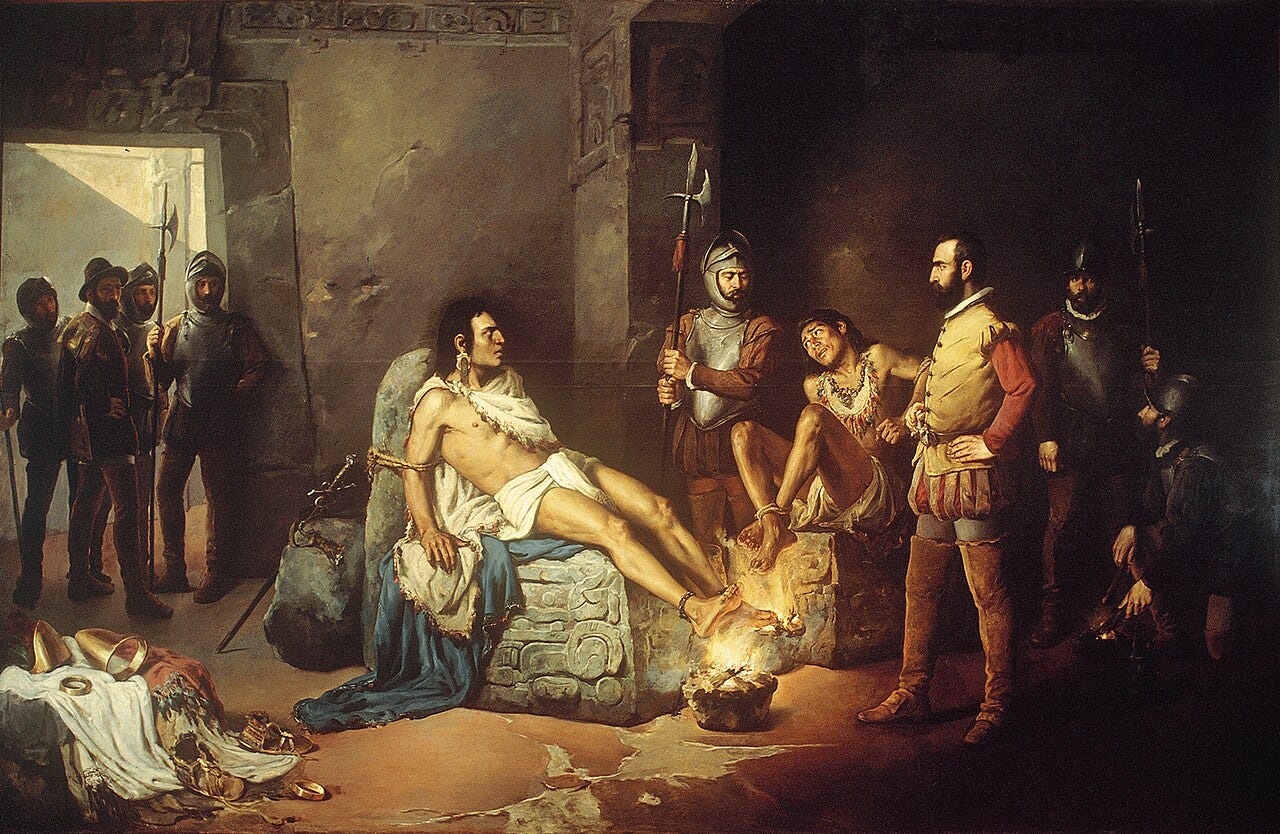
12. Leandro Izaguirre, The Torture of Cuauhtemoc (1892)

Leandro Izaguirre, The Torture of Cuauhtemoc, 1892

The last Aztec emperor sits calm and unbroken while Spaniards hold his feet to burning coals, demanding hidden gold. Leandro Izaguirre painted the scene as a grand national tragedy, the young ruler nobler than his torturers.

It caused a sensation the moment it was shown.

Cuauhtemoc gave up nothing, and legend says he told a companion begging for mercy that he too lay on no bed of roses. The huge canvas traveled to the Chicago World's Fair in 1893 as a statement of Mexican pride.

It hangs today in the National Museum of Art.


Join 130,000 readers who get the secrets behind the paintings. Free.


Mexico City, and beyond

  • Jose Maria Velasco, Felix Parra and Leandro Izaguirre: the National Museum of Art, Mexico City.

  • The Virgin of Guadalupe: the Basilica of Guadalupe, Mexico City.

  • Cristobal de Villalpando: the Cathedral of Puebla.

  • Sebastian Lopez de Arteaga, The Incredulity of Saint Thomas: the National Museum of Art, Mexico City.

  • Miguel Cabrera's casta paintings: collections in Mexico, Spain and the United States.


If these painters pulled you in, keep going:


Two new stories a week, 130+ secrets unlocked. Start free.


Mexican paintings, a few quick questions

  • What is the most famous Mexican painting? Probably Frida Kahlo's The Two Fridas or one of Diego Rivera's murals, though those are still under copyright, so we have focused on the earlier works that are free to show.

  • What about Frida Kahlo and Diego Rivera? They are the giants of twentieth century Mexican art, along with Jose Clemente Orozco, David Alfaro Siqueiros and Rufino Tamayo, but their work remains under copyright and cannot be shown freely here.

  • What is a casta painting? A colonial Mexican genre that pictured mixed families and labeled them by ancestry, a beautiful and troubling record of a society obsessed with race.

  • Who was the greatest Mexican landscape painter? Jose Maria Velasco, whose vast views of the valley of Mexico shaped how the whole country saw its land.

  • Where can I see Mexican paintings? The National Museum of Art in Mexico City holds the deepest collection, with major works also in Puebla, Guadalajara and museums across the United States.

The art before the murals

The muralists did not come from nowhere. Behind Rivera and Kahlo stands four centuries of painting, Villalpando's soaring ceilings, Velasco's endless valley, Posada's laughing skeletons, Herran's marigolds.

Each had already asked what it meant to be Mexican, in paint. The famous names of the twentieth century were the heirs of this deep tradition, not its beginning.

By the time Rivera lifted a brush, Mexico had been painting itself for three hundred years.