Mirror Paintings: 12 Famous Works and Their Secrets

Las Meninas mirror reflecting the royal couple
Diego Velazquez, Las Meninas, 1656. On the far wall, a mirror shows the king and queen who stand outside the picture.

A mirror lets a painter show two things at once, the person and the world behind you, the visible scene and the trick behind it. For six centuries artists used mirrors to smuggle in hidden faces, secret witnesses, and quiet warnings about vanity.

A convex mirror in a Bruges bedroom in 1434 reflects two visitors nobody expected. Three centuries later a Madrid mirror shows a king who is not even in the room, and a Paris barmaid stands in front of a reflection that refuses to add up.

  • The hidden witness: some mirrors reveal people standing where you are, outside the frame.

  • The vanity warning: others turn a woman at her glass into a lesson about time and beauty.

  • The impossible reflection: a few show the wrong thing on purpose, and the mistake is the point.

  • The self portrait trap: when the painter holds the mirror, the reflection becomes a signature.


Learn art the fun way. Free stories every week, no boring lectures.


If you like the secrets hidden in paintings

Three that take a single picture apart, properly:


1. Jan van Eyck, The Arnolfini Portrait

Van Eyck Arnolfini Portrait convex mirror
Jan van Eyck, The Arnolfini Portrait, 1434. National Gallery, London.

A merchant and a woman join hands in a Bruges bedroom in 1434. On the back wall hangs a small convex mirror the size of a saucer.

The mirror curves the whole room into its frame and shows two figures in the doorway, standing where the viewer stands. Above it Van Eyck wrote in Latin that he was here, turning the picture into a witnessed document.

Ten tiny scenes from the Passion of Christ ring the mirror, each one smaller than a fingernail.

2. Diego Velazquez, Las Meninas

Velazquez Las Meninas with mirror on the wall
Diego Velazquez, Las Meninas, 1656. Museo del Prado, Madrid.

Velazquez paints himself at a huge canvas in 1656, surrounded by the young princess and her attendants in a palace room.

On the far wall a mirror reflects King Philip IV and Queen Mariana, the two people the painter is looking at. They stand outside the picture, exactly where we do.

Scholars still argue whether the mirror shows the royal couple in the room, or only their reflection off the canvas Velazquez is painting.

3. Diego Velazquez, The Rokeby Venus

Rokeby Venus with Cupid holding a mirror
Diego Velazquez, The Rokeby Venus, about 1647 to 1651. National Gallery, London.

Venus lies with her back to us while a winged Cupid holds up a dark mirror. It is the only surviving female nude by Velazquez.

Her reflected face is a soft blur, and the angle is impossible, since from her position she would be looking at us, not herself. Painters call this the Venus effect.

In March 1914 the suffragette Mary Richardson slashed the canvas seven times with a meat cleaver to protest a fellow campaigner arrest.

4. Parmigianino, Self Portrait in a Convex Mirror

Parmigianino self portrait warped in a convex mirror
Parmigianino, Self Portrait in a Convex Mirror, about 1524. Kunsthistorisches Museum, Vienna.

At twenty one, Parmigianino painted his own reflection in a barber convex mirror around 1524.

He had a woodworker cut a curved panel to match the bulge of the glass, so the whole picture warps the way the mirror did. His hand swells huge in front while his face stays calm and small.

He carried it to Rome as a calling card, and it helped win him the attention of Pope Clement the Seventh.

5. Titian, Venus with a Mirror

Titian Venus with a mirror held by cupids
Titian, Venus with a Mirror, about 1555. National Gallery of Art, Washington.

Titian Venus gathers a fur robe as two cupids hold a mirror to her around 1555.

Titian kept this painting in his own house until he died and reused the pose again and again. At least thirty versions came out of his workshop.

The canvas later hung in the Hermitage, was sold by the Soviet government in 1931, and crossed the ocean to Washington.

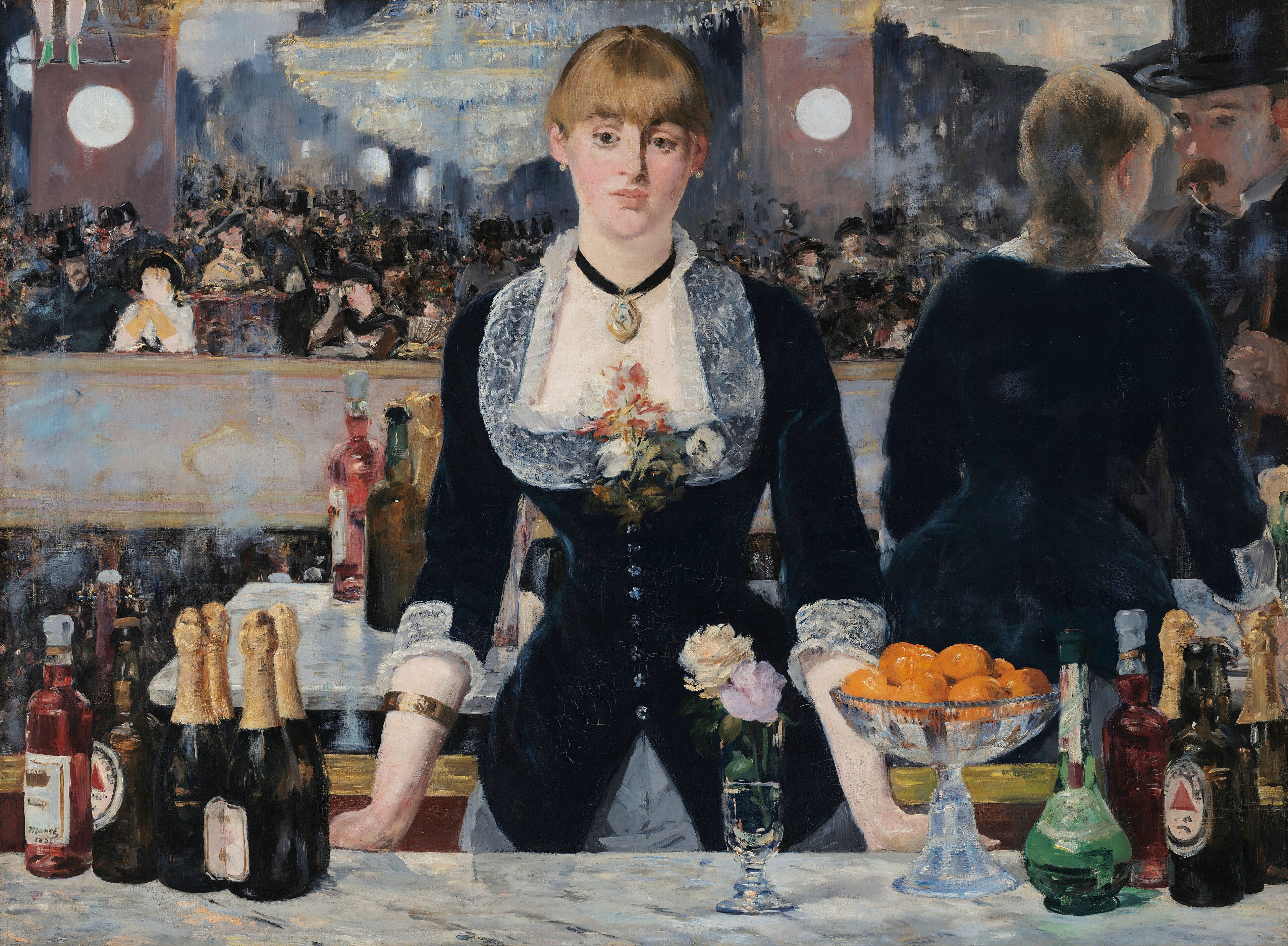
6. Edouard Manet, A Bar at the Folies Bergere

Manet barmaid before a mirror at the Folies Bergere
Edouard Manet, A Bar at the Folies Bergere, 1882. Courtauld Gallery, London.

A barmaid faces us at a Paris music hall in 1882, bottles lined in front of her. Everything behind her is a mirror.

The reflection is deliberately wrong. Her mirrored back is shoved too far to the right, and it shows a top hatted customer leaning in who is nowhere in the direct view.

It was the last major painting Manet finished before his death in 1883.

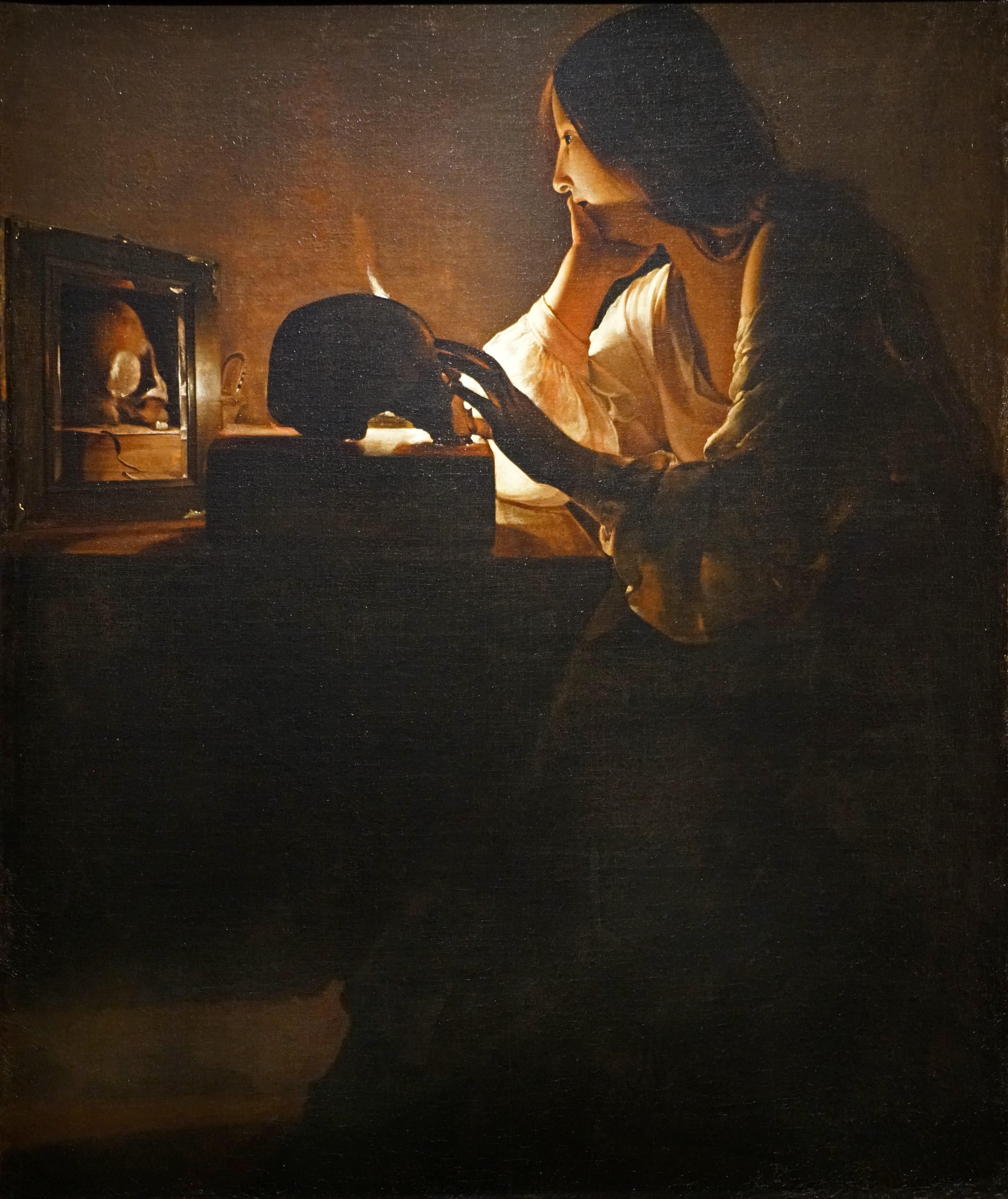
7. Georges de La Tour, The Repentant Magdalen

La Tour Magdalen with candle skull and mirror
Georges de La Tour, The Repentant Magdalen, about 1635 to 1640. National Gallery of Art, Washington.

Mary Magdalene sits in the dark with one hand on a skull, a single candle burning beside a mirror, painted around 1640.

The mirror does not flatter her, it doubles the flame and the skull, so vanity own tool becomes a reminder of death. La Tour built the entire scene from one candle glow.

Three other candlelit Magdalenes by La Tour survive, and each one sets her before a mirror or a skull.

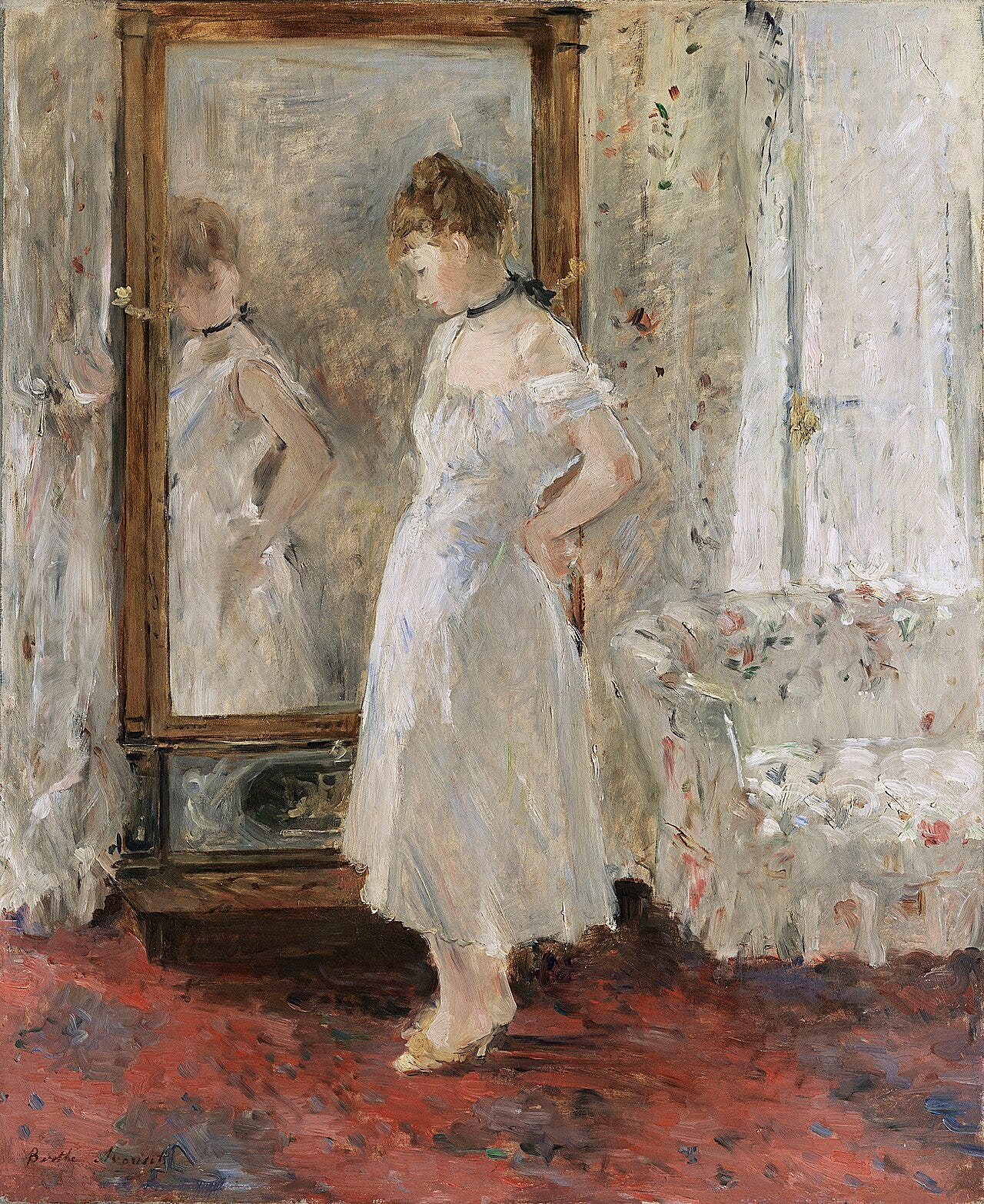
8. Berthe Morisot, The Psyche Mirror

Morisot young woman before a tall swivel mirror
Berthe Morisot, The Psyche Mirror, 1876. Museo Thyssen Bornemisza, Madrid.

A young woman adjusts her blouse before a tall tilting mirror in 1876, light pouring from windows on either side.

That kind of full length swivel mirror was called a psyche in French, after the myth of a woman who longed to see. Morisot showed the work at the third Impressionist exhibition in 1877.

Four of the eight paintings she made that year put a woman at her dressing table.


Join 130,000 readers who get the secrets behind the paintings. Free.


9. Norman Rockwell, Girl at Mirror

Rockwell girl studying her face in a mirror
Norman Rockwell, Girl at Mirror, 1954. Norman Rockwell Museum, Stockbridge.

A girl sits on the floor and studies her own face in a propped mirror, a discarded doll beside her, painted for a magazine cover in 1954.

On her lap lies a magazine open to a photo of the film star Jane Russell, the grown up face she is measuring herself against. Rockwell painted it for the Saturday Evening Post cover of March 6, 1954.

A lipstick, a comb and a hairbrush sit in front of her, untouched props of an adulthood she is still trying on.

10. Pablo Picasso, Girl before a Mirror

Picasso Girl before a Mirror with a warped reflection
Pablo Picasso, Girl before a Mirror, 1932. Museum of Modern Art, New York.

Picasso painted his lover Marie Therese Walter facing a mirror on March 14, 1932.

The reflection does not match the girl. Her bright profile turns dark and warped in the glass, as if the mirror sees an older, sadder self she cannot.

He finished it in a single day, one of a burst of paintings of Marie Therese he made that spring in near secret.

11. M.C. Escher, Hand with Reflecting Sphere

Escher hand holding a mirrored sphere
M.C. Escher, Hand with Reflecting Sphere, 1935. Lithograph.

Escher holds up a silver ball in his own hand and draws exactly what it reflects, printed as a lithograph in January 1935.

The sphere bends his entire studio in Rome into one curved image, with his face fixed dead center. No matter how he moved, the reflection kept him at the middle of the world.

He drew it at 122 Via Alessandro Poerio, the Rome studio he soon left behind for good.

12. John William Waterhouse, I Am Half Sick of Shadows

Waterhouse Lady of Shalott at her loom with a mirror
John William Waterhouse, I Am Half Sick of Shadows, 1915. Art Gallery of Ontario, Toronto.

The Lady of Shalott sits at her loom in 1915, cursed to see the outside world only as it appears in a large mirror behind her.

Waterhouse took the scene from Tennyson poem, where looking straight at Camelot means death. The mirror is her only safe window, and the reflected road is the closest she gets to living.

The title is her own line, spoken the moment she grows sick of shadows and turns toward the real world that will kill her.

Where to see them

  • National Gallery, London: Van Eyck, The Arnolfini Portrait, and Velazquez, The Rokeby Venus.

  • Museo del Prado, Madrid: Velazquez, Las Meninas.

  • Courtauld Gallery, London: Manet, A Bar at the Folies Bergere.

  • National Gallery of Art, Washington: Titian, Venus with a Mirror.

  • Museum of Modern Art, New York: Picasso, Girl before a Mirror.

Why painters kept reaching for a mirror

The mirror is one of the oldest tools in the vanitas, the language of objects painters used to warn about vanity and passing time. A woman at her glass is beauty already fading.

Many of these are also self portraits, since the only way to paint your own face was to sit before a mirror. When Parmigianino kept the warp of the glass, he turned the tool itself into the subject.

And the convex mirror belongs to the story of oil painting in the north, where Van Eyck used the new medium to fit an entire room into a curved disk the size of a hand.

Mirrors in painting, questions people ask

  • What is the most famous painting with a mirror in it? Jan van Eyck Arnolfini Portrait of 1434, for the convex mirror that reflects two extra figures in the doorway.

  • Why did old painters put mirrors in their work? To show what lay outside the frame, add a hidden witness, or turn a scene into a warning about vanity.

  • What does the mirror show in Las Meninas? King Philip the Fourth and Queen Mariana of Spain, who stand outside the painting where the viewer stands.

  • Which mirror painting was attacked by a suffragette? Velazquez Rokeby Venus, slashed by Mary Richardson at the National Gallery in London in March 1914.

  • What is the Venus effect in painting? The trick where a woman looks into a mirror and we see her face, even though from her angle she could only be looking back at us.

Six words in the glass

A mirror hands the painter a second scene for free, the part of the room you cannot see, and it can hold a face, a king, or a warning. Van Eyck understood this in 1434 and signed his mirror painting with six words in Latin, Jan van Eyck was here, the first time an artist placed himself inside the reflection rather than just below it.


Two new stories a week, 130 secrets unlocked. Start free.