Famous Monet Paintings: His 12 Greatest Works
Claude Monet spent sixty years chasing one thing across canvas after canvas, the way light falls and changes on water, stone and flowers.
He gave Impressionism its very name and never stopped painting the fleeting moment, from a misty harbor at dawn to a pond of water lilies at the end of his life.
These are twelve of his most famous paintings, all now in the public domain, each one a hunt for a light that would not hold still.
For the whole story of the man, see the complete Monet guide; here, the paintings themselves. I have picked the ones the world lines up to see.
1. Impression, Sunrise (1872)
A blurred orange sun hangs over a misty harbor at dawn, its light shivering in loose dashes across the pale blue water. This one small, quick sketch gave a whole movement its name, after a hostile critic sneered that it was a mere impression, not a finished painting.
Monet painted the old port of Le Havre, his home town, from a hotel window in a single fast session. The word meant as an insult, Impressionism, was seized on with pride by Monet and his friends.
It hangs in the Musee Marmottan Monet in Paris, the picture that started everything.
2. The Magpie (1868 to 1869)
A single black and white magpie perches on a gate in a field of fresh, glittering snow, casting the faintest blue shadow across the white.
The Magpie hides a real secret, and it is one of the finest snow scenes ever painted, all soft blues and violets in what looks at first like plain white.
The official Salon rejected it as too plain and strange, blind to the delicate color in the snow. Monet was in his twenties, poor and unknown, already chasing the way light colors a shadow.
Today it is one of the most loved paintings in the Musee d'Orsay, no longer thought plain at all.
3. La Grenouillere (1869)
Boaters and bathers crowd a floating cafe and jetty on a sunny river, the water broken into quick dabs of light and reflection. Monet and his friend Renoir set up their easels side by side here and painted the same scene, inventing the art of painting outdoors fast and loose.
Neither could afford much paint or food that summer, yet between them they cracked the code of Impressionism on this riverbank. The choppy, shorthand brushwork was unlike anything the official Salon wanted to see.
It now hangs in New York, a rough, thrilling first draft of a whole new way to paint.
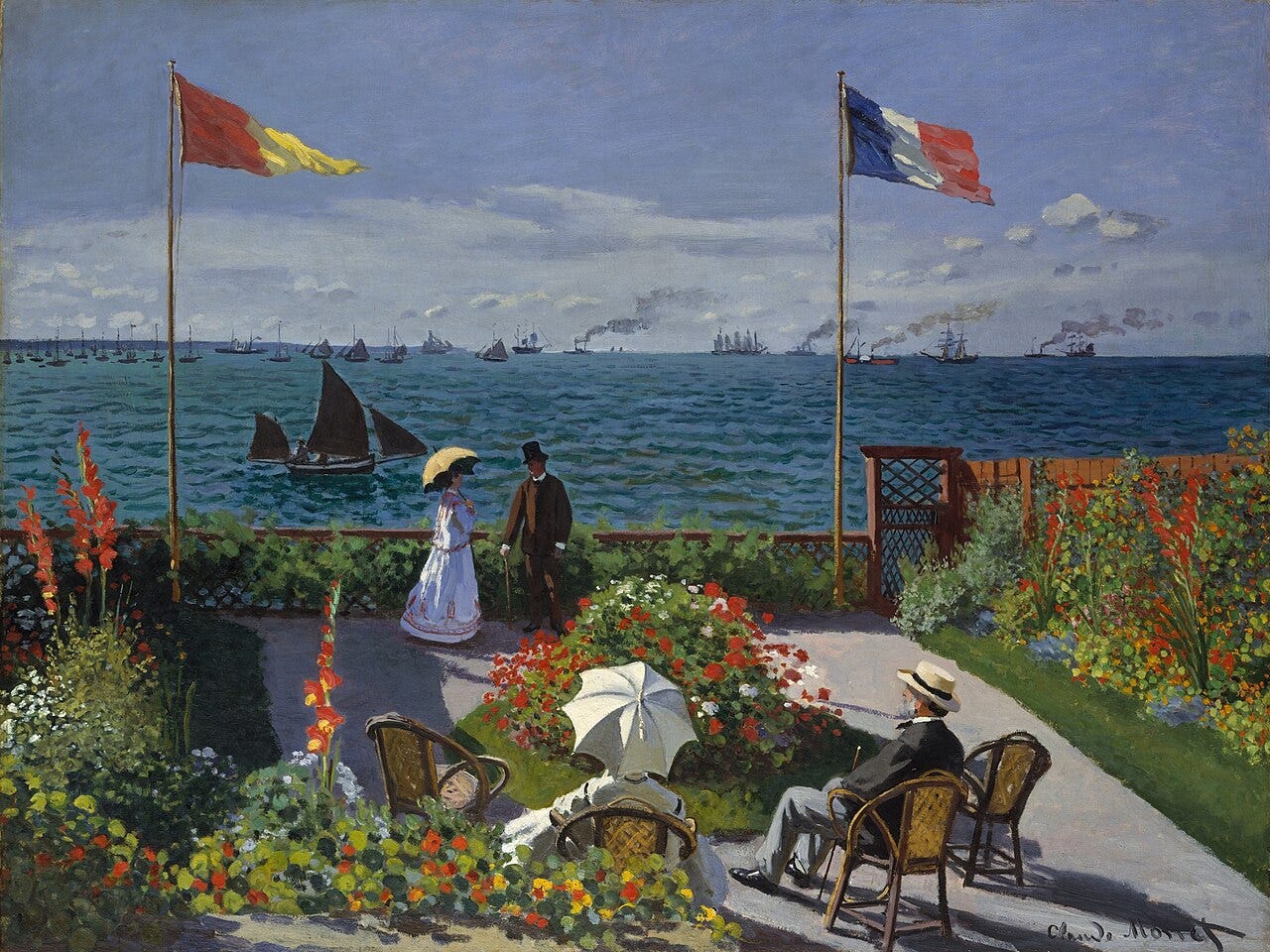
4. Garden at Sainte Adresse (1867)
Two figures sit on a bright flowered terrace above a sea dotted with sailboats, flags snapping in the breeze, the whole scene flooded with summer light.
Monet painted his own family at his aunt's seaside villa, stacking terrace, sea and sky in three flat bands like a Japanese print.
He was so broke that year that he had to leave the coast and move back in with relatives. The picture is packed with the pleasure of a sunny day, giving no hint of his money troubles.
Long dismissed, it sold to the Metropolitan Museum in 1967 for a price that was then a record for a Monet.
5. Woman with a Parasol (1875)
A woman stands on a grassy rise against a bright, windblown sky, her veil and white dress fluttering, a child half hidden behind her.
The woman is Camille, Monet's first wife, and the boy their son Jean, caught on an ordinary walk near their home at Argenteuil. He painted it fast, looking up at her from below so she seems to float against the racing clouds.
You can feel the wind in every loose stroke of the grass and the gauzy veil across her face. Years later, after Camille had died young, he painted the same pose again but left the woman's face a blank.
6. Grainstacks (1890 to 1891)
Two great stacks of harvested wheat stand in a field, painted over and over at every hour and season until they seem to glow from within.
Monet painted the stacks around twenty five times, chasing the same shapes through frost, mist, sunset and snow. It was his first true series, the idea of painting one subject again and again to catch the changing light.
When fifteen of them were shown together in 1891, they sold almost at once and made him rich at last. A single stack sold in 2019 for over one hundred and ten million dollars, a record for the artist.
7. Poplars (1891)
A row of tall poplar trees curves along a riverbank, their trunks striping the canvas while their reflections ripple below in green and violet.
Monet worked from a boat fitted out as a floating studio, painting the same trees through changing weather and light. The flat, decorative pattern of the trunks looks ahead to modern abstract art.
He loved these poplars so much that, when the local council put them up for sale to be cut down, he is said to have secretly paid the timber merchant to leave them standing until his series was finished.
8. Rouen Cathedral (1894)
The great stone front of Rouen Cathedral fills the whole canvas, dissolving in shifting light from cold blue morning to golden afternoon glow.
Monet rented rooms across the square and painted the cathedral more than thirty times, working on several canvases at once as the light moved.
He was not really painting stone at all but the veil of light and air between him and the building. The paint is built up so thickly in places that the surface itself looks carved and weathered like the cathedral.
Twenty of them were shown together in 1895, a single building seen at every hour of the day.
9. The Water Lily Pond, Japanese Bridge (1899)
A green wooden footbridge arches over a pond choked with water lilies and hanging willows, a private paradise Monet built with his own hands.
He diverted a stream to make the pond at his home in Giverny, then planted it and painted it for the rest of his life. This early view, still and clear, shows the famous green bridge he modeled on the Japanese prints he collected.
The story of how this pond changed as his eyesight failed is one I unpack in a separate paid piece. He would go on to paint the water lilies of this pond around two hundred and fifty times over the rest of his life.
10. Camille Monet on her Deathbed (1879)
Monet painted his young wife Camille as she lay dead, her face dissolving into a storm of pale blue and violet strokes. He was horrified to catch himself studying the changing colors of her skin even in his grief, a painter to the marrow.
Camille had died at just thirty two, worn out by illness and poverty, the model of so many of his sunlit pictures. He kept the painting private and rarely spoke of it, the rawest thing he ever made, and I tell the story of the guilt behind it in a separate piece.
It stayed with the family and now hangs in the Musee d'Orsay, a private goodbye he never meant for the public eye.
11. The Houses of Parliament, London (1904)
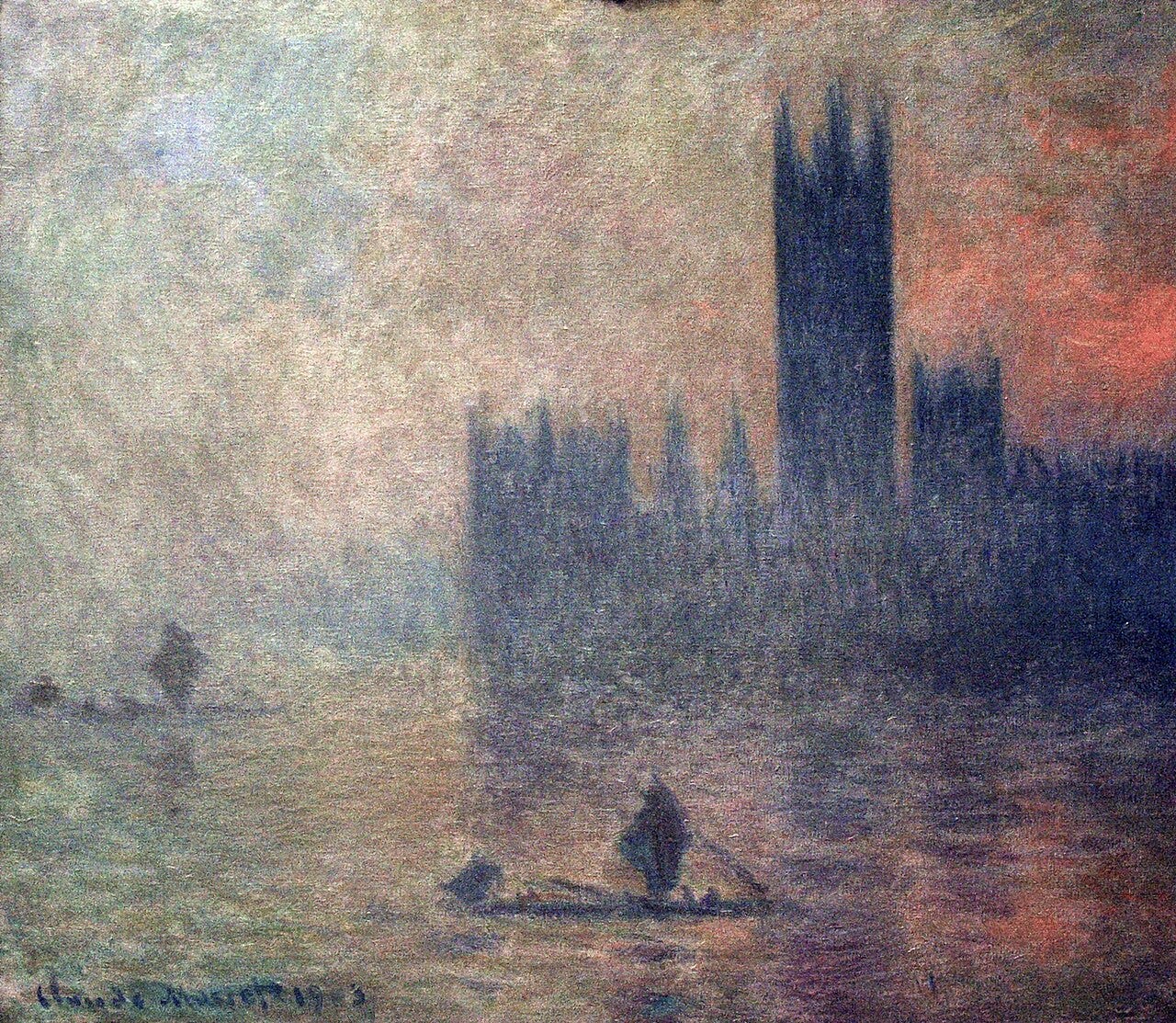
The towers of the Houses of Parliament loom as a ghostly purple silhouette through thick London fog, the sun a smear of orange on the Thames.
Monet came to London again and again, thrilled by the very fog everyone else complained about, calling it the city's finest feature.
He painted the same view from a hospital balcony at dusk, racing the changing light across dozens of canvases. He worked them up later in his studio in France, chasing a memory of London weather from afar.
He showed thirty seven of these London views in Paris in 1904, and the fog he loved has since almost vanished from the cleaner city.
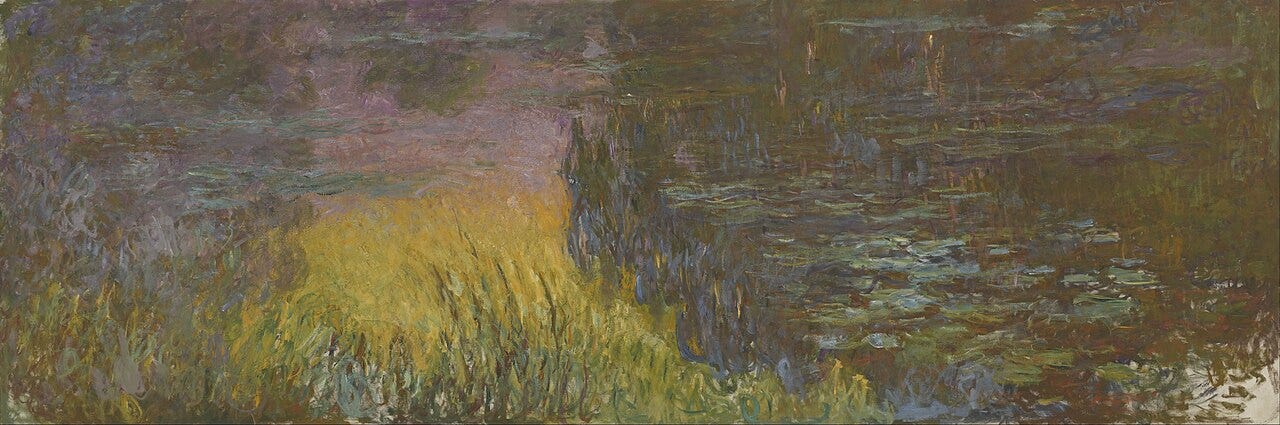
12. Water Lilies (about 1920)
In his last years Monet painted the surface of his lily pond so close up that the sky, the water and the flowers melt into one endless field with no horizon at all.
He painted the water lilies on enormous canvases, some over six meters wide, meant to wrap around a viewer like a room. He worked on through cataracts that turned his world muddy and yellow, half painting from memory and long habit.
He gave the greatest of these, the Grand Decorations, to France as a gift after the First World War. They fill two oval rooms in the Orangerie in Paris, a quiet place people still call a chapel of light.
Monet's paintings, the questions people ask
What is Monet's most famous painting? Impression, Sunrise from 1872, which named Impressionism, along with his many Water Lilies.
How many paintings did Monet make? Around 2,000 works over sixty years, including hundreds of the water lilies alone.
Why did Monet paint the same thing so many times? To capture how light and weather change a subject through the day, his idea of a series.
Where can I see Monet's Water Lilies? The two huge oval rooms of the Orangerie in Paris, with more spread across major museums worldwide.
Why are Monet's paintings so blurry? He painted the fleeting effect of light and air rather than sharp detail, the whole point of Impressionism.
If these paintings pulled you in, you will love these too:
The secret behind Monet Magpie, one bird in the snow, and why it matters
Was Monet really the first Impressionist, the painting that may have got there first
The Last Supper, detail by detail, the detail hiding at that table
Chasing the light
Monet spent his whole life trying to paint something that will not stay still, the exact color of a moment of light before it changes.
He failed, of course, because light always wins, and that failure is the whole beauty of his work. Each of these paintings is one held breath, a single passing effect fixed forever.
Stand in front of any of them and the light seems to move again.