
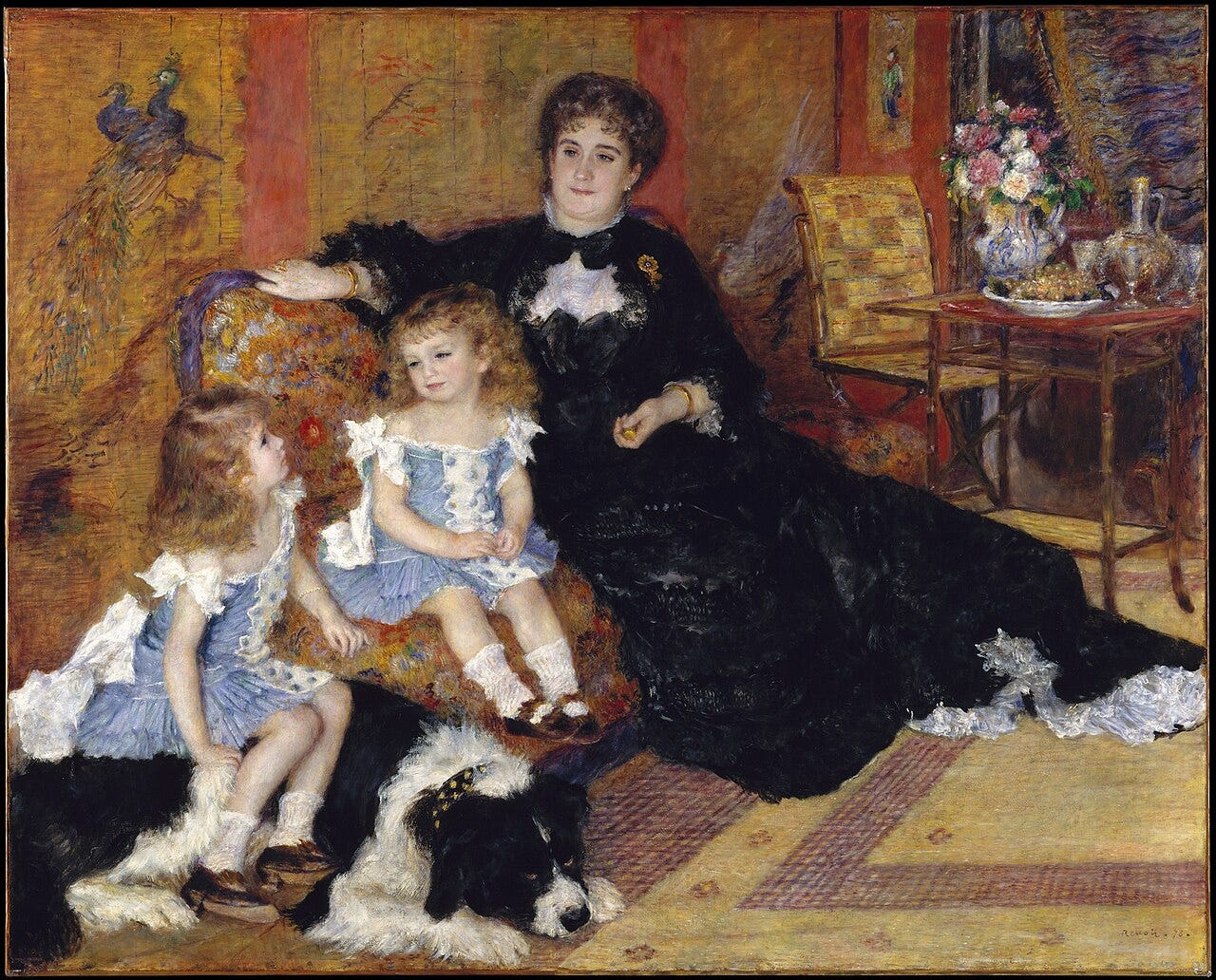
Famous mother and child paintings include Raphael's The Madonna of the Pinks, Vigée Le Brun's Marie Antoinette and Her Children and Renoir's Madame Georges Charpentier and Her Children. All take the bond between a woman and a small child as their subject.
This page counts down twelve of them. The oldest show the Virgin with the infant Christ, the later ones mothers of the painter's own day, at home, on a train or in a formal portrait.
Cool Stories About Art is a newsletter to learn art the fun way.
Join 200,000+ readers and get:
10 new art stories / month
The entire archive of content (140+ articles)
Comment, ask questions, and chat with other readers
Each entry looks at how the child is held, where the mother's eyes go, who feeds or keeps watch, and what the painting was made to do.
To earn its place, every painting passes at least one of four simple tests. First, the mother feeds, soothes or tends the child. Second, the sitters, the patron or the purpose are on record.
Third, Mary wears the dress or sits in the rooms of the painter's own day, or a real mother takes her pose. Fourth, the image comes back in other versions, in a series, or as a model for other painters.
12. The Virgin and Child before a Firescreen, Follower of Robert Campin, about 1440
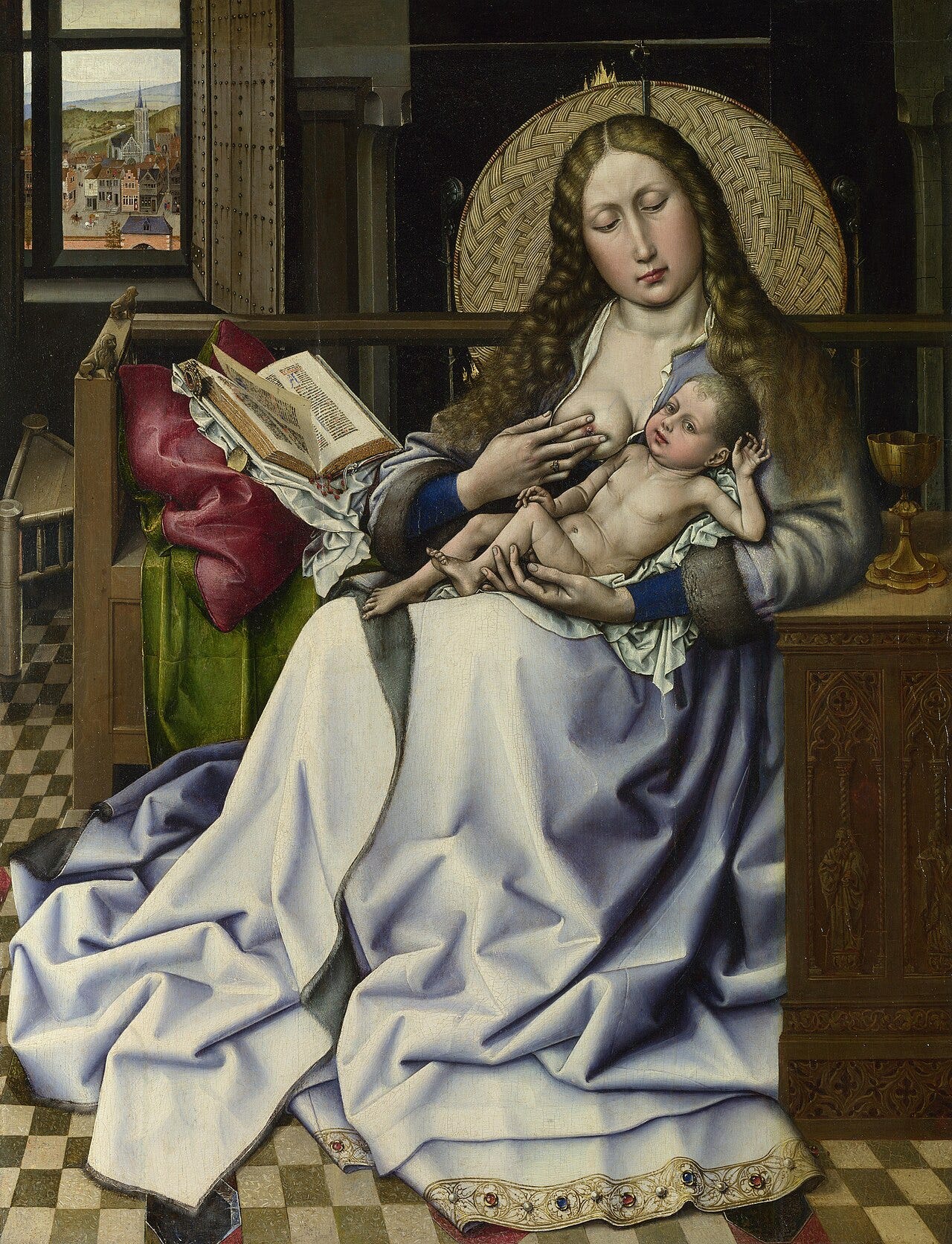
A mother nurses her baby beside a blazing fire, a white cloth spread across her knees. The Virgin and Child before a Firescreen was painted about 1440 by a follower of Robert Campin, on a panel of oak.
Campin's name places the panel. He was the leading painter of Tournai, a town in present day Belgium, and with Jan van Eyck he helped launch early Netherlandish painting, the art of the Low Countries in the fifteenth century. He died in 1444.
Young painters trained in his workshop, among them Rogier van der Weyden. The follower who made this panel learned from the pictures of both men, but he left no name.
Mary wears a blue overdress over a linen shift. The shift lies open at the neck, and the painter even records the blue veins of her breasts. The naked Child feeds at one of them.
Under the baby lies the white cloth, there to protect her clothes from a wriggling infant. At one of its corners, the painter added a tiny hook, so that the cloth could be hung up to dry.
Behind her head stands a large wicker firescreen, round and pale gold, and flames from the stone fireplace rise just above its rim. Placed exactly behind Mary's head, the screen works as a halo, the ring of light that painters drew around holy heads.
Around the pair, the room fills with precious things. A bound Bible with blue and red initials lies open beside Mary, its covers fastened with jeweled clasps. Through an open window, horsemen ride through a walled town with a tall church tower and gabled houses.
Mary sits on a bench, yet she seems to hover between the bench and the floor. The painter appears to have assembled the scene from borrowed parts, taking elements from paintings by Campin and by Rogier, and the joins show.
The panel has also survived a long series of accidents. It appears to be a fragment of a slightly larger painting. A burn mark on its right edge, just below the Virgin's fur cuff, suggests that it may once have been damaged by fire.
One later change was deliberate. A restorer, out of prudishness, painted over the Child's genitals. They came back to light when the panel was cleaned in 1992 and 1993, and they show again today, just under the Virgin's left hand.
The painter had perhaps put them there on purpose, as a reminder that Christ was fully human, a real baby in a real room.
At a Glance
Artist: Follower of Robert Campin (Campin lived 1378 or 1379 to 1444)
Date: About 1440
Medium: Oil on oak, with later walnut additions
Where to see it: National Gallery, London
Size: 63.4 by 48.5 cm (about 25 by 19 inches)
About This Painting
Why is The Virgin and Child before a Firescreen called the Firescreen Madonna? The nickname comes from the woven screen behind Mary. The National Gallery uses it alongside the full title.
What did the nineteenth century restorer add to the Firescreen panel? The restorer added strips of walnut, 9 cm wide on the right and 3 cm at the top. He also built up a far more elaborate cupboard and swapped a simple brass bowl for an ornate chalice. The 1992 treatment kept these additions.
How did the National Gallery get the Firescreen panel? The panel is NG2609 in the National Gallery's catalogue. An old inscription on its back names a "conte Balbiano." A Belgian collector bought it in Venice in 1875. George Salting acquired it from the dealer Agnew's in 1903, and it entered the National Gallery with his bequest of 1910.
11. Mother (Madre), Joaquín Sorolla, about 1895 to 1900
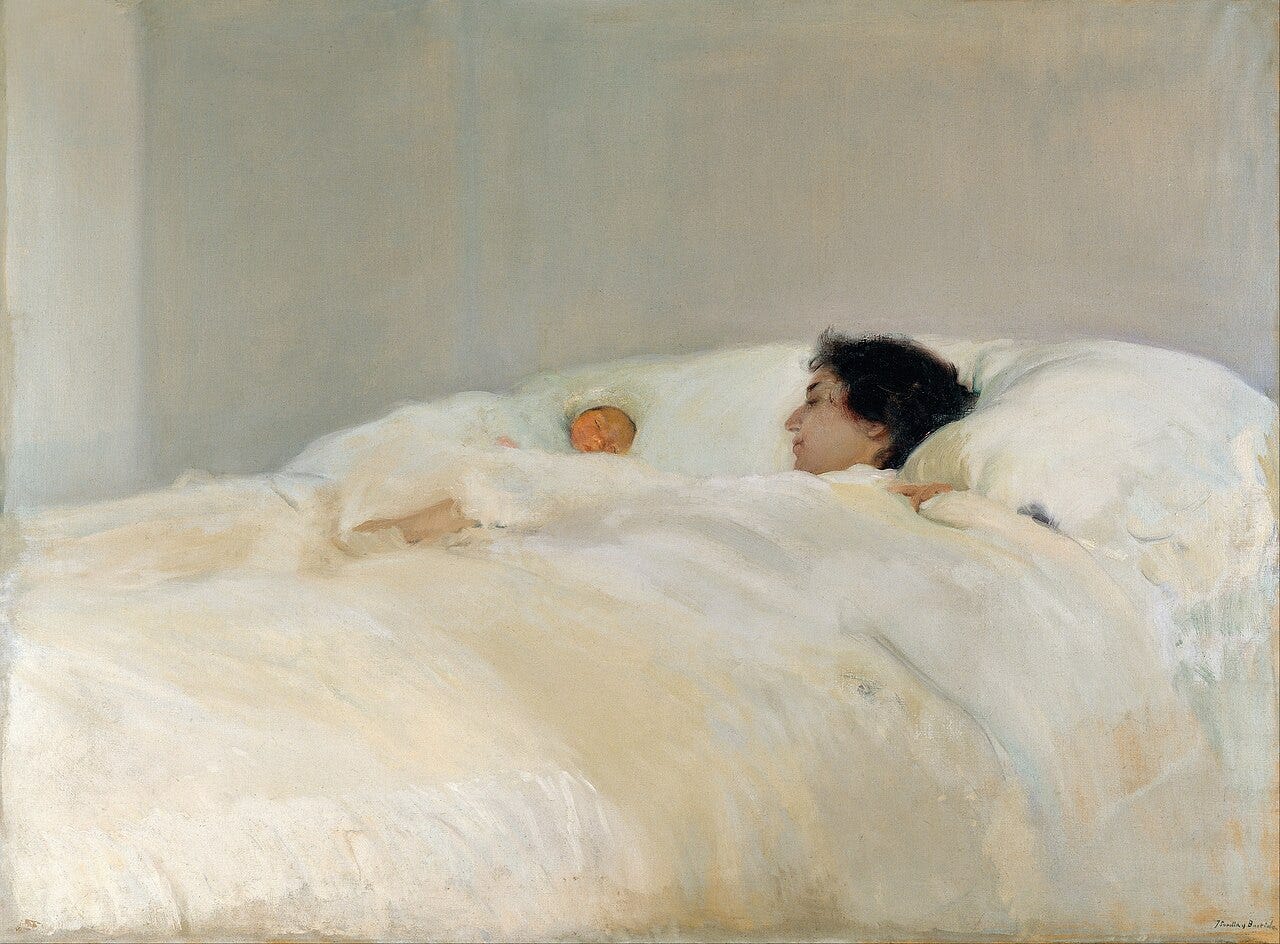
Two faces rise out of a sea of white: a baby girl and her mother, resting together in bed. Joaquín Sorolla painted Mother between about 1895 and 1900.
Sorolla, a Spanish painter born in Valencia in 1863, took his own family as the subject. The baby is Elena, his youngest daughter, born on July 12, 1895. To mark her birth, he painted the pair almost lost in a bed of white sheets.