Famous Mountain Paintings: 12 Views of the Sublime
Few things humble a painter like a mountain, and for two centuries artists have tried to fit that overwhelming scale onto a flat canvas.
A mountain in a painting is rarely just rock and snow. It stands for the sublime, for danger, for the smallness of a single human life against something vast and old.
Here are twelve of the most famous mountain paintings, all now in the public domain. I have chosen the ones that make you feel the thin, cold air.
Three for later
The ones I would send you to next:
The secret behind Monet Magpie, one bird in the snow, and why it matters
Luncheon of the Boating Party, detail by detail, who everybody at that table actually was
Was Monet really the first Impressionist, the painting that may have got there first
1. Caspar David Friedrich, Wanderer above the Sea of Fog (about 1818)
A lone man in a dark coat stands with his back to us on a rocky summit, gazing out over a churning sea of fog and distant peaks. It is the single most famous image of German Romanticism, the perfect picture of one person facing the vast unknown.
Because we see only his back, we step into his shoes and look out at the sublime ourselves. Friedrich painted real cliffs from the Elbe Sandstone hills but stitched them together into a place that exists nowhere.
For a century it was half forgotten, until the twentieth century embraced it, and it now hangs in the Hamburger Kunsthalle as the face of German Romanticism.
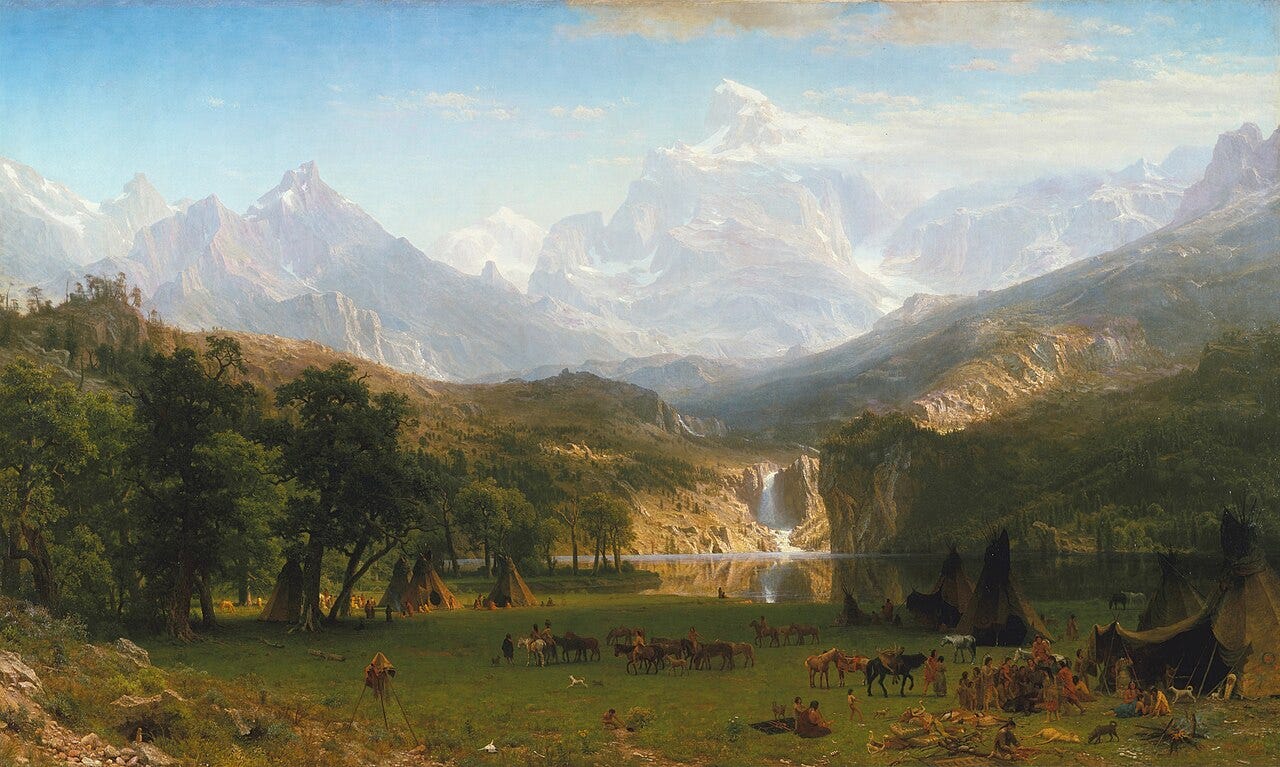
2. Albert Bierstadt, The Rocky Mountains, Lander's Peak (1863)
A vast golden landscape opens onto snowcapped peaks while a Native American camp goes about its life in the sunlit valley below. Bierstadt painted the American West at a heroic, operatic scale, working up sketches from an expedition into the Rockies.
He toured single giant canvases like this one as ticketed spectacles, charging the public to come and gasp. This painting sold for twenty five thousand dollars in 1865, a staggering sum that made him rich.
The peak he named for a dead army officer does not quite exist as shown, being a glorious composite of the mountains he had seen.
3. Frederic Edwin Church, Cotopaxi (1862)
A volcano erupts on the horizon, hurling a plume of dark smoke across a blood red sky, while the sun burns through the haze over a wild South American valley.
Church, the star of American landscape, painted the great Andean volcano as a vision of a violent, primal earth. He had traveled to Ecuador following the path of the explorer Alexander von Humboldt, sketching the real mountain up close.
Painted in the middle of the American Civil War, its fire and smoke read to many as a picture of a nation tearing itself apart. When it went on show, people paid to sit and stare at it as if at a natural wonder.
4. Thomas Moran, The Mountain of the Holy Cross (1875)
High in the Colorado Rockies, a snow filled crevice in the shape of a giant cross glows on the face of a remote peak, as if set there by a divine hand.
Moran painted this real and celebrated mountain after climbing a neighboring ridge in 1874 to sketch the cross, and worked partly from photographs taken the year before.
The image struck a deep chord in a religious age, and pilgrims began making the hard journey to view it. He took liberties, adding a waterfall and a stream that are not really there, to lead the eye up toward the cross.
The painting helped make the peak a national symbol, though the snowy cross has since partly collapsed and faded.
5. Paul Cezanne, Mont Sainte Victoire (about 1890)
Cezanne painted the same limestone mountain near his home in Provence more than thirty times, an obsession that lasted the rest of his life.
He built the peak out of blocky patches of green, ochre and blue, a Post Impressionist way of flattening deep distance into a solid wall of color.
This patient breaking of the world into planes fed straight into Cubism and the whole of modern art, a case I make in the piece asking if Cezanne is the greatest painter of the modern age He died of a chill caught while painting outdoors, still at work on this mountain near the end.
6. J.M.W. Turner, Snow Storm: Hannibal Crossing the Alps (1812)
A black whirlwind of snow swallows the sky and the tiny figures of an ancient army struggling through an Alpine pass, the mountains barely visible in the chaos.
Turner made the storm itself the real subject, the soldiers of Hannibal reduced to specks about to be crushed by nature. He is said to have watched a real storm break over the Yorkshire hills and shouted that he would paint it.
The sun is a pale, cold disc, offering the doomed men no warmth at all. Turner hung it low on the gallery wall and insisted people stand close, so the storm would swallow them too.
7. Ferdinand Hodler, The Jungfrau (about 1911)
A great Swiss peak rises pink and white above a bank of cloud, painted in flat, clean bands that turn a real mountain into something calm and eternal.
Hodler, the leading Swiss painter of his day, climbed and painted the Alps again and again, seeking an underlying order he called Parallelism, the rhyming of shapes across a scene.
He stripped away fuss and detail until a mountain became almost an abstract symbol His clear, still peaks feel less like weather and more like a state of mind.
His Alpine views became so iconic that his work later appeared on Swiss banknotes.
8. Giovanni Segantini, Midday in the Alps (1891)
A peasant woman shields her eyes at noon on a high pasture, a single goat beside her, the great peaks blazing white behind under a hard blue sky.
Segantini painted the high Alps with a technique of separate threads of pure color, so the snow and grass seem to flicker with real sunlight.
Born poor and orphaned, he spent his last years living and painting outdoors above two thousand meters, closer to his beloved mountains. His hunger for pure light in thin air makes him the painter of the high Alps.
He died at forty one on a mountainside high in the Engadine, at his easel above Pontresina on a vast Alpine triptych he never finished.
9. Pieter Bruegel the Elder, The Hunters in the Snow (1565)
Three weary hunters trudge home through deep snow with their dogs, looking down over a frozen valley ringed by jagged Alpine peaks.
Bruegel had crossed the real Alps years earlier on a trip to Italy, and the mountains stayed with him for life, appearing in the distance of this Flemish winter.
It is part of a series showing the seasons, and the most loved winter scene in all of art. Down in the valley, tiny figures skate and play on the ice while the hunters climb wearily home with a single fox.
Those craggy peaks belong to no real place, a memory of the Alps dropped behind a Dutch village.
10. Fan Kuan, Travelers Among Mountains and Streams (about 1000)
A single towering cliff fills almost the entire silk scroll, a thin waterfall dropping down its face, while far below a tiny mule train winds along, easy to miss.
Painted a thousand years ago in Song dynasty China, it is one of the most revered landscapes ever made, a mountain treated as something sacred and immense.
The people are deliberately minute, a quiet lesson in how small a human is before nature. For centuries scholars debated whether it was genuine, until someone found the painter's hidden signature among the leaves in 1958.
It hangs in Taipei as a national treasure that only rarely goes on show.
11. Arkhip Kuindzhi, Elbrus (about 1900)
The twin snowy summit of Mount Elbrus, the highest peak in Europe, floats above a soft band of haze, seeming to glow with its own inner light.
Kuindzhi was a Russian painter famous for glowing night scenes so intense that audiences peered behind the canvas for a hidden lamp.
He was born poor, the orphan son of a shoemaker, and became one of the most talked about painters in Russia. He grew so secretive about his methods that he stopped exhibiting for the last thirty years of his life, painting in private.
When he died he left his whole fortune and every canvas to a society for young artists, keeping almost nothing for himself.
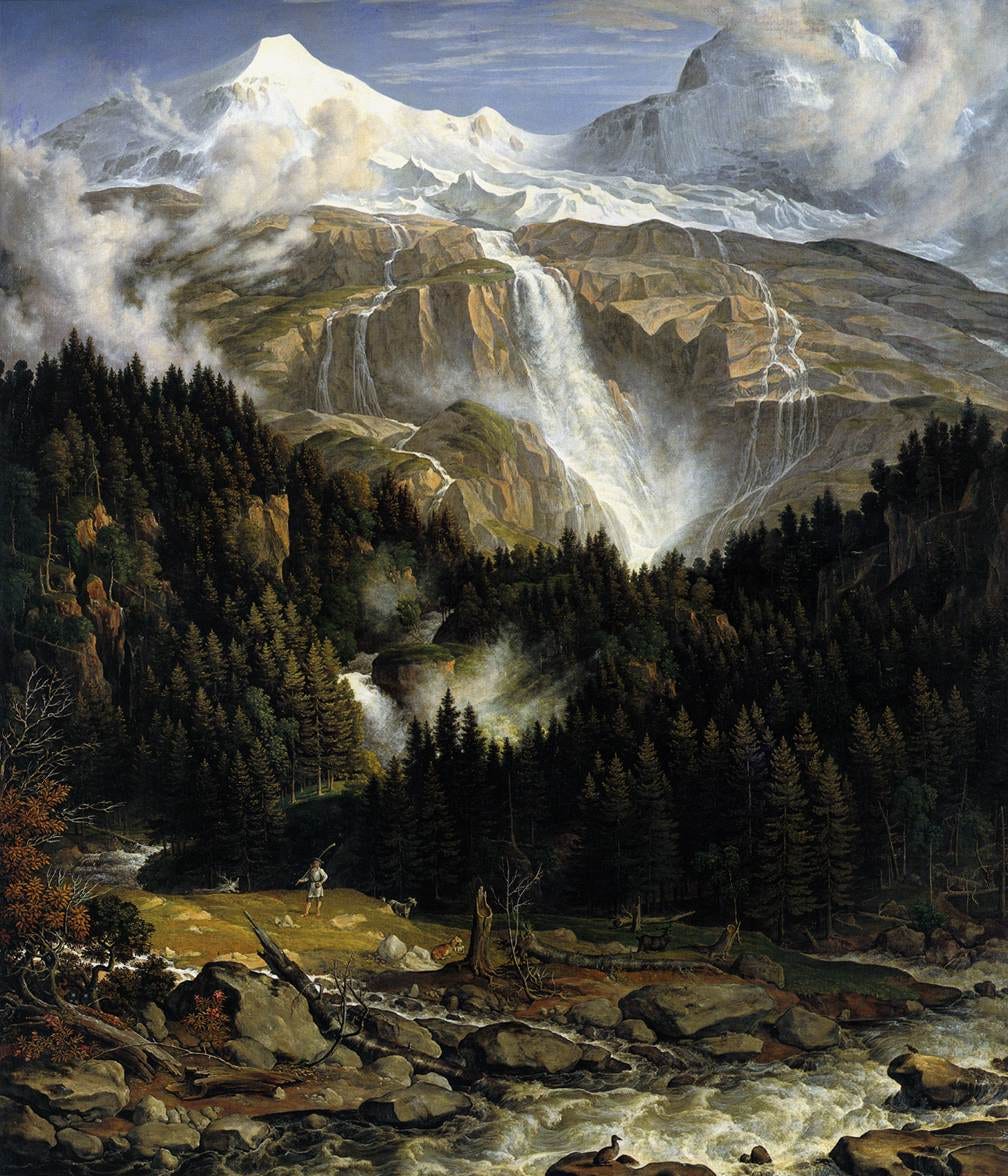
12. Joseph Anton Koch, The Schmadribach Falls (about 1822)
A wild Alpine valley climbs in stages from a foaming waterfall at the bottom up to a wall of snowy peaks and a huge sky, the whole of nature stacked into one heroic view.
Koch, a shepherd's son from the Tyrol who ran away from a strict art school, became the great painter of the ideal mountain landscape.
He built this valley out of many real Alpine places fused into one grand, orderly whole, every zone of plant and rock in its right place.
It is nature imagined as a moral order, rising from wild torrent up to a serene summit. His heroic peaks shaped how a whole generation of Romantics learned to see the Alps.
Mountain paintings, questions people ask
What is the most famous mountain painting? Caspar David Friedrich's Wanderer above the Sea of Fog, closely followed by Cezanne's many views of Mont Sainte Victoire.
Why did artists paint mountains? Mountains stood for the sublime, that mix of beauty and terror, and for the smallness of people before a vast and ancient world.
What is the sublime in art? A feeling of awe edged with fear, stirred by things too huge or wild to fully grasp, like a storm, an ocean or a mountain.
Which real mountains appear most in art? Mont Sainte Victoire in France, Mount Fuji in Japan, the Swiss Alps and the peaks of the American West.
Who painted the American mountains best? Albert Bierstadt and Thomas Moran, whose huge canvases of the West helped inspire the first national parks.
If these peaks pulled you in, you will love these too:
Lady with an Ermine, detail by detail, why she is holding that animal
The secret behind Hopper Soir Bleu, the clown picture that went wrong
Titian, Sacred and Profane Love, which of the two women is which
The pull of the peak
A mountain gives a painter everything, scale, danger, silence and light, and asks in return that they admit how small they are. That is the strange thrill of these pictures, the way they shrink us and lift us at the same time.
Whether it is a lone figure in the fog or a peasant at noon on a high pasture, someone is always looking up. Stand in front of any of them and, for a moment, so are you.