Famous Mushroom Art: 12 Works Full of Fungi

Mushrooms have been painted for five centuries, as poison, as magic and as the strangest beauty on the forest floor, from Bosch and Beatrix Potter to the fairy toadstools of Victorian England.

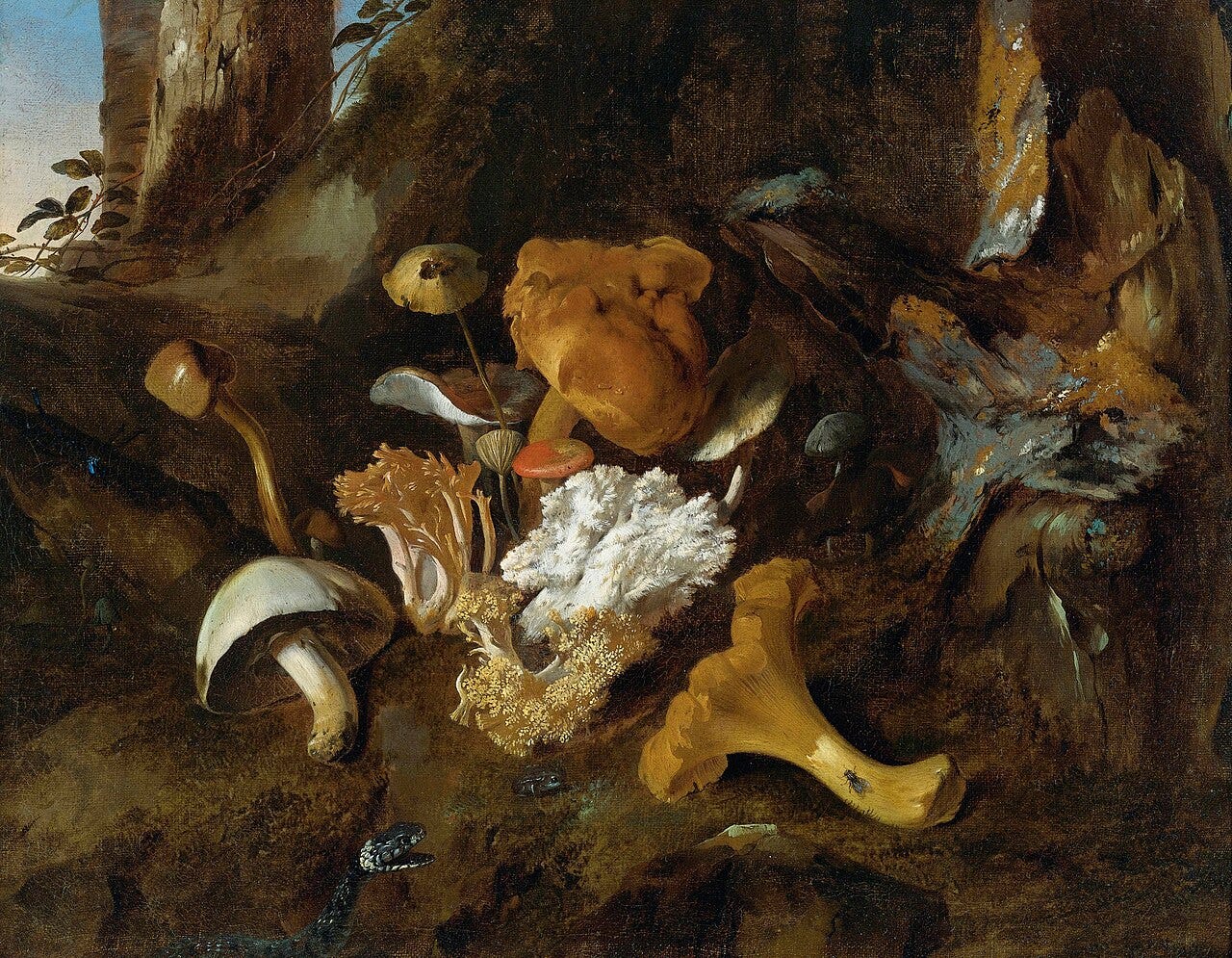
Dark forest floor with mushrooms, snake and moths
Otto Marseus van Schrieck, Forest Floor Still Life with Mushrooms, about 1660

Europe spent centuries treating fungi as poison and rot, while in Japan the autumn mushroom hunt was a pleasure worth a print. Painters on both sides could not leave them alone.

Here are twelve of the most famous works of mushroom art, all now in the public domain. I have picked the ones where the fungi are the real subject and not just scenery.


Learn art the fun way. Free stories every week, no boring lectures.


1. Otto Marseus van Schrieck, Forest Floor with Mushrooms (about 1660)

A snake rears at a thistle while moths hover and pale mushrooms push up out of the black leaf litter, the whole scene lit as if by a single low lamp.

Van Schrieck invented an entire genre for this, the sottobosco or undergrowth picture, painting the damp world beneath our feet. His fellow Dutch painters in Rome nicknamed him the Snuffler for the way he rooted about the undergrowth hunting specimens, and back home near Amsterdam he kept snakes, lizards and insects in his own garden.

He gave his fungi the still life precision usually reserved for silver and lemons, except that these are quietly rotting. Dutch and German painters copied his undergrowth for the next hundred years.

2. Hieronymus Bosch, The Garden of Earthly Delights (about 1500)

Bosch triptych of paradise, pleasure and hell
Hieronymus Bosch, The Garden of Earthly Delights, about 1500

Bosch fills his hallucinatory paradise with giant fruit, transparent spheres and swollen forms that look unmistakably like toadstools sheltering naked lovers.

Scholars have argued for a century over whether he knew what fungi can do to a mind, and the honest answer is that nobody knows. The mushrooms are of a piece with everything else here, growth gone wild, pleasure tipping over into rot.

He painted in a world where ergot, a fungus that infects rye, poisoned whole villages with hallucinations and gangrene. Every reading of this panel depends on the symbolism you bring to it, which is why his fungal forms have haunted painters ever since.

3. Frans van Sterbeeck, Theatrum Fungorum frontispiece (1675)

Engraved scene of men buying mushrooms at a market
Frontispiece of Frans van Sterbeeck, Theatrum Fungorum, 1675

Frans van Sterbeeck was an Antwerp priest who spent decades collecting mushrooms and warning his readers which ones would kill them.

The frontispiece of his book shows two gentlemen in wide hats stooping over a basket at a market stall, engraved as the opening image of the first work about fungi ever printed in Dutch.

It carried dozens of plates, some copied from earlier botanists, some drawn from specimens he gathered himself. It appeared at a moment when poisonings were common enough to alarm city authorities.

The picture makes the point of the whole book, that buying a mushroom without knowing it is a small act of faith.

4. Jean Henri Fabre, Fungi of the Vaucluse (about 1890)

Watercolor study of a pale mushroom on white ground
Jean Henri Fabre, fungus study from his Vaucluse watercolors, about 1890

Everyone knows Fabre as the great entomologist of Provence, the man who watched wasps and beetles for fifty years and wrote about them like a novelist.

Almost nobody knows he also painted hundreds of the fungi growing around his house at Serignan, in watercolor so faithful that you can see where the flesh has begun to sag.

He never published them, doubting the colors could be printed truthfully. The poet Frederic Mistral was among the few who ever saw them.

They stayed in a cupboard until long after his death in 1915.


Join 130,000 readers who get the secrets behind the paintings. Free.


5. Beatrix Potter, Fungi Studies (about 1893)

Watercolor study of fungi by Beatrix Potter
Beatrix Potter, fungus study, about 1893

Long before Peter Rabbit, Beatrix Potter painted exact watercolor studies of fungi, catching the gills and the faint bloom on a cap with a naturalist's eye.

She made more than three hundred of them, germinated fungus spores at home under a microscope, and backed the then unpopular idea that a lichen is a partnership between a fungus and an alga.

In 1897 a paper of hers was submitted to the Linnean Society of London, which did not admit women, so a man had to read it on her behalf.

The society formally apologized to her, a century later. Her fungus paintings are kept in the Lake District, and mycologists still consult them.

6. Ernst Haeckel, Fungi (1904)

Symmetrical plate of toadstools on black ground
Ernst Haeckel, Basimycetes, from Art Forms in Nature, 1904

Toadstools bloom across a black page in perfect symmetry, arranged like chandeliers or sea creatures, every gill and stalk drawn with hypnotic exactness.

Haeckel was a German biologist who believed nature was governed by symmetry, and his prints made science look like ornament. This plate came from Art Forms in Nature, the book that shaped Art Nouveau right across Europe.

He was accused, fairly, of tidying his specimens, bending real organisms into prettier shapes to fit his theory. His curving forms fed straight into the ironwork of the age, from the Paris Metro entrances to the doorways of Brussels.

7. John Tenniel, Advice from a Caterpillar (1865)

Caterpillar smoking a hookah on a mushroom, facing Alice
John Tenniel, Advice from a Caterpillar, 1865

Here is probably the most reproduced mushroom on earth, printed in nearly every edition of Alice in Wonderland since 1865. A blue caterpillar sits smoking a hookah on top of it, telling Alice that one side will make her grow taller and the other will make her shrink.

Scholars have long suspected Carroll drew on Victorian accounts of the fly agaric, whose eaters reported distortions in their sense of size, though the link is inferred rather than documented.

Tenniel drew a plain, generic cap, leaving the reader to decide which mushroom it was. He and Carroll fought so bitterly over the pictures that after illustrating the sequel in 1871 he refused to work with him ever again.


Get the story behind the painting, every week, free.


8. Mizuno Toshikata, Mushroom Gathering (about 1893)

Japanese print of a woman gathering mushrooms on a hillside
Mizuno Toshikata, Mushroom Gathering, about 1893

A woman in a fine kimono crouches among pine roots on a hillside, filling a basket with mushrooms, in a woodcut made when the autumn hunt was a fashionable outing in Japan.

Where Europe painted fungi as poison and decay, the Japan of Hokusai and his heirs treated them as a delight worth a day in the hills.

The matsutake shown here was then, and still is, the most expensive mushroom in the country. Toshikata trained under the print master Yoshitoshi and later made his name with dramatic scenes of the war with China, worked up in a Tokyo studio from newspaper reports.

His scene is social observation as much as natural history.

9. Matthias Withoos, Forest Floor with a Frog and a Mushroom (about 1670)

Frog beside a mushroom on a dark forest floor
Matthias Withoos, Forest Floor with a Frog and a Mushroom, about 1670

Withoos went to Rome as a young man, learned to paint the forest floor there, and came home to make rot a subject worth the same care as a pearl.

Here a frog squats beside a single mushroom in the dark undergrowth, everything damp, everything about to be eaten by something else.

In 1672 French troops took his home town of Amersfoort and he fled north to Hoorn. His pupils carried the undergrowth picture on.

Rachel Ruysch, the finest woman painter of the Dutch Republic, began her career with exactly this kind of scene.

10. Richard Doyle, In Fairyland (1870)

Fairies and elves among grasses and toadstools
Richard Doyle, illustration from In Fairyland, 1870

Elves and fairies swarm through grass taller than they are, perched on toadstools, riding beetles, peering out from under red and white caps.

Doyle's book of fairy pictures fixed the toadstool as a fairy seat in the English imagination, and every fairy painted since has been sitting on his mushroom.

He had been the star cartoonist at Punch and resigned on principle when the magazine attacked the Pope. His nephew was Arthur Conan Doyle, who would later be fooled by photographs of fairies.

Fairy rings, the circles that mushrooms really do grow in, were long said to be where the dancing happened, and each ring is one single fungus spreading outward underground for centuries.


Two new stories a week, 130+ secrets unlocked. Start free.


11. Ivan Bilibin, Baba Yaga's Hut (about 1900)

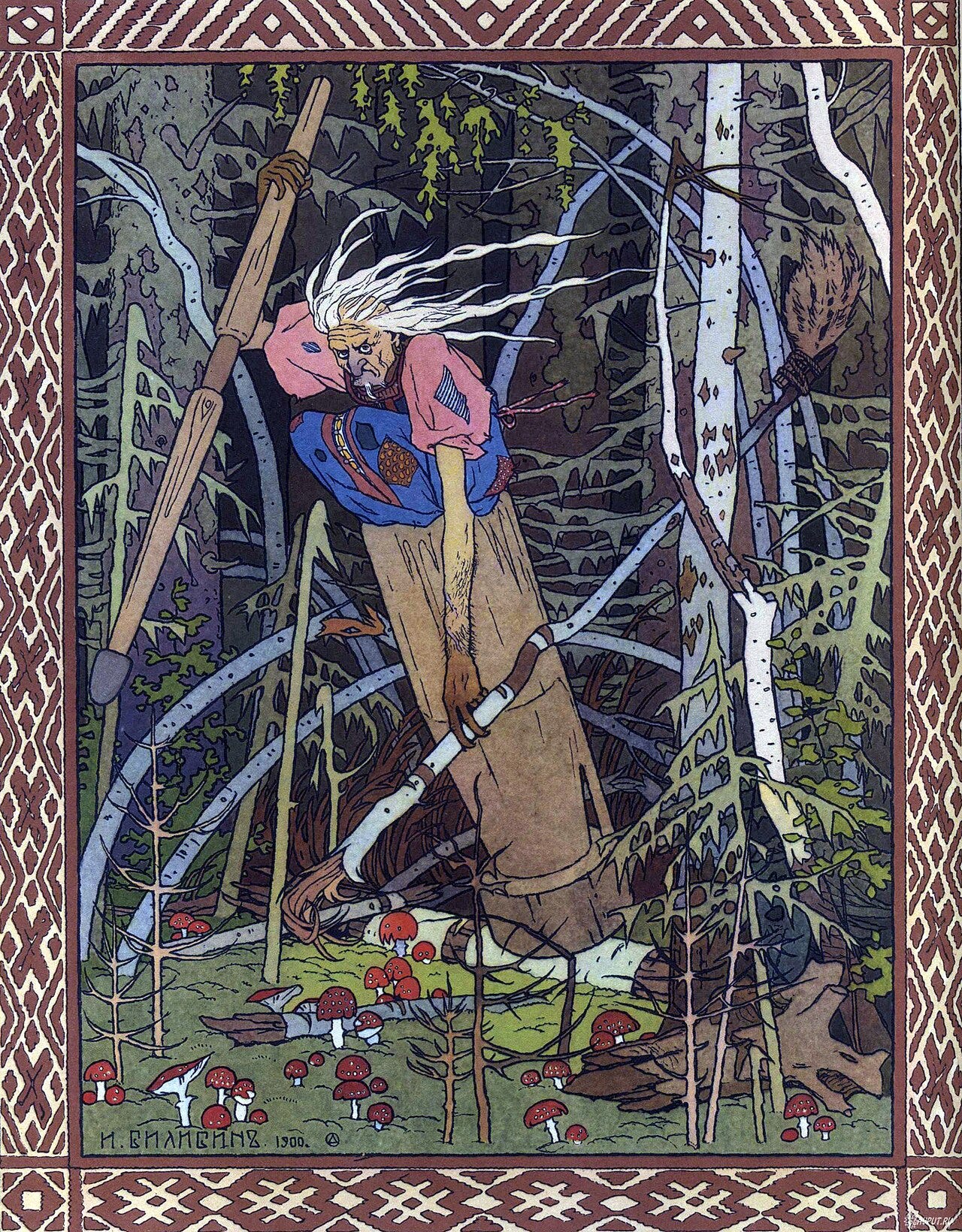
Baba Yaga in a mortar flying through a pine forest
Ivan Bilibin, Baba Yaga, about 1900

A witch's hut on chicken legs stands in a black pine forest, and at its feet the fly agaric grows red and white among the moss, drawn in flat color and hard black outline.

Bilibin gave Russian folk tales their look, borrowing from peasant embroidery, from Japanese prints and from the iconography of Russian religious painting.

The fly agaric runs deep in Russian and Siberian folklore, where shamans in the far north genuinely used it. His mushrooms are not decoration, they are a signal that you have crossed into the other world.

Bilibin died during the siege of Leningrad in 1942, having refused to leave the city.

12. James Sowerby, English Fungi (1797 to 1815)

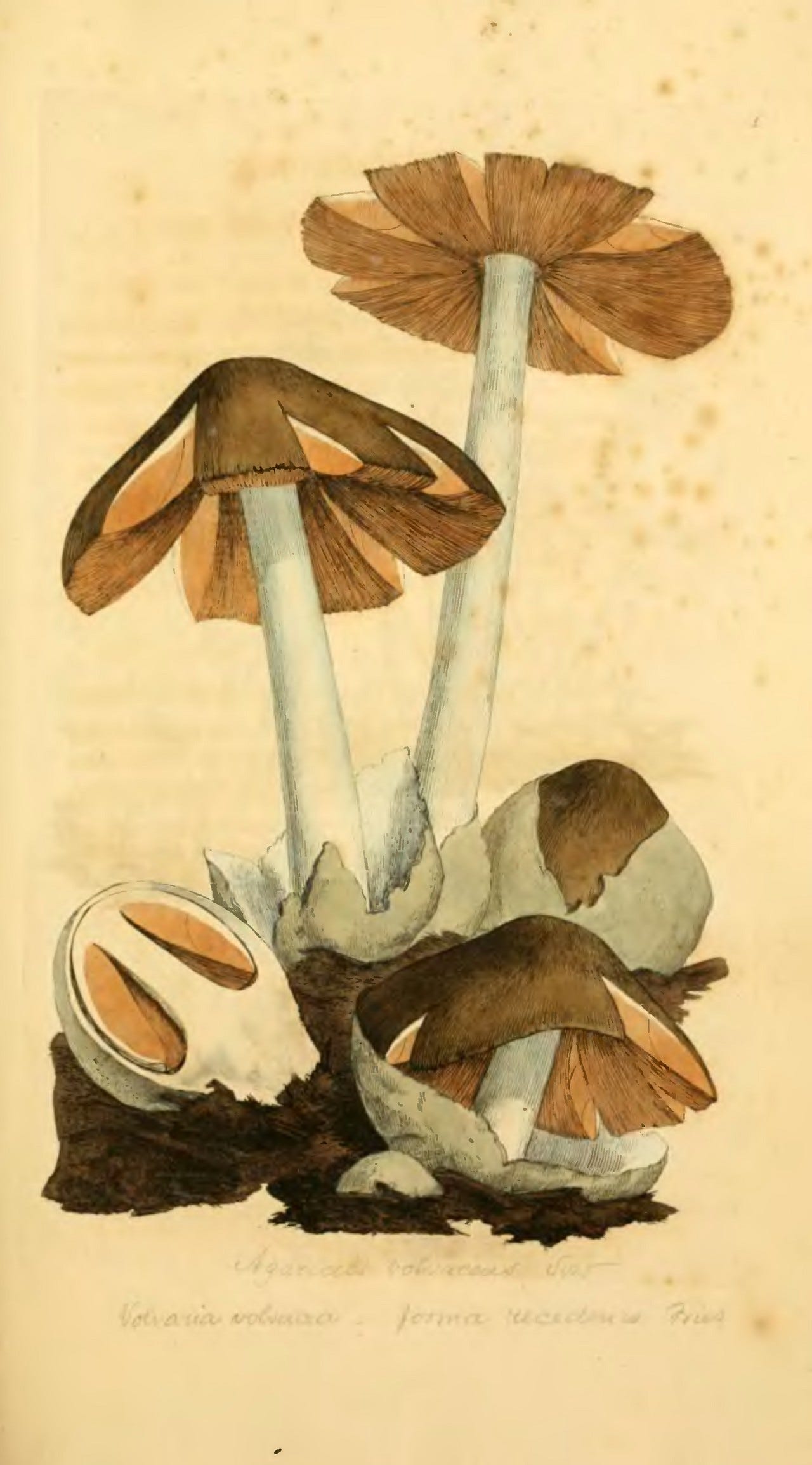
Hand painted plate of English fungi on white ground
James Sowerby, English Fungi, plate 53, 1797 to 1815

Sowerby produced more than four hundred plates over nearly twenty years, working from specimens posted to him by collectors all over Britain.

Fungi collapse within hours, so every drawing was a race against rot, finished before the specimen gave way. Mushrooms float on his white pages, painted from life and colored by hand, in the first great English attempt to record every fungus in the country.

Several species were named from these plates and carry his name to this day. Mycologists still open the book to settle an argument about what a Georgian collector actually found.


Mushrooms in art, from poison to paradise

  • Why are mushrooms in so much art? They are beautiful, deadly and appear overnight, so painters used them for decay, magic and the hidden life of the forest.

  • What do mushrooms symbolize in art? In Western art usually decay, poison and the underworld; in Japanese and Chinese art, long life, luck and good fortune.

  • Did Bosch paint hallucinogenic mushrooms? Nobody knows. His fungal shapes are suggestive, but there is no evidence he knew their effects, and the theory remains speculation.

  • Was Beatrix Potter really a mycologist? Yes. She painted over three hundred fungi and studied spore germination before turning to children's books.

  • Why is the red and white mushroom always in fairy tales? It is the fly agaric, a real hallucinogenic mushroom of northern forests, long tied to folklore and shamanism.


If these fungi pulled you in, you will love these too:


What grows in the dark

A mushroom appears overnight, feeds on death, and can either nourish you or kill you by morning. No wonder painters could not decide whether to draw it as a fairy's chair or a piece of the devil's supper.

The argument is still running. In the Malheur National Forest in Oregon, mycologists have traced a single honey fungus spreading underground across nearly four square miles, thought to be thousands of years old, the largest living organism ever recorded.

No painter has yet found a way to put that on a canvas.