Music in Art: 12 Famous Paintings of Instruments
Long before recordings, painters tried to make silence sing. These 12 famous works put a lute, a guitar, a virginal, or a full orchestra at their center, and each one uses the instrument to say something about love, class, longing, or the passing of a single held note.
A musical instrument in a painting is rarely just an object. It can stand for harmony between lovers, for the fleeting nature of pleasure, or for the artist showing off a hand as skilled as any player.
Music as love: in many of these scenes, two people making music together is a code for courtship and desire.
Music as vanity: a lute with a broken string was a common reminder that beauty and pleasure do not last.
The show off: painting a musician let artists prove they could render metal, wood, and a caught gesture.
From lute to orchestra: the subject grew from a single Baroque player to Degas crowded opera pit.
If these draw you in, you will also love 7 secrets hidden in famous paintings, the secret inside Vermeer Woman Holding a Balance, and who painted the first Impressionist.
1. Titian, Venus with an Organist and Cupid
A reclining Venus lets Cupid whisper in her ear while a richly dressed man at an organ turns his head to look back at her body. Titian painted this arrangement around 1550, one of several versions he made for wealthy patrons.
The organ is part of the seduction. This was a debate painting about the senses, sight against hearing, and whether love enters through the eye or the ear. The organist has chosen to look rather than play.
The picture came to the Prado in 1838 by way of the Spanish royal collection. Titian repeated the theme so often that near twins hang in Berlin and elsewhere.
2. Caravaggio, The Lute Player
A soft faced young musician looks up from a lute, an open songbook and a scatter of fruit and flowers on the table. Caravaggio painted it around 1596 for the Roman collector Vincenzo Giustiniani.
The music is real and readable. The notes on the page are a madrigal about love, so the lute is a love message aimed at whoever stands where you stand. A crack runs across one violin nearby, an old symbol that pleasure decays.
The Giustiniani collection reached the Hermitage in 1808 through the director of the Louvre. Caravaggio himself reportedly called this one of the finest pieces he ever made.
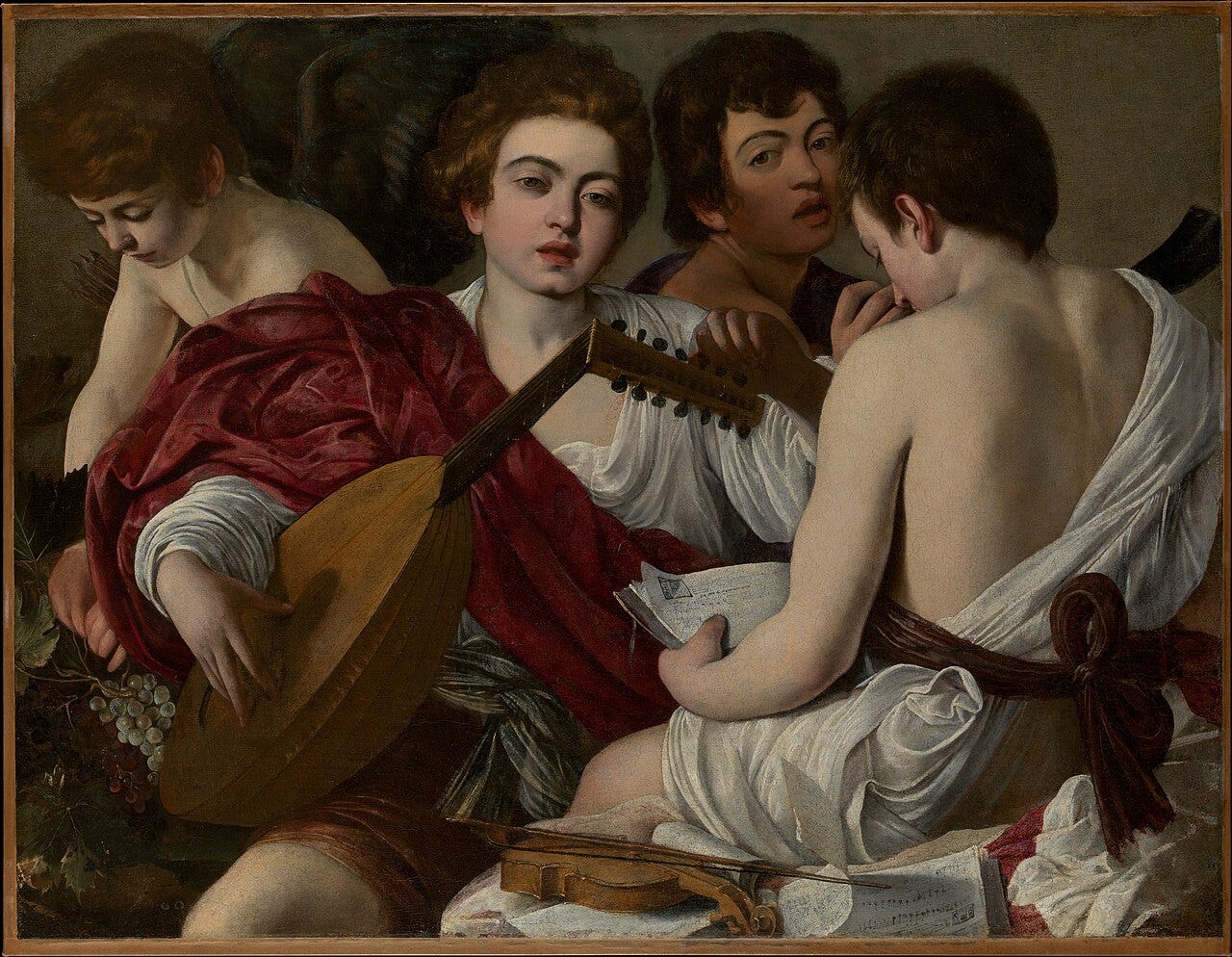
3. Caravaggio, The Musicians
Four boys in loose classical robes tune a lute, hold a cornetto, and study a songbook, one glancing out with damp eyes. Caravaggio painted them in 1597 for his early patron Cardinal del Monte, a passionate music lover.
This is not a real concert but an allegory of Music and Love. The boy at the back, reaching for grapes and fitted with small wings, is Cupid. The picture surfaced only in 1952, bought by the Met from a house sale.
The lute strings are loosened and being tuned, not played. Caravaggio froze the anxious quiet before the first note, not the performance.
4. Gerrit van Honthorst, The Concert
Five brightly dressed singers and players crowd around a table under ostrich plumes, leaning in to follow a concertmaster. Honthorst signed and dated this wide, festive scene 1623, soon after returning from Rome.
The painting vanished from public view for 218 years. It had not been seen since 1795 when the National Gallery of Art bought it in 2013 and put it back on the wall. Honthorst learned his warm candlelight in Italy.
It is more than six feet across. Every performer wears a different loud costume, turning a music rehearsal into a burst of color and noise you can almost hear.
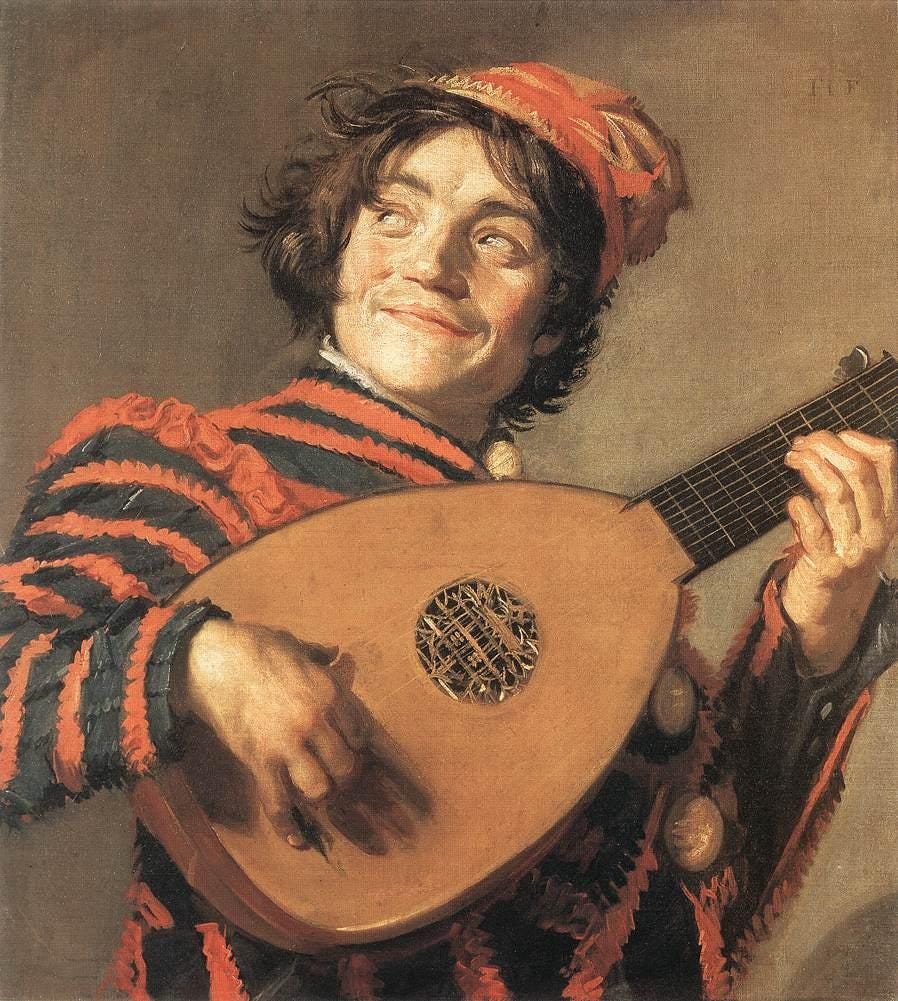
5. Frans Hals, The Lute Player
A grinning man in a jester striped costume glances sideways as he strums a lute. Frans Hals painted him around 1623 with the fast, open brushwork that became his signature.
The loose strokes look almost unfinished up close, then resolve into a living smile from a step back. The half length lute player came from Italy, and the Dutch painter Dirck van Baburen introduced it north in 1622.
The picture was so popular that a period copy still exists. The original hangs in the Louvre.
6. Judith Leyster, The Concert
Three figures make music together, a singer with sheet music, a violinist, and a lute player, smiling in easy harmony. Judith Leyster painted this warm trio around 1633 in Haarlem.
The woman at the center may be Leyster herself. She was one of very few women admitted to the Haarlem painters guild, and for centuries her works were wrongly credited to Frans Hals until her monogram was rediscovered in 1893.
People making music together was a stock Dutch symbol for love and concord. Leyster, painting her own likeness into the harmony, quietly claimed her place in it.
7. Johannes Vermeer, The Music Lesson
A young woman plays a virginal with her back to us while a man stands close, listening. Vermeer built this hushed room around 1662, every tile and window measured with care.
The mirror above the instrument holds a secret. It reflects the woman tilted head turning toward the man, and it also shows the leg of Vermeer easel, proof he painted the scene from life. An inscription reads that music is a companion in joy and a balm in sorrow.
King George III bought it in 1762 as part of a large collection, without fully knowing what he had. It remains one of the rarest Vermeers, held by the Crown.
8. Johannes Vermeer, The Guitar Player
A smiling young woman strums a guitar and looks off to the side, caught mid chord in a bright corner. Vermeer painted her late in his life, around 1672, with an almost casual energy.
The pose is off center in a way that feels modern, the figure pushed to one edge as if the picture caught her by chance. It hangs at Kenwood House through the Iveagh Bequest, left to the nation by Lord Iveagh in 1927.
This is one of Vermeer last works before debt and war closed in. The guitar, then a fashionable new instrument, marks him keeping up with the times to the end.
9. Jean Antoine Watteau, Mezzetin
A stock comedy character in a striped satin costume sits in a garden, guitar raised, singing up toward someone unseen. Watteau painted this figure around 1718, near the end of his short life.
Mezzetin was a lovesick servant from the Italian theater, and Watteau turns a clown into a study of yearning. Behind him a stone statue of a woman turns her back, a quiet joke that his song is aimed at someone who will not answer.
Watteau died of tuberculosis in 1721, only in his mid thirties. The Met acquired this melancholy serenade in 1934, and it stands as one of his most tender inventions.
10. Edouard Manet, The Fifer
A young army bandsman stands alone against a bare gray background, fife at his lips, one foot forward. Manet painted him in 1866 after a trip to Spain, where the flat backdrops of Velazquez left a deep mark.
The Salon jury rejected it in 1866, put off by the empty space and the boy who seems to float without a floor. The writer Emile Zola defended Manet in print, praising exactly the plainness the jury hated.
The fife is a small detail, but it is the reason the boy holds his frozen pose. Manet exhibited the rejected picture himself in 1867, and it now anchors a room at the Orsay.
11. Edgar Degas, The Orchestra at the Opera
We look up from inside the orchestra pit at the backs and faces of the musicians, bassoons and double basses crossing the frame, while ballet dancers glow in a strip of light above. Degas painted this odd viewpoint around 1870.
It began as a portrait of one player. The bassoonist Desire Dihau, a friend of Degas, sits at the center, and the picture grew outward into the whole pit. It is the first time dancers appear in Degas work, the subject that would define the rest of his life.
The dancers are cut off at the shoulders by the top edge, faceless and secondary. Degas cared about the men making the music, not the show they accompanied.
12. Pierre Auguste Renoir, Girls at the Piano
Two girls lean over a piano together, one seated and playing, one standing to follow the score, in a soft bourgeois parlor. Renoir painted this quiet duet in 1892.
It was made for the state. The French government wanted a Renoir for the Musee du Luxembourg, so he treated it as a showcase and painted the subject several times over to get it right. Extra oil and pastel versions survive in other museums.
The picture marked official acceptance for a painter once mocked. The instrument here is not drama or seduction, just two children learning music on an ordinary afternoon.
Where to see them
Musee d Orsay, Paris: Manet The Fifer, Degas The Orchestra at the Opera, and Renoir Girls at the Piano.
Metropolitan Museum of Art, New York: Caravaggio The Musicians and Watteau Mezzetin.
Hermitage Museum, Saint Petersburg: Caravaggio The Lute Player.
Museo del Prado, Madrid: Titian Venus with an Organist and Cupid.
National Gallery of Art, Washington: Honthorst The Concert.
What the instrument really means
Many of these are genre scenes where two people making music stands for courtship, and a broken string quietly warns that pleasure fades.
Others are portraits that let the painter show off a caught gesture, and later Impressionist works that traded the lute for the modern opera pit.
Music in art, questions people ask
What is the most famous painting with a musical instrument? Vermeer music scenes and Caravaggio The Lute Player are among the best known. Watteau Mezzetin is the definitive image of a lone guitar player.
Why do old paintings show lutes so often? The lute was the fashionable instrument of the Renaissance and Baroque home. Painters used it for love scenes and, with a broken string, as a symbol that pleasure fades.
What does music symbolize in art? Music usually stands for harmony and love, especially between couples. It can also signal vanity and the shortness of earthly pleasure.
Did Vermeer paint many musical scenes? Yes. Several of his roughly 34 known paintings feature women at a virginal or guitar, using the instrument to suggest courtship and quiet inner life.
Where can I see famous music paintings? The Musee d Orsay, the Louvre, the Metropolitan Museum of Art, and the Prado each hold major examples from this list.
The note that never ends
Degas started The Orchestra at the Opera as a favor to one friend, the bassoonist Desire Dihau, then let the whole pit crowd into the frame. That single portrait pulled Degas toward the ballet, the subject he would chase for the next forty years. One musician, painted around 1870, quietly set the course of a career. The instruments in these frames are silent, but they are still giving orders.