
Painters could show Christ preaching, dying and rising again, but his birth set them a harder problem: how to paint a delivery that is also a miracle? Their answer kept changing for centuries. The mother lay down, then knelt. The baby slept in a manger, then shone on the bare ground. And one saint gave up on pictures altogether and staged the scene with a live ox.
Cool Stories About Art is a newsletter to learn art the fun way.
Join 200,000+ readers and get:
10 new art stories / month
The entire archive of content (140+ articles)
Comment, ask questions, and chat with other readers
What a Birth Asked of Painters
The Gospel of Luke gives painters very little to work with: a manger, shepherds watching their flocks at night, a choir of angels. It says nothing of an ox, a donkey or a midwife. Painters had to invent the rest, starting with the hardest question of all: how should a mother look an hour after giving birth?
The first answer came from Byzantine icons. There, the birth takes place in a cave, the mother lies down to rest and women bathe the child. From the 1400s, many painters followed a different source, the vision of a mystic, in which the mother kneels and the child glows on the ground.
The twelve paintings below show the birth itself, the manger and the shepherds. The kings and their gifts belong to another scene, so they stay out. Each painting was chosen for the answer it gives to that old question, and for the story that comes with it.
12. Follower of Jan Joest of Kalkar, The Adoration of the Christ Child (about 1515)
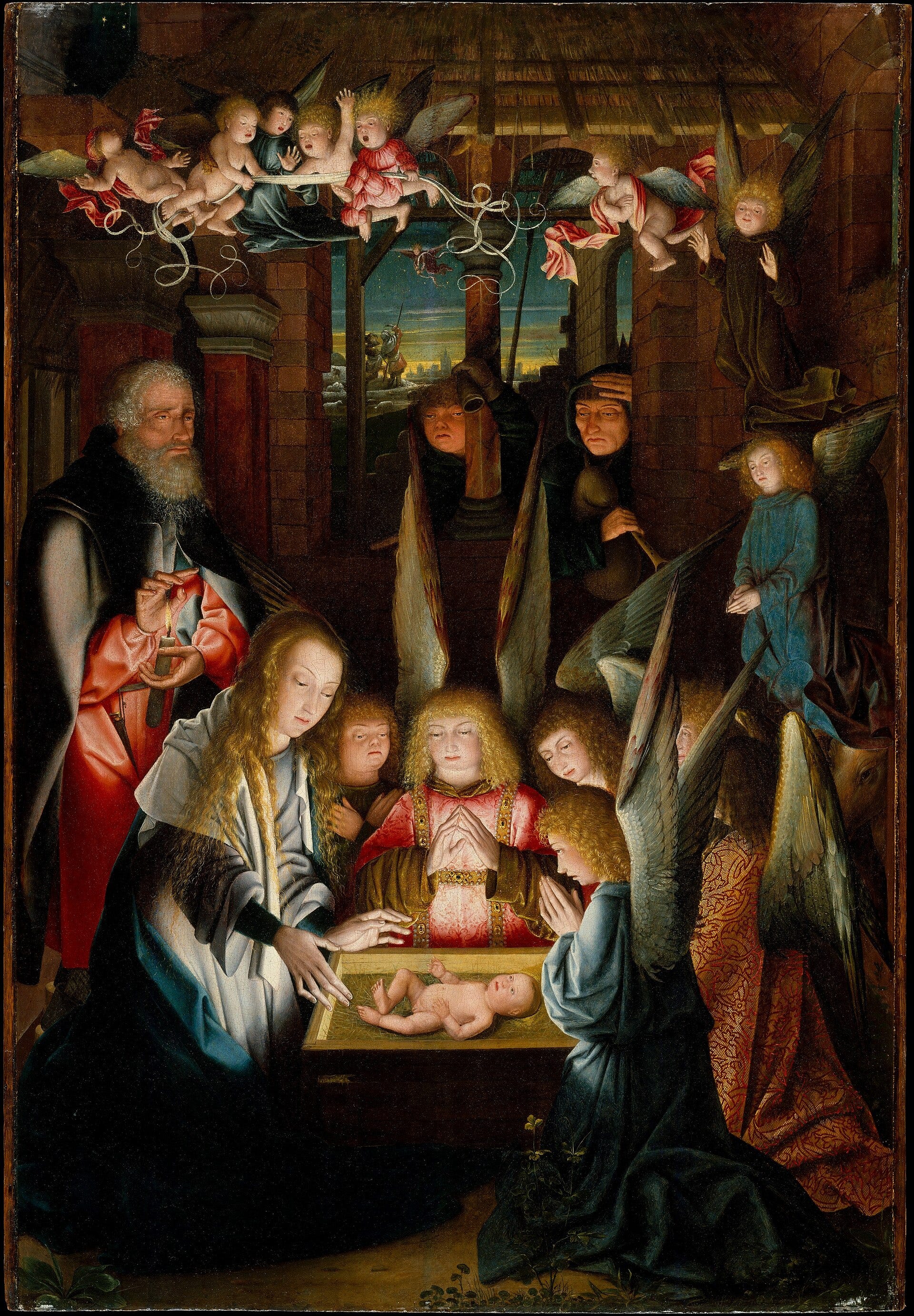
The newborn lies naked on the bare ground, and the only light in the ruined stable comes from his own body. A very young Virgin kneels before him, her long hair loose on her shoulders. Small angels kneel in a ring around them, and behind a wooden post in the center, shepherds lean in to look.
This arrangement comes from a vision. Bridget of Sweden, a mystic of the fourteenth century, described the birth of Christ as she had seen it in prayer, with the child lying on the ground and giving off "a great and ineffable light." Painters in the Netherlands took up her account and made it their own.
This particular composition goes back to a lost work by the Flemish master Hugo van der Goes, known today only through drawings and a long series of copies. The man who painted this version has no name. He is known only as a follower of Jan Joest of Kalkar, a painter active in the early 1500s.
Five centuries later, one of his angels caught the attention of two researchers, Andrew Levitas and Cheryl Reid. In 2003, in the American Journal of Medical Genetics, they proposed that the angel standing beside the Virgin, and one of the shepherds, have the facial features of Down syndrome.
If they are right, these two faces are among the earliest images of people with Down syndrome in Western painting. The authors set out the limits of their reading themselves. Nobody can know, they wrote, whether anyone in that time and place saw a disability at all, and nobody knows who sat for these faces.
What strikes me is where the painter placed that angel: among the others, at the Virgin's side, a step away from the child and his light.
At a Glance
Artist: Follower of Jan Joest of Kalkar (active about 1515)
Painted: About 1515
Medium: Oil on wood
Size: 104.1 × 71.8 cm (41 × 28 1/4 in)
Where to see it: The Metropolitan Museum of Art, New York
11. Attributed to Giotto, The Crib at Greccio (about 1295 to 1299)
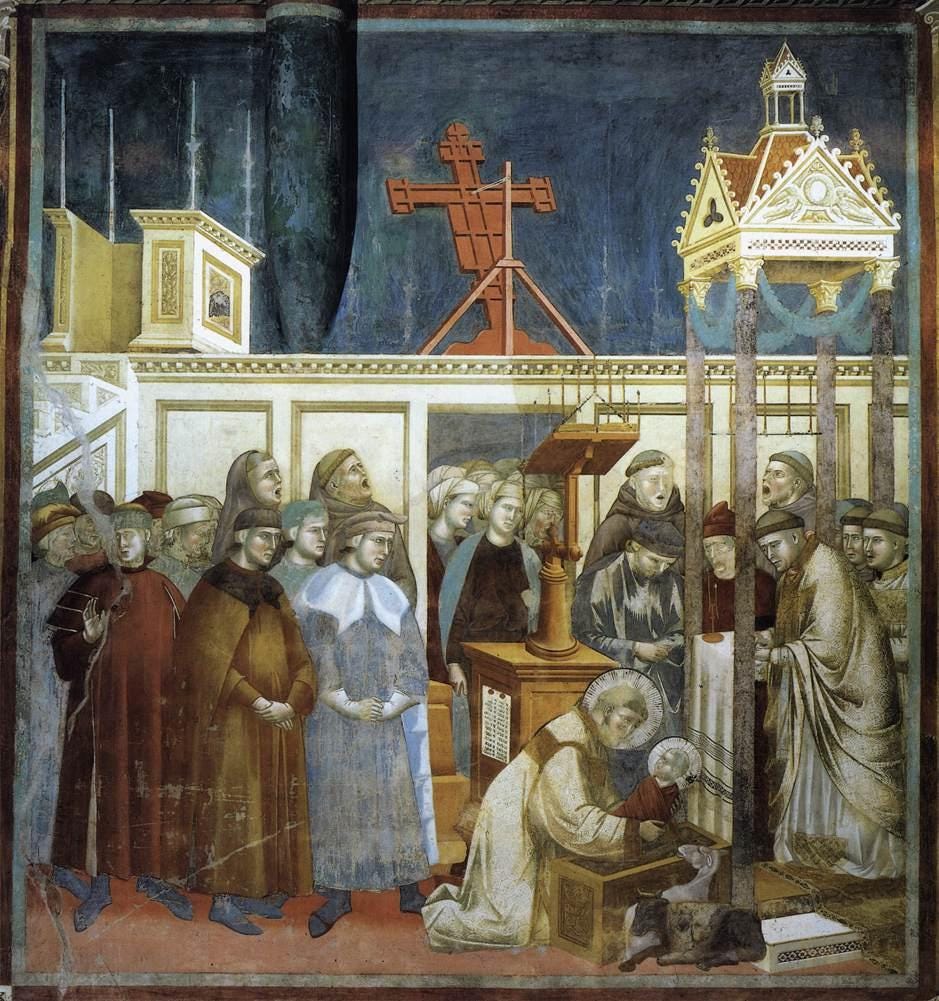
Inside a church full of singing friars, a kneeling man lifts a tiny child from a manger, between an ox and a donkey. The man is Francis of Assisi, who founded the Franciscan order, and the night this fresco shows began with a strange request. A few weeks before Christmas in 1223, he asked a man named John, from the hill village of Greccio in central Italy, for a manger, some hay, an ox and a donkey.