Famous Nature Paintings: 12 That Captured the Living World

The most famous nature paintings zoom in on the living world: Durer's hare, Stubbs's horse, Van Gogh's irises, Monet's lilies and Rousseau's tiger.

These artists stopped painting the wide view and started staring at a single creature or bloom until it breathed.

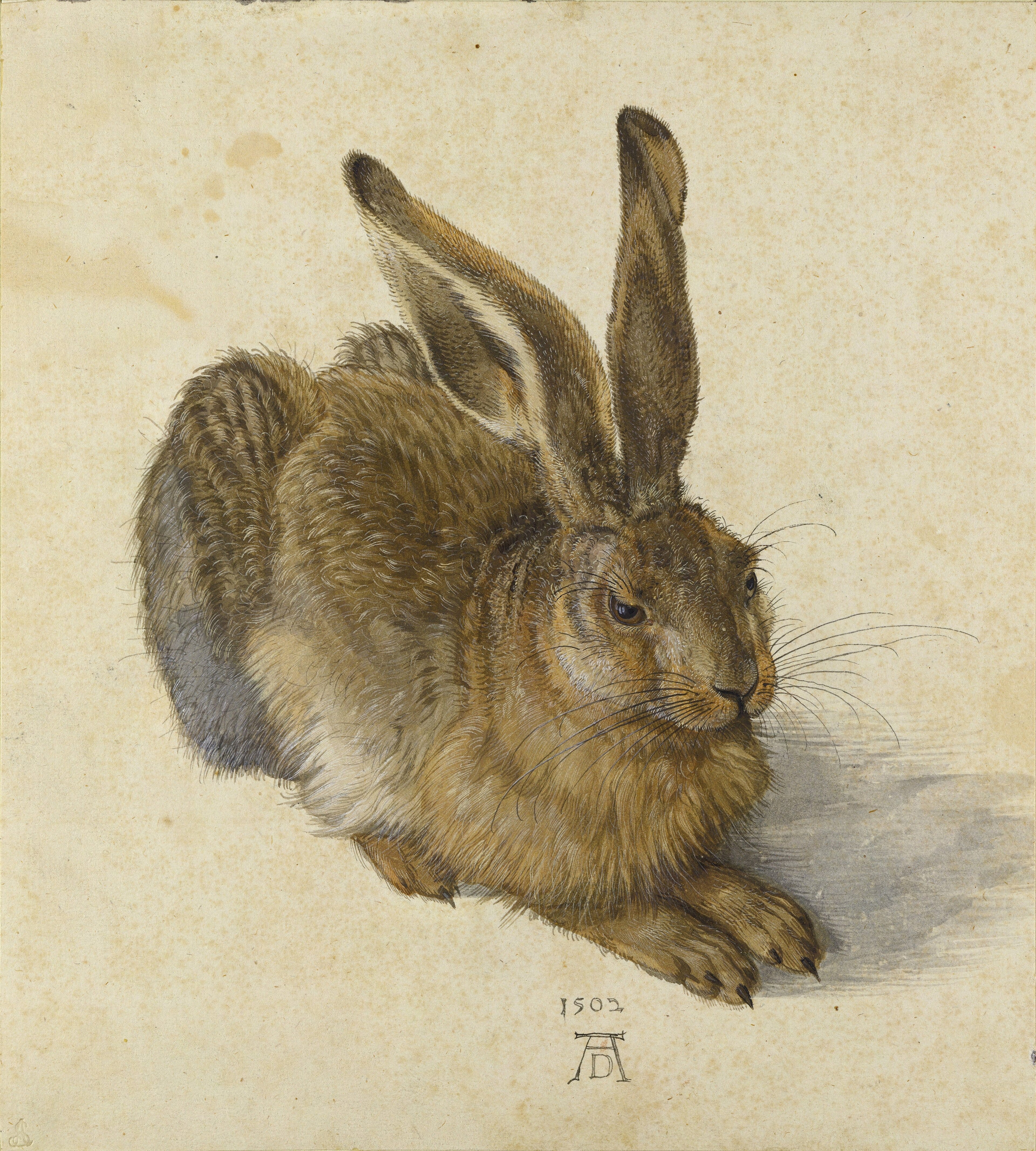
Durer Young Hare watercolor
Albrecht Durer, Young Hare, 1502, Albertina, Vienna

A landscape gives you the whole horizon. Nature painting does the opposite, pressing close to one animal, one flower, one pond, and the best of it can teach you to see a hare or a leaf as if for the first time.

I have picked twelve, and one of them helped invent the watercolor study as real art.

What painters chase in nature:

  • The detail. A single hare, feather or leaf, studied so closely you can count the hairs.

  • The wild. Big cats and stags that carry danger and freedom into a frame.

  • The bloom. Flowers held at their peak, a beauty that in life lasts a day.

  • The water. Ponds and lilies where light, not land, becomes the subject.


Learn art the fun way. Free stories every week, no boring lectures.


Where this gets interesting

If this is the kind of art history you want more of:


1. Albrecht Durer, Young Hare (1502)

A single brown hare sits alert on blank paper, ears up, whiskers catching the light, every hair painted one at a time. Durer made this watercolor study in 1502, and it is still one of the most lifelike animals in all of art.

In the hare's eye sits a tiny cross of light, which many read as the reflection of Durer's studio window, a hint that the animal sat right there in front of him.

Durer even added his famous monogram and the date at the bottom, treating a plain nature study as a finished work, which for its time was a new idea.

2. Maria Sibylla Merian, Insects of Surinam (1705)

Merian Surinam insect plate
Maria Sibylla Merian, plate from Insects of Surinam, 1705

On one sheet a caterpillar, a chrysalis and a full grown moth cluster on the branch of a fruit tree, the whole life cycle shown at once. Maria Sibylla Merian published plates like this in 1705, and they changed how Europe saw the insect world.

She had done something almost unheard of for a woman of her time. At fifty two she sailed from Amsterdam to the jungles of Surinam with her daughter, paid for it herself, and drew living insects and plants on the spot instead of copying dead specimens.

Her work was so admired that centuries later Germany put her face and her creatures on a banknote.

3. Jan van Huysum, Flowers in a Vase (about 1720)

Van Huysum flower bouquet
Jan van Huysum, Flowers in a Terracotta Vase, about 1720

Roses, tulips, poppies and grapes spill from a vase, so crisp you can see the dew and a crawling insect, and yet the bouquet could never have existed.

Jan van Huysum built showpieces like this around 1720 from flowers that bloom in different seasons, spring tulips beside summer roses, assembled from studies made across a whole year.

He guarded the trick like treasure, kept his recipes secret, took years over a single picture, and sold to the richest collectors in Europe, at the very height of the Dutch craze for flowers.

4. George Stubbs, Whistlejacket (about 1762)

Stubbs Whistlejacket rearing horse
George Stubbs, Whistlejacket, about 1762, National Gallery, London

A chestnut racehorse rears up life size against nothing at all, no rider, no saddle, no background, just the animal alone. George Stubbs painted Whistlejacket around 1762, and the emptiness makes the horse look ready to gallop off the wall.

Stubbs earned that anatomy the hard way. For eighteen months he dissected dead horses in a barn, drawing every muscle, and published the results in a book that vets and artists leaned on for a century.

When collectors expected a king or a background added later, Stubbs and his patron left the horse gloriously alone, which is why it still stops people in the National Gallery today.

5. John James Audubon, American Flamingo (1838)

Audubon American Flamingo plate
John James Audubon, American Flamingo, 1838, from Birds of America

A flamingo bends its whole neck to the ground so its pink body can fit the page, filling the sheet from top to bottom. John James Audubon drew it for Birds of America, printed life size on some of the largest book pages ever made.

To catch a wild bird in such sharp detail before the camera existed, Audubon shot the birds himself and wired them into lifelike poses on a board.

He had no backer, so he sold the whole vast work by subscription, plate by plate, and a complete copy is now among the most valuable printed books in the world.

6. Edwin Landseer, The Monarch of the Glen (1851)

Landseer Monarch of the Glen stag
Edwin Landseer, The Monarch of the Glen, 1851

A great stag lifts its antlered head against a Highland sky, proud and untouchable, mist curling around the far peaks. Edwin Landseer painted this deer in 1851, and it became the most reproduced image of Scottish wildlife ever made.

For more than a century the stag was borrowed for whisky labels, soap adverts and biscuit tins, until the noble beast quietly turned into a brand you have seen without knowing.

Landseer had a second life in stone as well, since he also designed the four huge bronze lions that crouch at the base of Nelson's Column in Trafalgar Square.

7. Rosa Bonheur, The Horse Fair (1855)

Bonheur The Horse Fair horses
Rosa Bonheur, The Horse Fair, 1855, Metropolitan Museum

Powerful horses surge and rear through a Paris market, muscles straining, handlers hauling on the reins. Rosa Bonheur finished this huge canvas in 1855, and it made her the most famous animal painter in Europe.

She dressed as a man to make it. To sketch at the rough horse market Bonheur held an official police permit to wear trousers, since a woman in a skirt drawing among the dealers would have caused a stir.

The picture crossed the ocean. It toured to acclaim, was bought by an American collector, and now hangs in the Metropolitan Museum in New York, still one of its favorite paintings.


130,000 readers already get these. Add your email, it is free.


8. Vincent van Gogh, Irises (1889)

Van Gogh Irises blue flowers
Vincent van Gogh, Irises, 1889, Getty, Los Angeles

A bed of blue irises twists and leans, one lone white bloom standing apart among them, every stem alive with movement. Van Gogh painted Irises in 1889, during his very first week inside the asylum at Saint Remy.

He called painting a way to keep himself steady, and he went out to the garden almost at once, studying the flowers instead of his own troubles.

He sold almost nothing in his lifetime, yet in 1987 Irises sold for close to fifty four million dollars, briefly the most expensive painting in the world, and I follow his final year in the last day of Vincent van Gogh.

9. Henri Rousseau, Tiger in a Tropical Storm (1891)

Rousseau tiger jungle storm
Henri Rousseau, Tiger in a Tropical Storm (Surprised), 1891, National Gallery

A tiger crouches in tall grass, teeth bared, as lightning splits a sheet of driving rain and the whole jungle bends in the wind. Henri Rousseau showed this in 1891, the first of the dreamlike jungle scenes that made his name, and he had never seen a jungle in his life.

Rousseau never left France, and built his wild worlds from the hothouses of the Paris botanical gardens, the zoo, and pictures in books.

Critics laughed at his flat, strange style while he lived, then Picasso and the next generation adored it, seeing a fresh kind of imagination the experts had missed.

10. Claude Monet, Water Lilies (about 1906)

Monet Water Lilies pond
Claude Monet, Water Lilies, 1906

The surface of a pond fills the whole canvas, lilies floating on reflections of sky and willow, with no bank and no horizon in sight. Claude Monet painted water lilies like this from about 1906 onward, in the garden he built at Giverny.

He stayed at the pond for nearly thirty years and made around two hundred and fifty of them, working in the open air even as his eyesight failed with cataracts.

At the end of his life he gave a set of huge curved panels to France, and you can follow how he chased light across his whole career in his complete story.

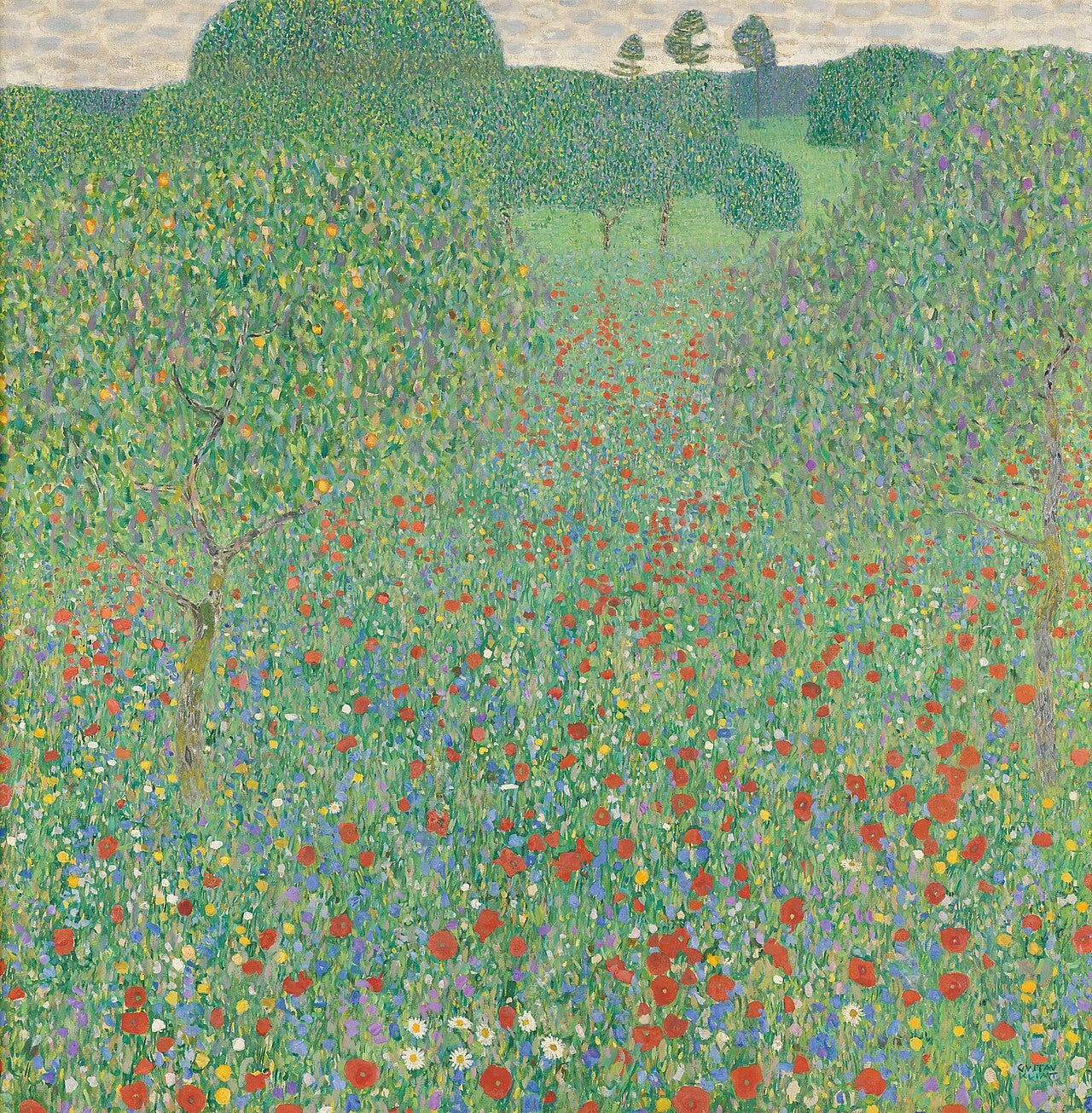
11. Gustav Klimt, Flower Garden (1907)

Klimt flowering poppies garden
Gustav Klimt, Flowering Poppies, 1907, Belvedere, Vienna

A square canvas dissolves into a wall of poppies, daisies and tangled green, so packed that the flowers press right up to the frame.

Gustav Klimt painted garden pictures like this around 1907 during summers by Lake Attersee in Austria, cropping the view like a photograph and tipping it upward so it becomes a flat, glowing screen of color.

These gardens were his escape from the gold portraits that made him famous, painted quietly on holiday. Collectors have chased them ever since: a companion Attersee garden, Bauerngarten, sold in 2017 for around fifty nine million dollars, while this one hangs safely in the Belvedere in Vienna.

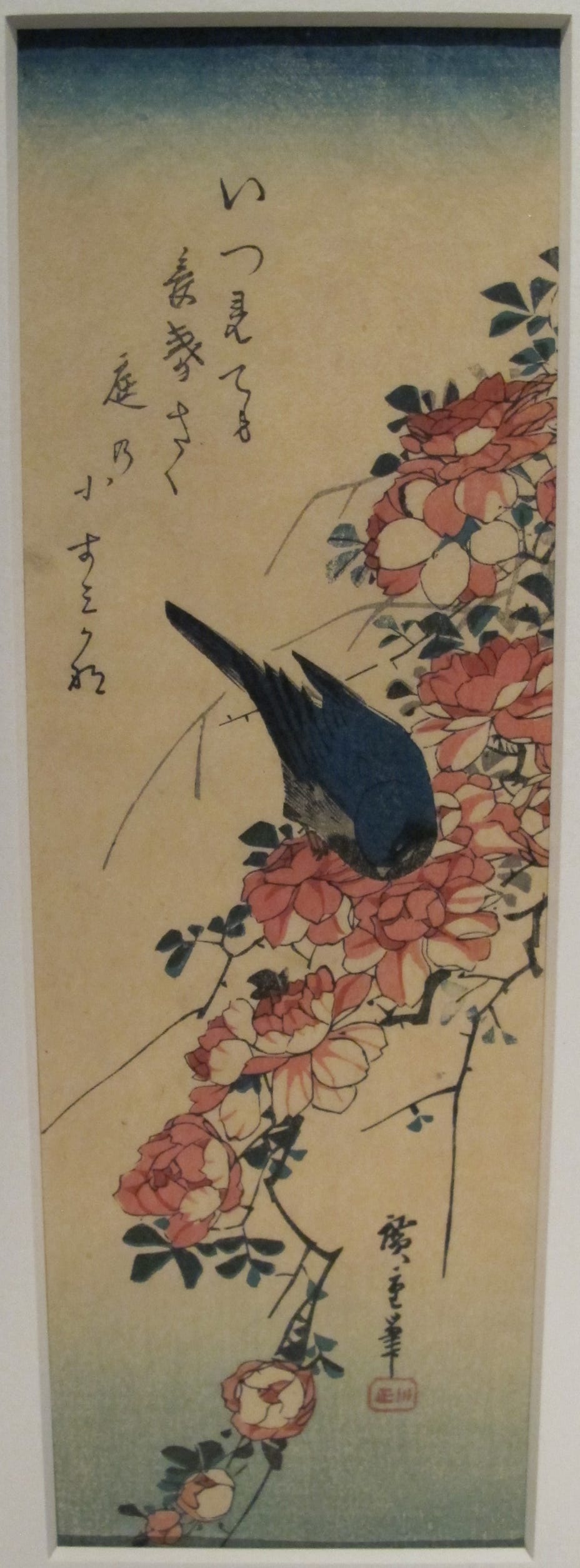
12. Utagawa Hiroshige, Bird and Flower Print (about 1838)

Hiroshige bird and flower print
Utagawa Hiroshige, Bird and Rose, a bird and flower print, 1800s

A small bird perches on a blossoming branch against a flat band of deep blue, a few lines of poetry floating beside it. Utagawa Hiroshige made bird and flower prints like this in the 1830s, a whole Japanese genre devoted to a single creature and plant.

These woodblock prints were cheap, printed in the hundreds, and sold like postcards in old Edo. Decades later they poured into Europe and amazed painters like Van Gogh, who copied Hiroshige directly, so a modest nature print helped push Western art toward flatness, crop and pure color.

That craze even has a name, which you can read in what japonisme means.


Join 130,000 readers who get the secrets behind the paintings. Free.


Where to meet them

  • Durer, Young Hare: the Albertina, Vienna.

  • Stubbs, Whistlejacket, and Rousseau, Tiger in a Tropical Storm: the National Gallery, London.

  • Bonheur, The Horse Fair: the Metropolitan Museum, New York.

  • Van Gogh, Irises: the Getty, Los Angeles.

  • Monet, Water Lilies: the Orangerie, Paris, among many museums.


If the living world in paint pulled you in, wander on:


Two new stories a week, 130+ secrets unlocked. Start free.


Nature in paint, a few quick questions

  • What is the most famous nature painting? Monet's Water Lilies and Van Gogh's Irises are among the most famous, along with Durer's Young Hare and Stubbs's Whistlejacket.

  • What counts as a nature painting? Any work whose real subject is the natural world, animals, plants, flowers, water or insects, rather than people or events.

  • Who painted the most famous horse? George Stubbs, whose life size Whistlejacket from around 1762 is the best known horse portrait in art.

  • What is bird and flower painting? A Japanese and Chinese genre, called kacho e in Japan, showing a single bird and plant, made famous in the West by Hiroshige.

  • Are nature paintings the same as still life? Not always. A cut bouquet on a table is still life, but a living tiger, a flying bird or a garden pond is nature seen alive.

The world, held still for a moment

Set them side by side and you are watching people fall in love with the things that will not sit for a portrait. A hare that would bolt, a moth mid change, a horse that will not stand, a pond that never stops moving.

Merian crossed an ocean at fifty two to draw living insects, Bonheur put on trousers to sketch among the dealers, and Monet chased the same lilies for nearly thirty years as his eyes gave out.

The Young Hare that Durer painted in 1502 is now kept so carefully in Vienna that it is shown to the public only a few times each decade.