The most famous Neoclassical paintings turned ancient Rome into political propaganda: Jacques Louis David’s Oath of the Horatii, his Death of Marat, his Napoleon Crossing the Alps, and Ingres’s Grande Odalisque. Here are twelve, with the year, the museum and the story behind each one.
David voted to execute Louis XVI in January 1793, sitting as a deputy in the National Convention, then became Napoleon’s official painter a few years later. I don’t think his Neoclassicism was ever just a style. It was a weapon for whoever held power in France.
Ingres, his most famous student, won the Prix de Rome in 1801 and spent decades chasing the same cold precision, one impossible spine at a time.
What sets Neoclassicism apart:
Clean line. Brushwork disappears so the drawing underneath does the work.
Antique subjects. Stories borrowed from Rome and Greece, used to argue about the present.
Public duty over private feeling. Figures give up love, family or comfort for a cause.
Cool, even light. Shadows stay sharp and color stays restrained, nothing left loose or vague.
History painting as politics. David painted for the Convention, then for the Empire, without changing his method.
1. Jacques Louis David, The Oath of the Horatii (1784)
Three brothers reach for three swords held up by their father, swearing to fight to the death for Rome. Their sister slumps in the corner, engaged to a man from the enemy family she is about to lose either way.
David painted it in Rome in 1784, working from live models and Roman armor he had studied from ancient ruins. He showed it at the Paris Salon of 1785, and it became the sensation of the show.
No loose brushwork anywhere. The men’s arms and the raised swords form one hard triangle, closer to a carved relief than a painting, and that discipline became the whole style’s signature.
2. Jacques Louis David, The Death of Socrates (1787)
Socrates sits upright on his prison bed, one hand raised as if still arguing, the other reaching for the cup of hemlock his student holds without looking at it.
Plato wrote that Socrates kept debating the immortality of the soul as he prepared to die, and David paints exactly that moment, calm philosophy against a violent sentence.
The painting won over the Salon of 1787. The English painter Joshua Reynolds called it the greatest work of art since Michelangelo’s Sistine ceiling and Raphael’s Vatican rooms.
It now hangs at the Metropolitan Museum of Art in New York, one of the few major Neoclassical history paintings kept outside Europe.
3. Jacques Louis David, The Death of Marat (1793)
Marat lies dead in his bath, one arm hanging over the edge, still holding the pen he used to write for the Republic. Charlotte Corday had stabbed him on 13 July 1793, while he treated a skin condition in the water.
David was Marat’s friend and a fellow member of the National Convention. He painted the scene from memory within days of the murder, turning a political killing into a modern Pietà, the wound placed under the collarbone like a saint’s.
I dig into the murder and the propaganda in full in The Death of Marat: Meaning, the Murder, the Propaganda. The finished painting has belonged to the Musées royaux des Beaux Arts de Belgique in Brussels since 1893.
4. Jacques Louis David, The Intervention of the Sabine Women (1799)
Hersilia throws herself between her Roman husband and her Sabine father, arms spread wide, stopping a battle that would otherwise kill men on both sides of her own family.
David worked on it for three years, from 1796 to 1799, while France was still recovering from the Terror and his own patron Robespierre had just been executed. He said he wanted the calm of Greek sculpture, not the drama of an ordinary battle scene.
It hangs in the Louvre. Its message of peace after a decade of violence and civil war in France was impossible for viewers at the time to miss.
5. Jacques Louis David, Portrait of Madame Récamier (1800)
Juliette Récamier reclines on a bare Directoire sofa in a plain white dress, barefoot, her hair cut short in the style called à la Titus.
David began the portrait in May 1800 and never finished it. One story says Récamier grew impatient with how slowly he worked and sat instead for a rival painter, François Gérard.
The bare room and the empty sofa arm became as famous as the sitter. The Louvre acquired the unfinished canvas in 1826, more than two decades after David set his brush down.
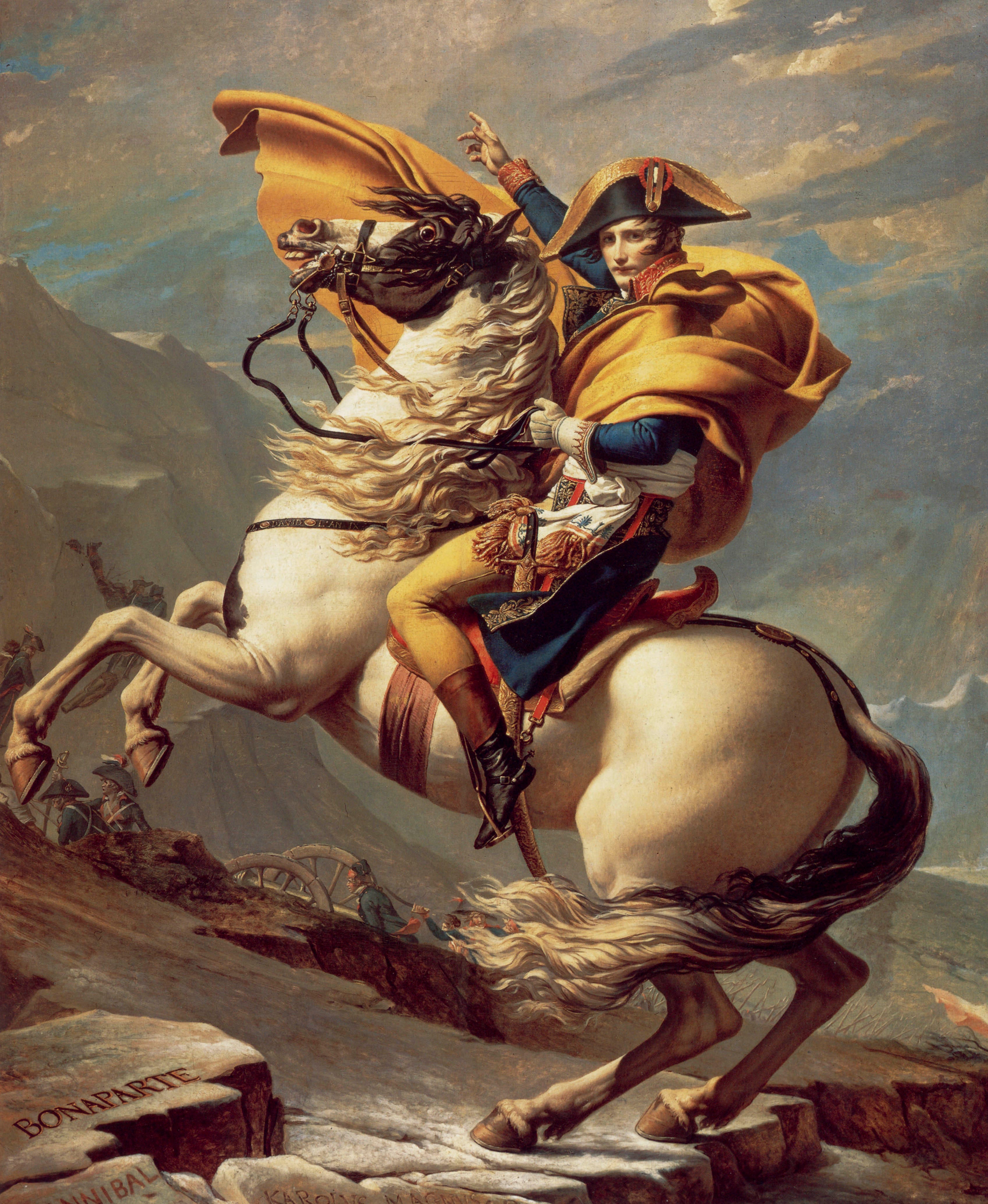
6. Jacques Louis David, Napoleon Crossing the Alps (1801)
Napoleon sits on a rearing horse, cloak snapping in the wind, one arm pointing up toward the pass. The names Hannibal and Charlemagne are carved into the rocks under the hooves, placing him beside history’s great conquerors.
He actually crossed the Great Saint Bernard Pass on a mule, led by a local guide, in far calmer conditions than the painting shows. David painted the myth Napoleon wanted, not the crossing that happened.
I cover the myth against the mule in full in Napoleon Crossing the Alps: The Propaganda vs the Mule. David painted five versions between 1801 and 1805.
7. Jean Auguste Dominique Ingres, Napoleon on His Imperial Throne (1806)
Napoleon sits frontally on a circular throne in his coronation robes, holding the scepter of Charlemagne in one hand and the hand of justice in the other, a laurel wreath on his head like a Roman emperor.
Ingres never painted Napoleon from life. He built the face from other artists’ portraits, and critics at the 1806 Salon said the likeness failed completely.
The painting hangs today at the Musée de l’Armée in the Hôtel des Invalides in Paris, the same building where Napoleon himself is buried.
Ingres’s full career, from the Prix de Rome to old age in Paris, is covered in Ingres: The Complete Story.
8. Jacques Louis David, The Coronation of Napoleon (1807)
Napoleon crowns himself inside Notre Dame Cathedral while Pope Pius VII looks on, seated and passive, stripped of the role he would normally have played.
The canvas is almost ten meters wide. David worked on it for more than two years, with his student Georges Rouget assisting, and finished it in January 1808.
It hangs in the Louvre, a painted record of a ceremony that settled, on canvas, exactly who held the power in the room.
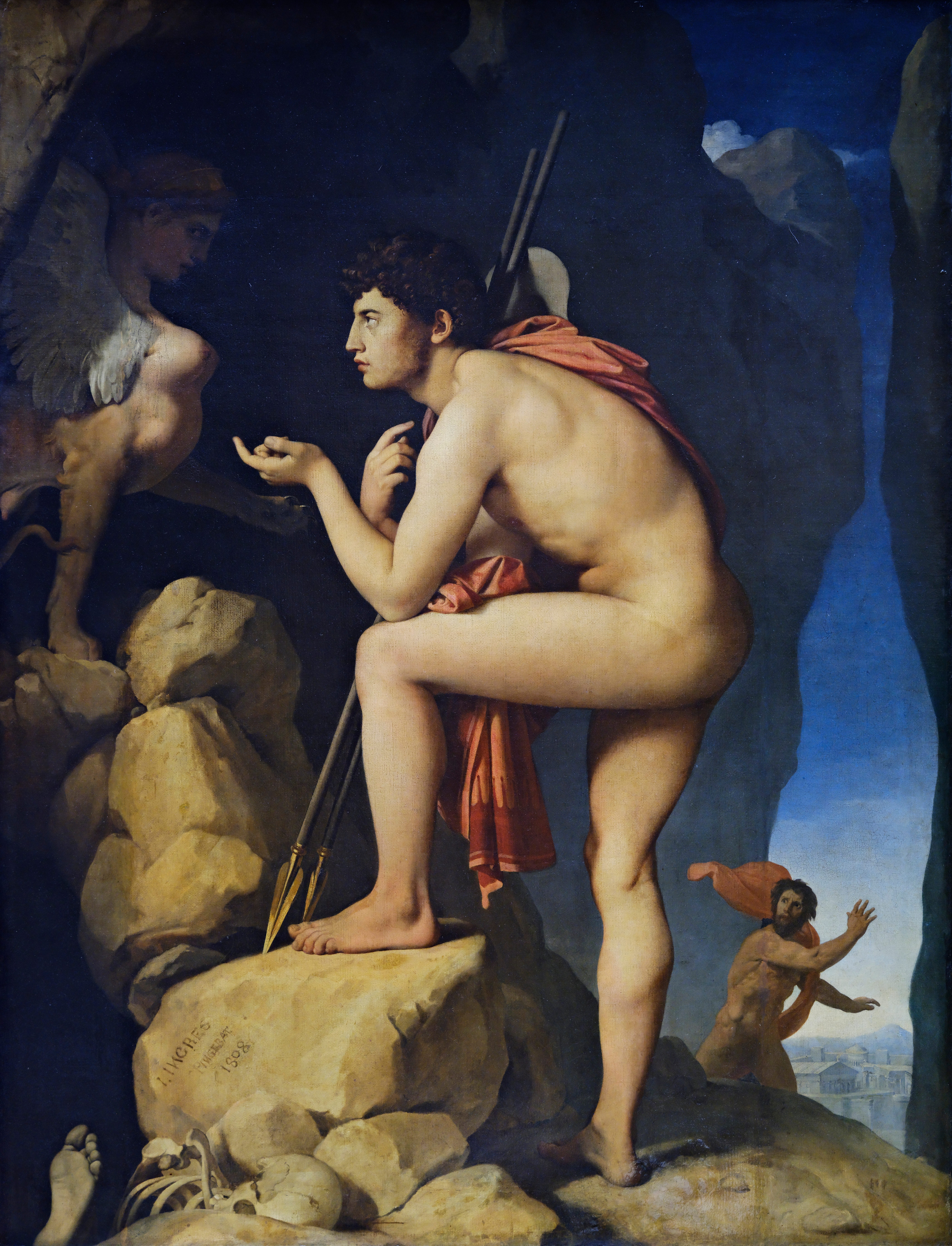
9. Jean Auguste Dominique Ingres, Oedipus and the Sphinx (1808, reworked 1827)
A naked Oedipus leans into a dark cave to answer the Sphinx’s riddle, calm and unhurried, while a fleeing man’s foot in the distance is the only sign of how much danger the wrong answer carries.
Ingres painted the figure in Rome in 1808 as a student exercise, proof that he could handle the male nude. He returned to it almost twenty years later, in 1827, enlarging it into the full scene known today.
The Louvre bought it in 1878. It remains one of the clearest statements of Ingres’s belief that drawing, not color, was where a painting’s real strength lived.
10. Jean Auguste Dominique Ingres, Jupiter and Thetis (1811)
A massive, cloud seated Jupiter dwarfs the nymph Thetis, who kneels at his knee and strokes his chin, begging him to favor her son Achilles in the war at Troy.
Ingres painted it in Rome and sent it to the 1811 Salon as proof of his progress on the King’s scholarship. Critics mocked the exaggerated scale and Thetis’s oddly boneless arm.
The French state bought it in 1834. It has stayed on loan at the Musée Granet in Aix en Provence ever since.
11. Jean Auguste Dominique Ingres, La Grande Odalisque (1814)
A reclining nude looks back over her shoulder from a bed of blue silk, a peacock fan in one hand, her spine stretched into a curve no real body can make.
Ingres added roughly three extra vertebrae to lengthen her back, on purpose, trading anatomy for a single unbroken line. Critics at the 1819 Salon accused him of not knowing how to draw.
It has hung in the Louvre since 1899. I think that deliberate distortion, once used to mock Ingres, is now the exact detail every viewer is told to look for first, and I explain why in La Grande Odalisque: The Deliberate Anatomical Error.
12. Angelica Kauffman, Cornelia Pointing to Her Children as Her Treasures (1785)
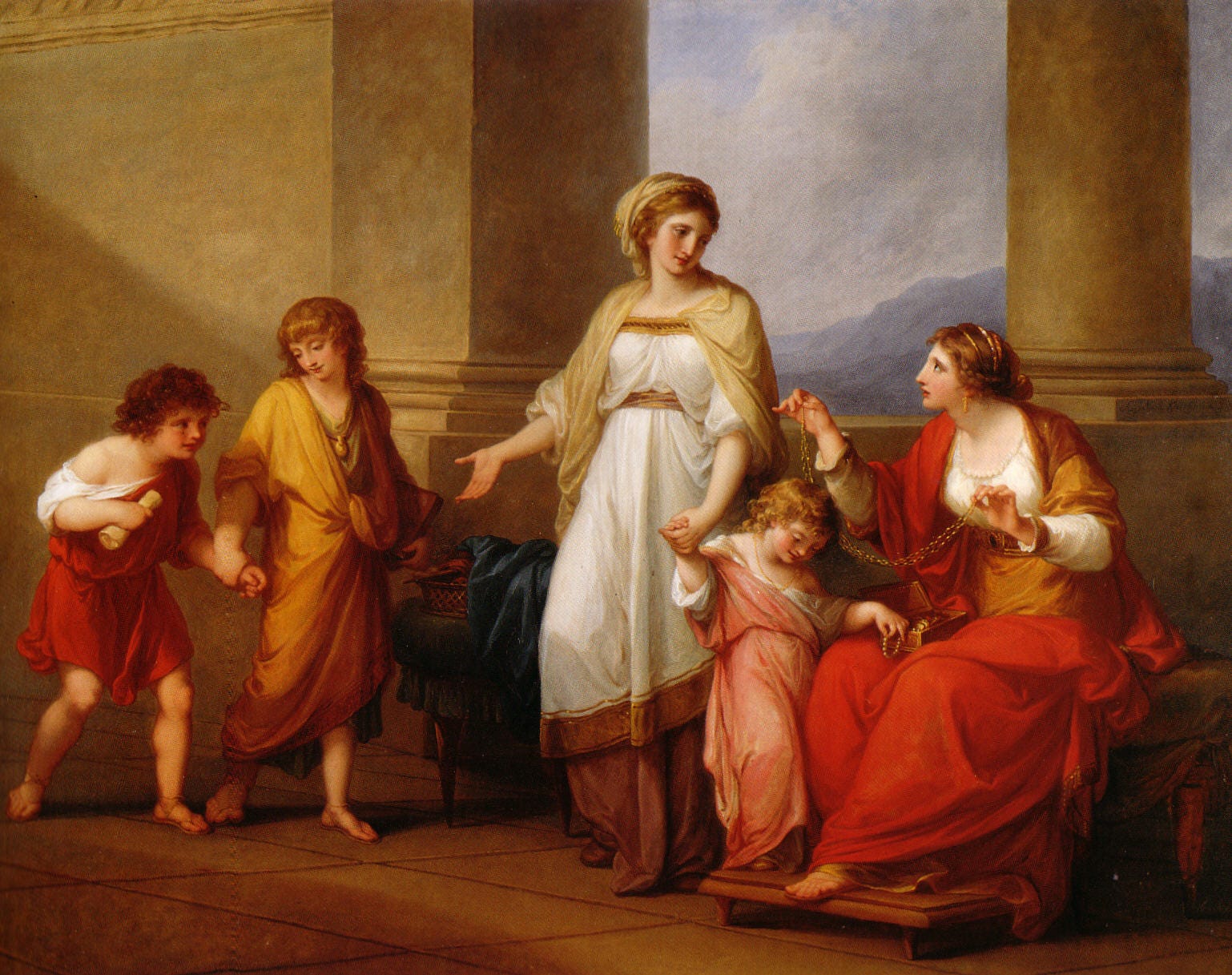
A wealthy visitor holds out her jewels, expecting Cornelia to show off treasures of her own. Cornelia gestures instead toward her two sons, the future Roman reformers Tiberius and Gaius Gracchus, and tells the visitor these are her only treasures.
Kauffman was a founding member of London’s Royal Academy in 1768, one of only two women among the founders, alongside Mary Moser. She kept painting subjects from ancient history and mythology for four more decades, the same moral, antique territory David and Ingres worked in Paris.
It hangs today at the Virginia Museum of Fine Arts in Richmond. Kauffman painted history subjects for a genre that formally barred women from studying the nude model, the core training every history painter needed.
Where the twelve hang
Musée du Louvre, Paris. The Oath of the Horatii, The Intervention of the Sabine Women, Portrait of Madame Récamier, The Coronation of Napoleon, Oedipus and the Sphinx and La Grande Odalisque, six of the twelve in one museum.
Metropolitan Museum of Art, New York. The Death of Socrates.
Musées royaux des Beaux Arts de Belgique, Brussels. The Death of Marat.
Musée de l’Armée, Hôtel des Invalides, Paris. Napoleon on His Imperial Throne.
Musée Granet, Aix en Provence. Jupiter and Thetis.
Virginia Museum of Fine Arts, Richmond. Cornelia Pointing to Her Children as Her Treasures.
Château de Malmaison, the Palace of Versailles, the Belvedere in Vienna and Charlottenburg Palace in Berlin. The five versions of Napoleon Crossing the Alps.
Neoclassical paintings, the questions readers ask
What is Neoclassicism in painting? A movement that revived the order and clarity of ancient Greece and Rome, from about 1760 to 1850, and used it to argue for reason and civic duty over private feeling.
Who are the two most famous Neoclassical painters? Jacques Louis David and his student Jean Auguste Dominique Ingres, working a generation apart between Paris and Rome.
What are the most famous Neoclassical paintings? The Oath of the Horatii, The Death of Marat and Napoleon Crossing the Alps by David, and La Grande Odalisque by Ingres, lead any list.
Was Ingres a Neoclassical or a Romantic painter? Neoclassical by training and by his belief in line over color, though his taste for exotic, emotional subjects like the Odalisque borrowed from the Romantic mood around him.
Where can you see Neoclassical paintings? The Louvre in Paris holds the largest group, with more at the Metropolitan Museum in New York, the Musées royaux des Beaux Arts de Belgique in Brussels and the Musée Granet in Aix en Provence.
What happened to the man who started it
David never went back to France. As a former deputy who had voted to execute Louis XVI, he was exiled to Brussels when the monarchy returned in 1815, and he died there on 29 December 1825.
He was buried in Brussels. His heart was cut out and buried separately, at Père Lachaise Cemetery in Paris, the city that would not take the rest of him back.
Neoclassicism is the seventh of twenty stops in Art Movements in Painting.