Famous Night Paintings: 12 Nocturnes and Dark Scenes
Painting the night is one of the hardest things an artist can try, a whole world lit only by moon, candle or gas lamp, where a single glow has to carry the entire picture.
For centuries painters chased that darkness, from Baroque candlelit saints to the electric blue swirl of Van Gogh. Here are twelve of the most famous night paintings, all now in the public domain.
I have gathered the ones that turned darkness into the real subject, and made a little light go a very long way.
What the archive holds
Three worth opening next:
The secret behind Hopper Soir Bleu, the clown picture that went wrong
The secret behind Monet Magpie, one bird in the snow, and why it matters
Lady with an Ermine, detail by detail, why she is holding that animal
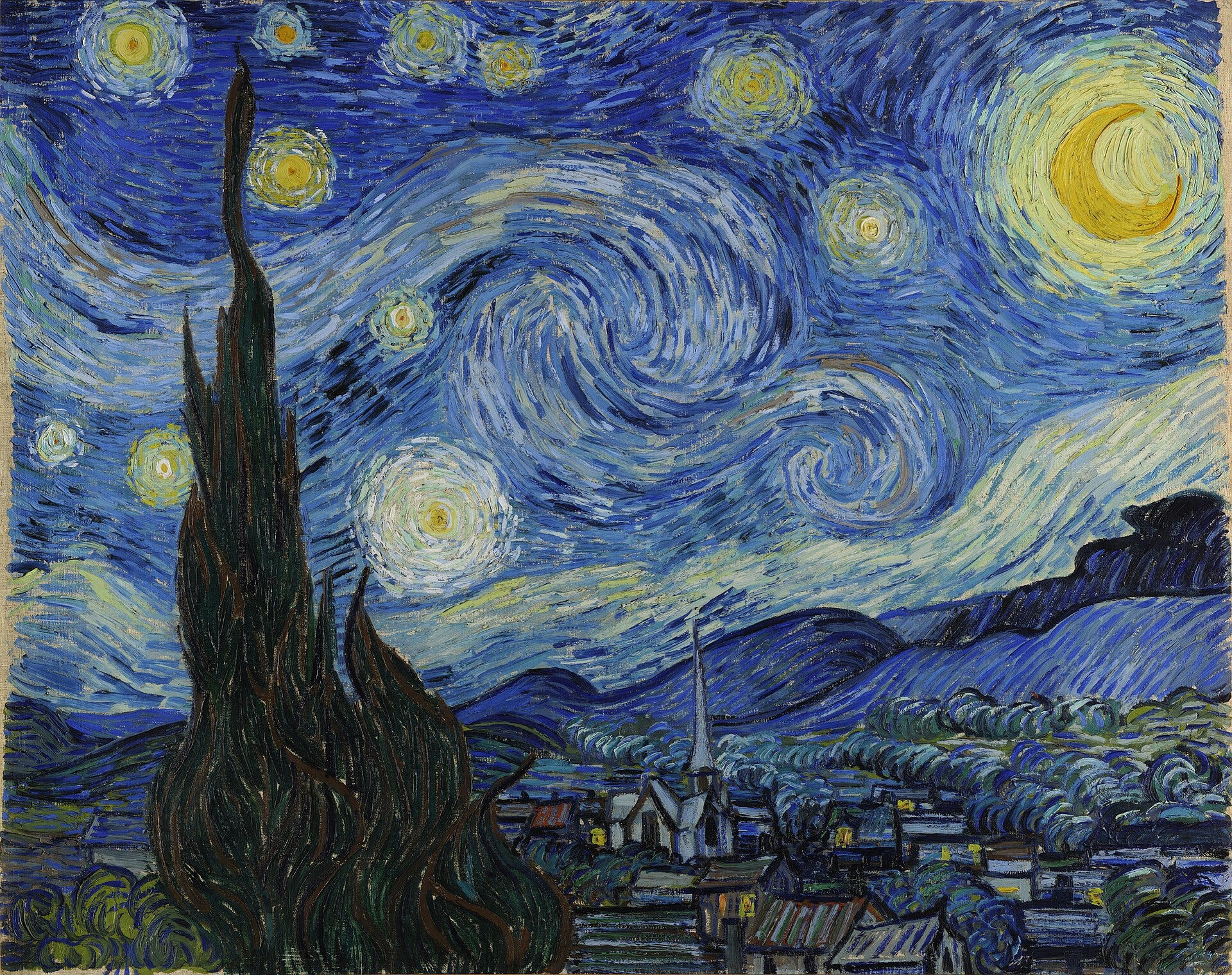
1. Vincent van Gogh, The Starry Night (1889)
The most famous night sky ever painted was made from a barred window in a mental asylum, from memory, in the hour before dawn. Van Gogh painted the swirling stars and dark cypress in June 1889 while he was a patient at Saint Remy in the south of France.
The village below is imaginary, added from his Dutch memory, and the whole sky churns like water though the real night was calm. He thought the picture was a failure and barely mentioned it in his letters.
I dig into why he really made it in the story of The Starry Night It hangs today in the Museum of Modern Art in New York, and though Van Gogh sold almost nothing in his life, this canvas is now among the most reproduced images on earth.
2. Vincent van Gogh, Cafe Terrace at Night (1888)
A year before The Starry Night, Van Gogh painted a golden cafe glowing under a star filled sky in the town of Arles, and it may be the first night scene he ever finished outdoors.
He set up his easel on the street after dark and worked by gaslight and starlight, refusing to use any black at all. The whole picture is built from warm yellow against deep blue, the light of the cafe fighting the cold of the night.
Some scholars read the scene as a hidden Last Supper, twelve figures around a central waiter in white, a claim I weigh in the full piece on his last months The cafe still stands in Arles, repainted yellow to match the picture, and tourists line up for coffee.
3. James McNeill Whistler, Nocturne in Black and Gold The Falling Rocket (1875)
Whistler gave the world the word nocturne, borrowing it from music for his hazy paintings of the Thames after dark. This one shows a firework bursting over the river in smears of gold, so loose that the great critic John Ruskin accused him of flinging a pot of paint in the public's face.
Whistler sued for libel and won, but the court awarded him a single farthing and the costs left him bankrupt. He cared nothing for detail, only for mood and the memory of a color.
When he later saw the moonlit scenes of a rival named Grimshaw, the story goes that he admitted he had thought himself the inventor of nocturnes until then.
4. John Atkinson Grimshaw, Nightfall down the Thames (1880)
The man Whistler envied painted the Victorian city by moonlight better than anyone alive. Grimshaw filled his canvases with wet cobbled streets, bare trees and gas lamps reflected in the damp, every leaf and puddle sharp as a photograph.
He was a self taught railway clerk from Leeds who trained himself to catch the exact orange of a street lamp against a blue dusk. He worked in near secrecy and left almost no letters, so his life is nearly as shadowed as his paintings.
For a century he was half forgotten, and only in recent decades have his moonlit docks begun to sell for large sums.
5. Georges de La Tour, The Magdalene with the Smoking Flame (about 1635)
A young woman sits alone in the dark, one hand resting on a skull, staring into the flame of a single candle that lights the whole canvas.
La Tour built almost his entire art from one small flame in the blackness, a style called tenebrism He was hugely famous in his own day, a painter to the King of France, then forgotten so completely that his name vanished for nearly three hundred years.
Only in the twentieth century did scholars piece his work back together from scattered, misattributed pictures. Now in a Los Angeles museum, it is one of several candlelit Magdalenes he painted, each lit by a single flame that never once flickers.
6. Joseph Wright of Derby, An Experiment on a Bird in the Air Pump (1768)
By candlelight a traveling scientist pumps the air out of a glass globe, slowly killing a white bird inside, while a family watches in wonder and horror.
Wright of Derby was the painter of the new science, and he lit his scenes of experiments and forges like religious dramas, all glowing chiaroscuro A little girl hides her eyes, a man times the death with his watch, and the whole room hangs on the moment life will be snuffed out or saved.
The single candle stands for reason itself, throwing light into the dark of old superstition. It hangs today in the National Gallery in London, but nothing like it existed before 1768, a science experiment staged as a grand drama with a scientist, not a saint, at its heart.
7. Caspar David Friedrich, Two Men Contemplating the Moon (about 1830)
Two men in old German coats stand on a rocky path with their backs to us, gazing up at a thin moon caught in the branches of a dead oak. Friedrich, the great German Romantic, painted the night as a place of longing and quiet awe rather than fear.
The two figures are probably Friedrich himself and a young pupil, sharing a moment of silent wonder. He painted several versions of the scene, and the sight of one is said to have given the writer Samuel Beckett the seed of Waiting for Godot.
Two men, a dead tree and a distant moon were all he needed.
8. Caravaggio, The Taking of Christ (1602)
Soldiers in black armor surge out of the darkness to seize Christ, their lantern the only warm light in a wall of night. Caravaggio painted the arrest as a violent scramble, the traitor Judas grabbing Jesus by the arm, a fleeing man's cloak torn from his shoulder.
On the far right a figure holds up the lantern to see, and that man is Caravaggio himself, painting his own face into the crime. The picture vanished for two hundred years and was found by accident in 1990, hanging unrecognized on the wall of a Jesuit dining room in Dublin.
It still stays there today on long loan, one of the most studied night scenes in all of art.
9. Henri Rousseau, The Sleeping Gypsy (1897)
Under a full moon in a silent desert, a lion sniffs at a sleeping woman who lies beside her mandolin, and neither the beast nor the dreamer stirs.
Rousseau was a self taught customs officer who painted in his spare time and was mocked by critics his whole life.
He described the scene in a letter with childlike calm, the lion drawn to the music but choosing not to attack. The flat, glowing moonlight and the frozen stillness make it feel less like a night than a dream of one.
Picasso found the picture years later in a junk shop, bought it cheap, and helped make Rousseau famous after his death.
10. Frederic Edwin Church, Aurora Borealis (1865)
A lone ship sits frozen in an arctic sea while a vast green curtain of northern lights ripples across the whole sky. Church, the star of American landscape painting, based the scene on sketches from a real polar expedition and on descriptions from an explorer friend.
To viewers in 1865 the eerie lights read as an omen, painted just as the Civil War was ending. A tiny sledge team crosses the ice below, dwarfed by a sky that seems almost alive.
Church never saw the aurora himself, and built the whole glowing heaven from another man's words and a few quick sketches.
11. Winslow Homer, Summer Night (1890)
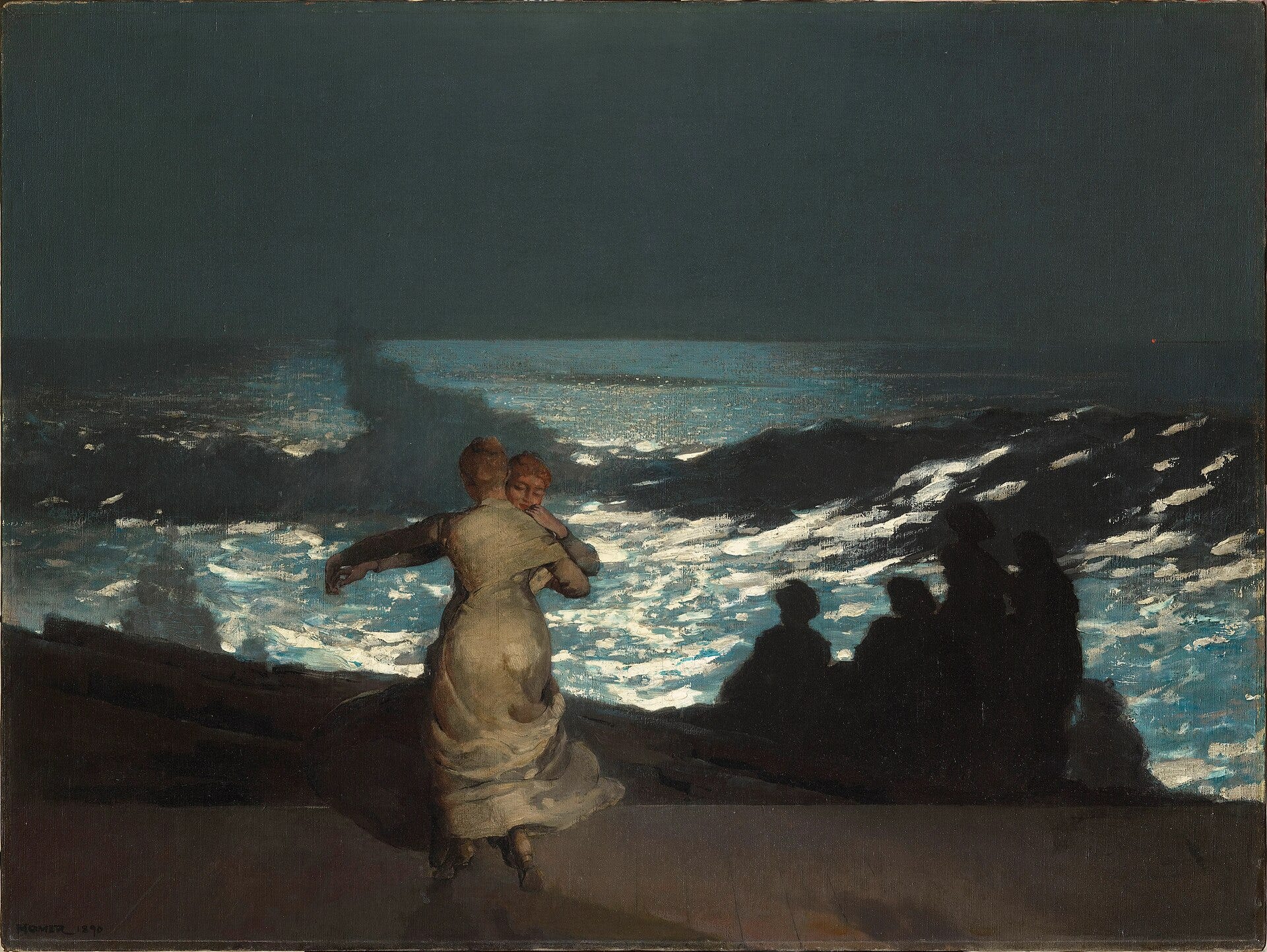
Two women dance together on a moonlit terrace above the sea while dark figures watch the waves crash below in the silver light. Homer painted it late in his life at his lonely studio on the coast of Maine, where he lived almost as a hermit.
The scene is real and strange at once, the dancers lost in their own world, the ocean roaring in the dark behind them. France bought it for the nation in 1900, one of the first American paintings the French state ever acquired, and hung it in the Musee d'Orsay.
Homer, who had once drawn the Civil War for magazines, ended his life painting the sea alone.
12. Ivan Aivazovsky, Moonlight in Naples (about 1842)
A huge moon hangs over the Bay of Naples, laying a road of silver light across the water toward a dark shore and a smoking Vesuvius.
Aivazovsky was the greatest painter of the sea who ever lived, and he caught moonlight on water better than anyone before or since.
He worked at furious speed from memory, finishing some seascapes in a single day, and left around six thousand paintings. The trick of his moonlight is thin, glowing paint laid over a dark ground so the light seems to shine through from behind.
Crowds once paid just to watch him work, and his moonlit bays still draw the biggest sums of any Russian art.
Night paintings, the questions readers ask
What is the most famous night painting? Van Gogh's The Starry Night is the most famous by far.
What is a nocturne in painting? A night scene, a term Whistler borrowed from music for his moody views of the dark.
Why is night so hard to paint? A night picture has almost no color and one small source of light, so the artist must build a whole world from a single glow.
Who painted the night best? Van Gogh, Whistler, Grimshaw and the Baroque master Georges de La Tour are the usual names.
What is chiaroscuro? The sharp contrast of light and dark that Baroque painters used to pull figures out of the shadows.
If these night scenes pulled you in, you will love these too:
Titian, Sacred and Profane Love, which of the two women is which
Twelve famous portraits and the real people, the faces behind the paintings
The Last Supper, detail by detail, the detail hiding at that table
A little light in the dark
Every one of these painters faced the same problem, a canvas that is almost entirely black. The answer was never to fill the dark but to trust it, and let one candle, one moon or one gas lamp do the work.
That is why night paintings feel so alive; they force you to lean in and look. Turn off the lights, and the best of them still seem to glow.