Famous Northern Renaissance Paintings: 12 Marvels
The most famous Northern Renaissance paintings trade grand Italian bodies for microscopic detail, a whole world caught in a candle flame, a brass pot, a hair on a dog's back.
Made in Flanders, the Netherlands and Germany in the 1400s and 1500s, they are here in twelve, all in the public domain.
These northern painters worked in oil when Italy still favored fresco, and they filled every inch with meaning. I have gathered the pictures that reward a close look, from a mirror full of witnesses to a god eating the world.
What sets them apart:
The detail. Every thread and reflection painted as if under a lens.
The oil. A new medium that let color glow and hold the smallest touch.
The hidden. Symbols tucked into furniture, mirrors and shadows.
The strange. Bosch monsters and secret skulls alongside the sacred.
Three worth your evening
Three that changed how I look at a picture:
The Arnolfini Portrait, detail by detail, the mirror, the dog, and the question everyone asks
Twelve famous portraits and the real people, the faces behind the paintings
Six women, one monster, what Picasso did to the women who loved him
1. Jan van Eyck, The Arnolfini Portrait (1434)
A couple stand hand in hand in a lamplit room, a little dog at their feet, a round mirror glinting on the back wall. Painted in 1434, it is one of the first oil paintings to feel like a real space you could step into.
Van Eyck signed it high on the wall like a witness, in curling Latin, Jan van Eyck was here.
For centuries people called it a wedding, though scholars now doubt any vows are taking place at all. Look into the mirror and you can make out two more figures at the door, reflected witnesses, perhaps the painter himself.
I decode every hidden detail in the Arnolfini Portrait.
2. Jan van Eyck, The Ghent Altarpiece (1432)
No painting in history has been stolen more often than this one. The Ghent Altarpiece is a towering set of hinged panels crowned by a jewel bright field where a lamb bleeds into a golden cup.
Van Eyck and his brother Hubert finished it in 1432, and it amazed Europe with its detail.
It has been looted by Napoleon, seized by the Nazis and pulled from an Austrian salt mine at the end of the war. One lower panel, stolen in 1934, has never been found, and the thief took its location to his grave.
A copy stands in its place to this day.
3. Hieronymus Bosch, The Garden of Earthly Delights (about 1500)
Open this triptych and a swarm of naked figures, giant fruit and impossible creatures spills across three panels, from Eden to a burning hell.
Nobody is sure whether Bosch meant it as a warning against sin or a strange hymn to pleasure. Five hundred years on, it still refuses to be explained.
In the hell panel a man is pinned under a harp with sheet music printed on his backside, and curious people have since played the tune aloud. Bosch left no diary and few clues, so every reading is a guess. The Prado keeps it behind a permanent crowd.
4. Robert Campin, The Merode Altarpiece (about 1428)
The angel Gabriel visits Mary not in heaven but in a tidy middle class living room, complete with brass pots and a snuffed candle.
This is one of the first great works to move a sacred story into an ordinary home. Campin, or the workshop around him, hid the meaning in the furniture.
A mousetrap sits on the side table, an old symbol for the trap set to catch the devil. In the right panel Joseph drills holes in a board, quietly building just such a trap. It hangs today at the Cloisters in New York.
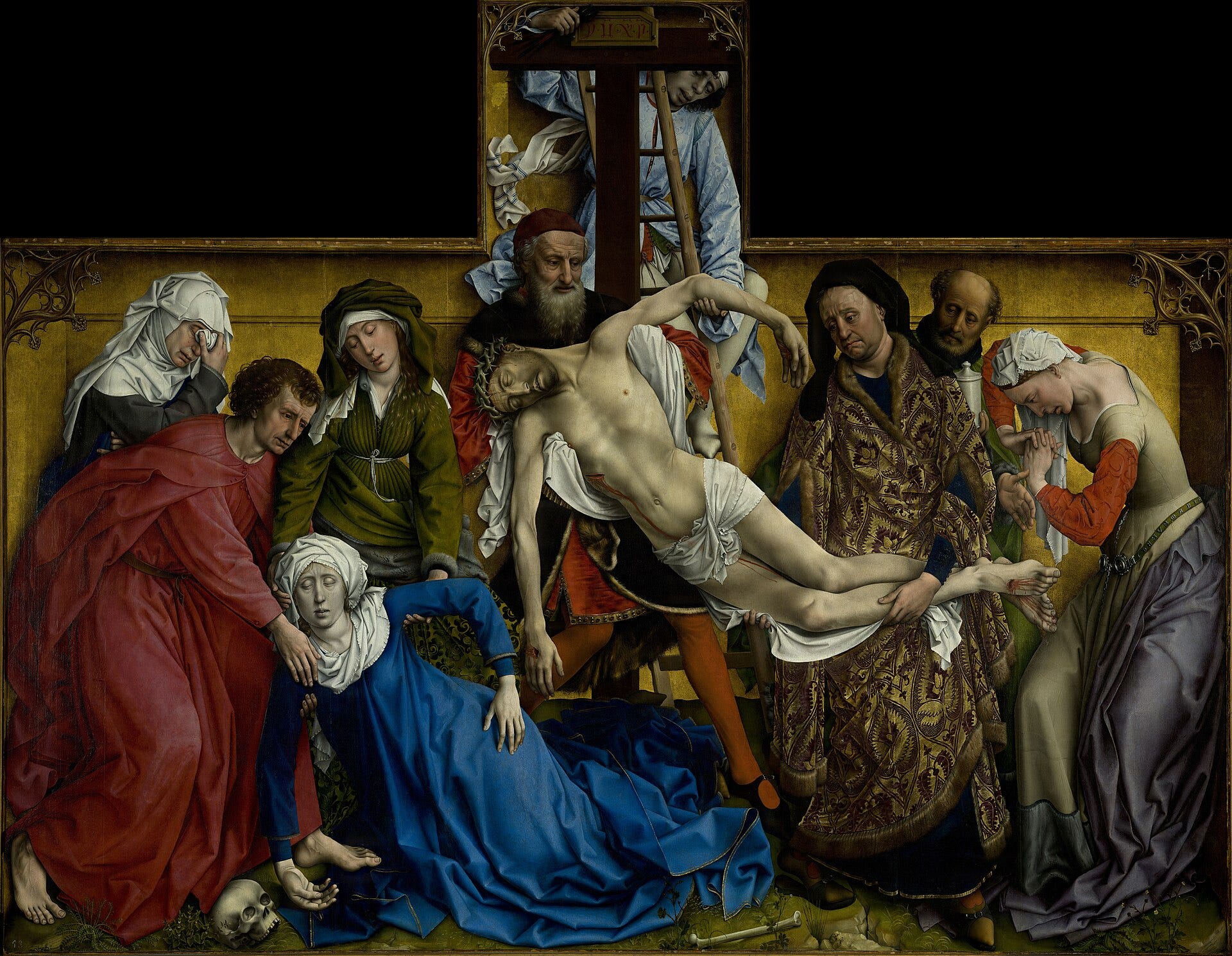
5. Rogier van der Weyden, The Descent from the Cross (about 1435)
The dead Christ is lowered from the cross while Mary faints below, her body curving in an exact echo of his, grief mirrored in flesh.
Van der Weyden squeezed ten life sized figures into a shallow gold box, like painted sculpture. It may be the most moving image the Netherlands ever produced.
There is no landscape and no sky, only the figures pressed forward against gold, so nothing pulls the eye from the sorrow. Philip the Second of Spain wanted it so badly that he kept the original for Spain and sent a copy back in its place.
It has hung there, now in the Prado, ever since.
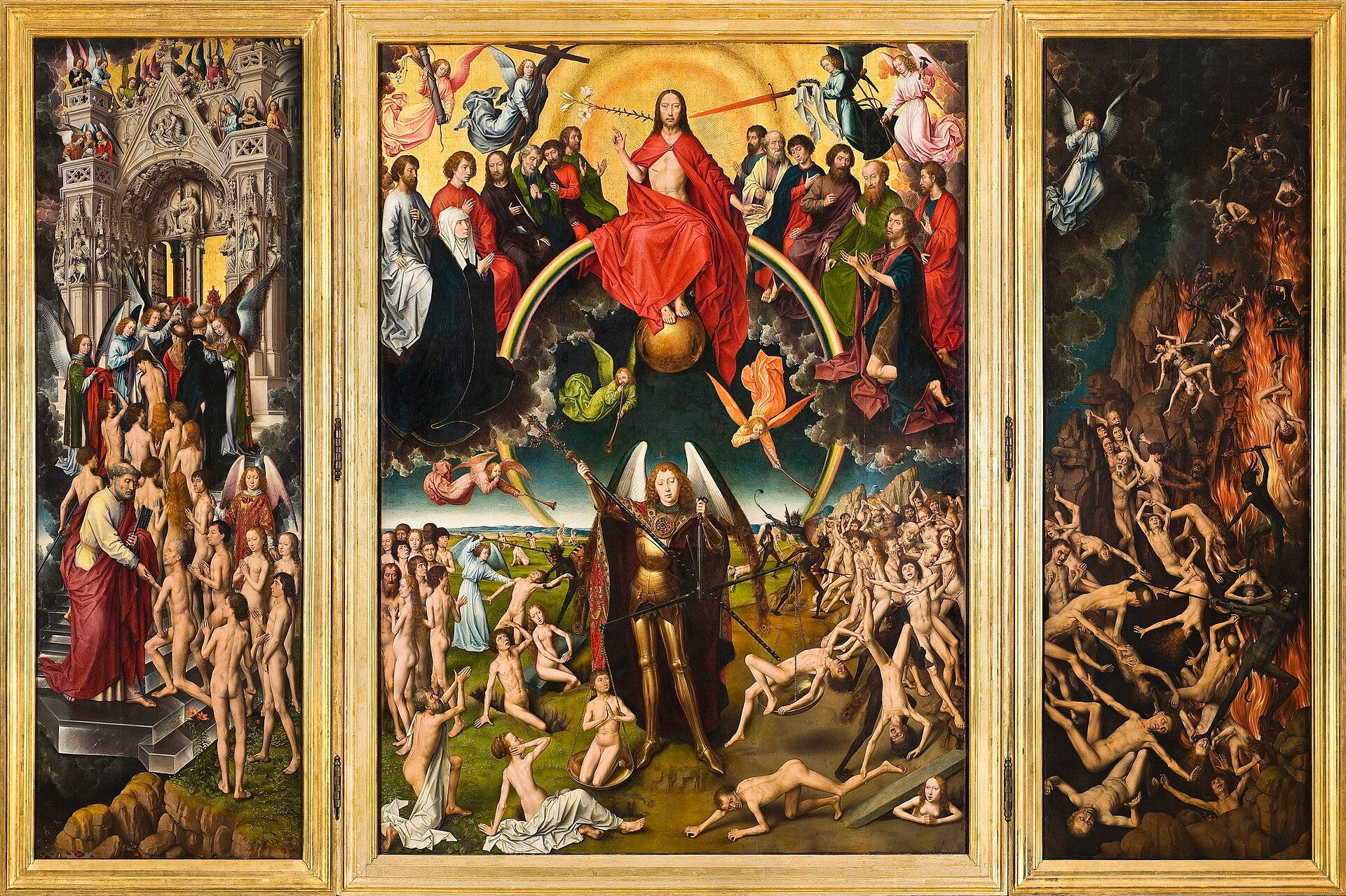
6. Hans Memling, The Last Judgment (1471)
This altarpiece was painted for a church in Florence, but it never arrived. A privateer seized the ship carrying it in 1473 and hauled the picture off to Gdansk, where it still hangs today. It is one of the oldest recorded acts of art piracy.
Memling filled it with the saved rising to gold and the damned dragged screaming into fire, weighed on the scales of the archangel Michael. Poland, Germany and Italy have all claimed it over the centuries. The little Baltic city simply kept it.
7. Albrecht Durer, Self Portrait (1500)
A young man stares straight out, symmetrical and solemn, one hand raised almost in blessing, looking uncannily like images of Christ.
Durer painted this self portrait at twenty eight, the first artist to set himself so squarely at the center of his own picture.
Beside his head he wrote that he had made himself in undying colors, a claim no painter had dared before. He signed it with the neat AD monogram he used like a modern logo, and guarded it jealously against copiers.
It hangs in Munich, still startling in its nerve.
8. Matthias Grunewald, The Isenheim Altarpiece (1515)
This altarpiece was built for a hospital full of the dying, and it shows. Grunewald covered his crucified Christ in the same oozing sores that plagued the patients who prayed before it, so their agony would look like his.
Few religious images have ever been so raw.
Its great wings open in stages to reveal a blazing resurrection, Christ rising in a ring of light like a cure for the body itself.
Made around 1515 for monks who nursed plague and skin disease, it was pure comfort dressed as horror. It still stands in Colmar, in eastern France.
9. Pieter Bruegel the Elder, Hunters in the Snow (1565)
Winter had never been painted like this before Bruegel. Three weary hunters trudge home through deep snow with their dogs and a single dead fox, a whole frozen valley falling away below them.
It is the first great snow scene in Western art, one of six panels tracking the turning of the year. Bruegel turned an ordinary winter day into something vast.
Skaters glide on the ponds far below, tiny and busy, while a fire blazes at an inn to the left. Six panels of the cycle were painted, and five survive, scattered across Europe. This one lives at the Kunsthistorisches Museum in Vienna.
10. Pieter Bruegel the Elder, The Tower of Babel (1563)
A vast spiral tower climbs into the clouds, half built and already crumbling, dwarfing the whole city and harbor around it. Bruegel modeled it on the Colosseum he had seen in Rome, a ruin standing for human pride.
The higher it rises, the more clearly it is doomed.
Tiny workers and cranes crawl over its ledges, and you can trace the exact point where the building starts to lean. The Bible tale of a people struck with a hundred tongues had fresh sting in Bruegel's divided Europe.
It hangs beside his Hunters in Vienna.
11. Hans Holbein the Younger, The Ambassadors (1533)
Two rich young men lean on a shelf of globes, books and instruments, at the height of worldly success. Then you notice the strange smear stretched across the floor, which resolves into a skull the moment you step to one side.
Holbein hid death in plain sight among all that wealth.
Every object carries a meaning, and a lute with a snapped string hints at discord in a dangerous year for England. I take the whole picture apart in the Ambassadors. It hangs in the National Gallery in London.
12. Albrecht Durer, Adam and Eve (1504)
Durer cut this into a copper plate, an engraving rather than a painting, with astonishing care. He used Adam and Eve to show off the perfect human proportions he had studied in Italy, two ideal bodies in a dark northern wood.
He printed it so fine it seems lit from within.
Around the pair he hid four animals for the four humors of the body, an elk, an ox, a cat and a rabbit, held in balance until the fall breaks the peace.
The cat eyes a mouse, seconds from pouncing, the instant before everything goes wrong. Durer sold prints like these across Europe and grew rich on them.
Bruges, Ghent and the museums up north
Jan van Eyck, The Arnolfini Portrait, and Hans Holbein, The Ambassadors: the National Gallery, London.
Jan van Eyck, The Ghent Altarpiece: Saint Bavo's Cathedral, Ghent.
Hieronymus Bosch, The Garden of Earthly Delights, and Rogier van der Weyden, The Descent from the Cross: the Prado, Madrid.
Pieter Bruegel, Hunters in the Snow and The Tower of Babel: the Kunsthistorisches Museum, Vienna.
Robert Campin, The Merode Altarpiece: the Cloisters, New York.
Matthias Grunewald, The Isenheim Altarpiece: the Unterlinden Museum, Colmar.
If this close looking pulled you in, keep going:
The darker truth about Gauguin, the part of the Tahiti story that never makes the wall label
Vermeer, Woman Holding a Balance, what is actually on those scales
Inside Monet house at Giverny, room by room, including his own bedroom
Northern Renaissance paintings, a few quick questions
What is the Northern Renaissance? The flowering of art in Flanders, the Netherlands and Germany in the 1400s and 1500s, sharp with detail and often painted in oil rather than fresco.
How is it different from the Italian Renaissance? The north prized fine detail, oil paint and everyday realism, where Italy chased classical bodies, perspective and grand scale.
Who are the most famous Northern Renaissance painters? Jan van Eyck, Hieronymus Bosch, Albrecht Durer, Pieter Bruegel the Elder and Hans Holbein the Younger.
Did they invent oil painting? No, but van Eyck perfected it so completely that he was long credited as its inventor.
Where can I see Northern Renaissance art? The National Gallery in London, the Prado in Madrid and the Kunsthistorisches Museum in Vienna hold major works.
The world in miniature
Look closely and the whole Northern Renaissance is about looking closely. While Italy chased ideal bodies and heroic scale, the north poured its genius into a candle flame, a brass pot, a single hair on a dog's back.
These painters believed that God and meaning hid in the smallest things, and they set down every one. Five centuries later you still lean in, and there is always one more detail waiting.