
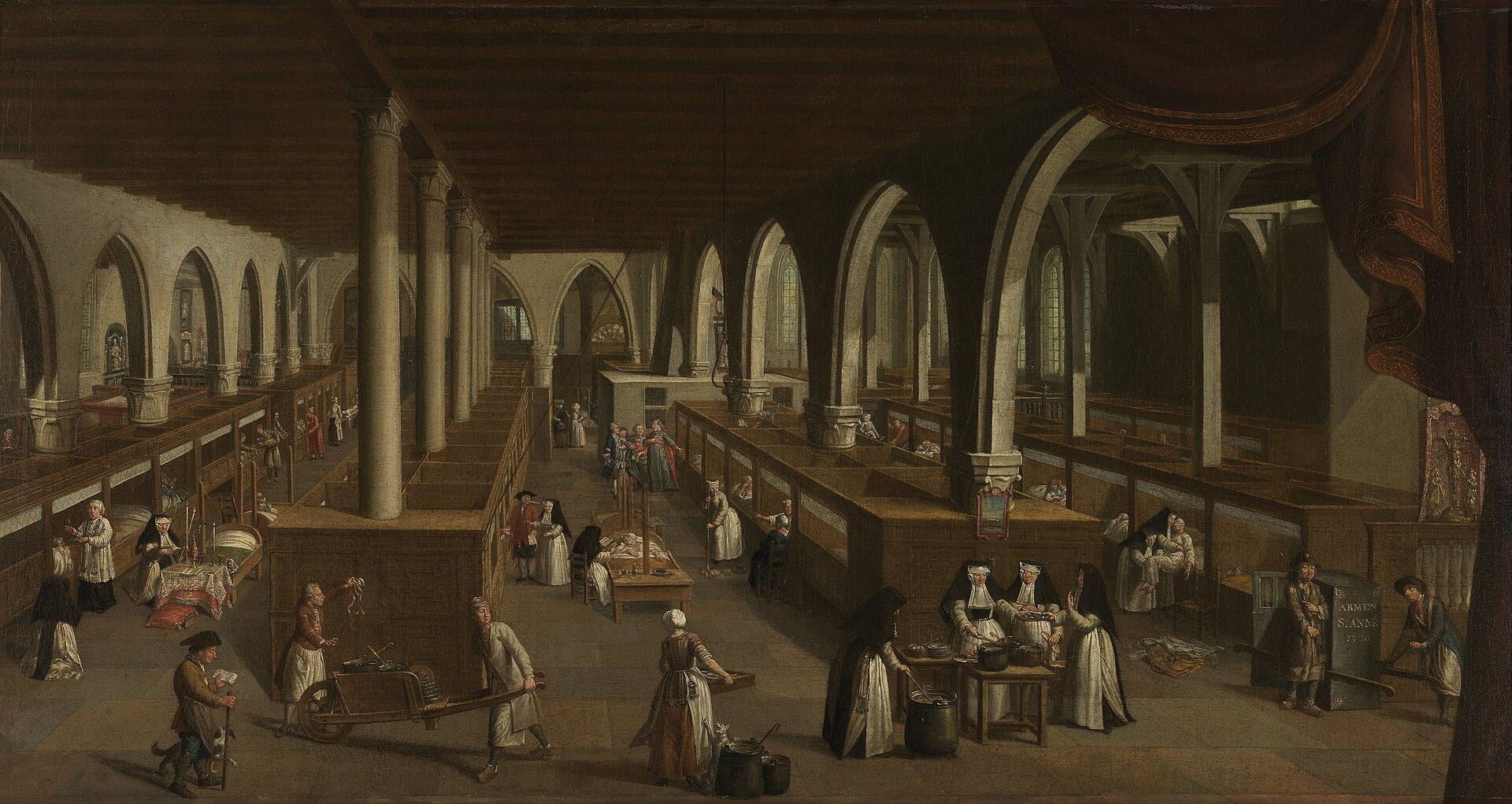
Before nursing had schools and uniforms, the person at a sickbed was usually a nun, a lay brother or a servant, and the English word nurse also meant a woman hired to breastfeed another family's baby. Painters followed the work from convent wards to the front, and one of them painted the hospital where she had done night shifts as an unpaid orderly.
Cool Stories About Art is a newsletter to learn art the fun way.
Join 200,000+ readers and get:
10 new art stories / month
The entire archive of content (140+ articles)
Comment, ask questions, and chat with other readers
Why Nursing Was So Hard to Paint
Nursing is hard to paint. Most of it happens at night, in small gestures repeated at every bed, and nobody changing a dressing stops to pose. Painters therefore showed care through objects a nurse recognizes at once: a basin, a dressing trolley, a lamp, a stretcher.
The most famous nurses, the women of the Crimean War in the 1850s and of the First World War, owe part of their fame to pictures. Several of those pictures were made by artists who never saw the scene they painted.
Every work chosen here shows the job itself, with its gesture, its tools and its room. One of them keeps the older meaning of the word nurse.
12. Norah Neilson Gray, The Scottish Women's Hospital: In the Cloister of the Abbaye at Royaumont (1920)
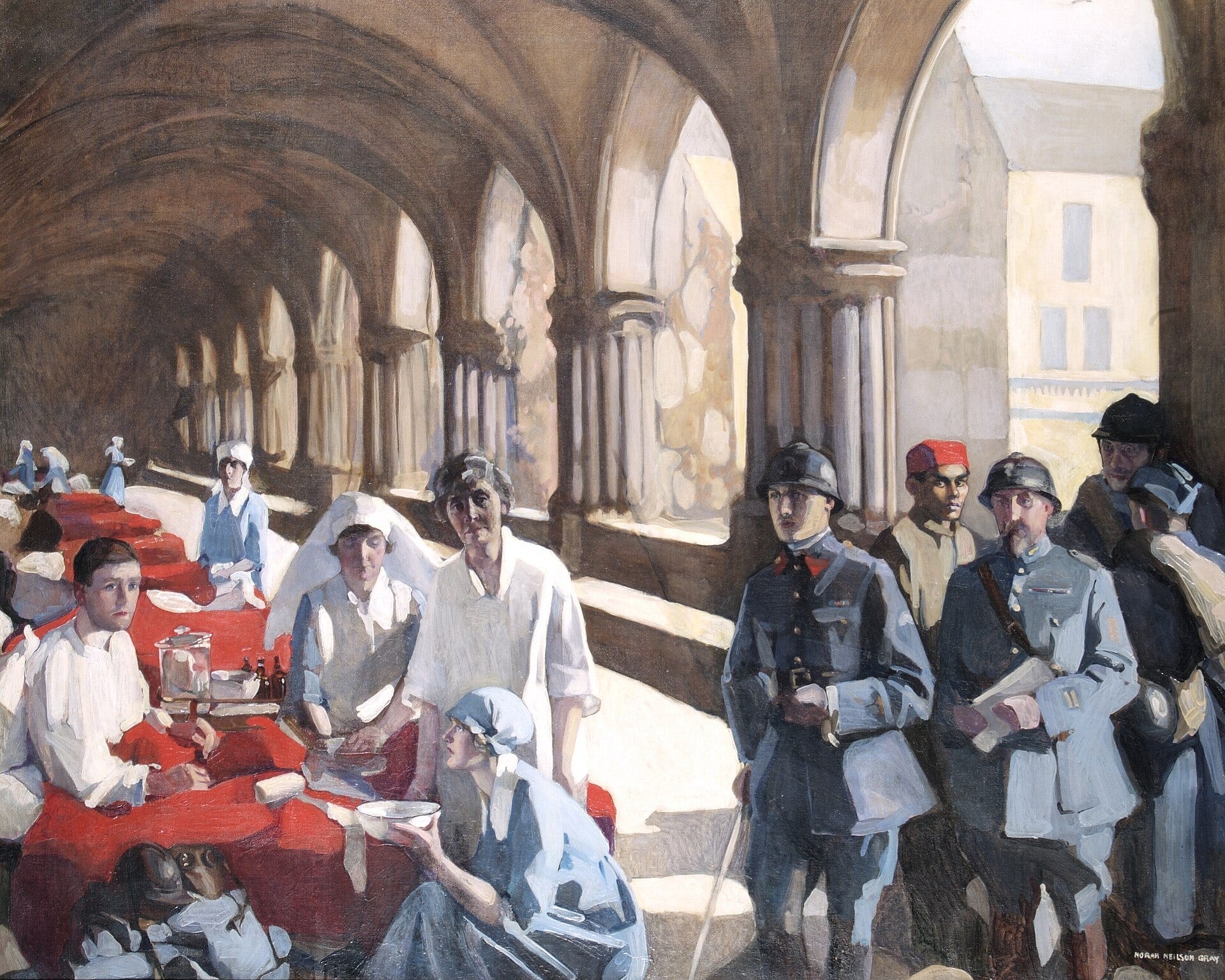
Hospital beds line the left side of a stone cloister, set right under vaults built for monks, and the patients lie in the open air of the cloister walk. In the foreground, three nurses in white caps tend a wounded French soldier while a woman doctor stands beside them. Everyone looking after him is a woman.
The cloister belongs to the Abbey of Royaumont, a thirteenth-century monastery north of Paris. In January 1915, the Scottish Women's Hospitals, a volunteer organization from Scotland, turned it into a military hospital staffed entirely by women. Its first team counted seven doctors, ten senior nurses, eight orderlies and three drivers, and by March 1919 Royaumont and a second site at Villers-Cotterêts had treated 10,861 patients.
Norah Neilson Gray, a painter from the Scottish town of Helensburgh, joined them in April 1918, though not as a trained nurse. She served as an orderly, one of the unpaid white caps who did the heavy work of the wards, and she painted by daylight after her night shifts.
The picture owes its existence to a refusal. After the war, she offered London's Imperial War Museum a view of the hospital's reception hall, titled Hôpital Auxiliaire 1918. The museum's committee on women's work turned it down, because what it wanted was a woman doctor at work.
So she painted the chief surgeon, Frances Ivens, from Liverpool, examining a French patient in the cloister, and the committee accepted the picture in 1920. It got its doctor. Neilson Gray placed her at the side of the bed and left the patient in the hands of the three nurses.
At a Glance
Artist: Norah Neilson Gray (1882 to 1931)
Painted: 1920
Medium: Oil on canvas
Size: 139.7 × 114.3 cm (55 × 45 in)
Where to see it: Imperial War Museum, London
11. Berthe Morisot, The Wet Nurse Angèle Feeding Julie Manet (1879)
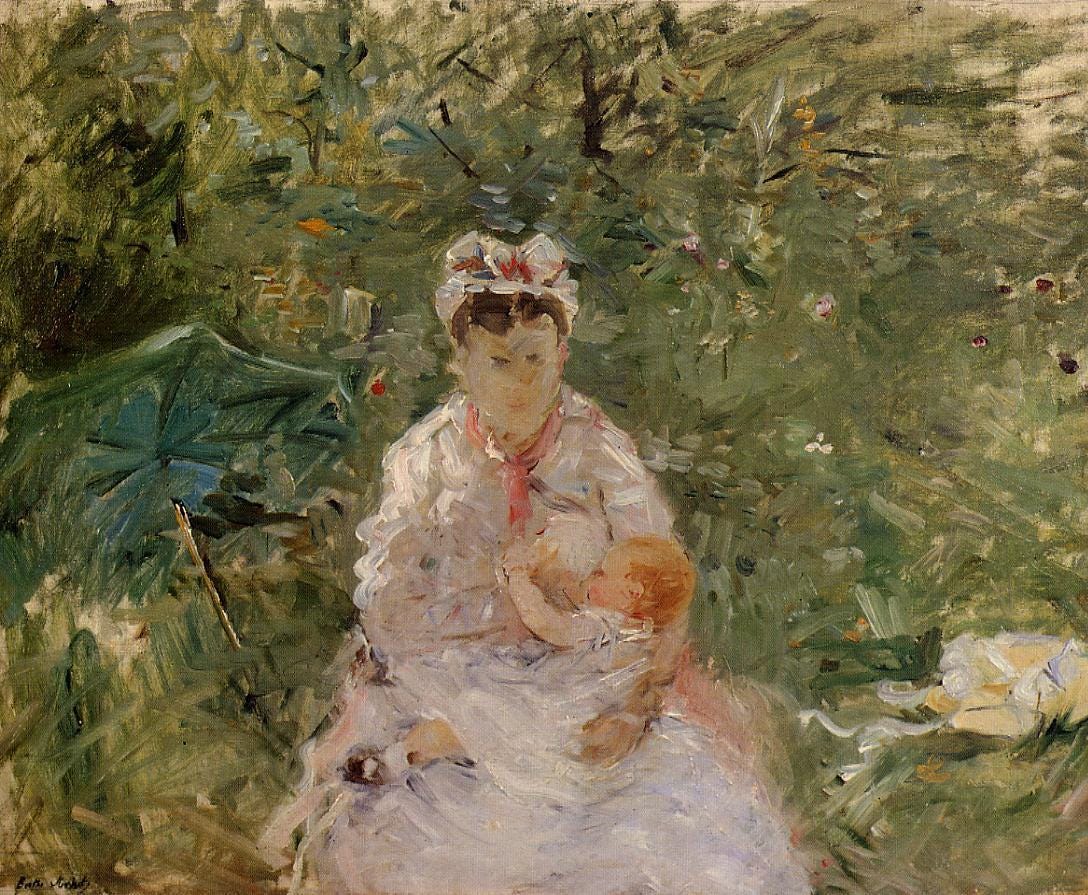
A young woman in white holds a baby to her breast in a garden. The strokes run in every direction and the canvas was left unfinished, so her dress, the child and the leaves almost melt into one another. The baby is the painter's daughter, yet the woman holding her to the breast is not her mother.