Famous Ocean and Sea Paintings: 12 Great Waves
The most famous ocean and sea paintings turn our oldest fear into something beautiful. A wave becomes a claw, a storm becomes the end of the world, and one small figure stands for all of us against something vast.
Here are twelve of the greatest, all now in the public domain.
From a Japanese print copied a million times to a Rembrandt no one can find, painters have chased the sea for four centuries. I have gathered the pictures that still make you brace as if the spray might reach you.
What churns in them:
The terror. Storms, sharks and shipwrecks, the sea as a killer.
The sublime. Emptiness so vast it makes a person feel tiny.
The pride. Fleets and battles, the sea as power and wealth.
The light. Sunrise on water, the hardest thing in art to catch.
What else is in here
Three that take a single painting apart, properly:
The secret behind Monet Magpie, one bird in the snow, and why it matters
The Ambassadors, detail by detail, the object at the bottom that only works from one side
Luncheon of the Boating Party, detail by detail, who everybody at that table actually was
1. Katsushika Hokusai, The Great Wave off Kanagawa (about 1831)
It is the most reproduced image in the history of art, printed on everything from mugs to phone cases. Hokusai's Great Wave is a woodblock print, not a painting, showing a giant claw of water about to crash down on three tiny boats.
Far behind it, small and calm, sits Mount Fuji.
He made it around 1831, in his seventies, as one of Thirty Six Views of Mount Fuji. The deep blue came from a new imported pigment, Prussian blue, that had just reached Japan.
Thousands of copies were printed, and the finest now hang in museums around the world.
2. Ivan Aivazovsky, The Ninth Wave (1850)
A handful of shipwreck survivors cling to a broken mast in a golden dawn, while a monstrous wave gathers to swallow them. Old sailors believed the ninth wave in a storm was the deadliest of all, and Aivazovsky painted the moment just before it strikes.
The light is so warm it almost feels like hope.
A Russian of Armenian descent, Aivazovsky painted the sea from memory, never from life, and could finish a large work in a single day.
He left roughly six thousand pictures, most of them water. The Ninth Wave hangs in the Russian Museum in Saint Petersburg, where crowds still gather in front of it.
3. J.M.W. Turner, Snow Storm (1842)
Turner claimed he had himself lashed to a ship's mast for four hours to feel a storm from the inside. The result is a churning white vortex of snow, steam and sea with a boat lost somewhere in the middle.
Whether the mast story is true or not, no one had painted weather like this before.
Critics jeered, calling it soapsuds and whitewash, and Turner, then sixty seven, was wounded by the mockery. Held today at Tate Britain, it pushed closer to pure abstraction than almost anything else painted in its century.
4. Rembrandt, The Storm on the Sea of Galilee (1633)
This is the only seascape Rembrandt ever painted, and today you cannot see it anywhere. In 1990 thieves dressed as police walked into a Boston museum and cut it from its frame, along with twelve other works. It has never been found.
The picture shows Christ asleep in a boat as his terrified disciples fight a rising storm, one of them looking straight out at us. Rembrandt is traditionally identified as that startled figure, gripping a rope and clutching his cap.
The empty frame still hangs on the wall of the Gardner Museum in Boston, waiting.
5. Winslow Homer, The Gulf Stream (1899)
A Black sailor lies on the deck of a broken boat, surrounded by circling sharks, a waterspout twisting on the horizon. Homer painted this grim scene late in his life, after years of watching the sea off Florida and the Bahamas.
It is a picture with almost no hope in it.
When buyers found it too bleak, Homer grudgingly added a faint rescue ship far away on the left. It now hangs in the Metropolitan Museum, and when collectors pressed him to explain the ending, he told them only to stop worrying about the poor man.
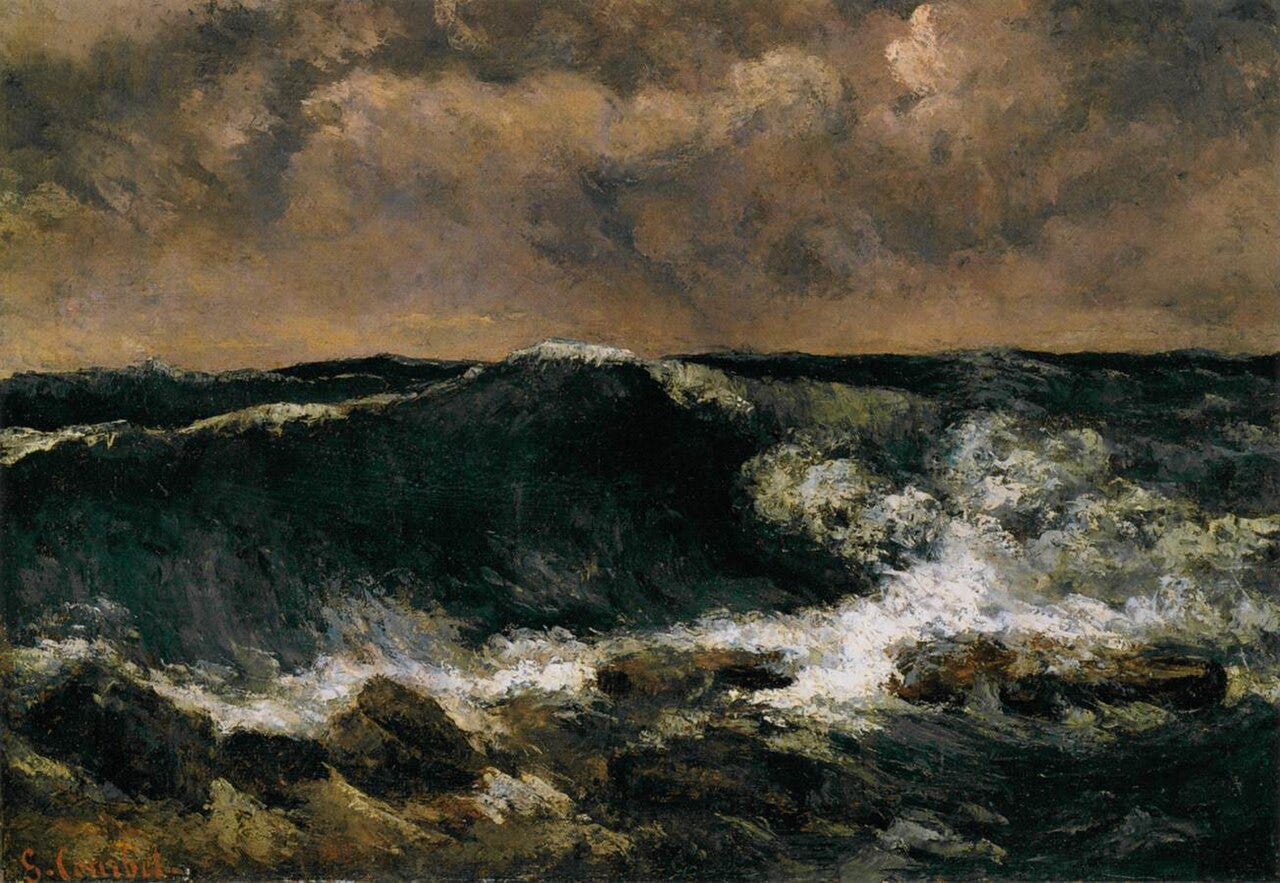
6. Gustave Courbet, The Wave (1869)
In one single autumn on the Normandy coast, Courbet painted dozens of pictures of nothing but a wave. Each shows a wall of green water curling under a heavy sky, thick paint slapped on with a knife.
He wanted you to feel the weight and cold of the sea, not admire a pretty view.
He laid the paint on so thickly you can almost touch the spray. The young Monet and Cezanne studied these waves closely and never forgot them. Versions now hang in museums from Berlin to Paris.
7. Caspar David Friedrich, The Monk by the Sea (1810)
Almost nothing happens in this picture, and that was the shock. A single tiny monk stands on an empty shore before a vast dark sea and an even vaster sky, the emptiest landscape anyone had dared to paint. It made viewers in 1810 feel dizzy and small.
Friedrich stripped away the ships, rocks and framing trees that every seascape was supposed to have. Now in Berlin, it left its first viewers reeling, one of them writing that looking at it was like having your eyelids cut off.
8. Claude Monet, Impression Sunrise (1872)
This hazy little view of a harbor at dawn accidentally named a whole movement. Monet caught the port of Le Havre at sunrise in 1872, all mist, water and a small orange sun.
A critic sneered at the loose title, Impression, and Impressionism had its name.
He barely finished it, working fast to catch a moment of light that would not last. The orange sun is actually the same brightness as the misty sky around it, so it seems to pulse.
It hangs in the Marmottan Monet museum in Paris, from which it was once stolen and later recovered.
9. Willem van de Velde the Younger, Ships in a Gale (about 1671)
The Dutch invented the sea painting, and no family did it better than the van de Veldes. This son sailed out in a small boat during real battles and storms to sketch what he saw, then worked the drawings into grand pictures.
Every rope and sail is exactly right.
When war with England ruined the Dutch art market, he simply moved to London and became the king's marine painter. His ships heel and plunge so convincingly that sailors trusted them as records. His work shaped English sea painting for a century.
10. Winslow Homer, Breezing Up (1876)
Three boys and a fisherman lean into the wind in a small sailboat, spray flying, the whole hull tilting toward adventure. After the grimness of the Gulf Stream, this is Homer at his most hopeful, painted for a young and confident America.
You can almost feel the tug of the sail.
He reworked it for two years, even painting out a second boat to keep the eye on the horizon ahead. One of the best loved American pictures of its century, it hangs in Washington, where an X ray still shows the ghost of the boat he removed.
11. Ludolf Bakhuizen, Ships in Distress off a Rocky Coast (1667)
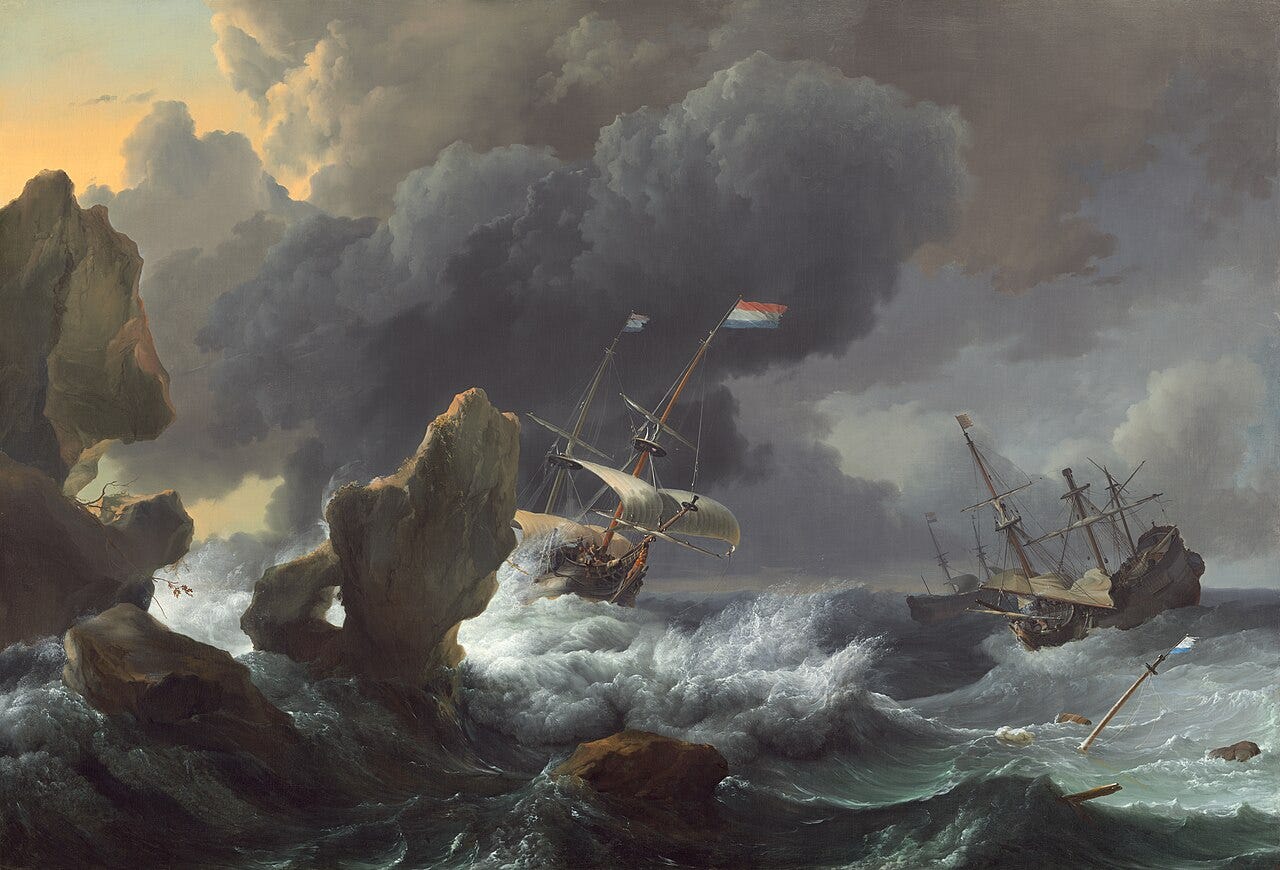
Bakhuizen loved a storm so much that he would hire boatmen to row him out into the worst of the weather. He came back and painted ships wallowing in wild green seas, sails torn, rocks waiting. Danger was his whole subject.
His storms taught buyers to feel the sea as something alive and hostile. This one now hangs in Washington, but his most surprising pupil was Tsar Peter the Great of Russia, who took drawing lessons from him while in Holland to learn shipbuilding.
12. Ivan Aivazovsky, Among the Waves (1898)
No ship, no survivors, no shore, just the open sea heaving in a storm under a torn sky. Aivazovsky painted this at the age of eighty one, near the end of a life spent painting almost nothing else. Many think it is the finest thing he ever made.
He worked the foam so thinly you can see the canvas glow through it, a trick that made the water seem to move. By then he was the most celebrated painter in Russia, holding huge shows of his own.
Among the Waves hangs in the gallery he built in the town of Feodosia, in Crimea, and left to the public.
Where to stand before the sea
Katsushika Hokusai, The Great Wave: the Metropolitan Museum, New York, and the British Museum, London, hold fine impressions.
Ivan Aivazovsky, The Ninth Wave: the Russian Museum, Saint Petersburg.
J.M.W. Turner, Snow Storm: Tate Britain, London.
Rembrandt, The Storm on the Sea of Galilee: stolen from the Gardner Museum, Boston, and still missing.
Winslow Homer, The Gulf Stream: the Metropolitan Museum; Breezing Up: the National Gallery of Art, Washington.
Claude Monet, Impression Sunrise: the Marmottan Monet museum, Paris.
If the sea pulled you in, keep going:
Ten women artists you need to know, the names the textbooks skipped
Was Monet really the first Impressionist, the painting that may have got there first
Lady with an Ermine, detail by detail, why she is holding that animal
Ocean and sea paintings, a few quick questions
What is the most famous ocean painting? Hokusai's The Great Wave off Kanagawa, though it is technically a woodblock print rather than a painting.
Who is the greatest painter of the sea? Many say Ivan Aivazovsky, a Russian who made roughly six thousand seascapes, or J.M.W. Turner for his storms of pure light.
What is a seascape? A picture whose main subject is the sea, a branch of landscape painting that the Dutch turned into an art of its own in the 1600s.
Why did the Dutch paint so many ships? The sea was the source of Dutch wealth and power, so proud merchants and admirals wanted their ships and battles on the wall.
Where can I see famous sea paintings? The Met and the National Gallery in Washington, Tate Britain, the Russian Museum and the Rijksmuseum all hold major seascapes.
The oldest fear we still hang on the wall
For as long as people have gone to sea, they have feared it, and these pictures are that fear made beautiful. A wave becomes a claw, a storm becomes the end of the world, and one small figure stands for all of us against something enormous.
Even the calm ones carry a warning under the surface. The sea does not care, and part of why we cannot look away is that we know it.