
The French painter Odilon Redon (1840 to 1916) was born in Bordeaux and spent some twenty years drawing almost only in black. His charcoal monsters won the admiration of the Symbolist poets.
In his fifties he turned to color, and after 1900 he gave up black altogether. Color brought him new subjects, from Greek myths to religious figures, and commissions to decorate whole rooms.
Cool Stories About Art is a newsletter to learn art the fun way.
Join 200,000+ readers and get:
10 new art stories / month
The entire archive of content (140+ articles)
Comment, ask questions, and chat with other readers
From Charcoal to Color
Those poets, like Redon himself, belonged to Symbolism, a movement of writers and artists of the late nineteenth century who put dreams, myths and inner life ahead of the visible world.
His tools in the black years were charcoal and lithography, a way of printing drawings made on stone. The French call the works of that period his Noirs, "the blacks."
In the 1890s, color began to enter his work. He tried oil and pastel, and pastel soon took the larger place: his letters speak of the joy it gave him, and his colored pictures sold. By about 1900 he had stopped drawing in black, and he went on to paint blossoms, then whole decorated rooms.
One habit survived the change of medium. Redon rarely started from nothing: a play by Shakespeare, a Greek myth, a book on evolution or a friend often stands behind a picture.
12. Night (1910 to 1911)
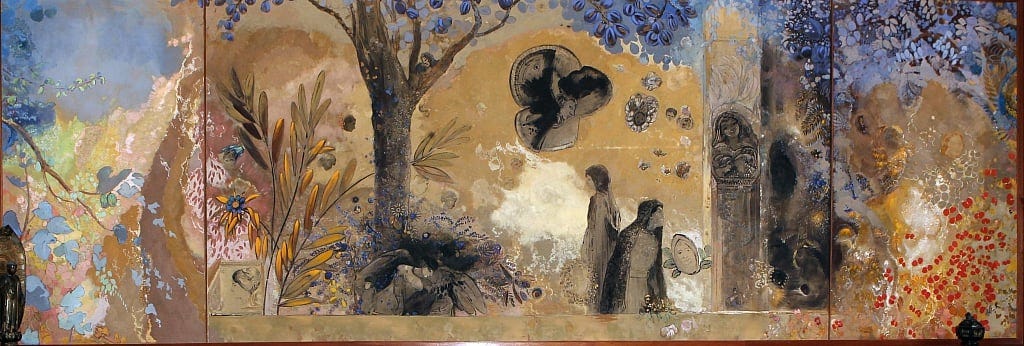
Pale faces and figures seem to float in a dark mass of blue and green vegetation, with patches of orange, pink and violet light between them. The canvas is more than six meters long, and it still hangs in the room for which it was made.
That room is the library of Fontfroide, a medieval abbey near Narbonne, in southern France, set above one of the galleries of the cloister. Gustave Fayet, a painter and collector from Béziers who owned works by Gauguin, had bought the abbey at a public sale in 1908.
Two years later he asked his friend Redon for three canvases to decorate the library. Night and Day hang on opposite walls, face to face, and the third canvas, Silence, sits above the door: a face with a finger to its lips.
Redon painted the three in 1910 and oversaw their installation in 1911. Into the foliage of Night he slipped about thirty portraits of people close to him: members of the Fayet family, the pianist Ricardo Viñes, the painter Richard Burgsthal, and the artist himself.
In 1988 the French state protected the decoration inside the abbey. An administrative court then cancelled that protection for Redon's canvases alone, because under French law pictures on canvas are not part of a building, even when they were made for it.
The answer came more than thirty years later, when the state protected the three canvases themselves, as movable objects. A first decision in December 2021 was followed, in December 2022, by the strongest status French law gives to such objects, one that ties them to the room for good.
The decision gives its reason in a single phrase: the three paintings had been "specially conceived and made to form the decoration of this room."
At a Glance
Artist: Odilon Redon (1840 to 1916)
Painted: 1910 to 1911
Medium: Oil on canvas
Size: About 200 × 650 cm (79 × 256 in)
Where to see it: Library of Fontfroide Abbey, near Narbonne, France
11. Grand Bouquet (1901)
Orange, pink, white and yellow blooms spill out of a blue vase and spread across a pale, cloudy ground. All of it is drawn in pastel, sticks of powdered color rubbed onto the surface, and it stands about eight feet tall. It was made for one particular wall, and for more than a hundred years almost no one outside a single family saw it.