
An Orientalist painting is a picture of North Africa, the Middle East or Central Asia by an artist trained in the European tradition. The genre peaked in the nineteenth century, when travel, conquest and photography opened these regions to Western painters.
Some of those painters lived there for years. Others crossed the sea for a few weeks, or never went at all. Picture by picture, this list separates what the painter saw from what he built in a studio.
Cool Stories About Art is a newsletter to learn art the fun way.
Join 200,000+ readers and get:
10 new art stories / month
The entire archive of content (1,000+ articles)
Comment, ask questions, and chat with other readers
How I Chose These 12 Paintings
A work earns its place if the painter spent time in the region he painted, if the sources behind the image are on record (a photograph, a book, a prop, an earlier picture, a model in costume), or if the picture changed how later artists and writers imagined the East.
12. John Singer Sargent, Smoke of Ambergris (1880)
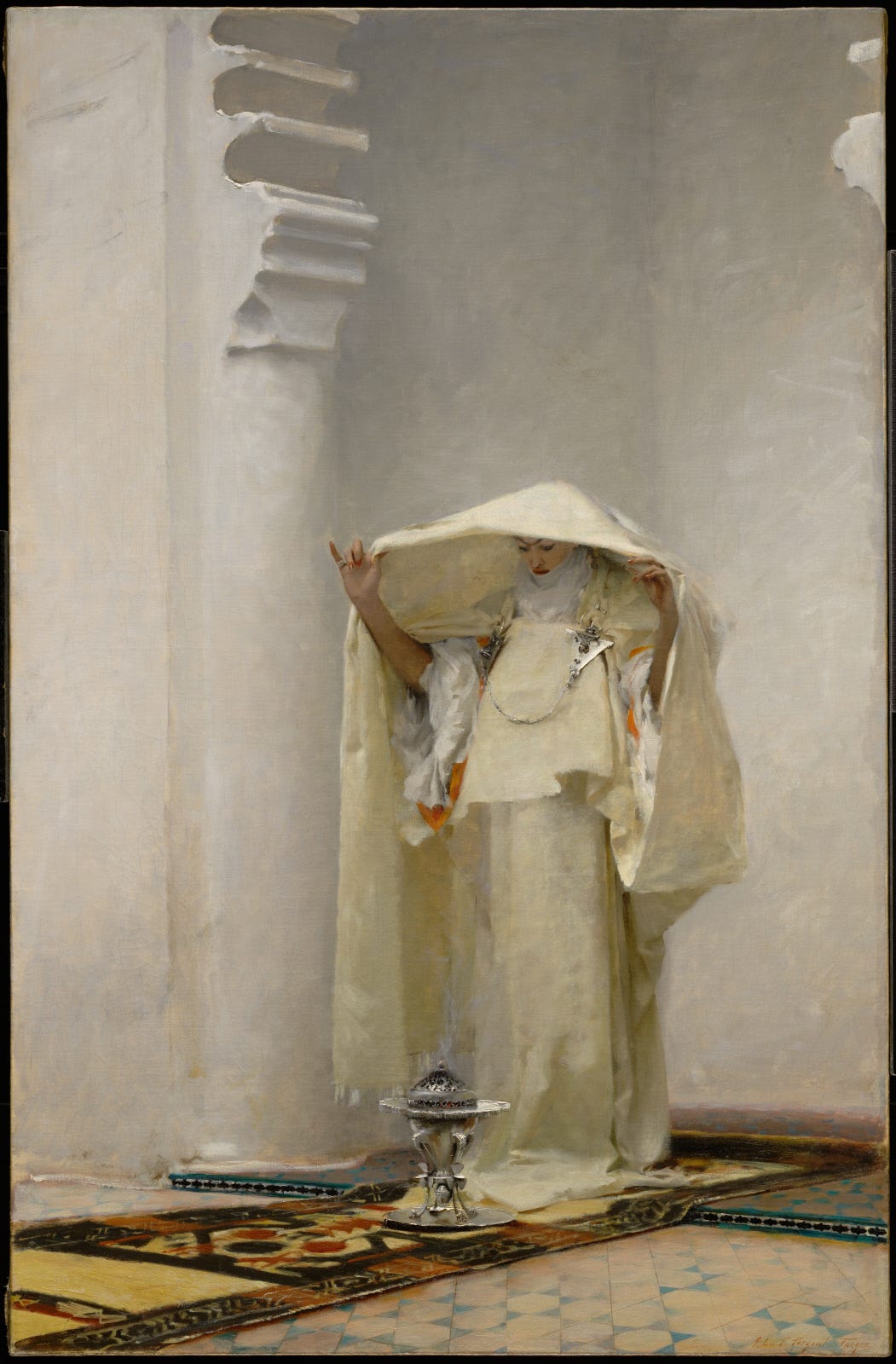
A woman stands under a white Moorish arch and lifts a large white cloth above her head like a canopy. At her feet, a silver incense burner sends its smoke up into the cloth.
The American painter John Singer Sargent painted her in 1880, after a winter spent in Spain and Morocco.
The title names what is burning. Ambergris is a waxy substance that forms in the gut of sperm whales, once burned in some rituals and prized as an aphrodisiac.
Sargent began the canvas in Tangier, working from a model. He finished it in his Paris studio early in 1880.
The Clark Art Institute, which owns the picture, explains that the costume and the setting mix elements from several regions of North Africa. The museum calls the result a fantasy for Western eyes.
A smaller watercolor of the same subject, Incensing the Veil, belongs to the Isabella Stewart Gardner Museum in Boston. A post on the Gardner's blog notes that Sargent's letters show little contact with local people.
Look closely at the whites. In the Metropolitan Museum's audio guide, the artist Elizabeth Colomba points out the blues, purples and yellow hidden inside them.
What I keep coming back to is how little of her face Sargent shows, only her eyes and painted brows above the veil. It's the one trace left of the real woman who posed for him in Tangier.
Sargent showed the canvas at the Paris Salon of 1880. He was 24.
Seven years later, the novelist Henry James wrote about it in Harper's Monthly. He called it "exquisite, a radiant effect of white upon white," and admitted he did not know who this "stately Mohammedan" was.
In 2005, the Clark asked the public to choose its 50 Favorites, and Smoke of Ambergris came out on top. The exhibition of the winners opened in 2006.
At a Glance
Artist: John Singer Sargent (1856 to 1925), American
Painted: 1880, begun in Tangier and finished in Paris
Medium: Oil on canvas
Where to see it: Clark Art Institute, Williamstown, Massachusetts
About This Painting
Where can you see Smoke of Ambergris today?
Smoke of Ambergris belongs to the Clark Art Institute in Williamstown, Massachusetts, under inventory number 1955.15. In 2025 it traveled to the exhibition "Sargent and Paris," at the Metropolitan Museum in New York and then the Musée d'Orsay.
How large is Smoke of Ambergris?
The canvas measures 139.1 by 90.6 centimeters, roughly 55 by 36 inches. Many sites quote a larger figure, 163.8 by 115.6 centimeters, which is the frame.
Who owned Smoke of Ambergris before Robert Sterling Clark?
Smoke of Ambergris passed through the Paris dealers Boussod, Valadon et Cie and then M. Knoedler and Co. Clark bought it on September 10, 1914.
11. David Roberts, The Hypostyle Hall of the Great Temple at Abu Simbel, Egypt (1849)
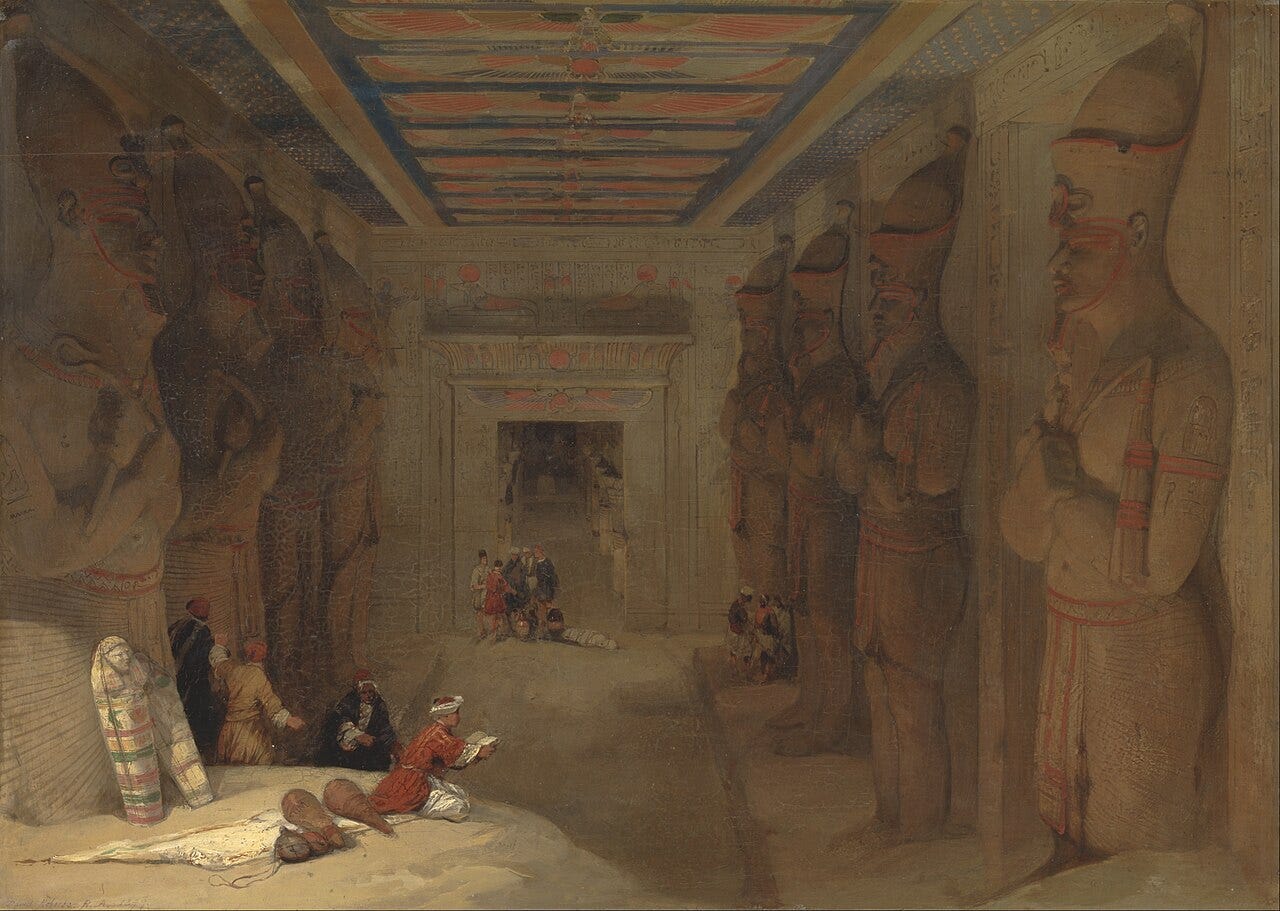
Colossal statues of a pharaoh, arms crossed on their chests, line a dim hall cut into the rock. At their feet, small figures in robes and turbans rest, and one of them reads from a book. The Scottish painter David Roberts signed the panel in 1849.