
Famous paintings of kings and queens are portraits and court scenes, made mostly for royal households where the sitters often chose how they would appear.
Behind many of them, surviving letters, palace inventories and laboratory examinations such as X-rays show who a picture was meant for and how it was changed or copied. The twelve below are counted down from 12 to 1, from a secret birthday present to a queen whose painted seas were redone long after her reign.
Cool Stories About Art is a newsletter to learn art the fun way.
Join 200,000+ readers and get:
10 new art stories / month
The entire archive of content (140+ articles)
Comment, ask questions, and chat with other readers
How These Were Chosen
To earn a place here, a picture needed one of four things on record. First, the royal sitter had a say in the order, the painter, the sittings or the result. Second, the picture was changed, repainted or withdrawn.
Third, it was made for a single viewer. Fourth, its preparatory studies survive, so the work can be followed from the first idea to the finished canvas.
12. Franz Xaver Winterhalter, Queen Victoria (1843)
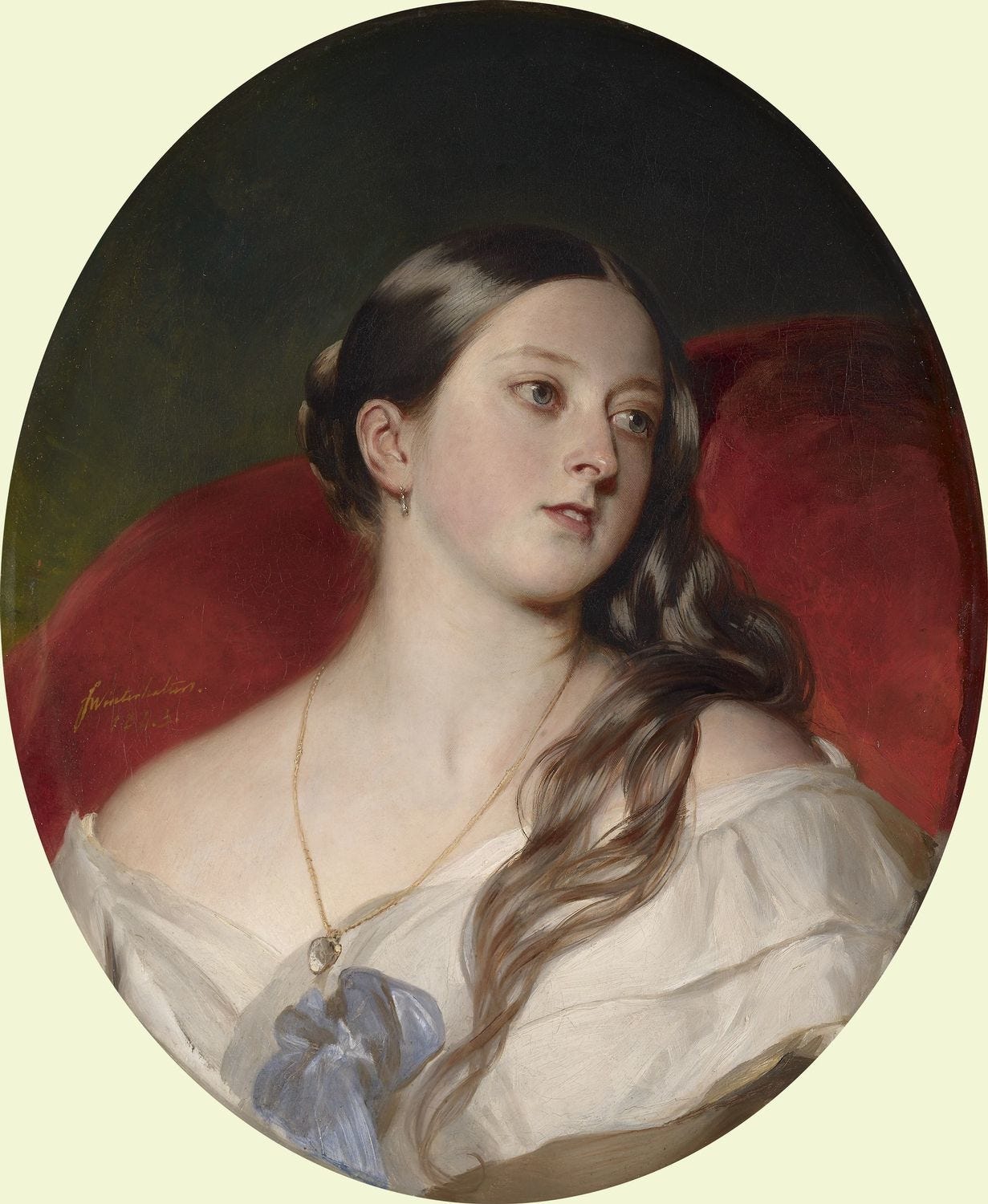
A young woman leans back against a red cushion and looks away to one side. She is Queen Victoria, painted in 1843 by Franz Xaver Winterhalter, a German artist who specialized in royal portraits.
Victoria and her husband, Prince Albert, had already chosen him for their official likenesses. This time the queen ordered a canvas on her own, as a gift for Albert alone.
The picture was meant as a surprise for his twenty-fourth birthday, on August 26, 1843. So she paid the painter 105 pounds herself and hid the work from him. On July 13, 1843, she noted in her journal how "the secret picture" was coming along.
On the birthday, the queen wrote that Albert "thought it so like, & so beautifully painted." She felt "so happy & proud to have found something that gave him so much pleasure."
Her dress is plain for a queen. Winterhalter usually painted costume in exact and lavish detail, but here he spent very little paint on the white gown, trimmed with flounces, wide ruffles of fabric.
The only ornaments are a ribbon bow, a pair of simple drop earrings and a heart-shaped pendant on a gold chain.
The detail that holds my eye is the hair. Half of it stays pinned up in a knot at the back of her head, and the rest falls loose over her left shoulder.
The canvas went to Albert's Writing Room, his study at Windsor Castle, the royal residence west of London. An inventory still recorded it in that room in 1878, seventeen years after his death. It remains in the Royal Collection, the art held by the British crown.
Because the image was so intimate, the copies made of it were miniatures, small enough to hold in the hand.
After Albert's death, Victoria held on to what the picture meant. On January 2, 1873, she gave a print after the portrait to her friend Fanny, Countess of Gainsborough, and wrote in her journal that day that the painting was "my darling Albert's favourite picture."
At a Glance
Artist: Franz Xaver Winterhalter (1805 to 1873)
Painted: 1843
Medium: Oil on canvas
Collection: Royal Collection Trust
About This Painting
How big is Winterhalter's 1843 portrait of Queen Victoria? Winterhalter's 1843 portrait of Queen Victoria measures 64.8 by 53.3 centimeters, with the image framed as an oval. It is signed and dated 1843.
Is the pendant in Winterhalter's portrait of Queen Victoria a locket with Albert's hair? Winterhalter's portrait of Queen Victoria shows a heart-shaped pendant that the Royal Collection links, without certainty, to a glass locket holding a lock of Albert's hair. Victoria wrote that she wore that locket "day and night" before her wedding. It was a gift from Queen Louise of the Belgians.
Who painted Queen Victoria with her hair down? The 1843 portrait of Queen Victoria with her hair down is by Franz Xaver Winterhalter. He was born in 1805 in Menzenschwand, a village in the southern Black Forest, and died in Frankfurt in 1873.
Which collection owns the portrait of Queen Victoria with her hair down? Winterhalter's portrait of Queen Victoria with her hair down is part of the Royal Collection, under the number RCIN 406010. It was chosen for the cover of the catalogue of "Victoria & Albert: Art & Love," the 2010 exhibition at The Queen's Gallery, Buckingham Palace.
11. Franz Xaver Winterhalter, Empress Elisabeth of Austria (1865)
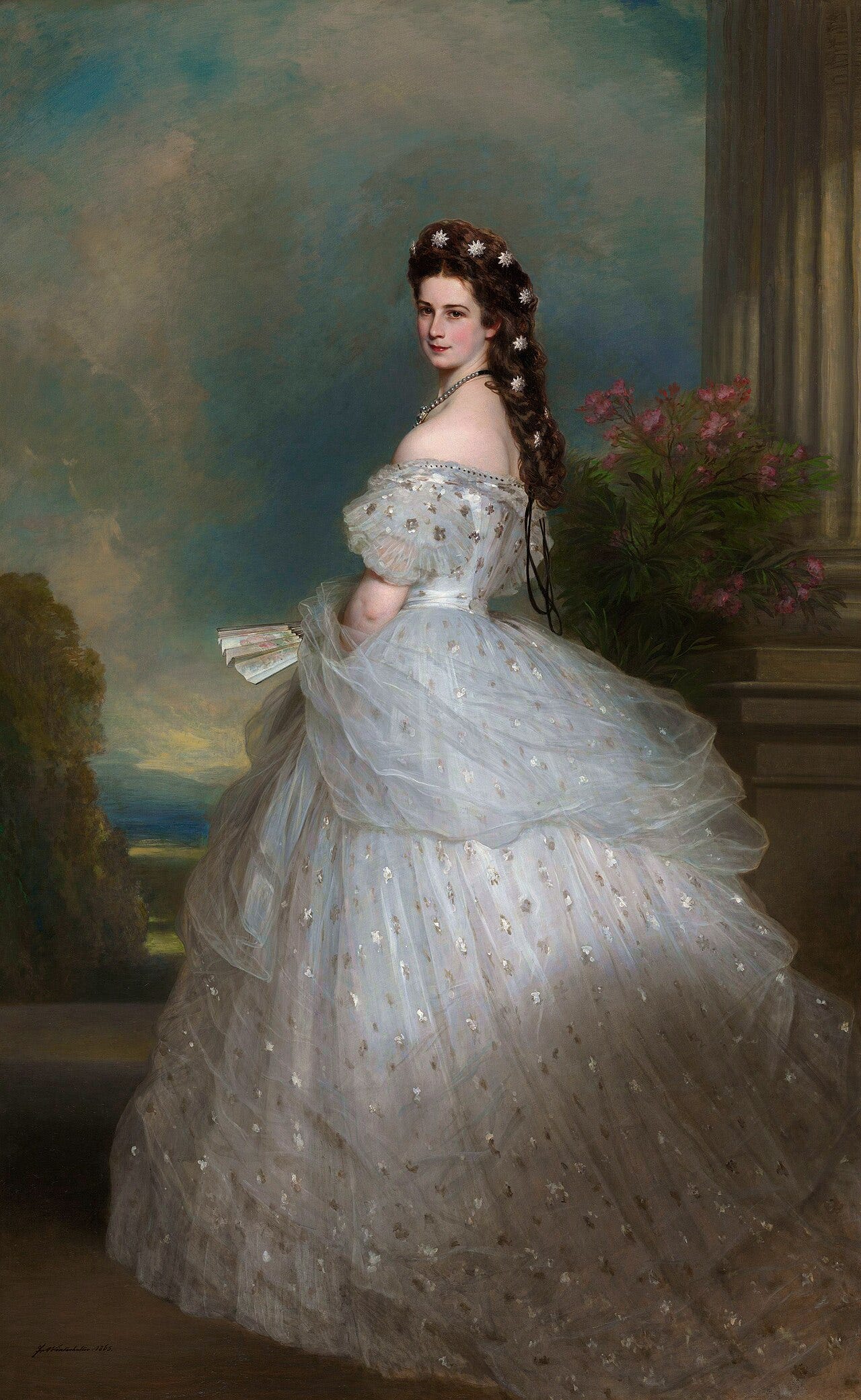
A young woman in a white ball gown turns her head back over a bare shoulder, with diamond stars scattered through her hair.
She is Empress Elisabeth of Austria, Sisi to those close to her, painted full-length in 1865, in her twenty-eighth year, by Winterhalter, who had painted the secret portrait of Queen Victoria. By then she had already run away from the court in Vienna once.