Famous Paintings of Mothers: 12 Tender Portraits

For as long as people have painted, they have painted mothers, from the sacred Madonna cradling her child to a modern woman bathing her baby in a quiet room.

A mother washing her small daughter's feet in a basin
Mary Cassatt, The Child's Bath, 1893

The bond between a mother and child is the oldest subject in Western art, and painters have returned to it in every age, sacred and ordinary, grand and intimate.

Here are twelve of the most famous paintings of mothers, all now in the public domain. I have chosen the ones that still make you stop, whether they show a queen, a saint, or a painter's own tired mother.


Learn art the fun way. Free stories every week, no boring lectures.


If curiosity got you here

These go past the caption and into what actually happened:


1. Mary Cassatt, The Child's Bath (1893)

An American woman in Paris painted a mother leaning over her small daughter, one arm around her, gently washing her feet in a basin.

Cassatt, the only American invited to show with the French Impressionists, never married or had children of her own, yet she became the great painter of motherhood.

She borrowed the high tilted viewpoint and flat pattern from Japanese prints, then aimed them at a plain domestic moment. There is no sentiment and no halo, just the weight of a child against an adult and the quiet care of an ordinary bath.

Cassatt is one of ten women artists worth knowing, and the Art Institute of Chicago bought this scene in 1910, its tilted floor still tipping the whole room toward you.

2. Whistler, Whistler's Mother (1871)

An elderly woman in profile in a dark dress against a bare wall
Whistler, Whistler's Mother, 1871

Whistler's mother sits in strict profile, hands folded, in a plain dark dress against a bare wall, in what may be the most famous portrait of a mother ever painted.

He actually titled it an arrangement in two colors, insisting it was a study of shape and tone, not a sentimental tribute to his mum. The story goes that a live model failed to turn up, so his elderly mother Anna sat in instead.

France bought it in 1891, the first Whistler to enter a public collection, and it slowly became a worldwide symbol of motherhood. It has since been printed on stamps, parodied in cartoons, and even accidentally ruined in a Mr Bean film.

3. Vigee Le Brun, Self Portrait with Her Daughter (1789)

A mother embracing her young daughter cheek to cheek
Vigee Le Brun, Self Portrait with Her Daughter, 1789

The self portrait shows the painter wrapping her arms around her young daughter Julie, both smiling, cheek to cheek, in a warm and natural embrace.

Vigee Le Brun was the favorite portraitist of Queen Marie Antoinette, and she poured that same softness into pictures of herself as a mother.

When she showed a version smiling with her teeth visible, Paris was scandalized, since open mouthed smiles were thought vulgar in a formal portrait. She painted it the very year the Revolution broke out, and fled France soon after with Julie in tow.

The two later fell out bitterly, which makes this tender embrace ache a little more.

4. Raphael, Madonna of the Chair (1514)

The Virgin Mary hugging the infant Jesus in a round frame
Raphael, Madonna of the Chair, 1514

Raphael painted the Virgin Mary hugging the infant Jesus in a round frame, her cheek pressed to his head, more like a real young mother than a distant holy queen.

He set the whole group in a tight circle, arms and glances curving around to hold the baby at the center. Legend says he sketched the idea on the bottom of a wine barrel when he suddenly saw a peasant girl holding her child.

It became one of the most copied images of mother and child in the world, reproduced on countless prints and plates. Napoleon's armies carried it off to Paris as war loot before it returned to the Pitti Palace in Florence, where it hangs today.


Join 130,000 readers who get the secrets behind the paintings. Free.


5. Leonardo, The Virgin and Child with Saint Anne (about 1503)

Three generations, the Virgin in her mother's lap reaching for the child
Leonardo, The Virgin and Child with Saint Anne, about 1503

Leonardo stacked three generations into one pyramid, the baby Jesus, his mother Mary, and her mother Saint Anne, all leaning into one another with soft, knowing smiles.

Mary sits in her own mother's lap like a grown child, reaching for her son, who reaches for a lamb, a chain of love and sacrifice.

Leonardo reworked this idea for years and left several versions, drawings and full size cartoons unfinished at his death.

Sigmund Freud famously wrote an entire essay reading Leonardo's two mothers into the picture. When the Louvre cleaned it a few years ago, the brightened colors set off a public row over how far a restorer should go.

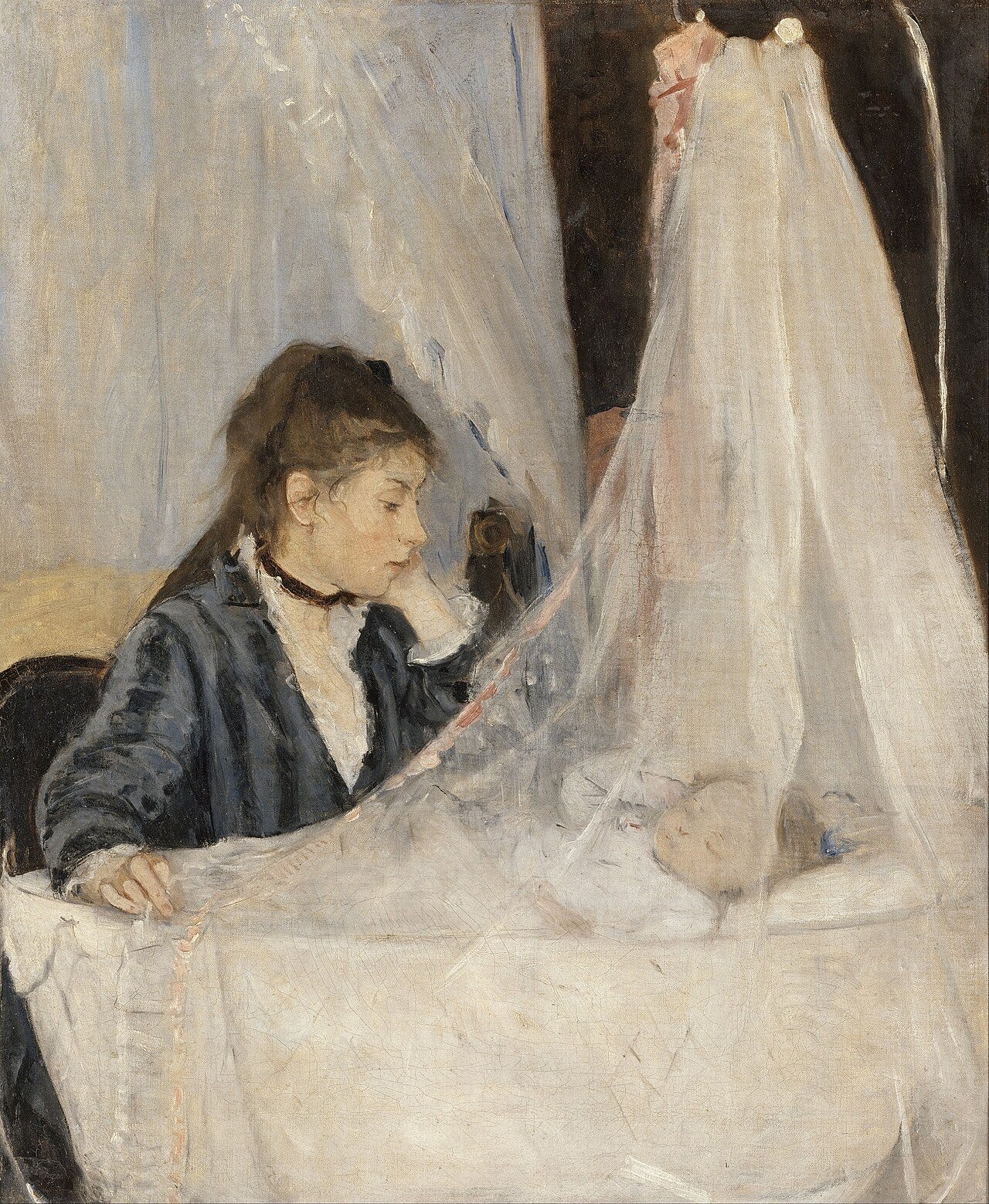
6. Berthe Morisot, The Cradle (1872)

A young mother watching her baby sleep through a veiled cradle
Berthe Morisot, The Cradle, 1872

A young mother rests her chin on her hand and gazes down at her sleeping baby through the thin white veil of a cradle, lost in thought.

Painted in oil by Berthe Morisot, the leading woman of the Impressionists, it shows her own sister Edma watching over her newborn daughter.

The gauzy curtain between mother and child is echoed by the curtain behind her, a soft world of whites and half seen shapes. It was one of the first paintings by a woman to make motherhood its serious subject, shown at the very first Impressionist exhibition in 1874.

Nobody bought it, and Morisot kept it in the family for the rest of her life.


Get the story behind the painting, every week, free.


7. Klimt, The Three Ages of Woman (1905)

A baby, a young mother and an aged woman shown together
Klimt, The Three Ages of Woman, 1905

Klimt painted the whole arc of a woman's life in one column, a baby held asleep against a young mother, and beside them an old woman bowed in grief.

The mother and child are wrapped in his famous gold and flowered patterns, glowing against a dark ground, while age is painted with unsparing honesty.

It is a picture about Symbolism, time and mortality as much as about motherhood, tender and brutal at once. The sleeping baby is completely at peace, held by a mother whose own old age stands right next to her.

It won a gold medal at the Rome world art show of 1911, where the Italian state bought it on the spot.

8. Rembrandt, The Holy Family (about 1645)

A Dutch mother beside a cradle with angels descending in light
Rembrandt, The Holy Family with Angels, 1645

Rembrandt painted the Virgin and child not as royalty but as a Dutch family in a carpenter's workshop, the mother pausing from a book to check on her sleeping baby.

Warm firelight falls across the cradle while Joseph works with an axe in the shadows behind. In one version, angels come tumbling down a beam of light into the humble room, the only sign that this is a holy family at all.

He painted it a few years after burying his wife Saskia and three of their infant children, and the care he lavishes on the sleeping baby feels hard earned.

That angel lit version, painted the same year, now hangs in the Hermitage in Saint Petersburg.

9. Bouguereau, Charity (1878)

A seated mother in classical robes surrounded by four children
Bouguereau, Charity, 1878

A calm, seated mother in classical robes holds a sleeping infant while four more children press against her, one asleep on her lap, one gazing straight out at us.

Bouguereau, the polished star of the French Salon, painted motherhood as a serene, almost sacred ideal, his surfaces smooth as marble.

He knew the subject in the hardest way, having lost four of his own children and his first wife over the course of his life.

Critics of his day adored him, then the modern world mocked him for decades as too sweet and slick. Only recently have his tender, technically perfect mothers climbed back into favor and into major museums.

10. Joshua Reynolds, Lady Cockburn and Her Three Eldest Sons (1773)

A mother with three young sons climbing over her, a macaw above
Joshua Reynolds, Lady Cockburn and Her Three Eldest Sons, about 1773

An elegant mother in bright silk turns as her three lively young sons clamber over her, one peeking cheekily over her shoulder like a little imp.

Reynolds, the first president of Britain's Royal Academy, borrowed the pose from an old painting of Charity to lend an ordinary family the dignity of high art.

He slyly signed his name along the gold hem of her dress, as if stitched into the fabric. A live macaw perches above the group, screeching color into the scene.

One of those small boys grew up to be George Cockburn, the admiral who burned Washington in 1814.


Two new stories a week, 130+ secrets unlocked. Start free.


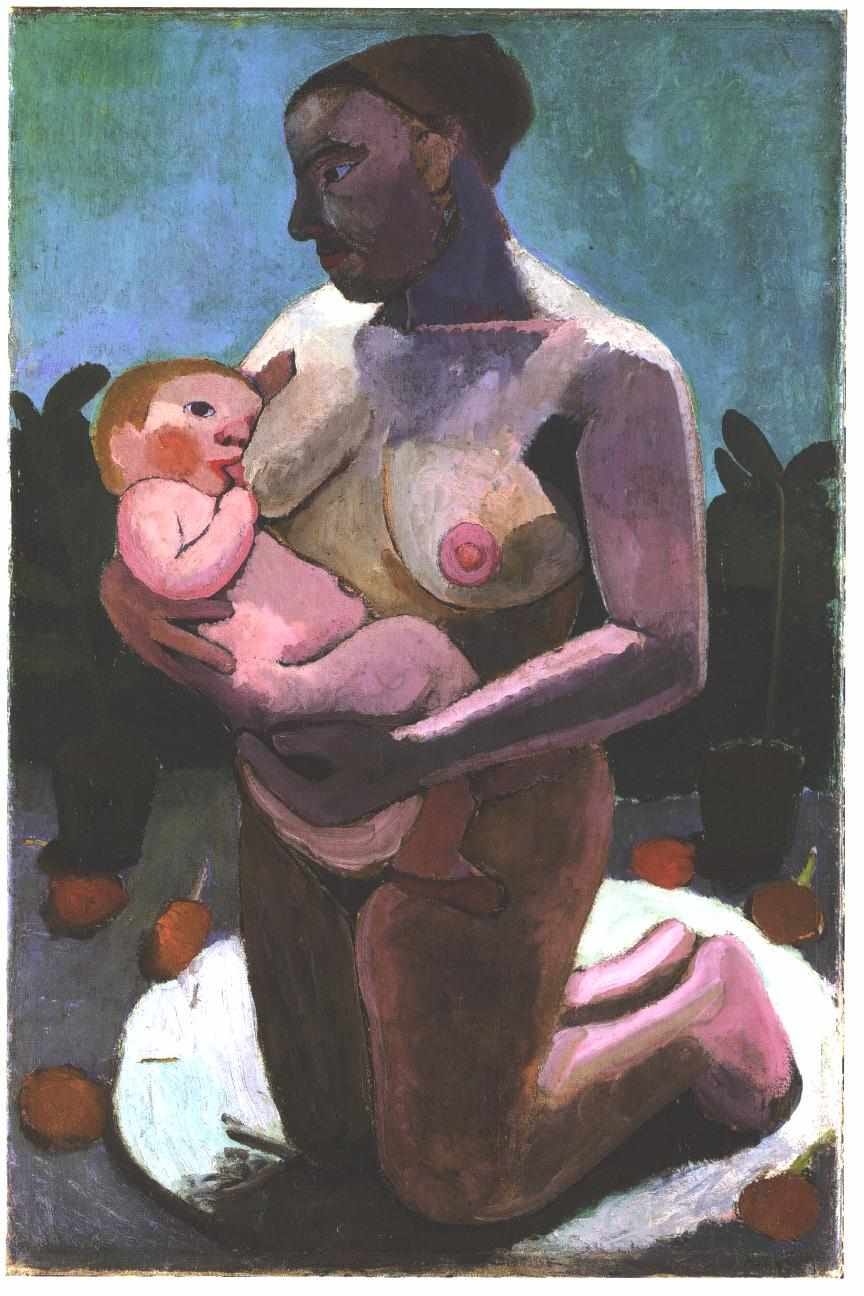
11. Paula Modersohn Becker, Mother and Child (about 1906)

A naked mother kneeling and cradling her naked baby
Paula Modersohn Becker, Kneeling Mother and Child, 1907

A naked mother kneels and gathers her equally naked baby against her body, the two forming one heavy, earthy, protective shape. Modersohn Becker, a German painter far ahead of her time, stripped motherhood of all lace and sentiment and painted it as raw, physical, animal love.

She was obsessed with the subject for years before she ever had a child of her own. In a cruel twist, she died at thirty one from an embolism just weeks after finally giving birth to her daughter.

Her last word, reportedly, was a simple what a pity.

12. Van Gogh, Portrait of the Artist's Mother (1888)
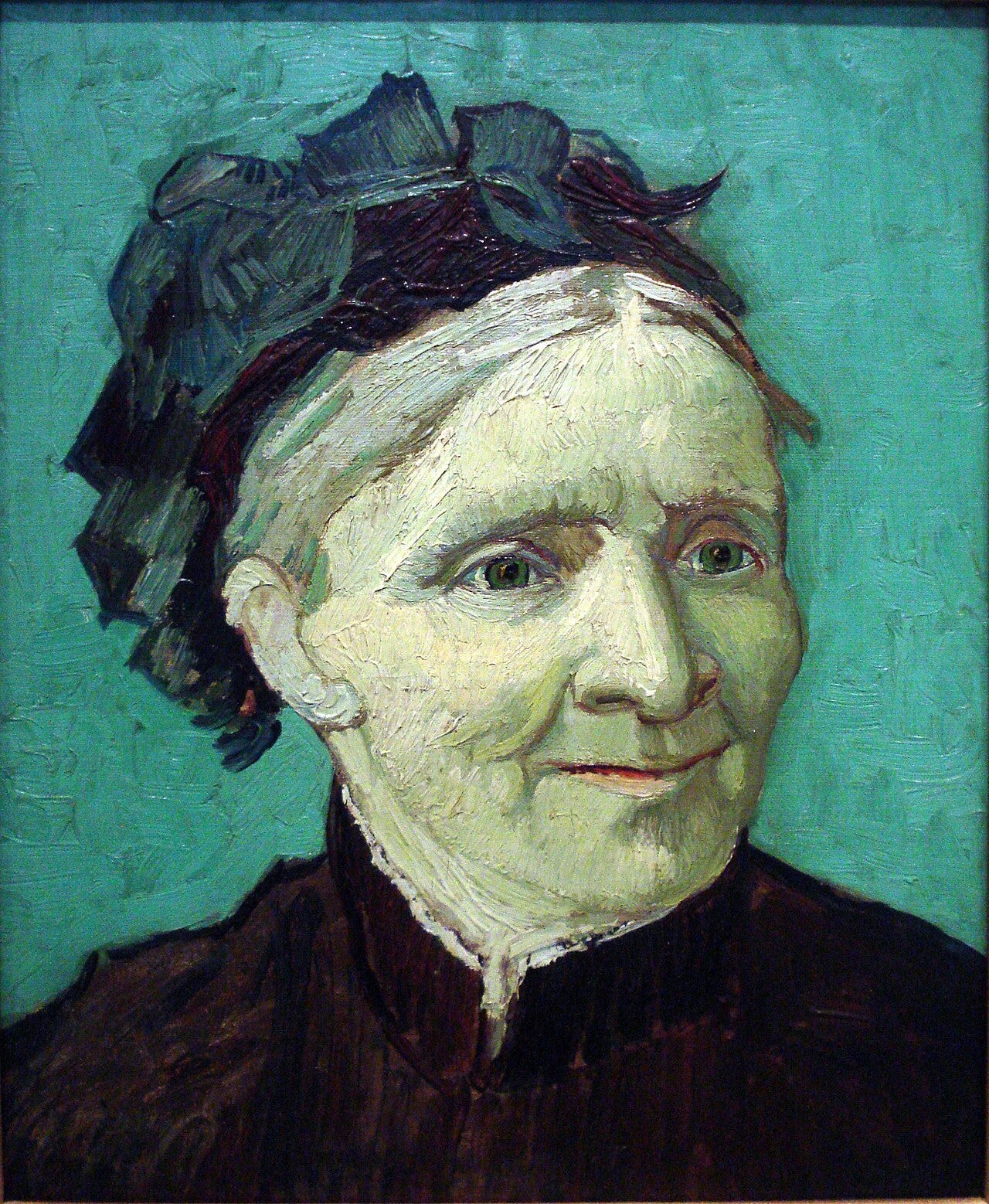
A warm color portrait of an elderly woman with green eyes
Van Gogh, Portrait of the Artist's Mother, 1888

Van Gogh painted his mother Anna from a black and white photograph, adding warm color from memory, giving her green eyes and a soft rose background.

He made it in Arles while missing his family badly, writing that he could not stand a colorless photograph of someone he loved.

The two had a difficult, distant relationship, and she reportedly never thought much of his art in her lifetime. She outlived him by seventeen years.

The real keeper of his legacy turned out to be his sister in law Johanna, whose story I tell in the piece on the woman who made Van Gogh, while his warm portrait of Anna now hangs in a museum in California.


Mother and child in art, a few questions

  • What is the most famous painting of a mother? Whistler's Mother from 1871, closely followed by Mary Cassatt's tender scenes of mothers bathing their children.

  • Who is the painter of motherhood? Mary Cassatt, an American Impressionist who never had children yet made mothers and babies her lifelong subject.

  • What is a Madonna in art? A painting of the Virgin Mary, usually holding the infant Jesus, the oldest and most painted mother in Western art.

  • Why did artists paint their own mothers? To practice portraiture on a patient, free model, and often out of plain love, as Whistler and Van Gogh both did.

  • Which women painters showed motherhood? Cassatt, Berthe Morisot, Vigee Le Brun and Paula Modersohn Becker all painted mothers from a woman's own point of view.


If these mothers moved you, you will love these too:


The first face we all know

A mother holding a child is the first image any of us ever sees, before we have words for it. That is why it runs through art from a golden Byzantine icon to a naked woman curled around her baby in a German studio.

These painters found the same tenderness in a queen and a peasant, a saint and their own tired mother. It is the one subject that never quite stops feeling new.