Famous Paintings of Women: 12 Faces That Shaped Art

The most famous paintings of women run from Leonardo's Mona Lisa and Vermeer's girl to Klimt's golden Adele and Grant Wood's stern farm daughter. For centuries women were the most painted subject in art, and almost always by men.

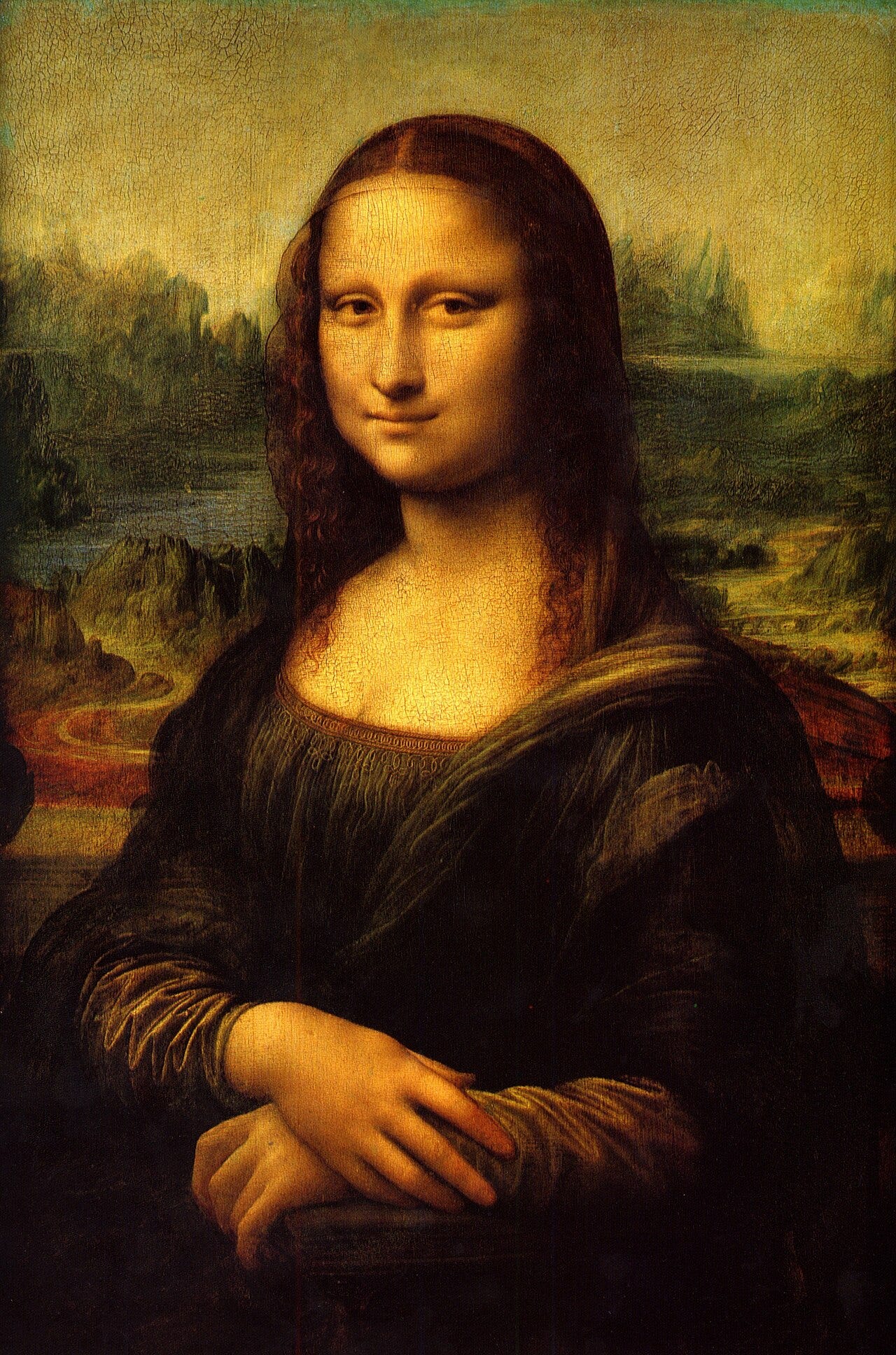
Mona Lisa Leonardo portrait
Leonardo da Vinci, Mona Lisa, about 1503, Louvre, Paris

So the story of women in paint is also the story of who held the brush. I have picked twelve faces across five hundred years, each one an idea of what a woman was meant to be, and the female painters left out of that story are their own tale in the old masters were women too.

How the painted woman keeps changing:

  • The muse. An ideal of beauty, often more dream than real person.

  • The wife. A sign of a husband's wealth, status and bloodline.

  • The scandal. A bare shoulder or a cold stare that shocked a whole city.

  • The icon. A face that escapes the frame and becomes a symbol.


Learn art the fun way. Free stories every week, no boring lectures.


For the parts the museums leave out

Three worth opening next:


1. Leonardo da Vinci, Mona Lisa (about 1503)

A woman in dark Florentine dress turns to look at you with the faint smile that has launched a thousand theories. Leonardo painted her around 1503, most likely Lisa Gherardini, a merchant's wife, in a small panel now behind glass in the Louvre.

She was admired for centuries but not yet a global star. That came in 1911, when a workman stole her off the wall, and for two years the empty space and the headlines turned Lisa into the most famous face on earth.

Doctors still read her health from the picture alone, which I dig into in was Mona Lisa sick.

2. Jan van Eyck, The Arnolfini Portrait (1434)

Arnolfini Portrait couple mirror
Jan van Eyck, The Arnolfini Portrait, 1434, National Gallery, London

A man and his richly dressed wife stand hand in hand in a Flemish room, a little dog at their feet and a round mirror on the wall behind. Jan van Eyck signed and dated it 1434, one of the first great double portraits in oil.

She is not pregnant, whatever you have heard, since the gathered green gown was simply the heavy fashion of the day. The real marvel is the convex mirror behind the couple, which reflects the whole room and two extra figures in the doorway, one of them perhaps van Eyck himself, and I unpack its hidden signals in the Arnolfini portrait.

3. Sandro Botticelli, Portrait of a Young Woman (about 1480)

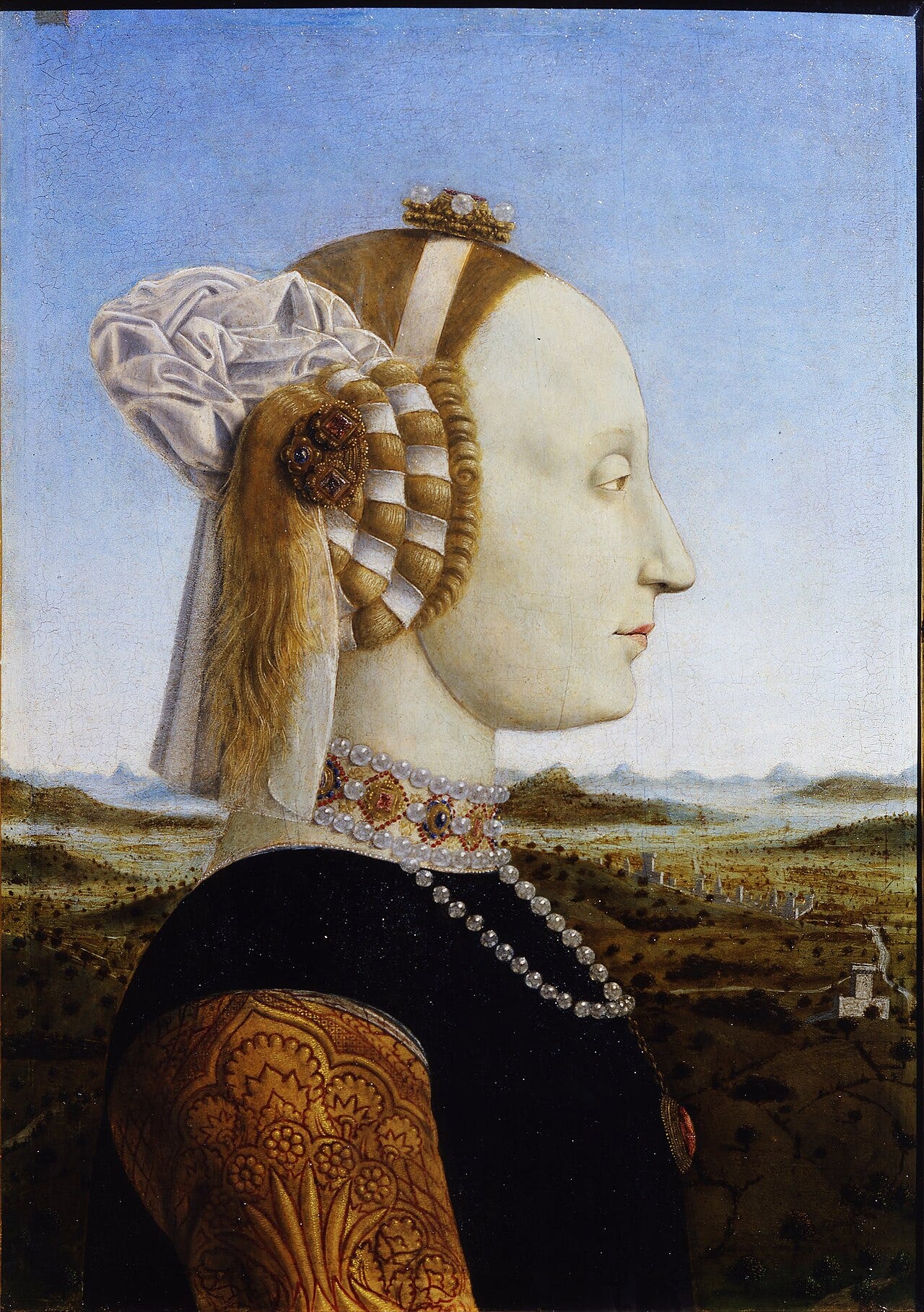
Botticelli young woman profile
Sandro Botticelli, Portrait of a Young Woman, about 1480

A young woman stands in profile, hair braided with pearls and ribbons, gazing past you with cool composure. Botticelli painted several idealized beauties like this around 1480, and many believe the model was Simonetta Vespucci, the great beauty of Florence.

Simonetta died young, and Botticelli seems to have painted her face for years afterward, turning a real woman into a template for the ideal.

In pictures like this the sitter is less a person than a vision, a perfect surface built from memory and myth.

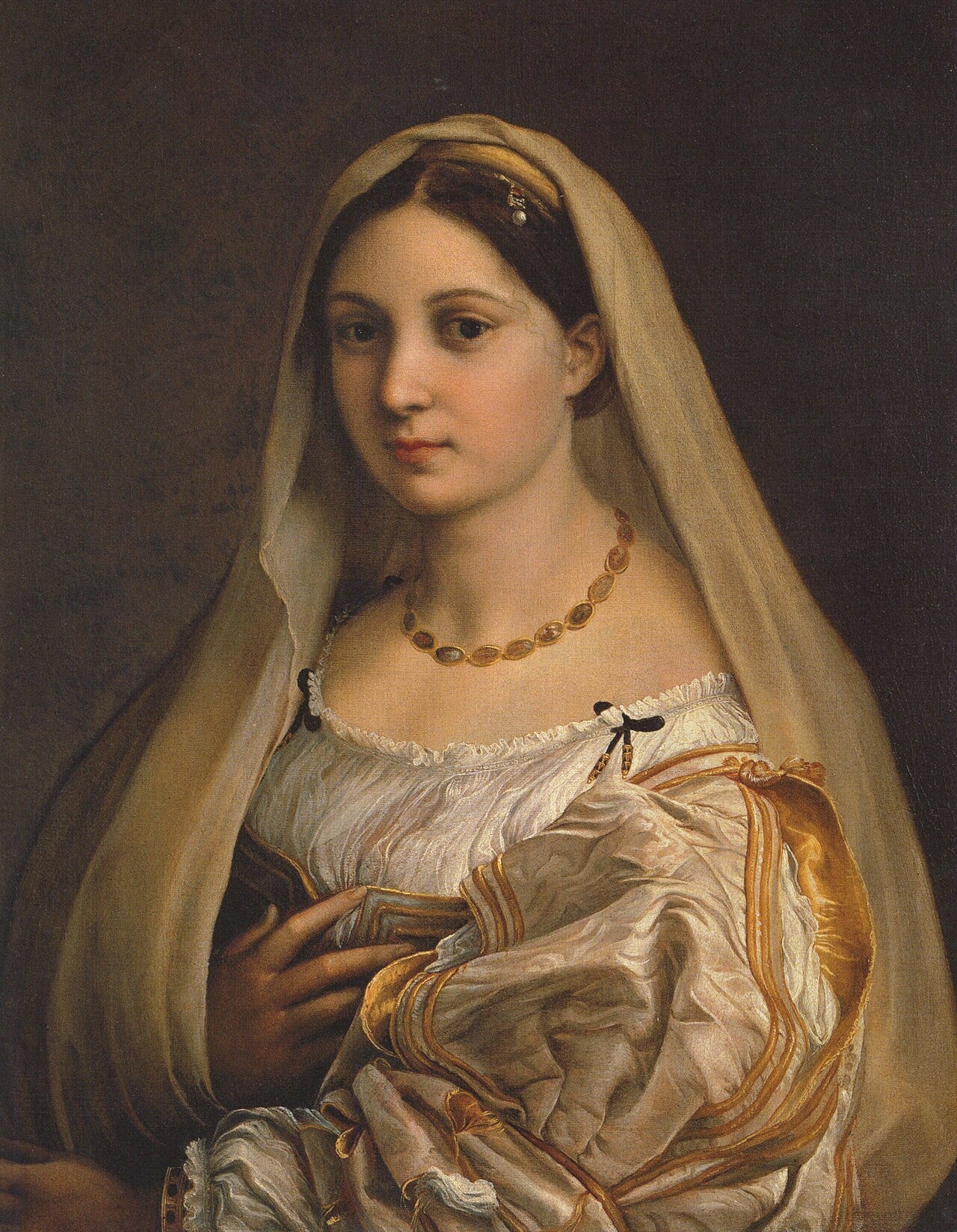
4. Raphael, La Donna Velata (about 1516)

Raphael veiled woman portrait
Raphael, La Donna Velata, about 1516, Palatine Gallery, Florence

A woman in a soft veil and a gleaming silk sleeve looks out with warm, direct calm. Raphael painted La Donna Velata around 1516, and it is one of the tenderest portraits of the whole Renaissance.

The model is widely identified as the woman Raphael loved, the same face he gave to some of his Madonnas, so a private muse became the mother of God on other walls.

He lavished as much care on her clothing as on her face, and the folded white sleeve alone shows a painter as taken with silk as with the woman inside it.

5. Diego Velazquez, Las Meninas (1656)

Velazquez Las Meninas Infanta
Diego Velazquez, Las Meninas, 1656, Prado, Madrid

A little blonde princess stands at the center of a busy studio, ringed by her maids, a dog, a dwarf and the painter himself at a huge canvas. Velazquez painted Las Meninas in 1656, and the five year old Infanta Margarita is its bright center.

Yet the real subjects may be off the canvas. In the mirror at the back glimmer the king and queen, as if they stand exactly where you do, so the picture quietly asks who is watching whom. The Infanta rules the room, but her parents haunt it.

6. Johannes Vermeer, Girl with a Pearl Earring (about 1665)

Girl with a Pearl Earring
Johannes Vermeer, Girl with a Pearl Earring, about 1665, Mauritshuis

A girl turns over her shoulder, lips parted, a fat pearl catching the light at her ear. Vermeer painted her around 1665, and she has become one of the most loved faces in art, though she may be no one at all.

She is likely not a portrait but a tronie, a study of a type and a costume rather than a named sitter, so the girl everyone longs to identify was perhaps invented. You can read how that odd genre works in what a tronie is.

7. Francisco Goya, The Clothed Maja (about 1805)

Goya Clothed Maja reclining
Francisco Goya, The Clothed Maja, about 1805, Prado, Madrid

A woman reclines on cushions in a short jacket and slippers, meeting your eye without a trace of shame. Goya painted The Clothed Maja around 1805, the respectable twin of his far more notorious nude version.

The two were painted as a pair, and Goya is said to have kept the clothed Maja hung in front of the nude, sliding it aside for select guests, a peep show tucked inside a nobleman's collection.

The Inquisition later summoned him over the naked version, and to this day no one is fully sure who the model actually was.


Learn art the fun way. Free stories every week, no boring lectures.


8. Jean Auguste Dominique Ingres, Madame Moitessier (1856)

Ingres Madame Moitessier mirror
Jean Auguste Dominique Ingres, Madame Moitessier, 1856, National Gallery, London

A grand Parisian lady in a flowered gown sits before a mirror, one finger raised to her cheek, serene and immovable. Ingres worked on this portrait of Madame Moitessier on and off for about twelve years, finishing in 1856.

He was so slow that the sitter aged during the sittings, and the mirror behind her shows her profile at an angle no real mirror could give.

Ingres bent reality to make a woman look eternal, and the result feels less like a person than a goddess in silk.

9. James McNeill Whistler, Whistler's Mother (1871)

Whistler's Mother seated profile
James McNeill Whistler, Whistler's Mother, 1871, Musee d'Orsay, Paris

An old woman sits in strict profile against a plain wall, dressed in black, hands folded in her lap. Whistler painted his own mother in 1871, though he insisted the picture was really about shapes and tones.

He framed it as a study in tone rather than a tribute, giving it a formal title that speaks only of an arrangement of black and neutral shades, and caring more about the balance of dark rectangles than about any warm feeling.

The public adored it anyway, and against his wishes the picture became a worldwide emblem of motherhood, printed on stamps and posters, the very sentiment he claimed not to want.

10. John Singer Sargent, Madame X (1884)

Sargent Madame X black gown
John Singer Sargent, Madame X, 1884, Metropolitan Museum

A pale society beauty stands in a black gown, face turned sharply away, one strap of her dress at first slipping off her shoulder. John Singer Sargent showed Madame X in 1884, and it nearly ended his career.

Paris was scandalized by the fallen strap and the woman's cold hauteur, so Sargent painted the strap back onto her shoulder and fled to London.

He later called it the best thing he ever made, while the sitter, Virginie Gautreau, is remembered only as a letter of the alphabet.

11. Gustav Klimt, Woman in Gold (1907)

Klimt Woman in Gold Adele
Gustav Klimt, Adele Bloch Bauer I, Woman in Gold, 1907

A dark eyed woman floats in a storm of gold, her face and hands the only soft flesh in a field of glittering pattern. Gustav Klimt painted Adele Bloch Bauer in 1907, a Viennese hostess wrapped in the shine of his golden years.

The Nazis seized the picture from her family, and it hung for decades in Vienna as a national treasure. After a long court fight her niece won it back in 2006, and it sold that year for about one hundred thirty five million dollars, then a record for any painting.

12. Grant Wood, American Gothic (1930)

American Gothic farmer daughter
Grant Wood, American Gothic, 1930, Art Institute of Chicago

A stern man with a pitchfork and a tight lipped woman stand before a white farmhouse, in the most parodied image in American art. Grant Wood painted it in 1930, at the start of the Great Depression, and people have argued about that pair ever since.

Most assume they are husband and wife, but Wood meant them as a farmer and his daughter, and the woman is his own sister, Nan. She hated being taken for the dour man's wife, and spent years correcting strangers, a small revenge for a face that outgrew her entirely.


Join 130,000 readers who get the secrets behind the paintings. Free.


Where to meet these women

  • Leonardo, Mona Lisa: the Louvre, Paris.

  • Van Eyck, The Arnolfini Portrait: the National Gallery, London.

  • Velazquez, Las Meninas, and Goya, The Clothed Maja: the Prado, Madrid.

  • Vermeer, Girl with a Pearl Earring: the Mauritshuis, The Hague.

  • Sargent, Madame X: the Metropolitan Museum, New York.

  • Wood, American Gothic: the Art Institute of Chicago.


If these faces held you, look closer here:


Two new stories a week, 130+ secrets unlocked. Start free.


Painted women, a few honest questions

  • What is the most famous painting of a woman? Leonardo's Mona Lisa, painted around 1503, seen by millions at the Louvre every year.

  • Who is the girl with a pearl earring? Probably no one in particular. Vermeer likely painted a tronie, an imagined type rather than a named sitter.

  • Why were most paintings of women made by men? For centuries women were barred from training and studios, so the image of woman was shaped almost entirely by male painters.

  • What is Woman in Gold? Klimt's 1907 portrait of Adele Bloch Bauer, looted by the Nazis, returned to her family in 2006 and sold for about one hundred thirty five million dollars.

  • Is American Gothic a husband and wife? No. Grant Wood painted a farmer and his daughter, and the woman was modeled by his own sister, Nan.

The faces that got away

Line them up and you can watch who held the brush. For most of these centuries a woman sat still while a man decided what she meant, a muse, a wife, a warning, a fortune in gold.

A few slipped the leash. Virginie Gautreau became a scandal and then a single letter, Adele Bloch Bauer became a court case worth a hundred and thirty five million dollars, and Nan Wood spent her life telling strangers she was the farmer's sister, not his wife.

The most famous of them all, Lisa Gherardini, sat for a small portrait around 1503 and became the most looked at face in human history.