
A painter born near Bern in 1879 is often filed under childlike art, yet he catalogued close to ten thousand of his own works and looked harder than his reputation suggests. One of his watercolors shows a tower in Tunisia that no longer stands, and it took old photographs to prove he had not made it up.
Cool Stories About Art is a newsletter to learn art the fun way.
Join 200,000+ readers and get:
10 new art stories / month
The entire archive of content (140+ articles)
Comment, ask questions, and chat with other readers
Zinc, Gauze, Burlap and a Pasted Sheet
For nearly forty years, this painter treated each picture as a trial of materials. He scratched zinc with a needle, painted on gauze, burlap and newspaper, traced drawings through paper coated with oil, and laid dots of color onto canvas. The support was rarely an afterthought.
His subjects, by contrast, stayed modest and close at hand: a town seen on a journey, a pet, a plant with a Latin name, an angel. What kept changing was the way a picture was made, and what could be hidden inside it.
The twelve follow him from his parents' house in Bern to Tunisia, then to the Bauhaus school in Weimar and Dessau, to an academy in Düsseldorf, and back to Bern in his last years of illness. Most of them are the works people search for first. A few seldom show up in lists of his work.
12. Hammamet with Its Mosque (1914)
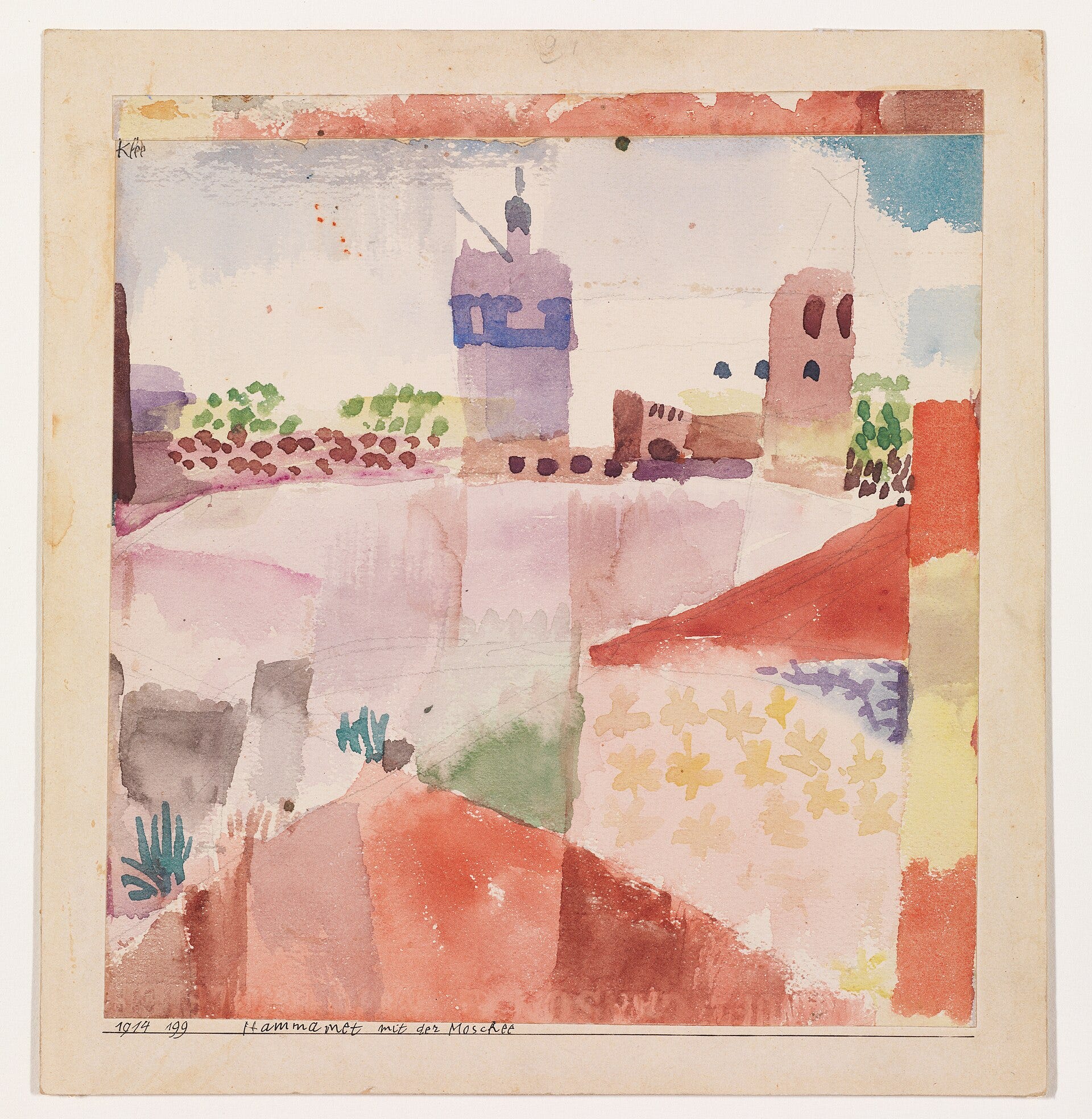
At the top of Hammamet with Its Mosque, a white minaret rises between two towers, above bands of pink, buff and green squares and triangles. The tower on the right has wine-colored windows, and nothing in Hammamet today matches it.
The sheet goes back to a journey. In April 1914, Klee traveled through Tunisia with two painter friends, the German August Macke and the Swiss Louis Moilliet. They carried light watercolor boxes and a Baedeker guidebook. On April 14 they stopped at Hammamet, a small walled town on the Mediterranean coast, and Klee painted it from outside the ramparts.
Seen from there, the bottom of the picture hardly describes anything. Klee laid it out in patches of transparent color, following Robert Delaunay, a French painter he had met in Paris, for whom pure color and its contrasts could be a subject in themselves. The top is another matter.
That top half sent an academic writing for The Conversation to Hammamet in 2014, for three days of looking for the spot. The mosque was still there, with its square minaret, the crenellated gallery where the muezzin calls the faithful to prayer, and a flagpole set at an angle. Klee had painted all of it very exactly. The tower on the right, though, was gone.
Old photographs solved the puzzle. From about 1910 to 1956, when Tunisia was a French protectorate, the casbah, the old fortress of Hammamet, was topped by a blockhouse called the poste optique, an optical telegraph station that relayed messages by visual signals. It stood more than 100 meters from the minaret.
One of those photographs was taken in color in 1931 by Frédéric Gadmer, working for Albert Kahn's Archives of the Planet. He stood outside the walls, as Klee had, and from there the minaret and the blockhouse appear side by side, as they do in the watercolor.
For me, this sheet is the strongest reply to the claim that Klee painted like a child, because it starts from what stood in front of him. The author of the article called his method "savvy combinations of the observed, the supposed and the superposed."
At a Glance
Artist: Paul Klee (1879 to 1940)
Painted: 1914
Medium: Watercolor and graphite on paper mounted on cardboard
Size: 23.8 × 22.2 cm (9 3/8 × 8 3/4 in)
Where to see it: Metropolitan Museum of Art, New York
11. Two Men Meet, Each Believing the Other to Be of Higher Rank (1903)
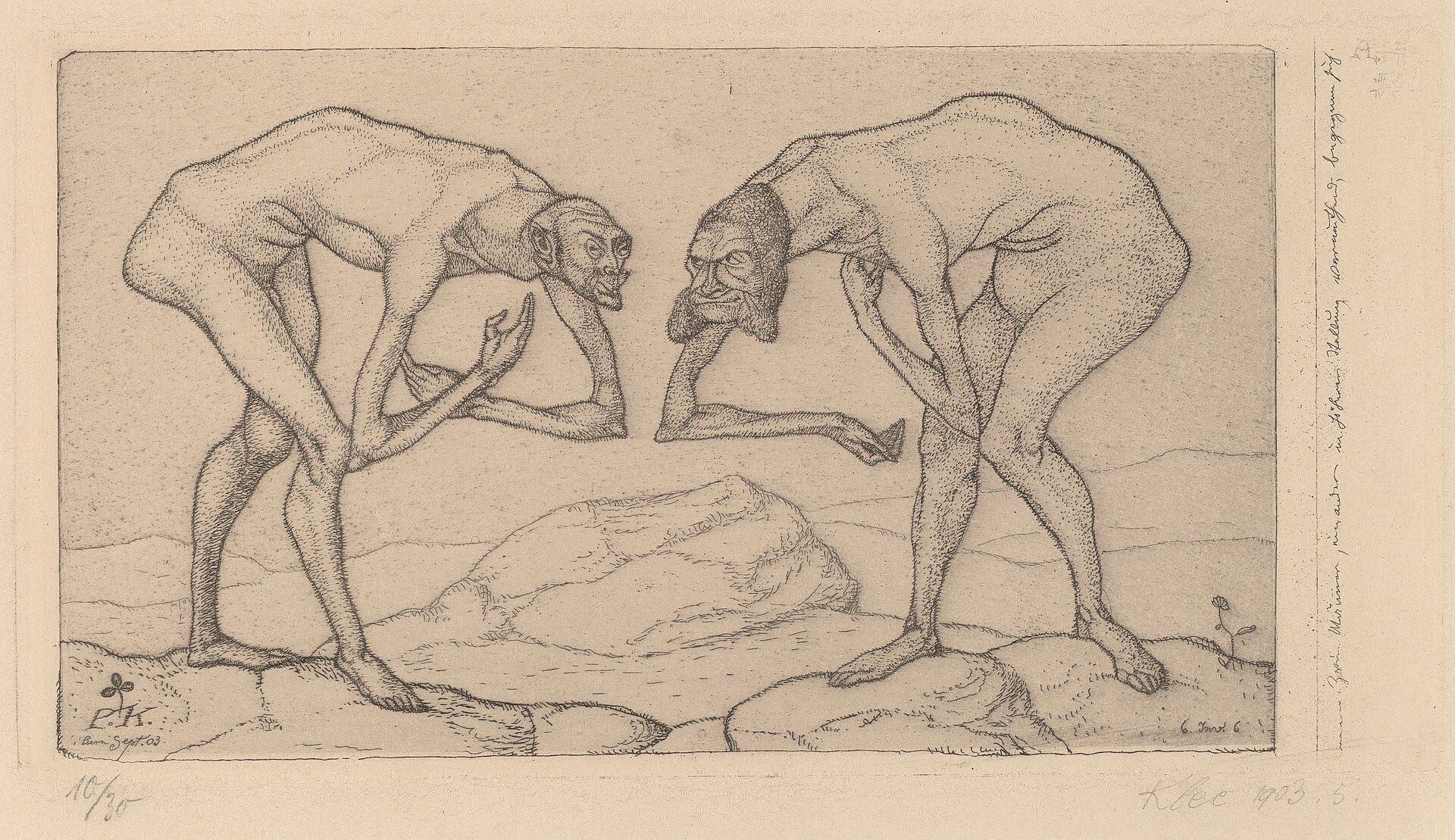
Two thin naked men, each with a crown of spiky hair, bow deeply toward each other. Neither looks ready to straighten up first, and both have bowed for the same mistaken reason.