
Camille Pissarro spent his life painting ordinary places: a village road, a field after a frost, a Paris street seen from a hotel window. Yet history kept breaking into those quiet pictures. An early canvas escaped a war because it had left his house weeks before soldiers moved in, and the Nazis took a later one from its owner in 1939.
Cool Stories About Art is a newsletter to learn art the fun way.
Join 200,000+ readers and get:
10 new art stories / month
The entire archive of content (140+ articles)
Comment, ask questions, and chat with other readers
From a Caribbean Shore to a Paris Window
Pissarro helped found Impressionism, the group of painters who exhibited together in Paris from 1874. He worked outdoors, facing what he painted, and that subject was nearly always a place where people live and work.
That habit kept him close to home. He settled in villages near Paris and painted the same fields and lanes in every season. In old age, when his eyes made outdoor work difficult, he rented rooms high above Paris streets and painted what lay below the window.
The twelve run from 1856 to 1901, from his arrival in Paris to his final years there. Most are the famous ones. A few are seldom shown, and each of them carries one of the best stories of his career.
12. Route to Versailles, Louveciennes (1869)
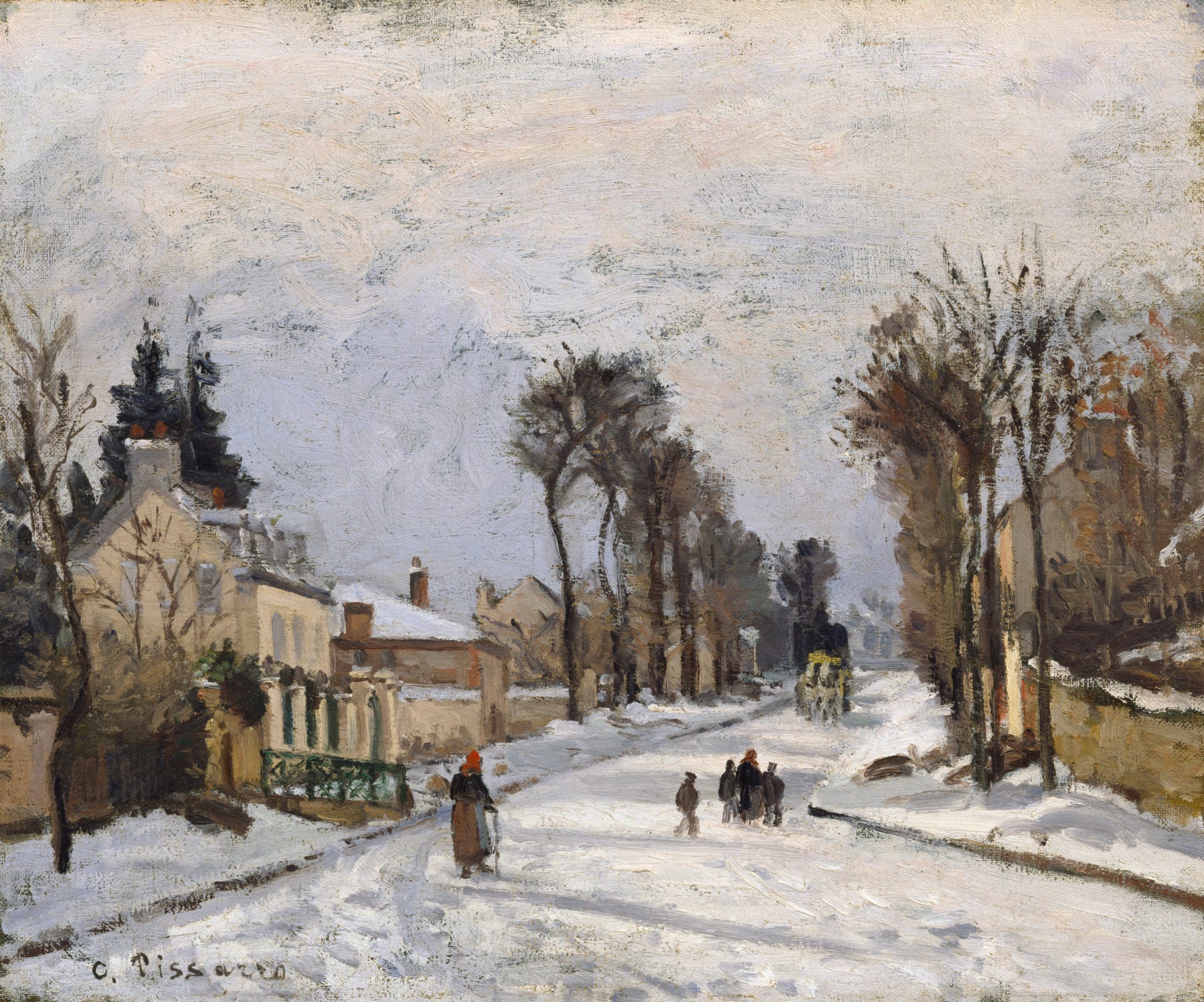
A road bends between pale houses and a garden wall under a gray winter sky, and a few small figures walk along it. Pissarro painted Route to Versailles, Louveciennes in 1869, soon after he moved his family to Louveciennes, a village west of Paris where the future Impressionists often came to work.
The canvas did not stay with him long. On January 7, 1870, a few weeks after he finished it, he sold it to George A. Lucas, an American art agent in Paris who found pictures for collectors back home in Baltimore. Lucas kept this one for his own collection.
That sale came just in time. In July 1870 war broke out between France and Prussia, and as the Prussian army advanced on Paris, Pissarro fled with his family and eventually reached London. His paintings stayed behind in the house at Louveciennes.
Prussian troops were quartered there. When Pissarro returned in 1871, he found the house wrecked and most of the paintings he had left in it destroyed. Few of his early works survived.
The road to Versailles was spared because it was already in Lucas's hands. It remains one of the rare canvases that show how Pissarro painted before the war: a wide gray sky, a road that draws the eye into the village, and people kept small among the houses.
At a Glance
Artist: Camille Pissarro (1830 to 1903)
Painted: 1869, Louveciennes
Medium: Oil on canvas
Size: 38.4 × 46.3 cm (15.1 × 18.2 in)
Where to see it: Walters Art Museum, Baltimore
11. Two Women Chatting by the Sea, St. Thomas (1856)
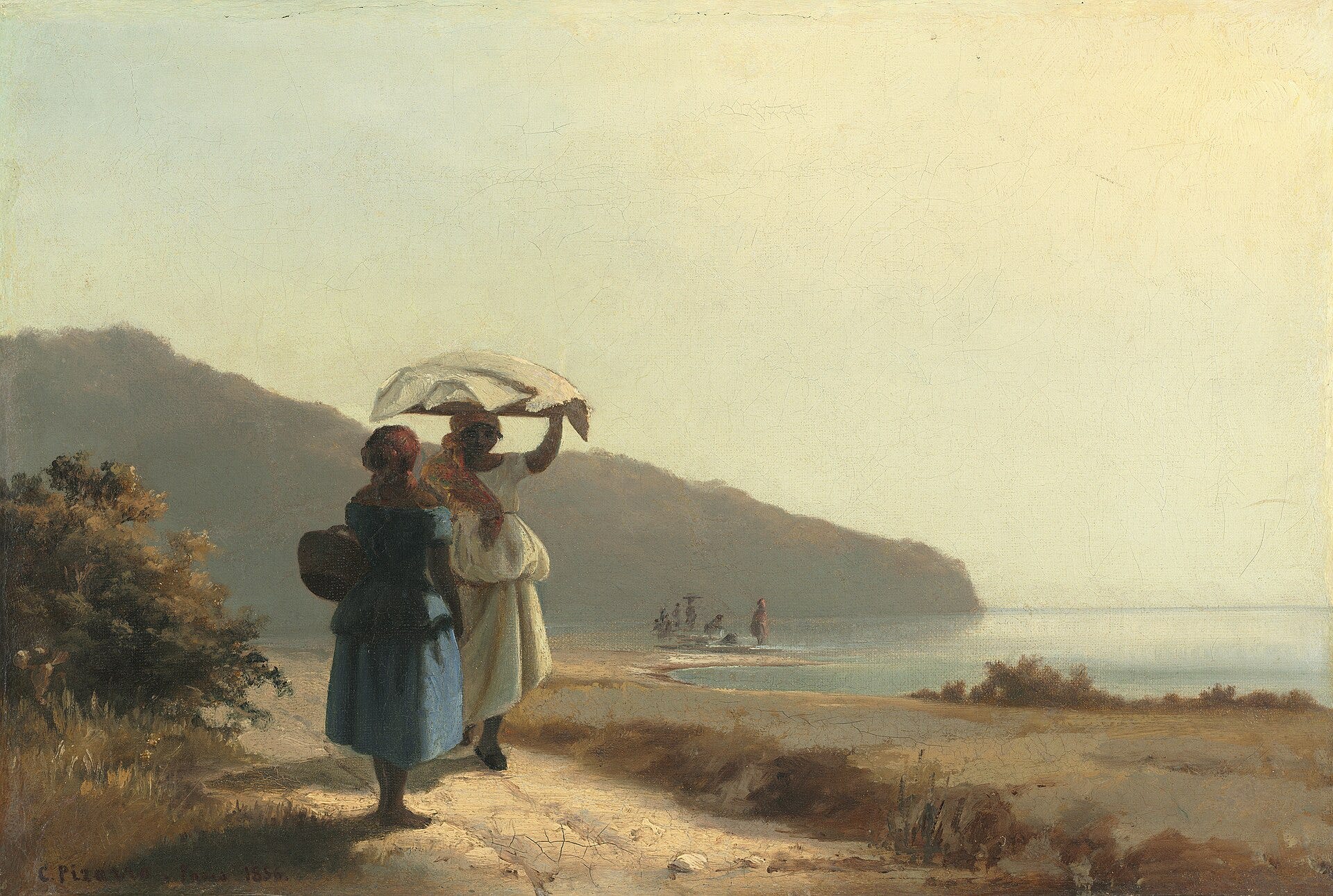
Two women stop to talk on a sandy path beside a calm blue-green sea. One balances a basket on her head, green hills rise behind them, and a sailboat stands out on the water. Yet in the corner, next to his name and the year, the painter wrote the city where he made the picture: Paris.