Famous Pointillist Paintings: 12 Made of Dots
Pointillism was built entirely out of tiny separate dots of pure color, laid side by side so that your own eye would mix them into light.
In the 1880s a handful of young painters put away the brushstroke and started building pictures from thousands of small dots, a technique as much science as art.
Here are twelve of the most famous pointillist paintings, all now in the public domain. To understand the method itself, see what pointillism is; here, the pictures it produced.
I have picked the twelve where the dots really sing.
For readers who stay
If you like knowing what is actually going on inside a picture, start with these three:
Twelve famous portraits and the real people, the faces behind the paintings
The Arnolfini Portrait, detail by detail, the mirror, the dog, and the question everyone asks
Lady with an Ermine, detail by detail, why she is holding that animal
1. Georges Seurat, A Sunday on La Grande Jatte (1884 to 1886)
Parisians stand frozen in a park on a Sunday afternoon, stiff as cut outs, the whole scene built from millions of tiny dots of pure color.
Seurat worked on it for two years and made about sixty studies, treating a lazy Sunday like a scientific experiment.
He wanted the colors to mix in your eye rather than on his palette, so green and orange dots sit side by side to make a glowing patch of grass.
It is over three metres wide, and when it was shown in 1886 the critics mocked it and the public was baffled.
He even painted a border of dots around the edge, so the picture would not clash with its own frame.
2. Georges Seurat, Bathers at Asnieres (1884)
Working men lounge on a riverbank in the hazy heat, a boy cupping his hands to shout across the water, the factory chimneys of Paris smoking behind them.
Seurat painted it just before he invented the dot technique, using long crisscrossed strokes, then went back years later and added dots to some areas.
The official Salon rejected it, so he showed it with a group of independents instead, a snub that helped launch a whole movement. The men are ordinary workers, painted with the calm grandeur usually reserved for gods and heroes.
The two great pictures show the same stretch of river from opposite banks, workers on one side and the middle classes on the other.
3. Georges Seurat, The Circus (1891)
A bareback rider stands on a galloping white horse while a clown watches from the front, the whole ring built from feverish yellow, red and blue dots.
Seurat left it unfinished when he died suddenly at thirty one, probably of an infection, only days after showing it in public. He was testing the idea that rising lines and warm colors could make a picture feel joyful, an emotion he believed he could engineer.
The tiers of the audience climb the canvas in flat, patterned rows, more decoration than crowd. He died before he could learn whether his theory of feeling held, and the movement lost its center with him.
4. Paul Signac, Portrait of Felix Feneon (1890)
An art critic stands in profile holding a flower and a top hat, set against a swirling background of colored rays, patterns and stars, like a hypnotist's wheel.
Feneon was the critic who coined the term Neo Impressionism and championed Seurat's dots while everyone else laughed. Signac gave him this dizzying halo, based on a Japanese fabric design and a fashionable theory about how patterns act on the mind.
The full title runs to a line of pseudo scientific jargon, half tribute and half private joke. It hangs at the Museum of Modern Art in New York, the strangest portrait the movement ever produced.
5. Paul Signac, The Papal Palace, Avignon (1900)
The great stone palace of the popes rises above the river in blocks of violet, orange and blue, painted not in fine dots but in broad square touches like mosaic tiles.
By 1900 Signac had loosened the method, letting the dots grow into little bricks of color that vibrate against each other. A passionate sailor, he painted most of his later work from the ports and rivers of the south of France.
He also wrote the book that explained the whole theory to a new generation, including a young Henri Matisse. It hangs in the Musee d'Orsay, painted around the time his book turned a technique into a doctrine.
6. Henri Edmond Cross, The Evening Air (1893)
Naked women lounge and stretch under pine trees beside a golden Mediterranean bay, the whole scene dissolving into warm dots of pink, green and gold.
Cross moved south for his health and painted a dream of a perfect sunlit world, an anarchist's vision of paradise with no masters. The dots here are large and loose, almost squares, and the colors are turned up far past anything real.
His imagined golden age directly inspired Matisse, who saw this picture and painted his own version of the same dream. Cross was crippled by arthritis, and made these idylls of ease while in constant pain.
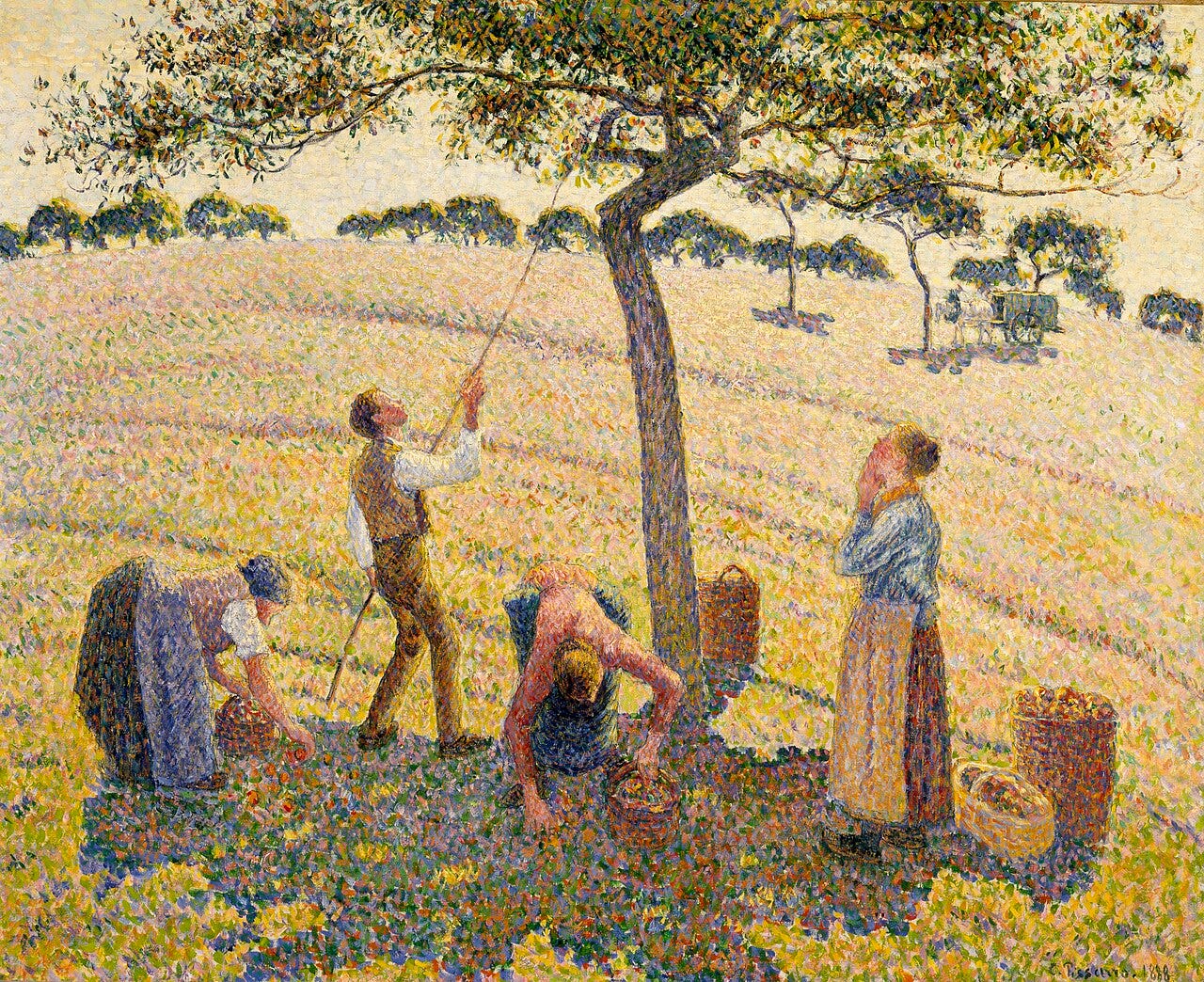
7. Camille Pissarro, Apple Harvest (1888)
Peasant women shake apples from a tree and gather them in the grass, every leaf and figure built from patient, separate dots. Pissarro, the oldest of the Impressionists, astonished his friends by converting to Seurat's method in his mid fifties.
He was the only one of the original group to make the leap, and he did it out of honest conviction rather than fashion. The dots slowed him down terribly, and after four years he abandoned them, saying the method killed the spontaneity he loved.
He went back to his old brush, and I dig into how the movement he helped found began in the piece on who painted the first Impressionist picture.
8. Maximilien Luce, Morning, Interior (1890)
A young man sits naked on the edge of his bed in a small Paris room, pulling on his clothes in the cold morning light, everything speckled in blue and orange dots.
Luce was an anarchist who painted the working poor, and this quiet, private moment is a world away from Seurat's Sunday crowds. The dots make the chilly light feel almost solid, filling a shabby room with a strange dignity.
He was arrested and jailed in 1894 during a government crackdown on anarchists, and spent his weeks inside drawing his fellow prisoners.
9. Theo van Rysselberghe, The Reading (1903)
A circle of serious men sit listening as the poet Emile Verhaeren reads aloud, their faces and the lamplight built from thousands of small strokes.
Rysselberghe was the Belgian who carried pointillism north and painted almost everyone who mattered in the Brussels avant garde.
He was a superb portraitist, and here he turns a literary evening into a solemn modern altarpiece of friendship. By this date he was already loosening the dots, letting them stretch into short dashes.
It hangs in Ghent, a group portrait of an entire generation of Belgian writers.
10. Georges Lemmen, Beach at Heist (1891)
An empty Belgian beach curves away in bands of orange sand and violet sea, the sky above laid down in restless dots, with not a single figure in sight.
Lemmen was barely twenty five and pushed the method toward something close to pure pattern, the waves reduced to a decorative ripple. The picture feels startlingly modern, closer to a poster or a length of fabric than to a seascape.
It hangs in the Musee d'Orsay. Within a few years Lemmen had abandoned the dots entirely, complaining that the method had become a prison.
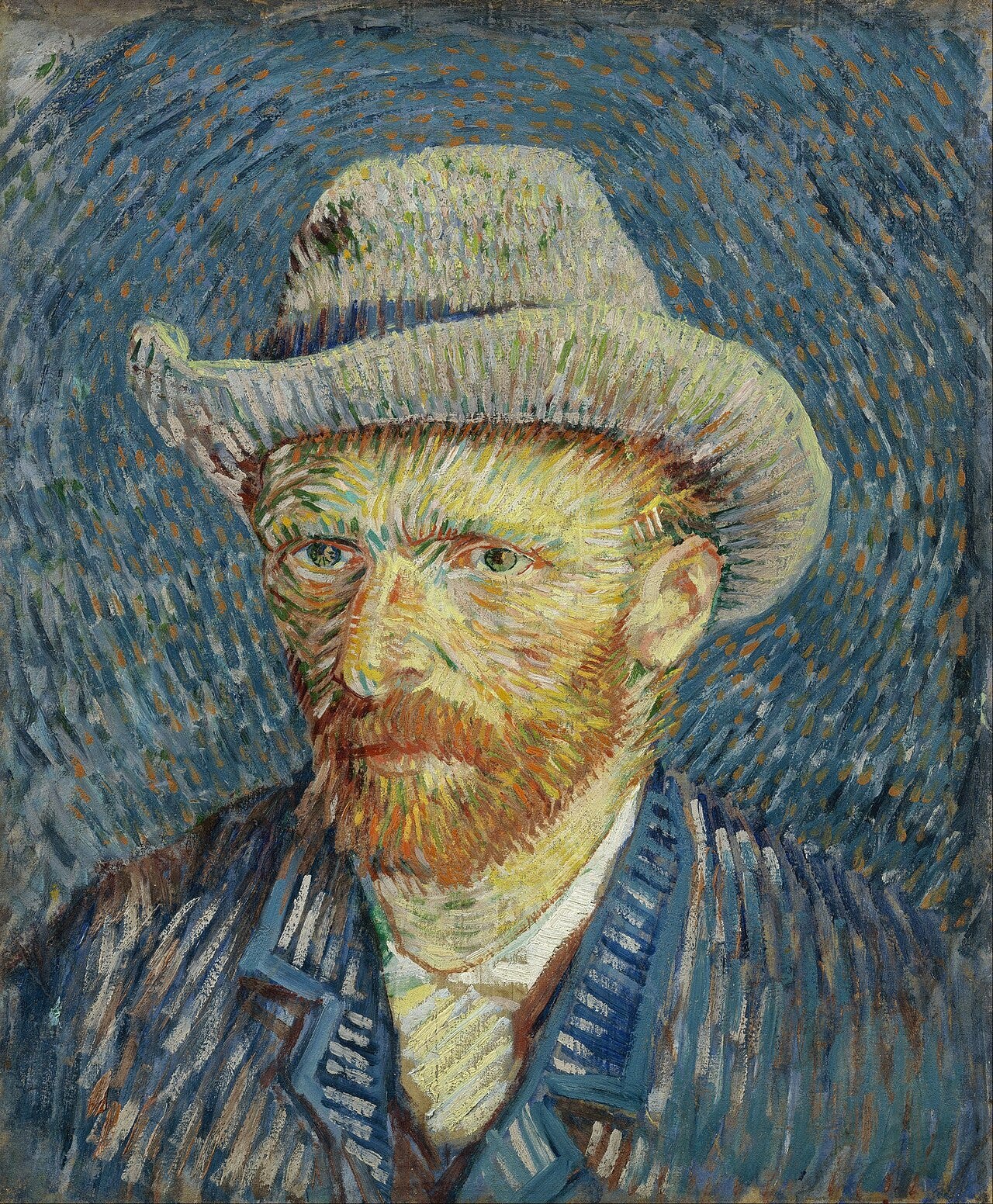
11. Van Gogh, Self Portrait (1887)
Van Gogh paints himself in a straw hat against a background of separate blue and orange strokes that radiate from his head like sparks.
He met Signac and Seurat in Paris and for a while tried the dot method, though he could never hold his hand still enough to obey its rules.
Instead he turned the dots into dashes, keeping their theory of opposite colors and throwing out their patience. Those short, clashing strokes became the twisting brushwork of his last and most famous years, the moment Post Impressionism caught fire.
He painted more than twenty self portraits in his two Paris years, using himself as the one model he never had to pay.
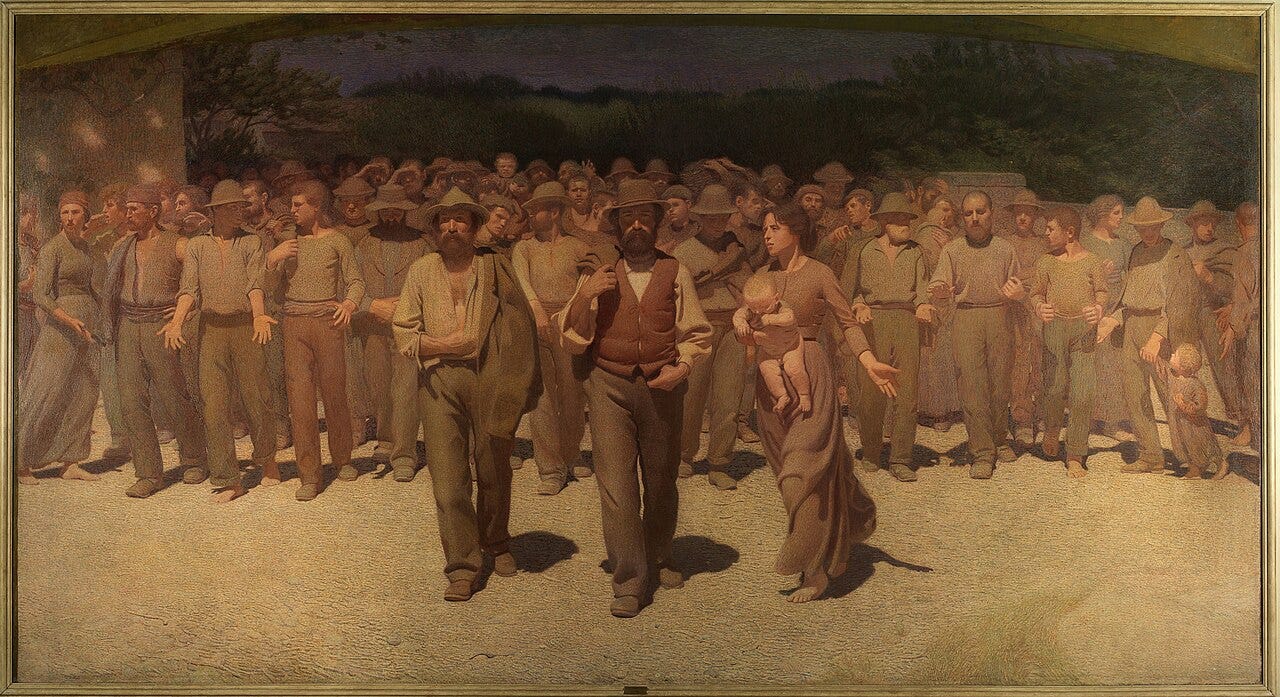
12. Giuseppe Pellizza da Volpedo, The Fourth Estate (1901)
A crowd of workers on strike walks slowly toward us across the whole width of an enormous canvas, led by three figures, painted in fine separate filaments of colored light.
Pellizza worked for ten years on this Italian version of the technique, known there as Divisionism, making countless studies. It shows the poor advancing calmly and inevitably, and it became the great image of Italian labor and socialism.
He took his own life at thirty eight, after his wife and newborn child died, never knowing what the painting would come to mean. It hangs in Milan, and a century later crowds still gather in front of it.
Pointillism, dot by dot
What is Pointillism? A technique of painting with small separate dots of pure color that mix in the viewer's eye rather than on the palette.
Who invented Pointillism? Georges Seurat, together with his friend Paul Signac, in Paris in the middle of the 1880s.
What is the most famous pointillist painting? Seurat's A Sunday on La Grande Jatte, finished in 1886 after two years of work.
What is the difference between Pointillism and Divisionism? Divisionism is the broader theory of separating colors; Pointillism is the specific method of applying them as dots.
Why did Pointillism die out? It was painfully slow. After Seurat died in 1891 the movement lost its center, and Signac and Cross gradually loosened the dots until the method fed into Fauvism.
If these dots pulled you in, you will love these too:
The secret behind Hopper Soir Bleu, the clown picture that went wrong
Titian, Sacred and Profane Love, which of the two women is which
The Last Supper, detail by detail, the detail hiding at that table
A picture made of light
Pointillism lasted barely fifteen years and exhausted almost everyone who tried it. These painters were chasing a real scientific idea, that light itself could be rebuilt on a canvas out of separate specks of pure color.
Stand too close and the pictures fall apart into confetti. Step back, and the dots vanish and the light arrives, exactly as they promised.