
Pop art is art made from the images of mass consumption: advertisements, magazine pages, press photographs, film and television. It took shape in Britain and the United States in the 1950s, as postwar prosperity filled daily life with printed pictures, and peaked in the 1960s.
These twelve works differ in medium and size, yet they share a method. Each starts from an image that already existed and changes its scale, its technique or its setting.
Cool Stories About Art is a newsletter to learn art the fun way.
Join 170,000+ readers and get:
10 new art stories / month
The entire archive of content (1,000+ articles)
Comment, ask questions, and chat with other readers
Every work on this list meets at least one of two tests: the image or design it started from is known, or the way it was made borrows a method or a material from commercial printing and advertising.
12. Marilyn Diptych, Andy Warhol, 1962

Fifty copies of the same face fill two tall canvases hung side by side, twenty-five on each. On the left panel, Marilyn Monroe repeats with yellow hair, turquoise eyeshadow and red lipstick against an orange ground. On the right panel, the same face is printed in black ink alone. Andy Warhol made the work in New York in 1962, in the months after the actress died on August 5.
Every face comes from a single photograph. It is a publicity still for Niagara, a 1953 Twentieth Century Fox film starring Monroe. Gene Kornman, a photographer working for the studio, took it. Warhol cropped the face and turned it into a silkscreen, the stencil method used to print posters and packaging.
Warhol had begun experimenting with silkscreens that same August, in his New York studio. The color panel took more than one pass. On some of these early canvases, he printed the face, painted the colors over it by hand, then printed the face again on top. Between August and the end of 1962 he made at least twenty-three paintings of Monroe from that one photograph.
Some are in color. Others are in black and white only. The diptych is the largest of these early Marilyns.
The two panels did not start as one work. Burton and Emily Tremaine, a New York couple who collected modern art, visited Warhol's house on Lexington Avenue in 1962. Two stereo machines were playing at once, one Bach and the other rock.
Warhol showed them the black Marilyns first. The colored canvas came out several pictures later. Emily Tremaine suggested presenting the two together as a diptych.
Warhol answered "gee whiz yes." The couple bought both panels. Emily Tremaine came to see herself as a collaborator on the work.
On the black panel, the faces grow fainter from left to right. Some print almost solid black. Others break up into gray patches.
What moves me most is that far right edge, where Monroe is printed so faintly that her face is barely there.
Tate's conservators have since cleaned both canvases, removing sixty years of dust and dirt with new imaging and cleaning methods. The surface now looks closer to the way Warhol and the Tremaines saw it in 1962.
At a Glance
Artist: Andy Warhol
Date: 1962
Medium: Alkyd ink, acrylic paint, oil ground and graphite on two canvases
Where to see it: Tate Modern, London
Size: each panel 205.4 × 144.7 cm, overall 205.4 × 289.4 cm
About This Painting
When did the Tate acquire Marilyn Diptych? Tate acquired Marilyn Diptych in 1980, from Burton and Emily Tremaine, through the Pace Gallery in New York.
Where was Marilyn Diptych first exhibited? Marilyn Diptych's earliest recorded show is Six Painters and the Object, at the Guggenheim Museum in New York, from March to June 1963.
Where did Marilyn Diptych hang before London? The Tremaines lent Marilyn Diptych for most of the time, from 1970, to the Wadsworth Atheneum in Hartford, Connecticut. Its size kept them from hanging it at home very often.
Is Marilyn Diptych the Marilyn that sold for 195 million dollars? No. Shot Sage Blue Marilyn, a single canvas from 1964, holds that record, sold at Christie's in New York in May 2022.
11. Sgt. Pepper's Lonely Hearts Club Band (album cover), Peter Blake and Jann Haworth, 1967
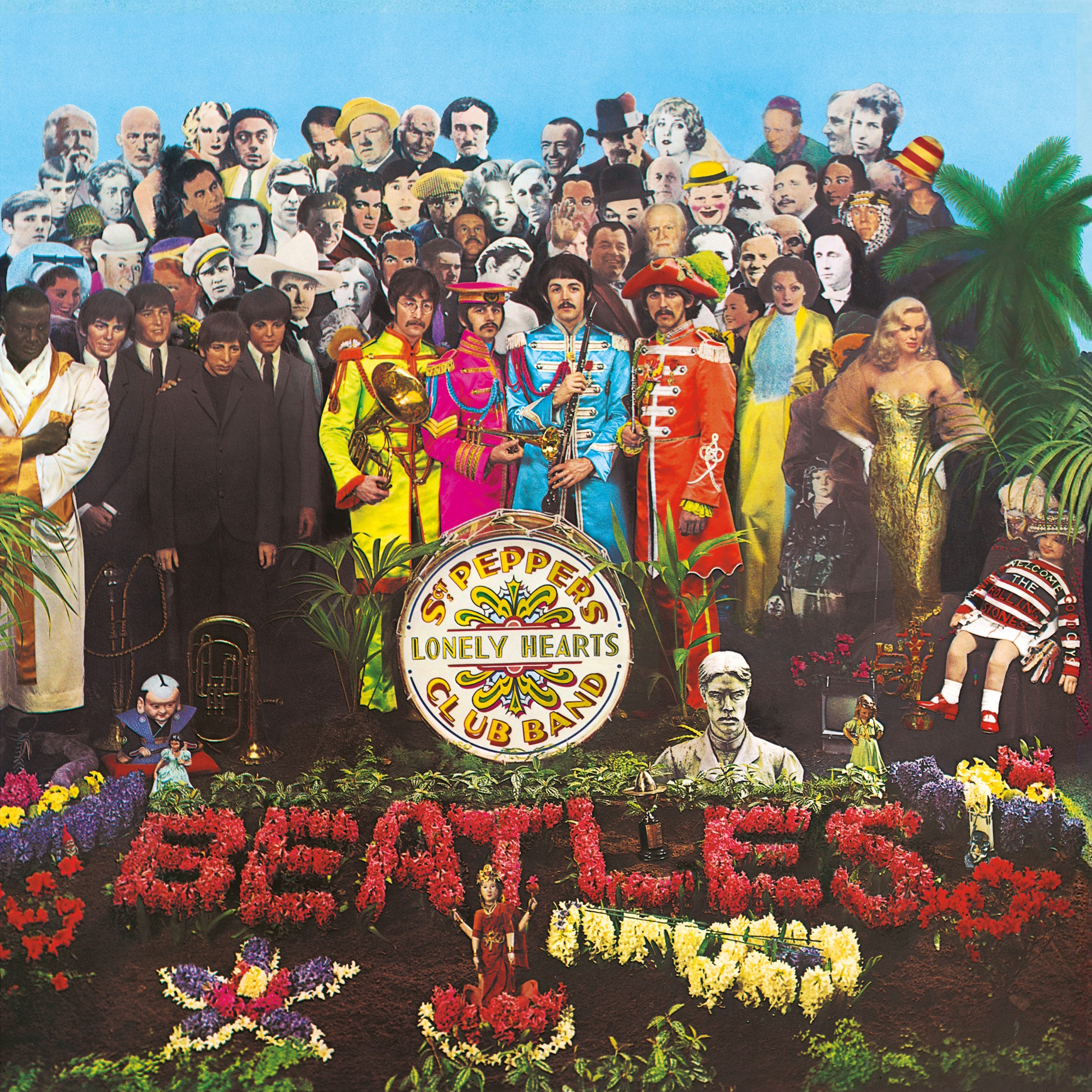
Four Beatles in day-glo uniforms cut like military dress stand behind a bass drum, in front of a crowd of famous faces. A bank of flowers at their feet spells out BEATLES. This is the cover of the Beatles' 1967 album Sgt. Pepper's Lonely Hearts Club Band.
The image is a photograph of a set built in a studio in Chelsea, London. Peter Blake, a British pop painter, designed it with his wife at the time. She was Jann Haworth, an American artist who worked in fabric.
Michael Cooper took the picture on March 30, 1967, in a session of about three hours. Most of the crowd is flat. Blake and Haworth had photographs enlarged to life size, mounted on hardboard and cut out along their outlines.