
Post Impressionism is painting from the mid 1880s to the early 1900s, mostly made in France, by artists who took Impressionism in separate directions. Its central figures are Paul Cézanne, Georges Seurat, Paul Gauguin and Vincent van Gogh.
Cézanne sought structure, Seurat a color method based on science, Gauguin subjects drawn from imagination, Van Gogh brushwork that carries feeling. The British critic Roger Fry coined the name in 1910 for a London show, after all four had died.
Cool Stories About Art is a newsletter to learn art the fun way.
Join 200,000+ readers and get:
10 new art stories / month
The entire archive of content (1,000+ articles)
Comment, ask questions, and chat with other readers
How These Were Chosen
Each pick rests on at least one of two surviving records. The painter singled it out himself: a letter about the canvas, a title painted into it, a signature he rarely gave. Or studies, X rays, other versions or later cuts and additions trace its making. A canvas with neither did not make the list.
12. Henri de Toulouse-Lautrec, At the Moulin Rouge (1892 to 1895)
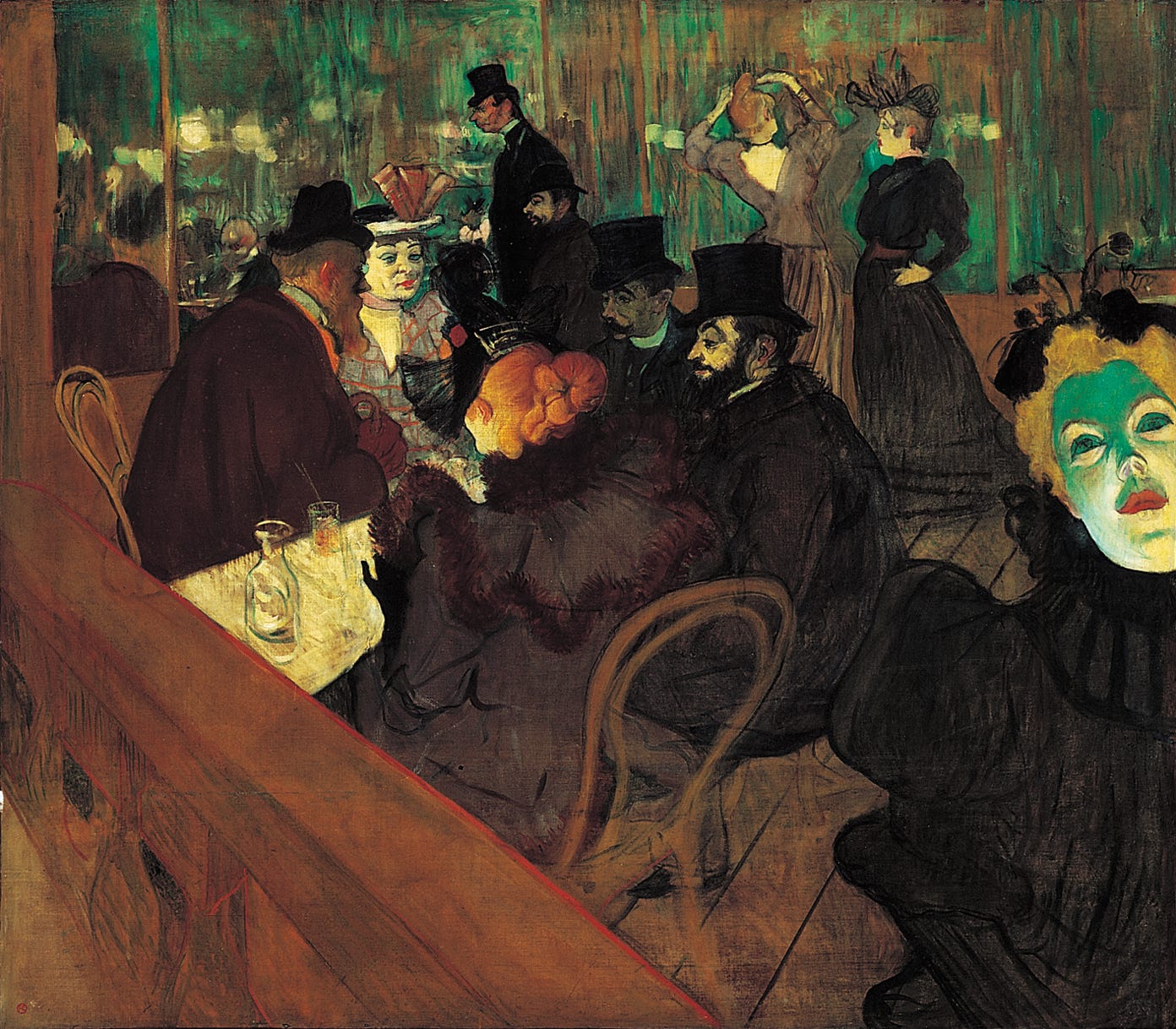
Five people talk around a table in a Paris nightclub, glasses in front of them. Other figures stand at the back of the room.
Henri de Toulouse-Lautrec painted At the Moulin Rouge between 1892 and 1895. It hangs in the Art Institute of Chicago. The Moulin Rouge had opened in 1889, and Lautrec kept a table there that was reserved for him at all times.
Every face at that table belonged to someone he knew. The Art Institute names them: the dancers Jane Avril and La Macarona, the photographer Paul Sescau, the vintner Maurice Guibert and the poet Édouard Dujardin.
In 1888 Dujardin published a short novel, Les Lauriers sont coupés. Britannica calls it the first work written as an interior monologue, the technique James Joyce later took up.
Two of the men at the table also worked behind a camera for Lautrec. Paul Sescau was a professional photographer.
Maurice Guibert, a well off friend, took up photography after Lautrec had taught him to paint. When Lautrec needed photographs for his work, he asked these friends to take them.
A print by Guibert in the Metropolitan Museum of Art shows Lautrec twice in the same frame, as the painter and as his own model.
The Moulin Rouge was designed for electric light, and Lautrec painted its glare. Behind the table, the dancer La Goulue stands fixing her hair.
Lautrec put himself back there too. He is the very small figure in the center background. Beside him stands his much taller cousin, Gabriel Tapié de Céleyran, a physician.
Then there is La Goulue. She was the dancer on Lautrec's 1891 poster for the club, and here he gives her nothing more to do than pin up her hair.
One figure caused the painting trouble. At the right edge, the singer May Milton peers into the picture, her face lit an acid green.
At some point, the artist or his dealer cut down the canvas to remove her. The Art Institute suggests her strange appearance made the picture hard to sell. By 1914, the cut section had been reattached to the painting.
At a Glance
Artist: Henri de Toulouse-Lautrec (1864 to 1901)
Painted: 1892 to 1895
Medium: Oil on canvas
Where to see it: Art Institute of Chicago, Chicago (1928.610)
About This Painting
How big is At the Moulin Rouge by Toulouse-Lautrec? At the Moulin Rouge measures 123 by 141 centimeters, about 48 by 55 inches.
How did At the Moulin Rouge reach Chicago? Maurice Joyant, Lautrec's friend and the executor of his estate, owned At the Moulin Rouge by 1902. After several dealers, Frederick Clay Bartlett, a Chicago collector, gave it to the Art Institute in 1928, as part of the Helen Birch Bartlett Memorial Collection.
Has At the Moulin Rouge been lent recently? The Minneapolis Institute of Art built a whole exhibition around Lautrec's painting, on loan from Chicago. It opened on October 12, 2024 and ran into March 2025.
11. Paul Cézanne, The Basket of Apples (about 1893)
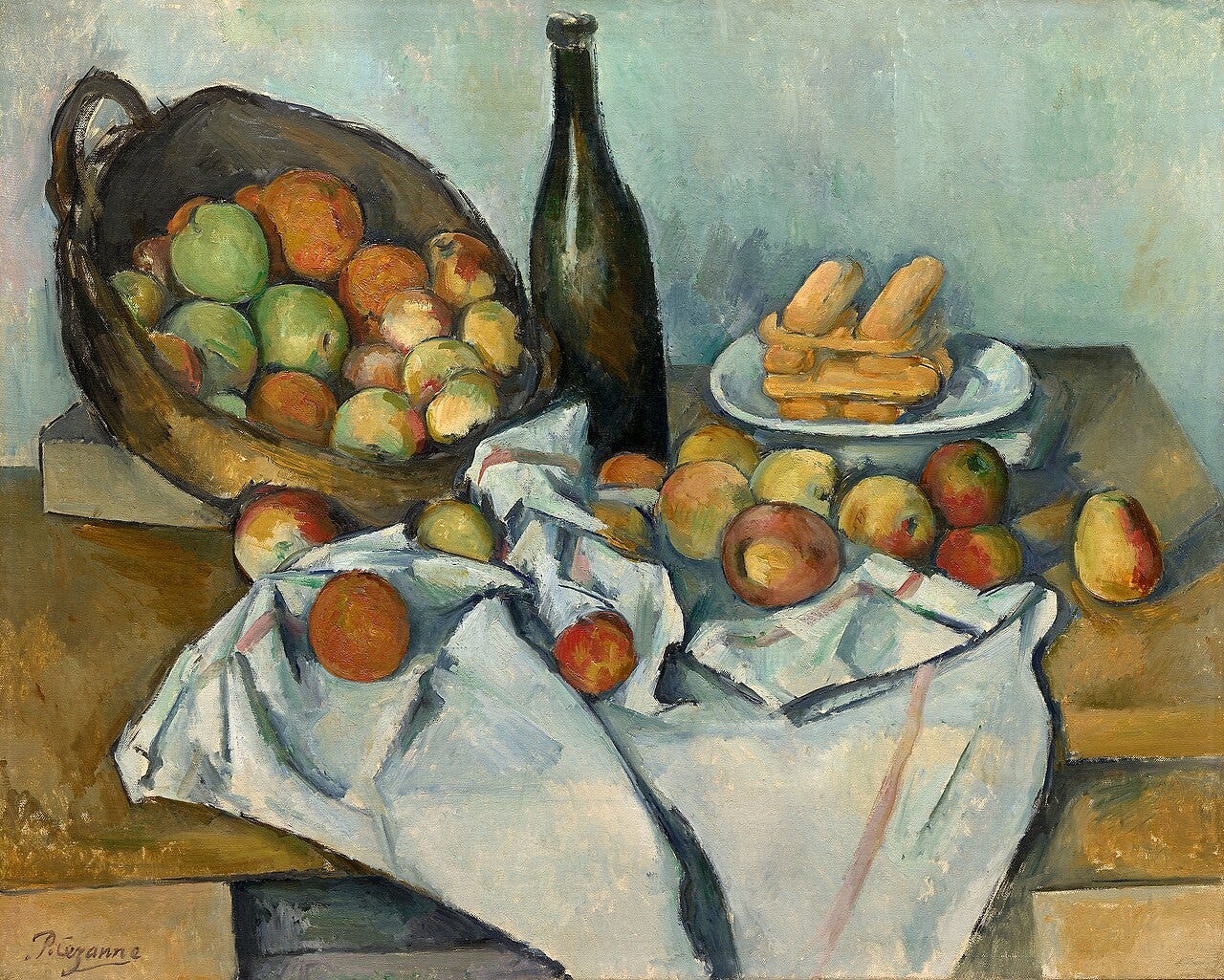
A wicker basket tips its apples toward a white cloth, beside a dark wine bottle and a plate of stacked biscuits. Paul Cézanne painted The Basket of Apples around 1893.
It is in the Art Institute of Chicago. The front edge of the table should run in one straight line. It breaks where the cloth hangs over it, and the two halves don't line up.