Famous Pre Raphaelite Paintings: 12 That Still Haunt
The most famous Pre Raphaelite paintings glow with jewel color, doomed heroines and buried meaning, made by a band of young British rebels who set out in 1848 to overturn the rules of art. Here are twelve, all now in the public domain.
They called themselves the Pre Raphaelite Brotherhood and signed their early work with a secret code, three letters, PRB, that baffled the critics.
I have gathered the pictures that still pull crowds, from a drowning Ophelia to a knight undone by a witch.
What binds them:
The revolt. A rebellion against the tired formulas taught in every art school.
The detail. Every leaf and petal painted from life, sharp as a photograph.
The women. Real models turned into tragic queens, lovers and saints.
The stories. Shakespeare, Tennyson and old myth, retold in paint.
The longer versions
Three worth opening next:
Ten women artists you need to know, the names the textbooks skipped
The darker truth about Gauguin, the part of the Tahiti story that never makes the wall label
Vermeer, Woman Holding a Balance, what is actually on those scales
1. John Everett Millais, Ophelia (1852)
A young woman floats in a dark stream, singing as she drowns, ringed by flowers so exact you can name every one. This is Shakespeare's Ophelia, and it may be the best loved British painting of the century.
The peace on her face makes the drowning worse.
The model, Elizabeth Siddal, lay for hours in a bath warmed by lamps beneath it, and when the lamps went out she caught a dangerous chill. Her father threatened to take Millais to court over the doctor's bills.
Every plant on the bank carries a meaning, from the poppies of death to the pansies of lost love.
2. John William Waterhouse, The Lady of Shalott (1888)
A pale woman in white loosens the chain of her boat and drifts toward a death she has chosen, three candles guttering at the prow.
She is the Lady of Shalott from Tennyson's poem, cursed to see the world only through a mirror. The moment here is the one where she looks at it directly anyway.
Painted forty years after the Brotherhood began, it shows how far their spell still reached. Waterhouse returned to the doomed lady twice more, unable to leave her alone.
The tapestry she wove trails into the water, her whole shut in life spilling out with it.
3. Dante Gabriel Rossetti, Proserpine (1874)
A tall dark woman holds a bitten pomegranate, caught between longing and gloom in a corridor of shadow. The figure is Proserpine, queen of the underworld, doomed by the fruit she tasted to spend half of every year below.
Rossetti loaded the picture with hidden symbolism, every object a clue.
The model was Jane Morris, wife of his friend William Morris and the great forbidden love of his life. He painted her over and over as sorrowing goddesses and queens, and the ache is always the same.
Proserpine, caught between two worlds, was the story of his own tangled heart.
4. William Holman Hunt, The Awakening Conscience (1853)
A kept woman rises suddenly from her lover's lap, staring at something outside the picture as if struck by a thought. Everything in the cluttered room is a clue, from the cat toying with a bird to the sheet music on the piano.
Holman Hunt built the whole scene as a sermon on sin and sudden grace.
He fussed over every object to make the moral legible, down to the tangled threads on the floor. Ruskin defended it in a public letter to the press in 1854, spelling out the symbols for a baffled audience.
The gilded room is a cage, and the woman has just seen the door.
5. John Everett Millais, Christ in the House of His Parents (1850)
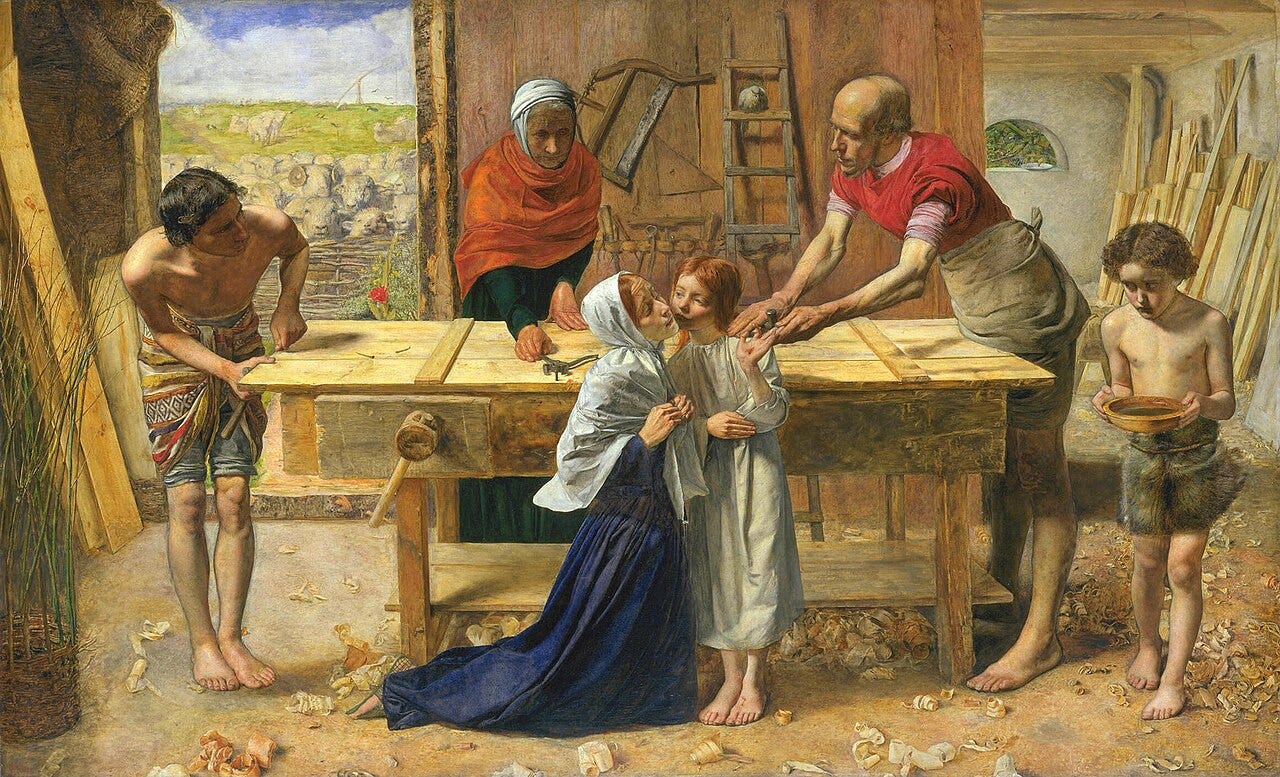
In a plain carpenter's shop a boy has cut his hand, and a drop of blood falls to his foot, quietly foretelling the crucifixion. The holy family here are ordinary working people, dirt and all, and the public was outraged when Millais showed them so.
Charles Dickens called the picture disgusting.
Critics thought showing Christ as a real, awkward child came close to blasphemy, and the attacks nearly sank the young Brotherhood.
Queen Victoria asked to have the painting brought to her rooms. Every detail, from the wood shavings to the waiting sheep, points forward to the death to come.
6. Dante Gabriel Rossetti, Beata Beatrix (1870)
A red haired woman sits with her eyes closed and her hands open, a red bird dropping a poppy into them, the whole picture dissolving into haze.
She is Dante's Beatrice at the moment of death, and she is also Elizabeth Siddal, Rossetti's own wife. He made it as a memorial after she was gone.
Siddal, the model who nearly froze for Ophelia, had become Rossetti's wife and then died of a laudanum overdose in 1862. Wild with grief, he buried his only manuscript of poems in her coffin.
Years later he had her grave opened to dig the poems back out.
7. Ford Madox Brown, The Last of England (1855)
A young couple huddle on the deck of a ship, the white cliffs receding behind them, the wife's hand clutching her husband's under a blanket. They are emigrants leaving England for good, faces set hard against an unknown future.
Behind the blanket, barely seen, a tiny baby's hand grips its mother's finger.
Brown based the couple on himself and his wife, and painted the cold sea light so truthfully that he worked outdoors in bitter weather to catch it. A fellow artist had just sailed for Australia, and the loss stayed with him.
It is one of the great pictures of leaving, made when a whole nation was scattering across the globe.
8. Arthur Hughes, April Love (1856)
A girl in a soft lilac dress turns away in a dim bower, her face caught between joy and doubt. She is a young lover feeling the first shadow of how quickly love can fade. Arthur Hughes gave the whole picture the ache of a single uncertain moment.
Ruskin admired it so much that he told people to buy it at once. The title comes from a poem about love as fragile as April weather. In the gloom behind her, a man's shadowy hands reach for the hem of her dress.
9. William Holman Hunt, The Light of the World (1853)
Christ stands at a night door choked with weeds, a lantern in his hand, knocking to be let in. The door has no handle on his side, because it can only open from within. Holman Hunt meant the whole image as a call to the soul.
He painted much of it by lamplight in a garden at night to get the glow exactly right. A later version toured the British Empire and was seen by enormous crowds around the world.
The weeds across the threshold show a door that has stayed shut a long time.
10. Edward Burne Jones, The Beguiling of Merlin (1874)
In a thicket of white hawthorn a young woman reads from a book while an old wizard sags helpless against the branches. The young woman is Nimue, and she uses Merlin's own magic to trap him forever.
Burne Jones painted love as a beautiful, quiet catastrophe.
A leader of the second wave of Pre Raphaelites, he filled his work with pale dreaming figures out of myth and legend. His model for Nimue was a Greek woman he loved unhappily while married to someone else.
Merlin, the wisest man alive, is undone by a spell he taught her.
11. John William Waterhouse, Hylas and the Nymphs (1896)
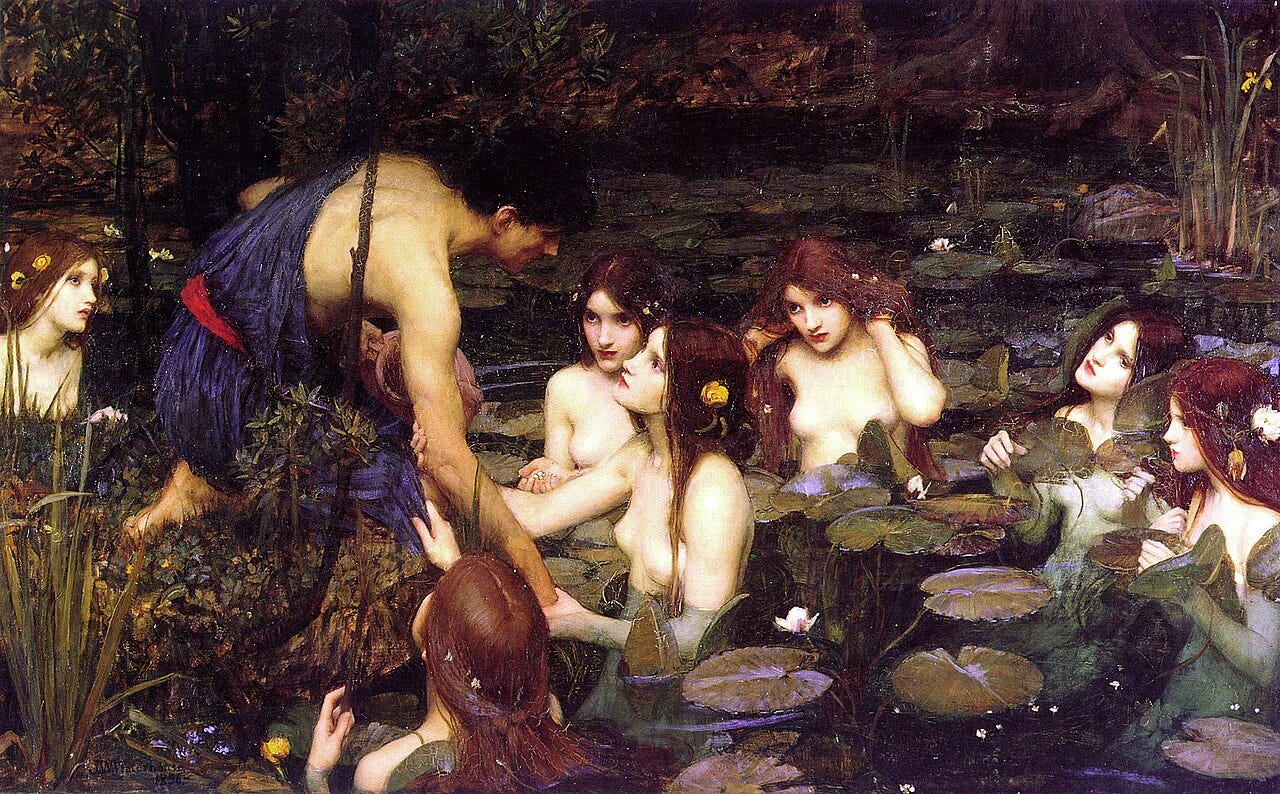
Seven water nymphs rise from a lily pond and reach for a beautiful young man, drawing him gently down to drown. The young man is Hylas, a companion of the Greek hero Heracles, lured away and never seen again.
Every nymph wears the same calm, pitiless face.
The scene comes from an ancient myth of desire that ends in death, a theme the Victorians loved. In 2018 a gallery briefly took the picture down to spark debate about how it shows women, and the outcry was instant.
The pond is lovely, and it is a trap.
12. John Everett Millais, Mariana (1851)
A woman in deep blue stretches her aching back at a window, worn out by years of waiting for a man who never comes. She is Mariana, jilted and abandoned, taken from a line of Tennyson and a play by Shakespeare.
Fallen autumn leaves have drifted across the floor of her room.
Every detail speaks of time running out, the stained glass, the mouse in the corner, the dead leaves blown inside. Millais painted her longing as a physical ache in the body, not only the face.
She is shut in a beautiful room, and the whole picture is about being unbearably stuck.
Britain holds nearly all of them
Millais, Ophelia and Mariana, and Waterhouse, The Lady of Shalott: Tate Britain, London.
Rossetti, Proserpine and Beata Beatrix, and Holman Hunt, The Awakening Conscience: Tate Britain, London.
Holman Hunt, The Light of the World: Keble College, Oxford, with a larger version at St Paul's Cathedral.
Ford Madox Brown, The Last of England: Birmingham Museum and Art Gallery.
Edward Burne Jones, The Beguiling of Merlin: the Lady Lever Art Gallery, Port Sunlight.
If these dreamers pulled you in, keep going:
Inside Monet house at Giverny, room by room, including his own bedroom
The Ambassadors, detail by detail, the object at the bottom that only works from one side
Luncheon of the Boating Party, detail by detail, who everybody at that table actually was
Pre Raphaelite paintings, a few quick questions
What was the Pre Raphaelite Brotherhood? A secret group of young British artists formed in 1848, led by Millais, Rossetti and Holman Hunt, who threw out the academic rules of their day and looked back to the bright detail of art before Raphael.
Why is it called Pre Raphaelite? They believed art had gone soft and formulaic after the Renaissance master Raphael, and wanted to return to the honesty and color of earlier painting.
Who is the woman in Ophelia? Elizabeth Siddal, a model and artist who nearly caught her death posing in a cold bath, and who later married Rossetti.
What are the most famous Pre Raphaelite paintings? Millais's Ophelia, Waterhouse's The Lady of Shalott, Holman Hunt's The Light of the World and Rossetti's dreaming women are the best known.
Where can I see Pre Raphaelite art? Tate Britain in London holds the greatest collection, with major works in Manchester, Birmingham and Liverpool.
Beautiful, doomed and built to last
The Brotherhood barely lasted five years before it split, and the critics who mocked it are forgotten. What remains is a room full of drowning girls, trapped lovers and color that still stops people in their tracks.
They set out to paint the world honestly, leaf by leaf, and ended up making some of the most haunting dreams in art. A movement written off as a young men's fad became the most popular British painting there is.