Rain in Painting: 12 Famous Downpours in Art

Rain is hard to paint, yet these 12 famous rain paintings pull it off, from wet Paris boulevards and Japanese bridges to a wheat field seen through asylum bars. They cover woodblock prints, Impressionist streets and quiet studies, each catching weather that most artists avoid.

Caillebotte painted a whole rainy Paris crossroads without a single visible raindrop, letting the wet cobbles do the work. Van Gogh slashed rain across a wheat field from behind the bars of an asylum window, while Hiroshige cut a Tokyo shower into a woodblock that later stunned Europe.

  • Suggested, not shown: great rain painters imply the weather through wet reflections and umbrellas, not always visible drops.

  • Diagonal lines: Japanese printmakers cut rain as fine crossing lines, a trick Western artists then borrowed.

  • Modern cities: rain gave Impressionists a reason to paint slick boulevards, gaslight and crowds under cover.

  • Mood over drama: a shower can signal loneliness, memory or quiet, as much as a passing storm.

If these draw you in, you will also love the secret behind Monet Magpie, the story of who painted the first Impressionist, and 7 secrets hidden in famous paintings.


Learn art the fun way. Free stories every week, no boring lectures.


1. Gustave Caillebotte, Paris Street; Rainy Day

A Paris crossroads on a wet day under umbrellas
Gustave Caillebotte, Paris Street; Rainy Day, 1877. Art Institute of Chicago.

In 1877 Caillebotte painted a Paris crossroads on a grey wet day, life size figures crossing under umbrellas past fresh stone buildings.

Here is the trick, he painted almost no raindrops at all. The rain lives in the shine on the cobbles and the umbrellas overhead, not in the air.

He showed it at the third Impressionist exhibition in 1877. The junction is a real place, still there in the eighth arrondissement of Paris.

2. Utagawa Hiroshige, Sudden Shower over Shin Ohashi Bridge and Atake

Travelers crossing a bridge in a sudden shower
Utagawa Hiroshige, Sudden Shower over Shin Ohashi Bridge and Atake, 1857. Brooklyn Museum, New York.

Made in 1857 for the series One Hundred Famous Views of Edo, this print catches travelers hurrying across a bridge as a sudden shower hits the Sumida River.

The rain is cut into the woodblock as fine crossing lines, a hard technique that took real skill. Van Gogh admired it so much that he copied it in oil in 1887.

It became one of the most copied rain images in the world. A Tokyo downpour from the 1850s still shapes how we picture rain.

3. Vincent van Gogh, Rain

A wheat field in a downpour of slashing lines
Vincent van Gogh, Rain, 1889. Philadelphia Museum of Art.

In the autumn of 1889, Van Gogh painted a wheat field in a downpour from a window of the asylum at Saint Remy, mint green and white lines slashing across the land.

He was looking through iron bars on the window, but he chose to leave them out. The diagonal strokes are a direct nod to the Japanese prints he loved.

It is the only picture he made of that field in the rain. Less than a year later he was dead.

4. J.M.W. Turner, Rain, Steam and Speed

A locomotive charging through rain and steam
J.M.W. Turner, Rain, Steam and Speed, the Great Western Railway, 1844. National Gallery, London.

Turner showed this in 1844, a black locomotive charging over a bridge near Maidenhead through driving rain and steam, the whole scene dissolving in weather.

Look in front of the engine and a small hare is running for its life along the track. Blink and you miss it.

The train crosses Isambard Kingdom Brunel new railway bridge. Turner painted the exact moment steam power outran the old world.

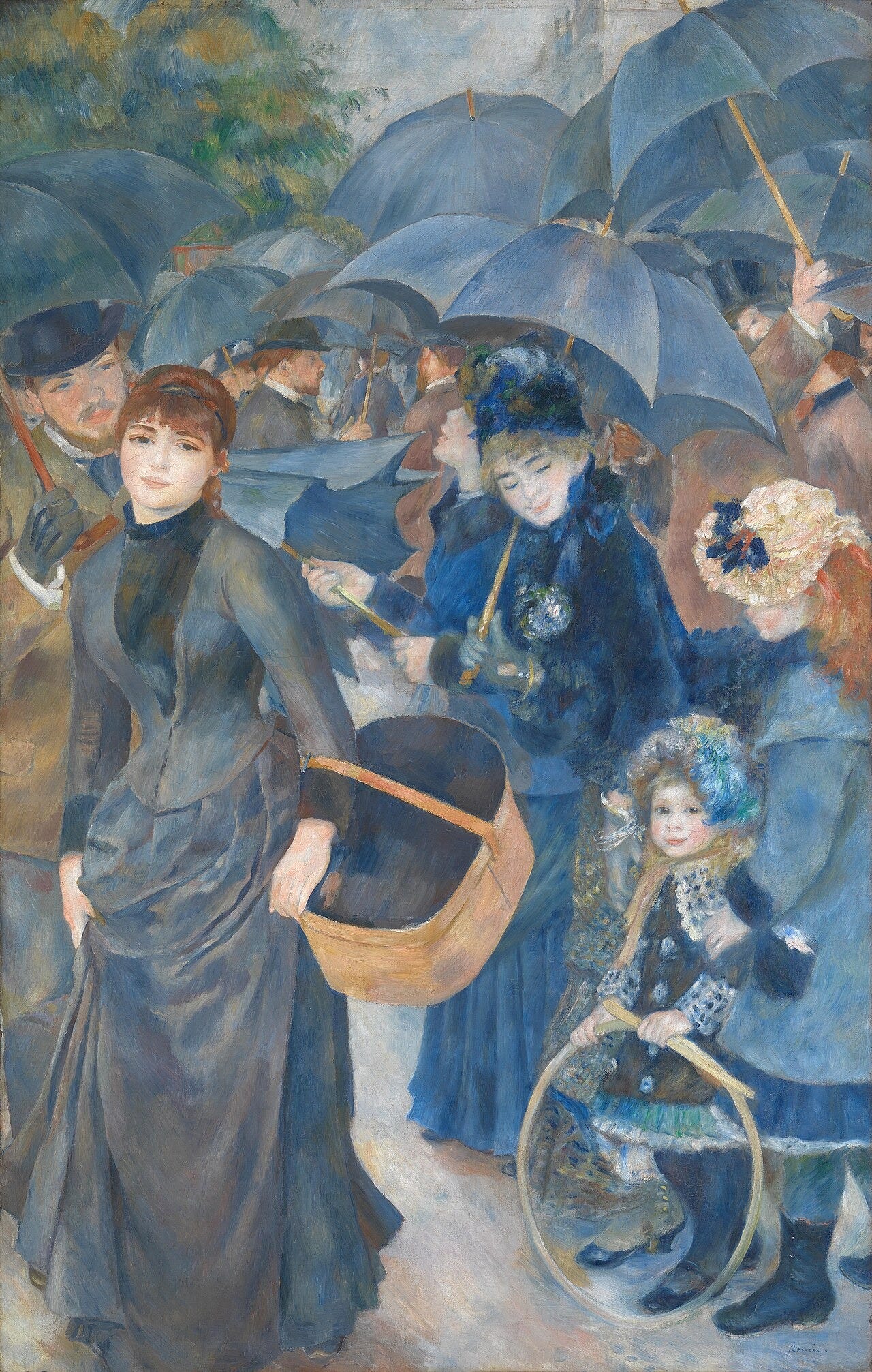
5. Pierre Auguste Renoir, The Umbrellas

A crowd of Parisians under a canopy of umbrellas
Pierre Auguste Renoir, The Umbrellas, about 1881 to 1886. National Gallery, London.

Renoir painted this crowd of Parisians under a canopy of umbrellas over several years, beginning around 1881 and finishing about 1886.

He stopped halfway and came back four years later with a changed style. The figures on the right are soft and feathery, the ones on the left firmer and more classical. Two Renoirs share one canvas.

The painting moves between London and Dublin under an old bequest. Wherever it hangs, the sky is about to open.

6. Childe Hassam, Rainy Day, Boston

Wet Boston avenue with carriages reflected on asphalt
Childe Hassam, Rainy Day, Boston, 1885. Toledo Museum of Art.

In 1885 Hassam painted the wet avenues of Boston South End, carriages and figures reflected on the shining asphalt at Columbus Avenue.

He was painting his own neighborhood. Hassam lived at 282 Columbus Avenue and loved how the street looked wet and shining with the reflections of passing people.

Watch the horses. He blurred their legs to show them trotting, a modern touch borrowed from the new medium of photography.

7. John Atkinson Grimshaw, Boar Lane, Leeds

A Leeds street at dusk mirrored in wet road
John Atkinson Grimshaw, Boar Lane, Leeds, 1881. Leeds Art Gallery.

In 1881 Grimshaw painted a busy Leeds street at dusk, gaslight and shop windows mirrored in the rain soaked road.

Almost every Grimshaw street is wet. He used the shine to catch light, and the lone woman with an umbrella is often his model Agnes Leefe, painted again and again.

He worked so close to photography that some accused him of tracing. The wet streets were his signature, and no one did them better.

8. Norman Garstin, The Rain It Raineth Every Day

A Cornish seafront in a storm with umbrellas
Norman Garstin, The Rain It Raineth Every Day, 1889. Penlee House Gallery and Museum, Penzance.

In 1889 Garstin painted the Penzance seafront in a Cornish storm, waves breaking over the promenade while figures lean into the wind under umbrellas.

The title comes from a song in Shakespeare. When Garstin sent the work to the Royal Academy, the jury refused it, reportedly because it looked too French.

The picture they rejected is now his best known work. It hangs a short walk from the very seafront he painted.


Join 130,000 readers who get the secrets behind the paintings. Free.


9. George Bellows, Rain on the River

A freight train along the Hudson in wet grey air
George Bellows, Rain on the River, 1908. RISD Museum, Providence.

In 1908 Bellows painted a rainy view over the Hudson from Riverside Park in New York, a freight train pushing along the river through wet grey air.

A lone figure hurries across the slick path while a cart waits for coal. Bellows was known for a rough, direct way of painting the modern city.

He rated it highly himself, calling it one of my most beautiful things in a letter years later.

10. Kawase Hasui, Rain at Shinagawa

A figure under an umbrella on a wet road
Kawase Hasui, Rain at Shinagawa, 1931. Art Institute of Chicago.

Hasui made this print in 1931, a figure under an umbrella on a wet road at Shinagawa, rain falling in long straight strokes.

Hasui was the great modern master of rain and snow in Japanese prints. Much of his early work was lost when the 1923 earthquake and fire destroyed the printing blocks, and he rebuilt from nothing.

He carried Hiroshige rain into the twentieth century. Collectors still chase his quiet, wet scenes today.

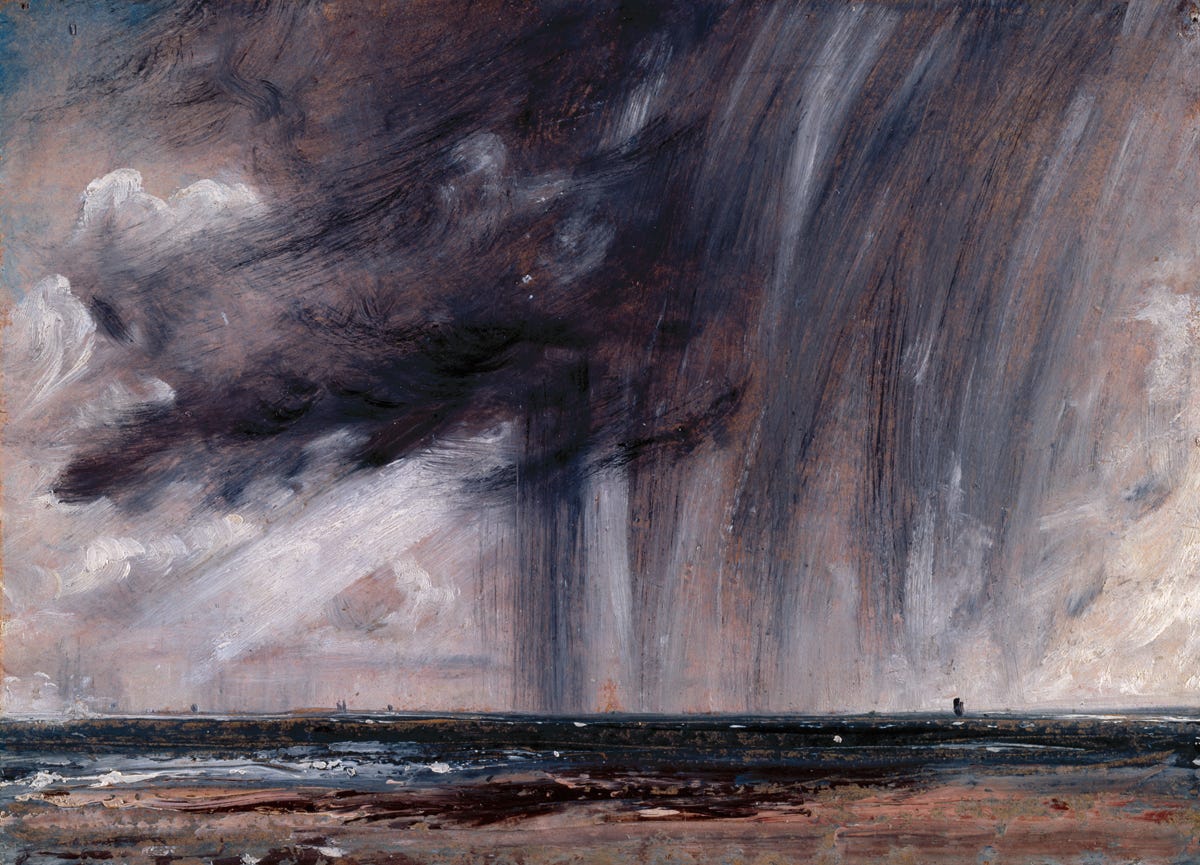
11. John Constable, Rainstorm over the Sea

A black squall dumping rain over the sea
John Constable, Rainstorm over the Sea, about 1824 to 1828. Royal Academy of Arts, London.

Constable made this small, fast oil sketch on the beach at Brighton in the 1820s, a black squall dumping rain over the sea with one shaft of sun breaking through.

It is barely bigger than a sheet of paper, painted straight from nature. He was on the Sussex coast because his wife Maria was ill with tuberculosis.

Maria died in 1828. The storm he caught in a few furious strokes carries all the weather of those hard years.

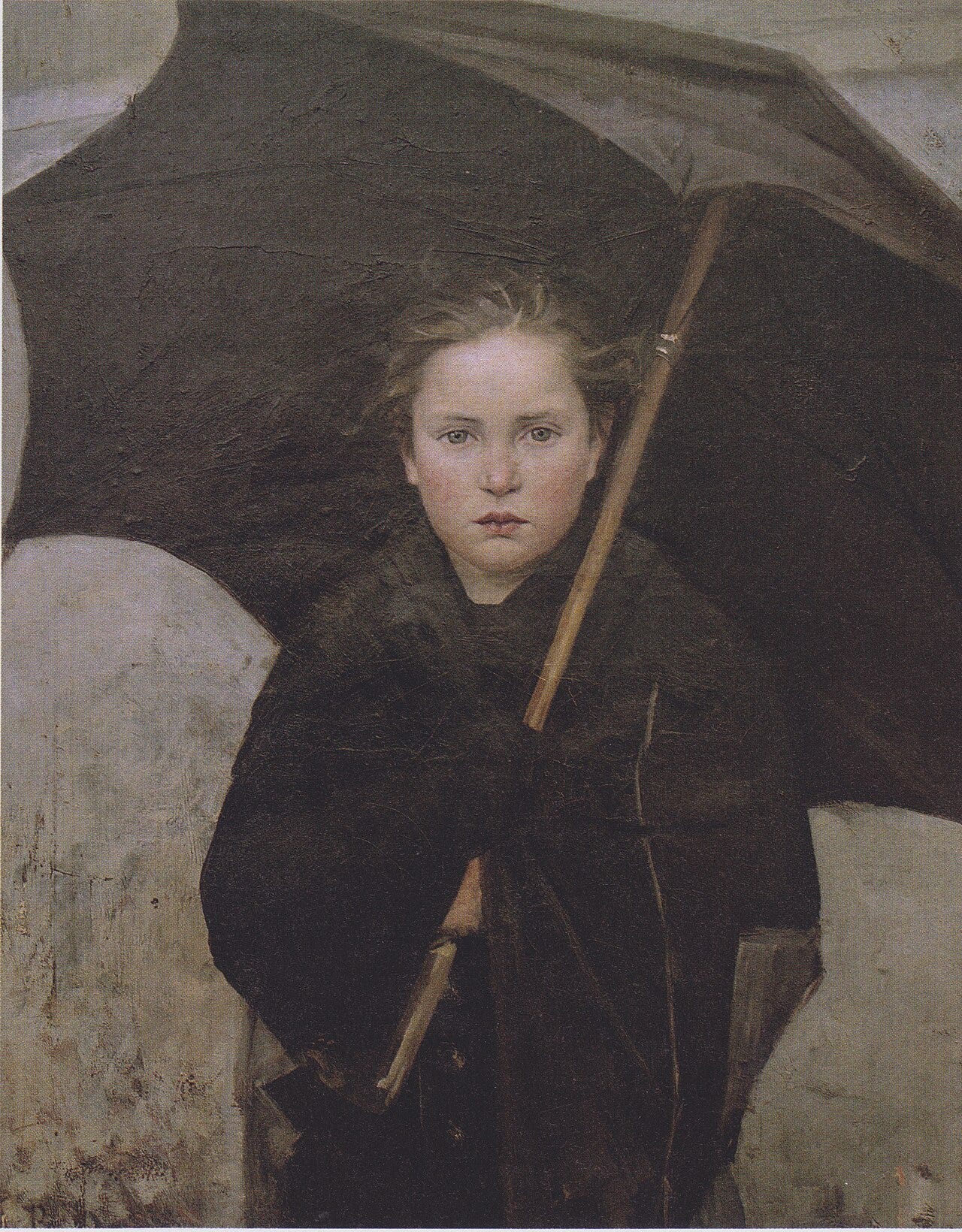
12. Marie Bashkirtseff, The Umbrella

A poor girl huddled under a large umbrella
Marie Bashkirtseff, The Umbrella, 1883. State Russian Museum, Saint Petersburg.

In 1883 Bashkirtseff painted a poor girl huddled under a large umbrella in cold, wet weather, staring straight out at us.

She worked from life outdoors and wrote in her famous diary, I work outside and it rains constantly. The damp is real, not invented.

She died of tuberculosis in 1884, only 25 years old. The soaked, watchful child is one of the last things she finished.

Where to see them

  • National Gallery, London: Turner Rain, Steam and Speed and Renoir The Umbrellas.

  • Art Institute of Chicago: Caillebotte Paris Street Rainy Day and Kawase Hasui Rain at Shinagawa.

  • Philadelphia Museum of Art: Van Gogh Rain.

  • Toledo Museum of Art: Childe Hassam Rainy Day, Boston.

  • State Russian Museum, Saint Petersburg: Marie Bashkirtseff The Umbrella.

How painters make rain you can feel

Many of these are Impressionist street scenes, where wet asphalt gave the painters a mirror for gaslight and crowds.

Others are Japanese woodblock prints, where rain became fine diagonal lines, and quiet landscape studies made straight from nature on a stormy shore.

Rain in art, questions people ask

  • What is the most famous rain painting? Gustave Caillebotte Paris Street; Rainy Day from 1877 is one of the most recognized, even though it contains no visible raindrops.

  • How do artists paint rain? Some suggest it with wet reflections and umbrellas, while others, like Hiroshige, cut fine diagonal lines to show falling water.

  • Did Van Gogh paint rain? Yes. His 1889 painting Rain shows a wheat field through slashing diagonal strokes, made while he was in an asylum at Saint Remy.

  • Which Japanese artists painted rain? Utagawa Hiroshige and later Kawase Hasui are famous for rain scenes that influenced European painters.

  • Where can I see famous rain paintings? The Art Institute of Chicago, the National Gallery in London and the Philadelphia Museum of Art all hold key works.

The crossroads that still gets wet

Caillebotte rainy junction is a real place. He painted the intersection now called the Place de Dublin in the eighth arrondissement of Paris, and you can still stand on that same corner when the sky opens. The gaslight and top hats are gone, but the grand geometry of Baron Haussmann boulevards remains. The painting itself lives far from the rain that inspired it, at the Art Institute of Chicago.


Two new stories a week, 130 secrets unlocked. Start free.