Rainbow Paintings: 12 Famous Works to Know
The most famous rainbow paintings use a trick of light to carry huge meaning. Turner and Constable studied its physics, Friedrich made it a religious sign, Rubens hung one over his own land, and Duncanson painted a rainbow that later hung at a presidential inauguration. Here are twelve to know, and where to see them.
A rainbow is the ultimate painter dare. It lasts a few minutes, it has no edges, and everyone knows what it should look like. Yet artists keep reaching for it, because a rainbow means something: peace, hope, a promise after the storm. The twelve below each bend that meaning a different way.
Use this as a quick tour:
The scientists: Turner and Constable, who studied the optics.
The believers: Friedrich, Koch and Church, who made it sacred.
The storytellers: Millais and Duncanson, who gave it human meaning.
Where to see them: a museum list at the end, grouped by city.
J.M.W. Turner, Buttermere Lake with a Rainbow
Turner exhibited this Lake District scene in 1798, when he was only in his early twenties. A faint rainbow arcs over Buttermere as a shower clears, the mountains still wet and dark.
Even this early, Turner was less interested in the tourist view than in the weather itself, the exact moment rain turns to light. The rainbow is a soft ghost, half dissolved into the damp air.
It hangs at Tate Britain in London. It is one of the first signs of the painter who would spend his life chasing light, mist and the edge where a scene almost disappears.
John Constable, Landscape with a Double Rainbow
Constable painted this oil sketch in 1812, catching a double rainbow over the English countryside in a single fast session outdoors. The paint is loose and quick, made to grab a moment.
Constable was obsessed with the science of skies and studied clouds and rainbows carefully, sometimes noting the exact date and weather on the back. This is en plein air painting decades before the Impressionists.
The sketch is held at the Victoria and Albert Museum in London. He knew a rainbow needs the sun behind you, and he placed his with real optical care, feeling as well as fact.
Peter Paul Rubens, Landscape with a Rainbow
Rubens painted this glowing Flemish landscape around 1636, in his last years, a rainbow spread over fields full of peasants, cattle and a loaded hay wagon. He owned the land he was painting.
Having bought a country estate, Rubens painted his own fertile fields as a vision of peace and plenty after a lifetime of war and diplomacy. The rainbow crowns it as a blessing.
A famous version hangs in the Wallace Collection in London. This is the rainbow as private happiness, the great Baroque painter finally at rest on his own soil.
Caspar David Friedrich, Mountain Landscape with a Rainbow
Caspar David Friedrich painted this around 1810, a lone traveller resting in dark mountains under a pale rainbow at dusk. The light is strange, almost lit from within.
For Friedrich the rainbow was never just weather. It was a covenant, a sign of God over a solitary human figure, the whole Romantic idea of nature as a door to the divine.
It is held at the Museum Folkwang in Essen. The tiny figure with his back to us, dwarfed by the mountains and the arc of light, is Friedrich in a single image.
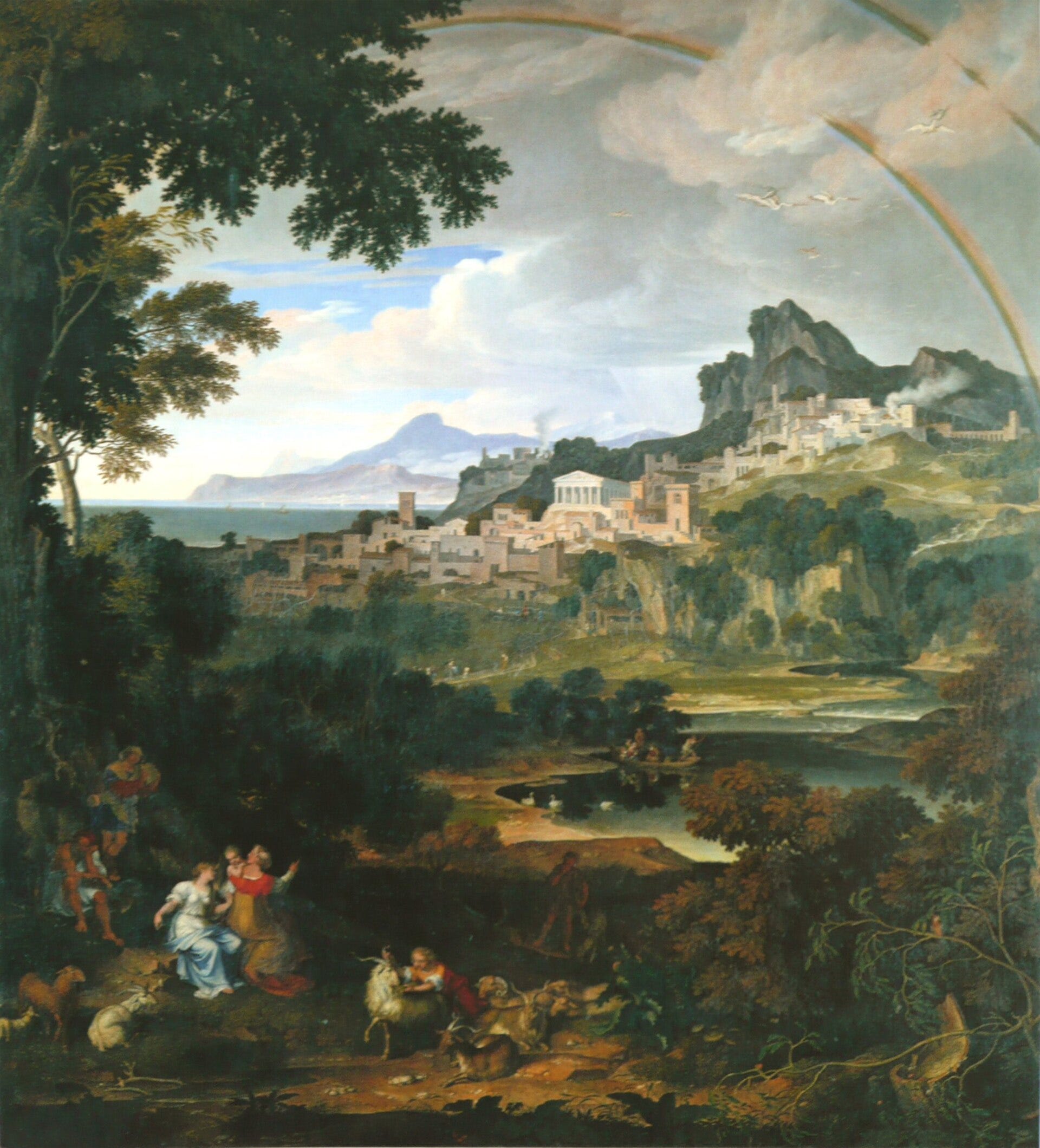
Joseph Anton Koch, Heroic Landscape with Rainbow
Joseph Anton Koch painted his Heroic Landscape with a Rainbow around 1805, a grand ordered world of mountains, waterfalls and shepherds crowned by a wide arc of colour.
Koch built an ideal, classical nature, everything balanced and noble, with the rainbow as the sign of a harmonious universe. It is the Enlightenment idea of nature as reason and order.
Versions hang in German museums including the Neue Pinakothek in Munich. Where Friedrich made the rainbow lonely and mystical, Koch made it calm, public and grand.
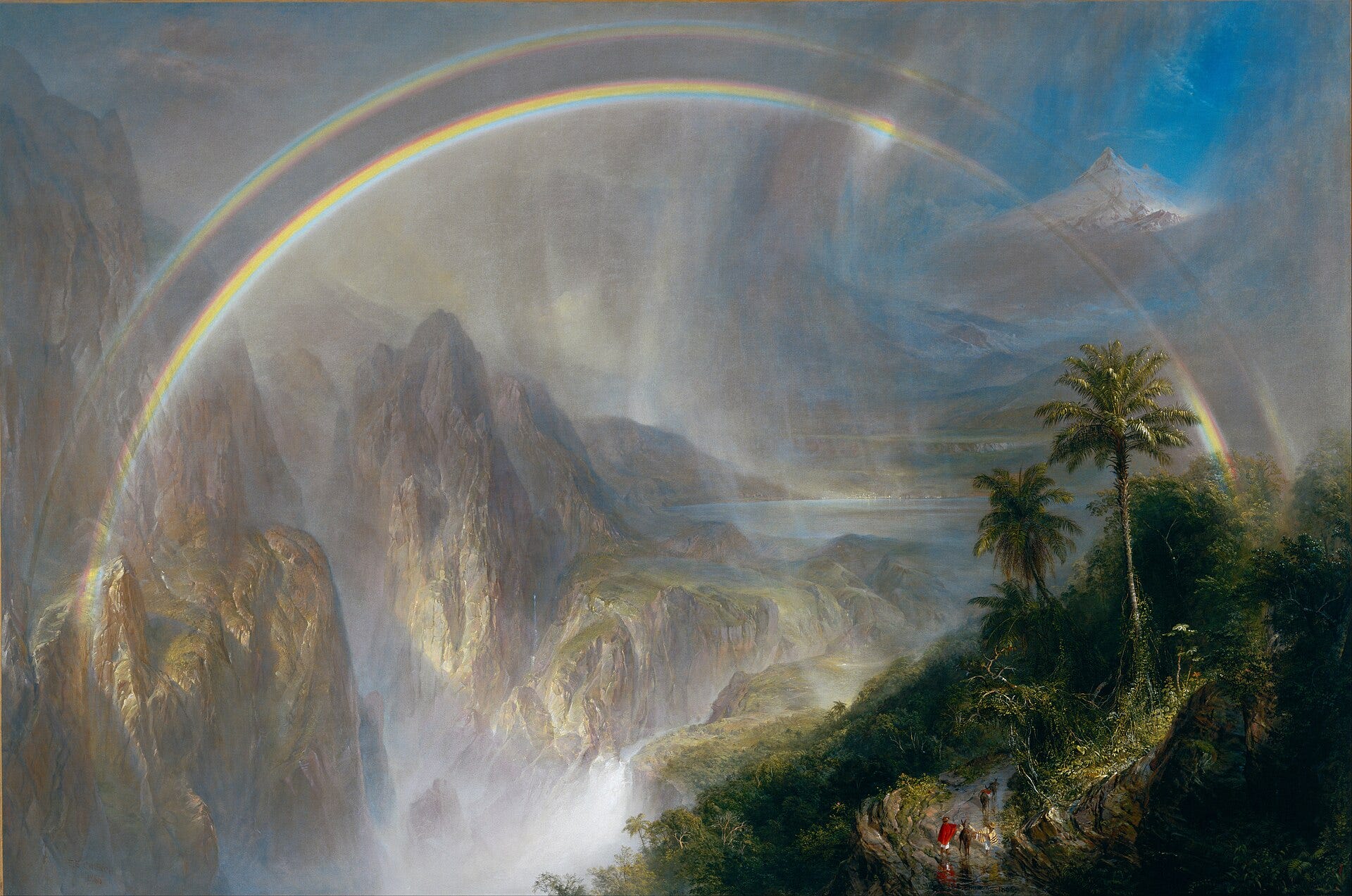
Frederic Edwin Church, Rainy Season in the Tropics
Frederic Church painted this enormous double rainbow over a tropical gorge in 1866, with tiny travellers on a mountain path below. He had lost two young children to illness the year before.
Church built the scene from his South American journeys, but many read the great arc of light after the storm as a private image of hope and recovery after grief.
It hangs at the de Young Museum in San Francisco. It is one of the grandest rainbows in all of painting, sorrow turned into a wall of colour.
John Everett Millais, The Blind Girl
John Everett Millais painted The Blind Girl in 1856, a blind beggar girl and a small child resting in a field after rain, under a brilliant double rainbow. She cannot see it.
That is the whole heartbreak of the picture. The rainbow, the richest thing in the scene, is lost on the one person we most want to share it with. A butterfly rests on her shawl, unnoticed.
It hangs at Birmingham Museum and Art Gallery. Millais, a founder of the Pre-Raphaelites, used the rainbow not as decoration but as an emblem of everything the girl is denied.
George Inness, The Rainbow
George Inness painted several rainbows in the 1870s, soft glowing American landscapes where a hazy arc rises over fields and trees. The mood is calm and inward.
Inness was deeply spiritual and treated nature as charged with feeling. His rainbows are blurred and atmospheric, less an optical event than a state of grace.
His rainbow paintings are held in American museums including the Indianapolis Museum of Art. He wanted the viewer to feel the light, not to measure it.
Robert Scott Duncanson, Landscape with Rainbow
Robert Scott Duncanson painted Landscape with Rainbow in 1859, a peaceful valley with grazing cattle and a young couple, a gentle arc of colour overhead. He was one of the first African American landscape painters to win real fame.
Painted on the eve of the Civil War, the rainbow over a calm, promised land reads now as a quiet vision of hope and freedom. Duncanson built an international career despite the world he lived in.
It hangs at the Smithsonian American Art Museum in Washington, and it was displayed at the 2021 presidential inauguration, more than a century and a half after he painted it.
John Constable, Salisbury Cathedral from the Meadows
Constable returns with his great Salisbury Cathedral from the Meadows of 1831, the spire rising against a broken storm sky, a rainbow arcing down beside it.
Constable painted this in a period of grief after his wife died, and the storm clearing over the cathedral has been read as faith holding against loss. The rainbow lands, tellingly, near a friend house.
It hangs at Tate Britain. Constable placed the rainbow with his usual optical accuracy, but here the science carries a heavy load of private feeling.
Jean-Francois Millet, Spring
Jean-Francois Millet painted Spring late in his life, between 1868 and 1873, an orchard drenched by a passing storm, blossoms wet, dark clouds breaking to reveal a faint rainbow.
Millet, best known for his peasants, here paints pure weather and season, the fresh charged air right after rain. It is one of his most tender landscapes.
It hangs at the Musee d’Orsay in Paris. The rainbow is quiet, almost hidden, a small promise glimpsed through the wet trees.
Jasper Francis Cropsey, Rainbow Landscape
Jasper Francis Cropsey, a painter of the Hudson River School famous for blazing autumn colour, set rainbows over several of his American valleys. Warm hills glow beneath the arc.
Cropsey trained as an architect and built his landscapes with care, then flooded them with the reds and golds of the American fall. The rainbow adds one more band of colour to an already rich scene.
His work is held across American collections. For Cropsey the rainbow was one more way to make the New World look like a promised land.
Questions people ask about rainbow paintings
What is the most famous rainbow painting? Constable Salisbury Cathedral from the Meadows and Millais The Blind Girl are among the most famous, along with Church huge double rainbow in Rainy Season in the Tropics.
Why do artists put rainbows in landscapes? A rainbow traditionally means hope, peace or a divine promise after a storm, so it lets a painter add meaning to a plain view.
Did Constable understand how rainbows work? Yes. He studied the optics closely and placed his rainbows with the sun correctly behind the viewer, combining science with feeling.
Why can the girl in The Blind Girl not see the rainbow? Millais made her blind on purpose, so the most beautiful thing in the scene is exactly what she is denied.
Where is Duncanson Landscape with Rainbow now? At the Smithsonian American Art Museum, and it was shown at the 2021 presidential inauguration.
Where to see them
Tate Britain, London: Turner Buttermere Lake and Constable Salisbury Cathedral from the Meadows.
Smithsonian American Art Museum, Washington: Duncanson Landscape with Rainbow.
Musee d’Orsay, Paris: Millet Spring.
Wallace Collection, London: Rubens Landscape with a Rainbow.
Keep exploring
If the light pulled you in, three more paths from here. See how one peasant painter shaped a young Dutchman in how Millet shaped Van Gogh, learn to read the hidden clues in famous canvases in seven secrets hidden in famous paintings, or start with the basics of landscape painting.
One last thing. A rainbow is gone in minutes, which is exactly why painters chase it. To fix that arc of colour on canvas is to promise that hope, once seen, can be kept. Twelve painters, twelve promises held.