
Raphael died in Rome at thirty-seven, after a career of about sixteen years, and his paintings have kept collecting stories ever since. Some of those stories belong to the people who ordered them. Others began long after he was gone, like the night an altarpiece was carried out of its church in secret.
Cool Stories About Art is a newsletter to learn art the fun way.
Join 200,000+ readers and get:
10 new art stories / month
The entire archive of content (140+ articles)
Comment, ask questions, and chat with other readers
What Patrons Asked of Raphael
Almost everything Raphael painted was made to order. In Umbria and Florence, families asked him for altarpieces for their chapels and for small devotional panels to hang at home. After he settled in Rome in 1508, the popes gave him whole walls to cover in the Vatican.
What those patrons paid for, to me, was clarity. Raphael learned it by studying other painters, first Perugino in Umbria, then Leonardo and Michelangelo in Florence. His figures stand in calm groups that the eye reads at once, and every gesture stays easy to follow, even in a crowd.
That career was short. Born in Urbino in 1483, Raphael took his first commissions around 1504, and twelve works are enough to follow him from there to his last pictures in Rome. They now hang in the Vatican and elsewhere in Rome, in Florence, Milan, Chantilly, Paris, London and Dresden.
12. The Entombment (1507)
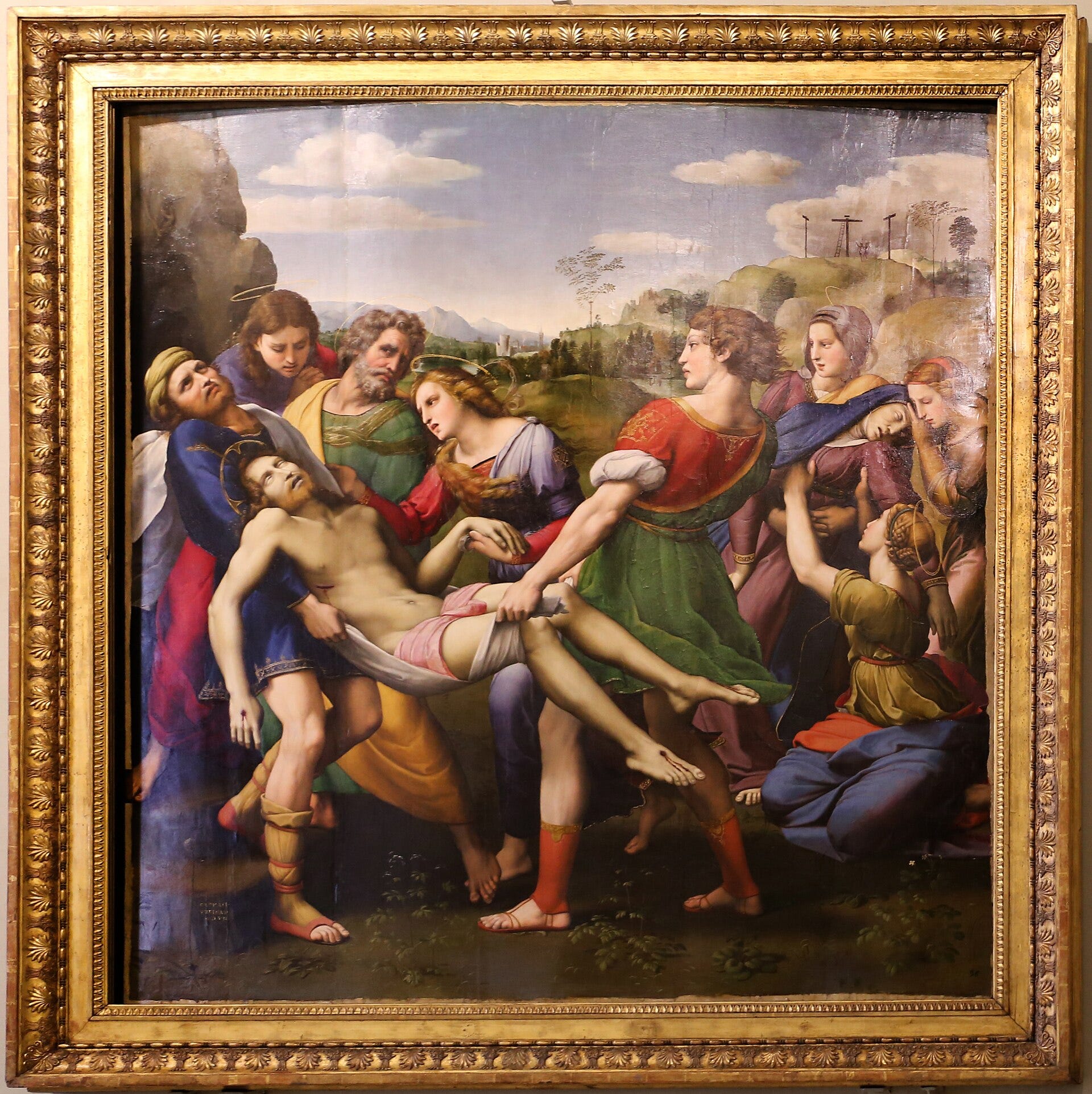
The dead body sags in a sheet, and the men carrying it lean back under its weight as they head toward a tomb on the left. On the right, a group of women holds up the Virgin Mary, who has fainted. Low on the left, in gold letters, the painter signed and dated the panel: RAPHAEL VRBINAS MDVII, Raphael of Urbino, 1507.
By that date Raphael lived in Florence, and he was twenty-four when he finished The Entombment. The order, though, came from Perugia, where records place him in 1505. The client was Atalanta Baglioni, of the family that ruled the city, and the panel was meant for her chapel in the church of San Francesco al Prato. Her son Grifonetto was already buried there.
Grifonetto had died in a family war. In 1500 he joined a plot that massacred his own cousins. The survivors, led by Giampaolo Baglioni, retook the city the next day and had Grifonetto killed near the church of Sant'Ercolano.
His mother had turned him away with a curse. Yet when he lay dying, she went to him and begged him to forgive the man who had struck him, and he died with her blessing. The chronicler Francesco Matarazzo wrote the scene down at the time, and the Swiss historian Jacob Burckhardt, who followed his chronicle, adds that Raphael later painted the picture for this mother.
Whether the commission really grew out of the son's death remains an open question, as Claudia Farini points out in the Italian art magazine Finestre sull'Arte. The panel itself records a change of plan. Raphael made at least sixteen preparatory drawings, and they move from a Lamentation, with the mourners gathered still around the body, to this scene of carrying, full of strain and movement.
The picture stayed in the chapel for a century. On the night of 18 to 19 March 1608, with the help of the friars, it was removed from the church in secret and sent to Rome for Pope Paul V, who gave it to his nephew, Cardinal Scipione Borghese. Grifonetto stayed behind in Perugia, buried in his mother's chapel.
At a Glance
Artist: Raphael (1483 to 1520)
Painted: 1507
Medium: Oil on panel
Size: 174.5 × 178.5 cm (68.7 × 70.3 in)
Where to see it: Galleria Borghese, Rome
11. Portrait of Pope Julius II (1511)
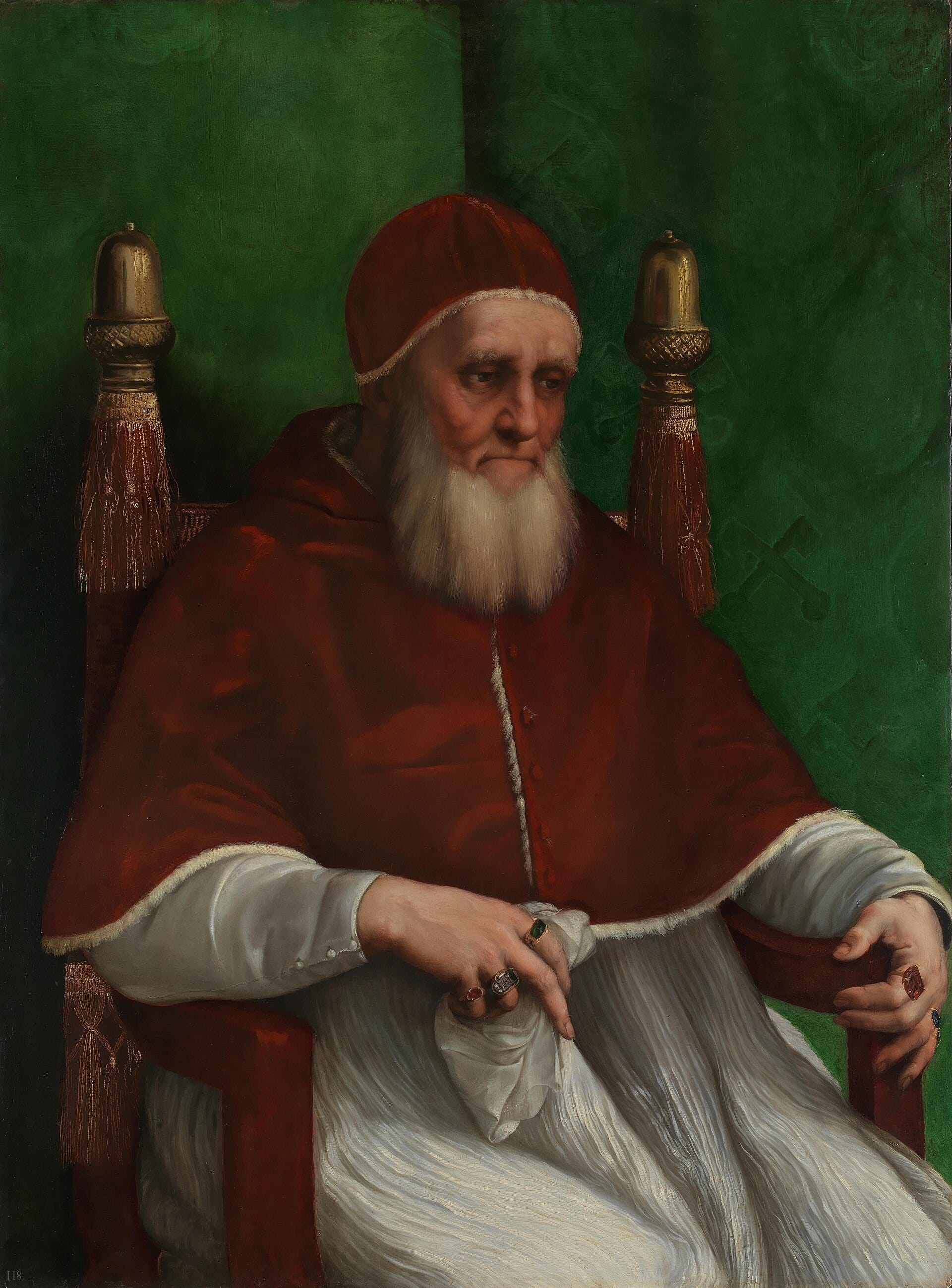
In the red velvet chair, an old man keeps his eyes lowered. One ringed hand grips the armrest, the other holds a handkerchief, and behind him hangs a plain green curtain. His long white beard was grown on an oath, and the oath came with a condition.